
India–Canada Trade Talks: Market Access, Investment and the Diplomatic Reset
Revise the static topic: UPSC International Relations notes
In short: Canada’s high commissioner to India, Christopher Cooter, has expressed optimism about concluding a bilateral trade pact ahead of a proposed visit by Prime Minister Narendra Modi. An agreement could improve market access and investment predictability, but the supplied reports do not establish that negotiations have concluded or that any commitments have entered into force.
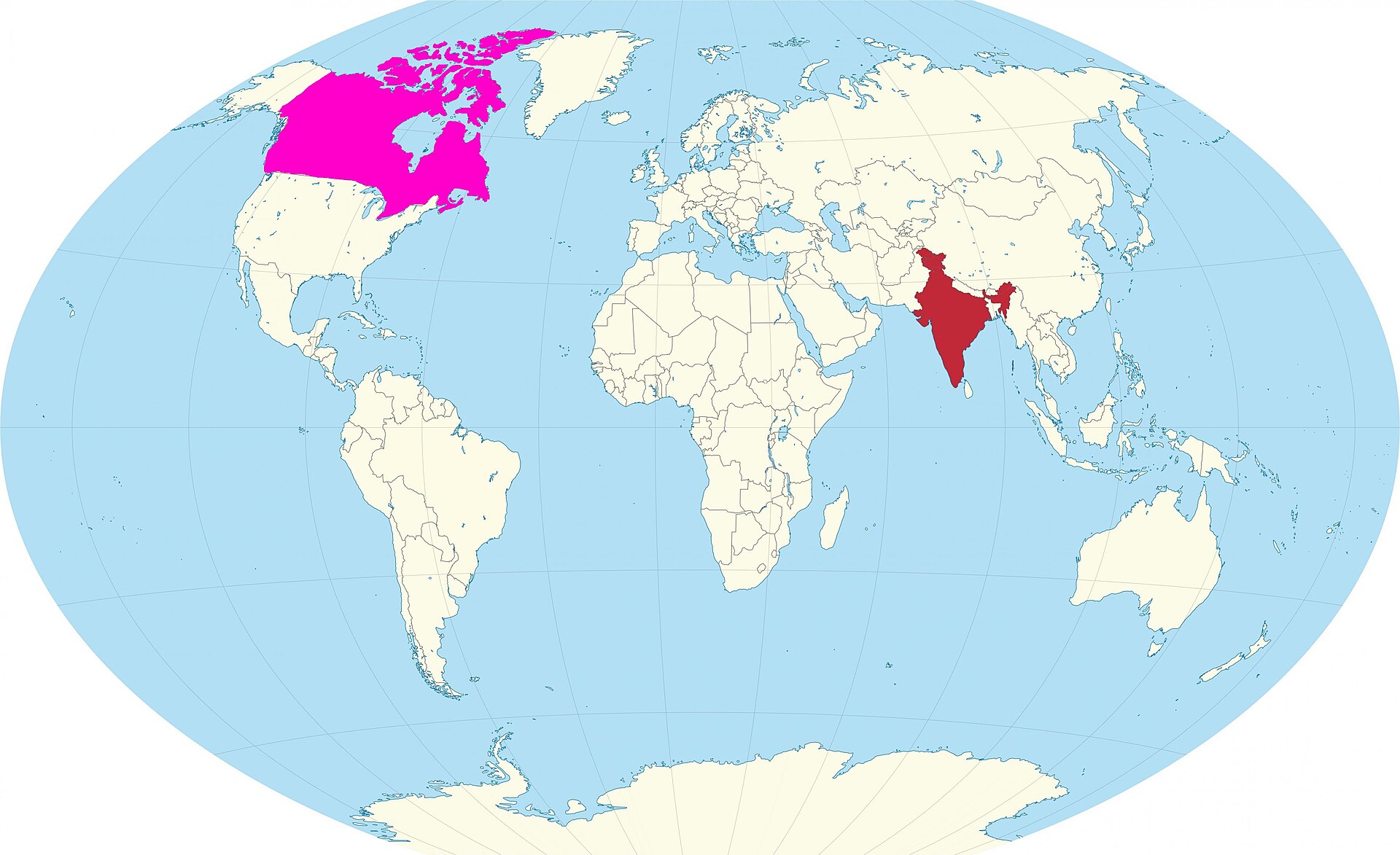
Reference map showing India and Canada, providing geographic context for bilateral trade talks. The supplied reports do not establish that negotiations have concluded or commitments have entered into force.
Image: Foxtrotvsp · CC BY-SA 4.0
Why in news
The Times of India reports Canadian diplomatic optimism about a trade breakthrough linked to a proposed prime ministerial visit. This brings the relationship between economic negotiations and a broader India–Canada diplomatic reset into focus.
Background
A preferential trade agreement gives participating economies negotiated advantages, such as lower tariffs or improved access for services, subject to its terms. Goods, services and investment involve distinct legal disciplines; a goods agreement does not automatically grant investment protection or professional mobility. India and Canada are WTO members, so any bilateral arrangement must be assessed alongside their multilateral obligations. The central policy challenge is to convert diplomatic intent into commercially meaningful, enforceable commitments while preserving legitimate regulatory space.
What the reports establish
The supplied Times of India material attributes optimism about a trade pact to Canada’s high commissioner, Christopher Cooter, and links a possible breakthrough to a proposed visit by Prime Minister Narendra Modi. This is a diplomatic signal of momentum, not evidence that a final agreement is already operational.
The excerpts do not provide an agreed text, tariff schedules, sectoral offers or a verified implementation timetable. The agreement’s precise scope and the concessions of either country therefore remain unconfirmed in the supplied material.
- An envoy’s expectation should be distinguished from a joint announcement confirming the conclusion of negotiations.
- Conclusion of negotiations, signature and entry into force are separate milestones.
- The proposed visit can provide political impetus, but commercial outcomes depend on the negotiated text.
Infographic
Evidence
Optimism is reported; final commitments are not established.
Market access
Assess tariffs, services access and regulatory barriers together.
Investment
Predictability matters; protection provisions cannot be presumed.
Diplomacy
Trade can support a reset, not replace political dialogue.
Delivery
Legal implementation and usable procedures determine gains.
AI-assisted infographic by Pragnya IAS Academy, based on the cited sources.
Market access: benefits depend on usable commitments
For goods, the value of an agreement would depend on which products receive tariff preferences, the pace of implementation and the conditions for claiming those preferences. Rules of origin would determine whether a product qualifies, while customs procedures and regulatory requirements would influence the actual cost of trading.
For services, commercially meaningful access could involve licensing transparency, recognition of qualifications and temporary entry for specified categories of professionals. Such provisions cannot be presumed, and temporary business mobility should not be confused with a general right to immigration.
- Exporters benefit only when tariff savings exceed the costs of documentation and compliance.
- Standards cooperation should reduce unnecessary duplication without weakening health, safety or environmental protection.
- Sensitive sectors may require phased commitments and adjustment support rather than abrupt liberalisation.
Investment and the broader diplomatic reset
A credible agreement could improve business confidence by making trade-related rules more predictable. Potential investment opportunities could be explored in infrastructure, manufacturing, clean energy and resource-linked supply chains, but these are analytical possibilities rather than reported negotiating outcomes.
Trade cooperation can create institutional channels that help sustain bilateral engagement. However, it cannot by itself resolve political or security disagreements; a durable reset requires parallel diplomatic dialogue and consistent implementation of economic commitments.
- Investment facilitation, market opening and investor protection are different commitments and must be examined separately.
- A trade pact should not be assumed to include investor–state arbitration.
- Stable regulation and credible dispute management matter alongside preferential market access.
Legal architecture and implementation
The WTO’s most-favoured-nation principle generally requires non-discrimination among trading partners. Preferential agreements may operate under applicable WTO exceptions and conditions, including GATT Article XXIV for goods and GATS Article V for services.
In India, treaty-making falls within the Union executive’s domain. Article 253 empowers Parliament to legislate for implementing international agreements; where implementation requires changes to domestic law, the necessary legal measures must follow. A political announcement does not itself amend tariffs, licensing rules or statutory rights.
- Rules of origin should prevent trade deflection without creating disproportionate compliance burdens.
- Dispute-settlement provisions should make obligations credible while preserving legitimate public-interest regulation.
- Coordination with States and sectoral regulators is important wherever domestic implementation affects their responsibilities.
| Area | Potential benefit | What must be verified |
|---|---|---|
| Goods | Lower import costs and improved export competitiveness | Product coverage, tariff schedules, exclusions and phase-in periods |
| Rules of origin | Preferential access for qualifying production | Eligibility criteria, documentation and verification procedures |
| Services | More predictable access for service suppliers | Sectoral commitments, licensing conditions and reservations |
| Professional mobility | Easier temporary entry for covered business categories | Eligible categories, duration and applicable immigration conditions |
| Investment | Greater predictability and easier project facilitation | Whether investment obligations are included and their precise scope |
| Implementation | Reliable delivery of negotiated benefits | Entry-into-force conditions, domestic measures and review mechanisms |
- 1. Political engagement provides direction to negotiators.
- 2. Negotiators settle market-access offers and legal obligations.
- 3. The agreed text undergoes legal review and applicable approval and signature procedures.
- 4. Each country completes necessary domestic measures and entry-into-force requirements.
- 5. Businesses use preferences subject to origin, documentation and regulatory conditions.
- 6. Bilateral institutions monitor implementation and address disputes.
Significance, challenges & way forward
Significance
- A commercially meaningful agreement could support India’s export-market diversification.
- Predictable rules could strengthen investor confidence and encourage longer-term business partnerships.
- Trade institutions could provide continuity to bilateral engagement beyond high-level visits.
- Services commitments could create opportunities for Indian suppliers if licensing and mobility barriers are effectively addressed.
Challenges
- The supplied material does not disclose negotiated commitments, making claims about sectoral gains premature.
- Domestic sensitivities can complicate tariff concessions and regulatory commitments.
- Non-tariff barriers may limit gains even when customs duties are reduced.
- Political or security disagreements could weaken confidence in the wider relationship.
- Complex origin requirements and limited awareness can prevent smaller firms from using trade preferences.
Way forward
- Prioritise a balanced, implementable agreement rather than treating a proposed visit as an inflexible negotiating deadline.
- Undertake sector-wise assessments of export opportunities, import competition and adjustment needs.
- Seek commercially meaningful services access while clearly distinguishing professional mobility from immigration policy.
- Design simple origin procedures, accessible guidance and predictable customs administration for smaller exporters.
- Preserve public-interest regulation and evaluate any investment-protection obligations on their actual wording.
- Establish regular diplomatic and economic review channels so that disagreements do not automatically derail cooperation.
Key terms
- Market access
- The conditions under which foreign goods, services or suppliers may enter and operate in a market.
- Rules of origin
- Criteria used to determine a product’s origin and its eligibility for preferential tariff treatment.
- Non-tariff measures
- Policy measures other than ordinary customs tariffs that can affect trade, including standards and licensing requirements.
- Most-favoured-nation treatment
- The WTO principle of generally extending a trade advantage granted to one member to other members, subject to permitted exceptions.
- Investment facilitation
- Measures that make investment-related procedures more transparent, predictable and administratively efficient.
- Entry into force
- The point at which an agreement becomes legally operative under its specified conditions.
Link with static syllabus
Prelims practice MCQs
Q1. With reference to the reported India–Canada trade talks, consider the following statements: 1. Diplomatic optimism about concluding a pact establishes that it has entered into force. 2. Conclusion of negotiations and entry into force are distinct stages. 3. The supplied reports disclose agreed sector-wise tariff schedules. Which of the statements given above is/are correct?
Q2. Consider the following pairs: 1. Rules of origin — Determination of eligibility for preferential tariff treatment 2. GATT Article XXIV — WTO framework concerning customs unions and free-trade areas in goods 3. GATS Article V — Economic integration agreements in services How many of the above pairs are correctly matched?
Q3. Which of the following constitutional provisions empowers Parliament to legislate for implementing treaties, agreements and conventions with other countries?
Q4. With reference to trade agreements, consider the following statements: 1. Tariff elimination necessarily removes all regulatory barriers to trade. 2. Temporary entry commitments for professionals necessarily confer permanent residence rights. 3. Investment facilitation and investor–state dispute settlement are distinct concepts. Which of the statements given above is/are correct?
Mains practice questions
GS 2 · 15 marks · 250 words
A bilateral trade agreement can support, but cannot substitute for, a diplomatic reset. Examine this proposition in the context of the prospects for an India–Canada trade agreement.
Frequently asked questions
Has an India–Canada trade agreement been finalised?
The supplied material does not establish finalisation. It reports Canadian diplomatic optimism about a possible conclusion linked to a proposed prime ministerial visit.
How could Indian exporters benefit?
Negotiated tariff preferences, simpler customs procedures and usable services commitments could improve access. Actual benefits would depend on product coverage, eligibility rules and regulatory conditions.
Would a trade agreement automatically make migration easier?
No. Any temporary professional-entry commitments would depend on the negotiated text and would not automatically create permanent residence rights.
Can trade cooperation resolve broader bilateral tensions?
It can strengthen communication and create incentives for cooperation. Political and security disagreements still require dedicated diplomatic engagement.
Sources
- Times of India: Confident of trade pact ahead of PM Modi's trip: Canada envoy
- Times of India: Canada envoy signals major breakthrough in ties with likely conclusion of trade talks by PM visit next month
Analysis prepared by the Pragnya IAS Academy current-affairs desk with AI assistance from the cited reports. Verify figures with the original sources.
Turn current affairs into marks
Join Pragnya IAS Academy's mentorship for daily answer-writing evaluation on stories like this — classroom programmes from a trusted name in IAS coaching in Hyderabad.