
India’s ₹53,866-Crore Corvette Deal: Naval Capability and Shipbuilding Capacity
Revise the static topic: UPSC Internal Security notes
In short: The Ministry of Defence has signed contracts worth ₹53,866.50 crore with GRSE and GSL for eight next-generation corvettes designed indigenously by the Indian Navy. The procurement aims to strengthen multi-domain maritime operations and domestic shipbuilding, but its long-term value will depend on timely delivery, systems integration and lifecycle support.
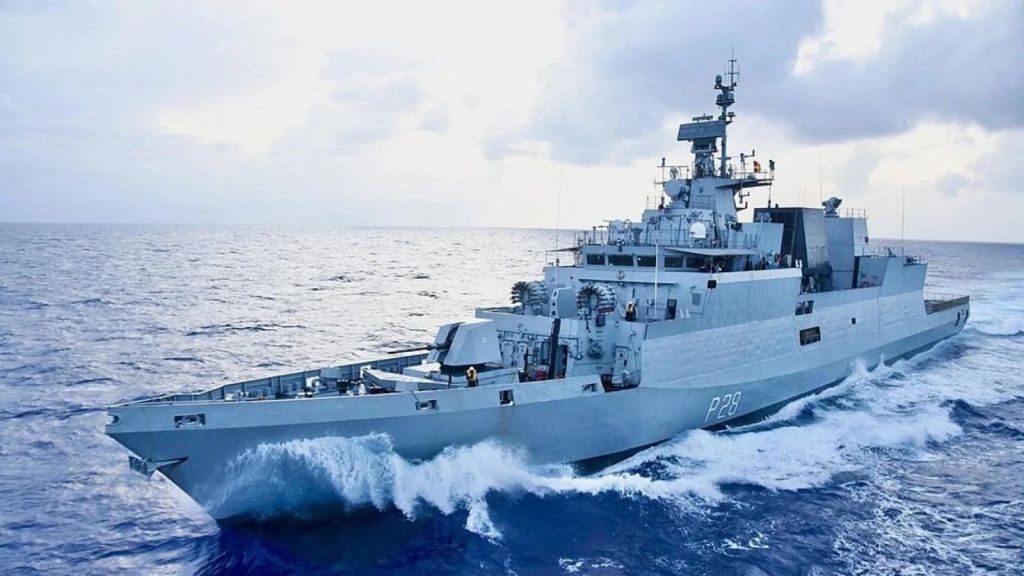
Reference image of an Indian Navy Kamorta-class stealth warship, illustrating an existing corvette platform. It is not one of the eight next-generation corvettes covered by the new contracts.
Image: Indian Express
Why in news
Following approval by the Cabinet Committee on Security, the Ministry of Defence signed contracts for five corvettes to be built by Garden Reach Shipbuilders and Engineers Limited and three by Goa Shipyard Limited. According to the ministry, this is the first project combining indigenous Navy design with construction by defence PSUs selected through a competitive process.
₹53,866.50 crore
Total contract value
8
Next-generation corvettes
5
Corvettes allocated to GRSE
3
Corvettes allocated to GSL
72 lakh person-days
Projected shipyard employment
460 lakh person-days
Projected ancillary and MSME employment
Background
A corvette is generally a smaller surface combatant than a frigate, although naval classifications vary. Depending on its weapons and sensors, it can undertake surveillance, escort, anti-surface and anti-submarine tasks, particularly in coastal and adjoining waters. For India, maritime security encompasses protection of trade routes, coastal approaches, offshore assets and the wider maritime neighbourhood. Indigenous warship construction links these operational requirements with domestic design expertise, shipyard infrastructure, equipment manufacturing and long-term maintenance capacity.
What the procurement establishes
The contracts cover eight next-generation corvettes, with construction divided between GRSE and GSL. Both are defence public sector undertakings. The Indian Navy will provide the indigenous design, while the selected shipyards will construct the vessels.
The stated institutional milestone is the combination of Navy-led indigenous design and competitive selection of defence PSU builders. It should not be interpreted as India’s first indigenous warship project or as proof that every onboard system will be domestically sourced.
- The ships are intended to carry advanced missiles, weapons and sensor suites for operations across air, surface and sub-surface domains.
- The source does not specify displacement, individual weapons, indigenous-content percentage or a ship-wise delivery schedule.
- The Cabinet Committee on Security approved the project before the contracts were signed.
Infographic
Naval capability
Eight planned platforms for multi-domain maritime missions.
Indigenous design
Indian Navy design; complete domestic sourcing is not established.
Industrial capacity
GRSE and GSL construction with wider supplier opportunities.
Execution discipline
Common standards, integration control and milestone monitoring.
Lifecycle readiness
Crews, spares, maintenance and upgrades determine sustained value.
AI-assisted infographic by Pragnya IAS Academy, based on the cited sources.
Operational implications: versatile platforms, not instant capability
The ministry identifies maritime trade-route protection, anti-surface warfare, anti-submarine warfare, coastal defence, littoral combat, presence and surveillance as intended missions. A versatile platform can improve the Navy’s ability to assign suitable ships to different tasks rather than relying on larger combatants for every deployment.
These benefits will materialise only after construction, trials, induction and operational work-up. Effective anti-submarine and surveillance operations also require trained crews, reliable sensors, communications and coordination with other maritime assets.
- Surface-warfare capability can support deterrence and the protection of maritime approaches.
- Anti-submarine capability can strengthen the defence of shipping and naval forces against underwater threats.
- Presence and surveillance missions can improve situational awareness and the ability to respond to emerging threats.
- The stated ability to operate across domains does not establish any particular air-defence range or fleet-wide protective capability.
Industrial implications: design authority and supplier depth
Navy-led indigenous design can support closer alignment between operational requirements and platform development. Domestic construction can deepen skills in shipbuilding, systems integration, testing, maintenance and future upgrades. However, domestic platform design and assembly are distinct from complete technological self-reliance.
The Defence Minister projected approximately 72 lakh person-days of employment in shipyards and 460 lakh person-days in ancillary industries and MSMEs over the next ten years. These are projected labour inputs, not counts of permanent jobs. The ministry also envisages collaboration among defence PSUs, private shipyards and Indian industrial partners; the prime construction contracts themselves are with GRSE and GSL.
- A sustained order pipeline can encourage suppliers to invest in specialised tooling, quality assurance and skilled workers.
- Using two shipyards can broaden production participation, but requires common specifications and disciplined configuration control.
- Industrial success should be assessed through domestic value addition, critical-system capability and reliable through-life support, not hull construction alone.
Acquisition planning: reconcile cost, time and readiness
The Defence Acquisition Council granted Acceptance of Necessity in June 2022 at an approximate cost of ₹36,000 crore. The signed contracts are worth ₹53,866.50 crore. These figures belong to different acquisition stages; the supplied source does not explain the difference or establish that their scope and cost bases are identical.
Sound scrutiny therefore requires an explanation of scope, price assumptions and included support rather than an unsupported conclusion about cost overruns. Likewise, the ten-year employment projection should not be treated as a confirmed delivery schedule.
Long-term planning must connect construction milestones with fleet requirements, crew training, maintenance infrastructure, spares and upgrade pathways. Procurement creates operational value only when the ships remain available, supportable and effective throughout their service.
- Track design maturity, equipment availability, systems integration and trials through measurable milestones.
- Assess acquisition and operating costs together instead of treating the contract price as the entire financial commitment.
- Preserve commonality across both builders while providing a controlled process for necessary design changes.
- Align induction with fleet renewal needs without assuming an unannounced replacement plan.
| Aspect | Source-supported position | Analytical caution |
|---|---|---|
| Platforms | Eight next-generation corvettes | Contract signing is not induction into operational service. |
| Construction | GRSE will build five; GSL will build three | Private shipyards are not named as prime contractors. |
| Design | Indigenous design by the Indian Navy | No indigenous-content percentage is provided. |
| Capabilities | Advanced missiles, weapons and sensors for multi-domain missions | Specific weapon types and performance parameters are not disclosed. |
| Employment | Projected shipyard and ancillary employment over ten years | Person-days do not represent the number of permanent jobs. |
| Cost comparison | Approximate ₹36,000-crore AoN estimate and ₹53,866.50-crore contracts | The source does not establish comparable scope or explain the difference. |
- 1. Translate naval operational requirements into a mature indigenous design.
- 2. Coordinate equipment procurement and construction across GRSE, GSL and suppliers.
- 3. Integrate weapons, sensors, communications and platform systems.
- 4. Validate performance through trials and acceptance.
- 5. Induct ships with trained crews and operational support.
- 6. Sustain readiness through maintenance, spares and upgrades.
June 2022
The Defence Acquisition Council granted Acceptance of Necessity for the project at an approximate cost of ₹36,000 crore.
Days before contract signing
The Cabinet Committee on Security approved the project.
Contract signing reported in the source
The Ministry of Defence signed contracts worth ₹53,866.50 crore with GRSE and GSL for eight next-generation corvettes.
Next ten years
The stated employment projection covers shipyards, ancillary industries and MSMEs; it is not a disclosed ship-wise delivery timetable.
Significance, challenges & way forward
Significance
- The planned corvettes can strengthen the Navy’s capacity for trade-route protection, coastal defence and multi-domain maritime operations.
- Indigenous design can support greater national control over platform development and future adaptation.
- Construction across two defence PSUs can broaden the domestic warship production base.
- Demand for components and services can create opportunities for ancillary industries and MSMEs.
- The project provides an opportunity to integrate fleet development with long-term industrial capability.
Challenges
- Integrating advanced weapons and sensors can create technical and scheduling risks even when the hull is domestically designed.
- Construction at different shipyards requires consistent standards, interface management and configuration control.
- The absence of disclosed indigenous-content details prevents a definitive assessment of dependence on foreign systems.
- Insufficient maintenance capacity, spares or crew preparation could reduce availability after induction.
- The difference between the initial estimate and contract value requires explanation before conclusions about cost performance can be drawn.
- Projected employment benefits depend on actual production activity and supplier participation.
Way forward
- Use milestone-based monitoring to identify design, equipment and integration bottlenecks early.
- Maintain a common technical baseline across both shipyards and rigorously manage design changes.
- Develop critical domestic technologies and supplier capabilities rather than treating local assembly as sufficient indigenisation.
- Provide timely payments, quality-support mechanisms and predictable demand visibility to participating MSMEs.
- Plan training, dockyard capacity, spares and technical documentation alongside construction.
- Explain major cost changes through appropriate public disclosure while protecting operationally sensitive information.
- Evaluate success through delivery reliability, operational availability, domestic value addition and lifecycle affordability.
Key terms
- Corvette
- A surface combatant generally smaller than a frigate, whose roles depend on its weapons, sensors and endurance.
- Littoral warfare
- Military operations in coastal waters and the adjoining maritime-land interface.
- Anti-submarine warfare
- Operations to detect, track, deter or engage hostile submarines.
- Acceptance of Necessity
- An acquisition-stage approval recognising the need for a proposed procurement, distinct from a signed contract.
- Person-day
- A unit of labour representing one person working for one day, rather than a separate permanent job.
- Lifecycle cost
- The combined cost of acquiring, operating, maintaining, upgrading and ultimately disposing of an asset.
- Configuration control
- The disciplined management of technical specifications and changes to preserve consistency and interoperability.
Link with static syllabus
Prelims practice MCQs
Q1. With reference to the next-generation corvette contracts described in the source, consider the following statements: 1. The Indian Navy will indigenously design the ships. 2. GRSE will construct five ships and GSL will construct three. 3. Private shipyards have been awarded the prime construction contracts. Which of the statements given above are correct?
Q2. In the context of employment projections for naval shipbuilding, the term person-day denotes:
Q3. Consider the following statements about indigenous warship construction: 1. Indigenous platform design necessarily establishes that every onboard system is domestically manufactured. 2. Domestic ship construction can generate demand for ancillary industries and MSMEs. 3. Lifecycle planning includes maintenance, spares and upgrades beyond the initial acquisition. Which of the statements given above are correct?
Q4. With reference to the corvette acquisition, consider the following statements: 1. The Defence Acquisition Council granted Acceptance of Necessity in June 2022. 2. Acceptance of Necessity is equivalent to signing the construction contract. 3. The ten-year employment projection establishes the delivery date of every vessel. Which of the statements given above is/are correct?
Mains practice questions
GS 3 · 15 marks · 250 words
India’s procurement of next-generation corvettes is both a maritime security investment and an industrial policy opportunity. Discuss its implications and the requirements for translating acquisition into sustained naval capability.
Frequently asked questions
What has India contracted to acquire?
The Ministry of Defence has contracted eight next-generation corvettes for ₹53,866.50 crore. GRSE will build five and GSL three, using indigenous designs by the Indian Navy.
How will these corvettes strengthen maritime security?
They are intended for anti-surface and anti-submarine warfare, trade-route protection, coastal and littoral defence, surveillance and maritime presence. Their operational contribution will follow construction, trials, induction and readiness development.
Does indigenous design mean all equipment will be Indian?
No. Indigenous design establishes domestic platform-design responsibility, but the source does not disclose the origin of every onboard system or an indigenous-content percentage.
Does the ten-year employment projection establish the delivery schedule?
No. It describes the period for projected employment generation; the supplied source does not provide a ship-wise delivery schedule.
Sources
- Indian Express: Rs 53,866 crore, 8 new warships: India signs major Navy deal
Analysis prepared by the Pragnya IAS Academy current-affairs desk with AI assistance from the cited reports. Verify figures with the original sources.
Turn current affairs into marks
Join Pragnya IAS Academy's mentorship for daily answer-writing evaluation on stories like this — classroom programmes from a trusted name in IAS coaching in Hyderabad.