
Misri’s Nepal Visit: Neighbourhood First, Connectivity and Disaster Cooperation
Revise the static topic: UPSC International Relations notes
In short: Foreign Secretary Vikram Misri is scheduled to visit Nepal on November 4–5, 2026, to advance engagement with Prime Minister Balendra Shah’s government and prepare for a possible visit by Shah to India. The visit connects high-level diplomacy with connectivity, clean energy and disaster assistance, making it an important test of India’s Neighbourhood First policy.
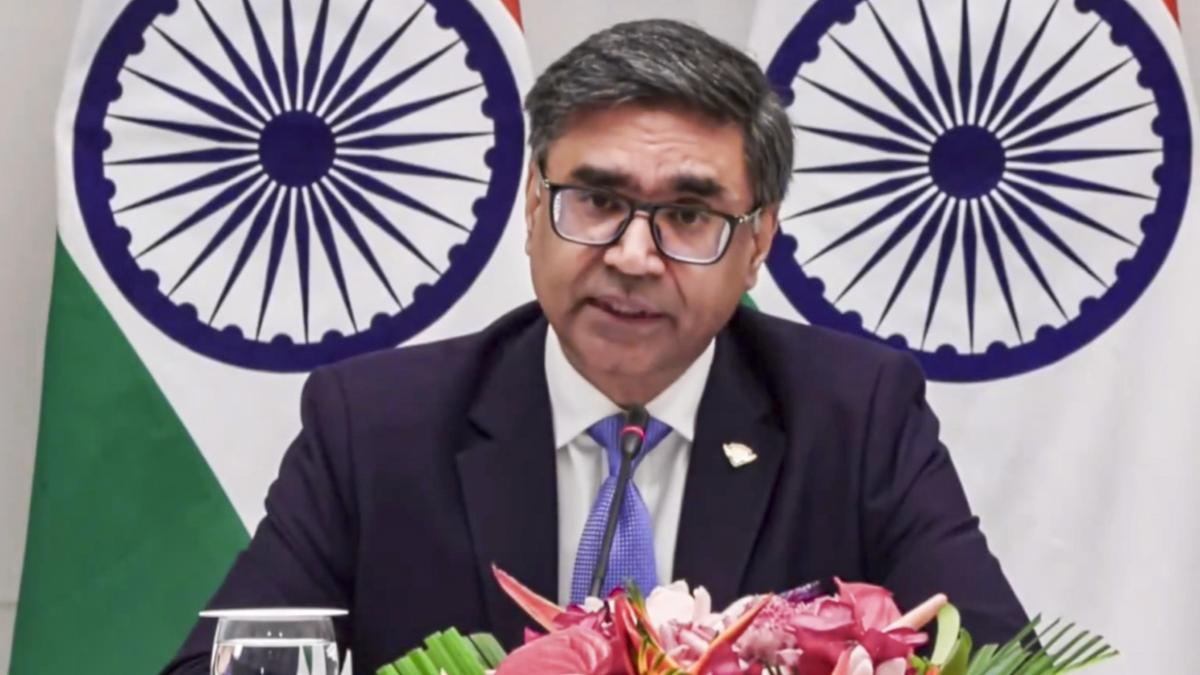
Reference image accompanying coverage of Foreign Secretary Vikram Misri’s planned Nepal visit, focused on bilateral engagement under India’s Neighbourhood First policy; not a photograph of the scheduled November 4–5, 2026 visit.
Image: The Hindu
Why in news
The Ministry of External Affairs announced the visit on November 2. It will be Misri’s first Nepal visit since Shah assumed office in March, with a prospective prime ministerial visit, diplomatic representation and flood assistance expected to feature in discussions.
35,000 MW
Nepal’s reported power-capacity target
9 years
Reported horizon for Nepal’s capacity target
At least 270
Indians reported still missing after the flood
Background
India and Nepal share an open border, extensive social and cultural links, and close economic and security interdependence. Nepal’s landlocked geography makes transit and cross-border connectivity central to bilateral relations, while Himalayan rivers create opportunities for hydropower alongside shared disaster risks. India’s Neighbourhood First policy prioritises engagement with neighbouring countries through political dialogue, development partnerships, connectivity and practical assistance. Relations with Nepal therefore require both sustained institutional cooperation and sensitivity to sovereignty, domestic politics and public perceptions.
What is confirmed, and what remains under discussion?
Misri’s official visit on November 4–5 is confirmed. The Ministry of External Affairs has stated that discussions will cover bilateral, regional and global matters of mutual interest. As of this edition, the visit has not taken place and no new bilateral agreement should be treated as concluded.
Preparing the ground for Prime Minister Balendra Shah’s possible India visit is a central reported objective. The Indian Express reports that dates between November 22 and 24 are being considered; these are prospective, not an announced itinerary.
The Hindu also identifies Nepal’s ambassadorial appointment and continued Indian assistance following the Bhote Koshi river disaster as expected agenda items. According to Nepali diplomatic sources cited in that report, Kathmandu was awaiting India’s agrément for proposed envoy Nischal Nath Pandey.
- The Foreign Secretary’s visit can translate ministerial contacts into an agreed agenda for leadership-level engagement.
- An ambassadorial appointment would strengthen routine diplomatic communication, but approval should not be presumed.
- The policy significance lies in rebuilding momentum rather than announcing a completed diplomatic breakthrough.
Infographic
Political continuity
Engage the new government through regular institutional dialogue.
Connectivity
Link transport infrastructure with smoother cross-border movement.
Clean energy
Match hydropower ambitions with transmission and investment.
Economic diversification
Explore services, investment and production-network cooperation.
Disaster resilience
Build on relief assistance through preparedness and resilient recovery.
AI-assisted infographic by Pragnya IAS Academy, based on the cited sources.
Neighbourhood First: continuity without political conditionality
Shah’s government emerged after the political upheaval associated with Nepal’s September 2025 Gen-Z uprising and the subsequent election under an interim government. India’s engagement must therefore accommodate a changed political leadership without treating bilateral ties as dependent on particular parties or personalities.
An anticipated Foreign Secretary-level visit in May did not materialise. Subsequent contacts, including Rabi Lamichhane’s June visit and Finance Minister Swarnim Wagle’s September discussions in India, provided channels for renewed engagement. Misri’s visit can consolidate these contacts while respecting Nepal’s domestic priorities.
Neighbourhood First is most credible when political accessibility is matched by dependable delivery. Disaster assistance, reliable connectivity and mutually beneficial economic cooperation can create confidence beyond ceremonial visits.
- Engagement should remain government-to-government, while sustaining wider institutional and people-to-people links.
- Nepal’s sovereign choices should be respected rather than interpreted only through external strategic competition.
- The reported protest over suspended Gurkha recruitment shows that economic and security relationships also have domestic social consequences.
Connectivity, energy and trade: the substantive economic agenda
The Indian Express identifies roads, railways, air routes and transmission infrastructure as reported priorities. These links can improve Nepal’s market access and support regional value chains, but their benefits depend on compatible regulations, border facilitation and reliable operation.
Clean-energy cooperation is another central reported theme. Nepal is targeting 35,000 MW over the next nine years through run-of-river and storage projects. This is a stated ambition, not installed capacity or an Indian financing commitment. Its realisation would require investment, transmission infrastructure, environmental safeguards and credible commercial arrangements.
Reported trade discussions include possible treaty updates covering services, investment protection, profit repatriation and movement of parts and components. Nepal also seeks Indian investment in digitalisation, high-value agriculture, green manufacturing and tourism. These proposals signal an effort to broaden cooperation beyond conventional merchandise trade.
- Generation projects and transmission links should be planned together to avoid infrastructure bottlenecks.
- Trade modernisation should distinguish treaty amendments from supporting domestic regulatory changes.
- Investment-led integration should create visible local benefits and address community and environmental concerns.
Disaster assistance: from emergency response to shared resilience
The August 26 flash flood has made disaster cooperation an immediate diplomatic priority. India provided humanitarian aid, disaster-relief supplies, Bailey bridges and emergency power support. The Indian Express reports that at least 270 Indians remain missing; this is a reported missing-person figure, not a confirmed death toll.
The disaster demonstrates how Himalayan hazards can disrupt mobility, electricity, infrastructure and livelihoods across borders. Relief assistance is therefore both a humanitarian responsibility and a response to shared vulnerability.
The next step should be to institutionalise cooperation before disasters occur. Timely hydrological information, interoperable warnings, resilient infrastructure and coordinated consular assistance would make the partnership less dependent on ad hoc emergency mobilisation.
- Joint protocols should connect flood warnings with local evacuation and response arrangements.
- Missing-person coordination requires verified information and sustained communication with families.
- Restoration of transport and electricity should incorporate resilience rather than merely reproduce damaged infrastructure.
| Issue | Status in the source reports | Policy relevance |
|---|---|---|
| Foreign Secretary’s visit | Confirmed for November 4–5 | Maintains high-level engagement with Nepal’s new government |
| Shah’s India visit | Likely visit under discussion; dates not confirmed | Could provide political direction to bilateral cooperation |
| Nepal’s ambassador | Agrément reportedly awaited for the proposed envoy | Supports regular diplomatic communication |
| Connectivity and clean energy | Reported priorities for discussions | Links market access, investment and electricity infrastructure |
| Trade treaty modernisation | Possible updates reported; no concluded amendment announced | Could widen cooperation into services and production networks |
| Flood assistance | Indian relief and emergency power support already provided | Creates a basis for longer-term disaster cooperation |
- 1. Share timely hazard and hydrological information through agreed channels.
- 2. Translate warnings into coordinated local preparedness and evacuation.
- 3. Mobilise relief, consular assistance and emergency infrastructure support.
- 4. Restore transport and electricity with disaster-resilient designs.
- 5. Review the response jointly and institutionalise lessons.
August 2025
Misri visited Kathmandu and met then Prime Minister K.P. Sharma Oli.
September 2025
The Gen-Z uprising brought down the Oli government, according to the supplied reports.
March 2026
Balendra Shah assumed office after an election conducted under an interim government.
June 2026
Rastriya Swatantra Party leader Rabi Lamichhane visited India and met Prime Minister Narendra Modi.
August 26, 2026
A devastating flash flood prompted rescue, relief and infrastructure-support efforts, including Indian assistance.
September 2026
Finance Minister Swarnim Wagle’s discussions in India included the possibility of Shah’s visit.
November 2, 2026
The Ministry of External Affairs announced Misri’s forthcoming Nepal visit.
November 4–5, 2026
Misri is scheduled to visit Kathmandu for official discussions.
Significance, challenges & way forward
Significance
- The visit demonstrates continuity in India’s engagement despite changes in Nepal’s political leadership.
- Preparing a leadership-level visit can give political direction to a wider economic and strategic partnership.
- Connectivity and electricity cooperation can deepen mutually beneficial interdependence.
- Trade modernisation could support diversification into services, investment and regional production networks.
- Humanitarian assistance can strengthen public trust when it is timely, transparent and responsive to local needs.
Challenges
- Nepal’s domestic political priorities and sovereignty sensitivities require patient diplomacy rather than pressure for quick outcomes.
- Reported agenda items may not become agreements unless both sides resolve regulatory, financial and implementation issues.
- Ambitious hydropower development must address transmission constraints, ecological risks and community concerns.
- Flood exposure can damage the same infrastructure intended to strengthen bilateral connectivity.
- Suspended Gurkha recruitment remains a sensitive people-to-people and security issue requiring separate dialogue.
- Ambassadorial gaps and disrupted high-level schedules can weaken routine coordination.
Way forward
- Prepare a mutually agreed, deliverable-focused agenda for any prime ministerial visit without presenting tentative dates as confirmed.
- Maintain regular diplomatic and sectoral contacts so that cooperation does not depend exclusively on summit meetings.
- Align connectivity and energy projects with financing, regulatory readiness and disaster-risk assessment.
- Explore trade modernisation through consultations that address investment safeguards, commercial predictability and local economic benefits.
- Establish stronger flood-information sharing, emergency coordination and verified missing-person communication.
- Address Gurkha recruitment concerns through sustained bilateral consultation that recognises their social and security dimensions.
Key terms
- Neighbourhood First
- India’s policy approach that prioritises relations and practical cooperation with neighbouring countries.
- Agrément
- The receiving state’s consent to a proposed head of a foreign diplomatic mission.
- Run-of-river hydropower
- Electricity generation primarily using river flow, generally with limited storage compared with reservoir-based projects.
- Storage hydropower
- Hydropower using stored water to provide greater flexibility in the timing of electricity generation.
- Bailey bridge
- A portable, prefabricated modular bridge used to restore or establish transport access.
- Profit repatriation
- The transfer of investment earnings from a host country to the investor’s home country, subject to applicable rules.
- Disaster diplomacy
- The influence of disaster-related cooperation on relations between political actors or countries.
Link with static syllabus
Prelims practice MCQs
Q1. In diplomatic practice, the term agrément refers to:
Q2. With reference to Misri’s scheduled Nepal visit, consider the following statements: 1. The Foreign Secretary’s visit has been officially announced. 2. Prime Minister Balendra Shah’s India visit is already confirmed for the dates reported in the media. 3. Nepal’s reported 35,000 MW target represents an ambition rather than its existing installed capacity. Which of the statements given above are correct?
Q3. Consider the following pairs: 1. Run-of-river hydropower: Generation primarily dependent on river flow 2. Storage hydropower: Greater flexibility through stored water 3. Bailey bridge: Portable prefabricated bridge Which of the pairs given above are correctly matched?
Q4. With reference to India–Nepal cooperation, consider the following statements: 1. Nepal’s landlocked location makes cross-border transit important for its external trade. 2. Electricity transmission infrastructure is relevant to cross-border hydropower cooperation. 3. Emergency relief assistance by itself constitutes a binding treaty on long-term disaster cooperation. Which of the statements given above are correct?
Mains practice questions
GS 2 · 15 marks · 250 words
India’s Neighbourhood First policy requires sustained political engagement backed by tangible public benefits. Discuss in the context of India–Nepal relations and the proposed Foreign Secretary-level visit.
Frequently asked questions
Why is Misri’s Nepal visit important?
It is his first visit since Prime Minister Balendra Shah assumed office and can prepare the ground for a possible leadership-level visit. It also brings connectivity, energy, diplomatic representation and disaster cooperation into a common bilateral agenda.
Has Balendra Shah’s visit to India been confirmed?
No confirmed itinerary is established by the supplied reports. The Indian Express reports that a visit later in November is being explored, with dates between November 22 and 24 under consideration.
What assistance did India provide after the flash flood?
The supplied reports mention humanitarian aid, disaster-relief supplies, Bailey bridges and emergency power support. Continued assistance is expected to feature in Misri’s discussions.
What is the main UPSC takeaway?
The visit illustrates how Neighbourhood First combines political engagement with connectivity, economic cooperation and humanitarian assistance. Its effectiveness depends on sovereignty-sensitive diplomacy and sustained implementation.
Sources
- The Hindu: In first high-level visit after new government’s arrival, Foreign Secretary Misri to visit Nepal on November 4-5
- Indian Express: Foreign Secretary Vikram Misri to visit Nepal tomorrow, set stage for Balen Shah’s likely trip to India this month
Analysis prepared by the Pragnya IAS Academy current-affairs desk with AI assistance from the cited reports. Verify figures with the original sources.
Turn current affairs into marks
Join Pragnya IAS Academy's mentorship for daily answer-writing evaluation on stories like this — classroom programmes from a trusted name in IAS coaching in Hyderabad.