
India’s G20 Diplomacy: Energy Security, Sanctions and Strategic Autonomy
Revise the static topic: UPSC International Relations notes
In short: At the G20 Foreign Ministers’ Meeting in Atlanta, India raised energy insecurity and pursued discussions on Ukraine, West Asia and multilateral cooperation. The engagements highlight India’s challenge of preserving energy access and diplomatic flexibility while supporting dialogue and the protection of civilian shipping.
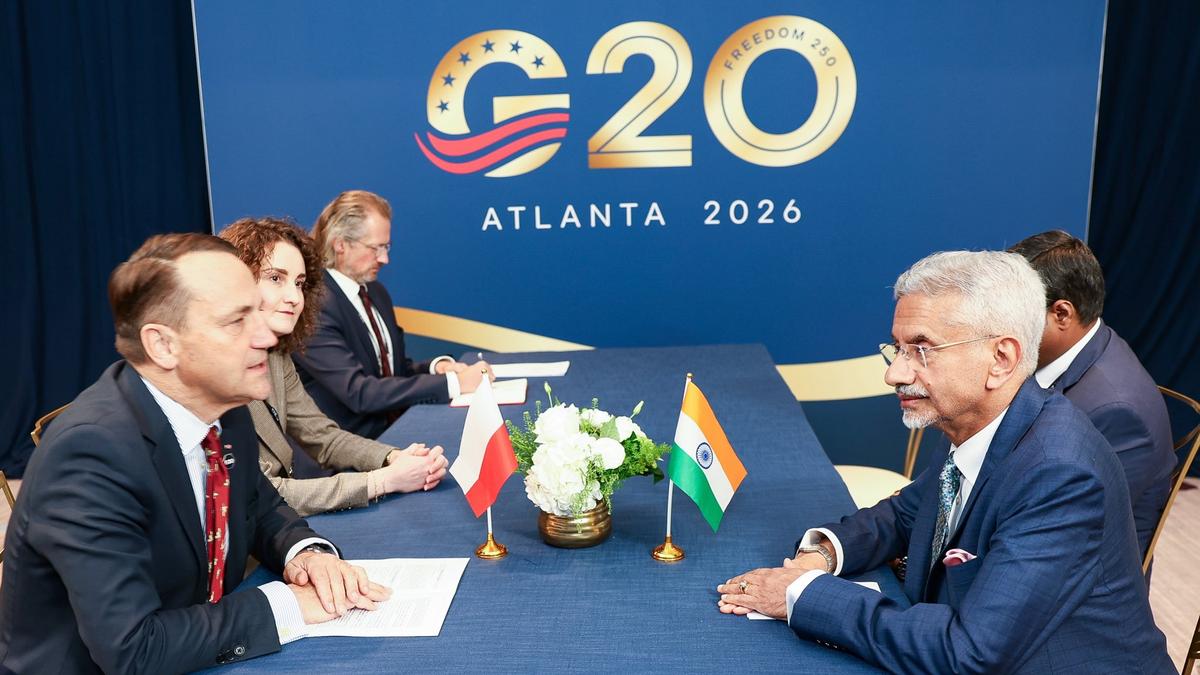
Reference view accompanying reporting on S. Jaishankar’s engagements with Russian, Polish and South Korean counterparts, providing context for India’s diplomacy on Ukraine and West Asia.
Image: The Hindu
Why in news
The supplied reports describe External Affairs Minister S. Jaishankar’s meetings with his Russian, Polish and South Korean counterparts on October 31, 2026, alongside concerns over energy insecurity, sanctions and attacks. They also indicate Indian efforts to encourage dialogue involving Russia, Ukraine and Europe.
Background
The G20 is a forum for international economic cooperation, not a collective-security alliance or a treaty-based conflict-resolution body. Nevertheless, wars enter its agenda because they affect energy prices, trade, investment and development. India’s strategic autonomy involves retaining independent decision-making while cooperating with different partners on specific issues. As an energy-importing economy connected to global maritime trade, India has a direct interest in affordable supplies, reliable transport routes and peaceful settlement of disputes. Article 51 of the Constitution provides a related normative framework by directing the State to promote international peace and security, respect for international law and settlement of international disputes by arbitration.
What the reported engagements establish
According to The Hindu report, Jaishankar met Russian Foreign Minister Sergey Lavrov, Polish Deputy Prime Minister and Foreign Minister Radoslaw Sikorski, and South Korean Foreign Minister Cho Hyun on the sidelines of the Atlanta meeting. Discussions with Russia covered Ukraine, the Gulf situation and multilateral issues; those with Poland covered Ukraine, India–EU ties and the G20; the South Korean engagement addressed bilateral cooperation and multilateral matters.
The Indian Express headline identifies energy insecurity, sanctions and attacks as concerns raised by India. The Times of India headline indicates efforts to bring Russia, Ukraine and Europe into dialogue, while its available excerpt mentions protection of civilian shipping. The supplied material does not identify the complete negotiating agenda or establish a concluded agreement.
Poland’s participation followed an invitation from the United States, according to the report. Its participation and expressed interest in permanent membership must not be confused with confirmation of permanent G20 membership.
- The meetings demonstrate engagement across different diplomatic constituencies rather than an exclusive alignment with one bloc.
- No sanctions exemption, ceasefire arrangement or civilian-shipping agreement is established by the supplied reports.
- The reported discussions on Ukraine and the Gulf should not be presented as a single, agreed peace initiative.
Infographic
Energy access
Protect affordability, availability and supply reliability.
Sanctions assessment
Separate legal obligations from commercial and financial exposure.
Civilian shipping
Prioritise seafarer safety and lawful maritime activity.
Dialogue
Preserve communication and pursue practical risk reduction.
Strategic autonomy
Combine independent choices with consistent principles.
AI-assisted infographic by Pragnya IAS Academy, based on the cited sources.
Sanctions and energy access: the economic-security link
Energy security requires availability, affordability and reliability. Conflict can disrupt production and transport, while sanctions can affect transactions through restrictions on trade, finance, shipping or insurance. These are distinct channels: physical supply may exist even when payment or transport becomes difficult.
For India, the policy challenge is to preserve dependable energy access without underestimating legal, commercial and diplomatic risks. Higher import costs can transmit into transport, production costs, inflation and external-sector pressures. This explains why sanctions and conflict-related disruptions are relevant to an economic forum such as the G20.
The legal character of sanctions matters. UN Security Council sanctions and unilateral or regional restrictions have different legal bases and reach. India’s assessment must distinguish binding international obligations from restrictions whose effects arise through foreign jurisdiction, market access or financial exposure; it should neither treat every sanctions regime as universally binding nor assume that non-UN measures have no practical consequences.
- Supply diversification should cover suppliers, routes and commercial arrangements rather than merely shifting dependence to another source.
- Affordable energy is a development concern for importing economies, not only a matter of geopolitical preference.
- A durable response combines diplomatic engagement with domestic efficiency, clean-energy expansion and supply resilience.
Civilian shipping: a practical agenda amid political deadlock
Civilian shipping connects energy producers, manufacturing centres and consumers. Threats to merchant vessels can endanger seafarers, delay cargo, trigger rerouting and raise freight and insurance costs. Thus, a geographically concentrated conflict can impose costs on countries far from the theatre of hostilities.
Protection of civilian shipping offers a possible area for limited cooperation even when parties disagree on the wider conflict. Communication channels, incident prevention, navigational warnings and humanitarian coordination can reduce risks without requiring an immediate comprehensive political settlement. These are possible policy measures, not arrangements confirmed by the supplied reports.
The legal framework must be stated carefully. UNCLOS provides the general framework for maritime navigation, while international humanitarian law governs the conduct of hostilities during armed conflict, including the principles of distinction, proportionality and precautions. Civilian vessels are not automatically lawful targets merely because of their nationality or commercial association; any targeting assessment must satisfy the applicable legal rules.
- Protection of seafarers should remain distinct from political disagreements over trading partners.
- Safe maritime passage supports energy security, food supply chains and wider commercial confidence.
- A shipping-safety mechanism requires operational clarity and acceptance by relevant parties, not only a diplomatic declaration.
Strategic autonomy: engagement without automatic alignment
India’s engagement with Russia, Poland and South Korea illustrates the use of multiple diplomatic channels. Maintaining contact with Russia can preserve communication on Ukraine, while discussions with Poland provide an additional European perspective alongside the India–EU agenda. Such engagement does not establish that India has been formally accepted as a mediator.
Strategic autonomy is best understood as independent, issue-based decision-making rather than equidistance between opposing sides. Its credibility depends on explaining how national interests coexist with consistent principles: sovereignty, peaceful settlement, civilian protection and respect for international law.
The G20 can draw attention to the economic spillovers of conflict and facilitate bilateral contacts, but it cannot compel a ceasefire or replace the UN’s peace-and-security role. India’s immediate contribution may therefore lie in sustaining communication and pursuing limited risk-reduction measures, while recognising that a political settlement ultimately depends on the parties concerned.
- Diplomatic access is an enabling asset, not proof of influence over belligerents.
- Humanitarian and maritime cooperation may be feasible before agreement on territorial or security disputes.
- Balancing becomes sustainable when backed by economic resilience and clearly articulated principles.
| Issue | Risk for India | Policy approach |
|---|---|---|
| Energy disruption | Uncertain supplies and higher import costs | Diversify supply sources and routes; improve efficiency and resilience |
| Sanctions | Transaction, finance, insurance and compliance constraints | Assess the applicable legal regime and commercial exposure separately |
| Threats to civilian shipping | Seafarer insecurity, delays and higher logistics costs | Promote lawful navigation, communication and incident prevention |
| Diplomatic polarisation | Pressure to align and reduced space for dialogue | Maintain issue-based partnerships and consistent public principles |
| G20 institutional limits | Expectations exceeding the forum’s authority | Use the forum for economic coordination and diplomatic facilitation |
- 1. Conflict creates production risks, maritime threats or sanctions-related restrictions.
- 2. Supply, payment, insurance or transport arrangements become less reliable.
- 3. Importers face potentially higher landed costs and delivery uncertainty.
- 4. Energy and logistics pressures can transmit into inflation, production costs and external balances.
- 5. India responds through diplomacy, diversification and domestic resilience measures.
October 31, 2026
Jaishankar held separate meetings with his Russian, Polish and South Korean counterparts on the sidelines of the G20 Foreign Ministers’ Meeting in Atlanta, according to the supplied report.
Significance, challenges & way forward
Significance
- India’s diplomacy connects conflict management with the everyday development concern of reliable and affordable energy.
- Engagement with different partners preserves channels that may support de-escalation and limited practical cooperation.
- Attention to civilian shipping broadens the discussion from strategic rivalry to seafarer safety and global supply-chain stability.
- The G20 provides a platform to highlight costs borne by energy-importing developing economies.
- The episode illustrates strategic autonomy as active engagement rather than diplomatic disengagement.
Challenges
- Conflicting security objectives can prevent dialogue from producing substantive concessions.
- Sanctions-related financial and commercial exposure can constrain transactions even where India has not adopted equivalent restrictions.
- Energy diversification may be limited by infrastructure, contractual requirements and the availability of suitable supplies.
- Maritime insecurity can persist despite diplomatic assurances when operational coordination is weak.
- Perceptions of inconsistency can undermine India’s credibility unless its positions are explained through clear principles.
- The G20’s economic role does not give it authority to impose a political settlement on parties to a conflict.
Way forward
- Pursue practical risk-reduction objectives, including civilian-shipping safety and humanitarian communication, without presenting them as substitutes for a political settlement.
- Maintain dialogue with Russia, Ukraine, European partners and relevant West Asian actors while consistently supporting sovereignty and peaceful dispute settlement.
- Evaluate sanctions through legal due diligence, transaction-level risk assessment and diplomatic consultation.
- Strengthen energy resilience through supplier and route diversification, strategic preparedness, efficiency and clean-energy deployment.
- Use the G20 to foreground the development costs of disrupted energy and trade, while coordinating with institutions suited to maritime and security questions.
- Report diplomatic outcomes precisely by distinguishing discussions, proposals, agreed mechanisms and verified implementation.
Key terms
- Strategic autonomy
- The capacity to make independent foreign-policy choices based on national interests and principles without automatic alignment.
- Energy security
- Reliable access to adequate energy at affordable prices, supported by resilience against disruptions.
- Sanctions
- Restrictive measures intended to influence conduct, potentially affecting trade, finance, travel or other transactions.
- Secondary sanctions
- Measures that can expose third-country persons or firms to penalties for specified dealings with sanctioned entities.
- Civilian shipping
- Non-military maritime activity, including merchant transport, subject to applicable maritime and armed-conflict rules.
- International humanitarian law
- Rules governing armed conflict that limit methods of warfare and protect persons and objects not lawfully subject to attack.
- Diplomatic facilitation
- Assistance in enabling communication or dialogue without necessarily assuming the formal role of mediator.
Link with static syllabus
Prelims practice MCQs
Q1. With reference to the G20, consider the following statements: 1. It is a forum for international economic cooperation. 2. It can impose binding ceasefire obligations on parties to an armed conflict. 3. Participation in a meeting at the host’s invitation does not by itself establish permanent membership. Which of the statements given above are correct?
Q2. Which of the following best describes strategic autonomy in India’s foreign policy?
Q3. Consider the following statements about sanctions and energy security: 1. UN Security Council sanctions and unilateral sanctions necessarily have identical legal bases and reach. 2. Sanctions can affect energy transactions through finance, insurance and transport. 3. Energy security includes affordability and reliability, not merely physical availability. Which of the statements given above are correct?
Q4. With reference to Article 51 of the Constitution of India, consider the following statements: 1. It is part of the Directive Principles of State Policy. 2. It directs the State to promote international peace and security. 3. It requires India to join a collective military alliance. Which of the statements given above are correct?
Mains practice questions
GS 2 · 15 marks · 250 words
India’s strategic autonomy must reconcile energy security with principled diplomacy. Examine in the context of the Ukraine and West Asia conflicts, with particular reference to sanctions and civilian shipping.
Frequently asked questions
What did India raise at the G20 Foreign Ministers’ Meeting?
The supplied reports identify energy insecurity, sanctions and attacks as concerns, alongside discussions on Ukraine, the Gulf and multilateral cooperation. The available material also mentions protection of civilian shipping.
Has India secured an agreement between Russia, Ukraine and Europe?
The supplied material indicates efforts to encourage dialogue but does not establish a concluded agreement or a formally accepted Indian mediation role.
Why do sanctions matter for India’s energy security?
Depending on their scope, sanctions can affect payment channels, insurance, shipping and supplier access. India must assess both the applicable legal obligations and the practical commercial exposure.
Does strategic autonomy mean neutrality on every conflict?
No. Strategic autonomy means retaining independent decision-making; it permits clear positions on sovereignty, international law and civilian protection while maintaining dialogue with different parties.
Sources
- The Hindu: S. Jaishankar meets Russian, Polish, South Korean counterparts; discusses Ukraine, West Asia
- Indian Express: At G20 foreign ministers’ meet: Jaishankar raises energy crisis, flags sanctions, attacks
- Times of India: India trying to bring Russia, Ukraine & Europe to the table on 3 fronts: Jaishankar
Analysis prepared by the Pragnya IAS Academy current-affairs desk with AI assistance from the cited reports. Verify figures with the original sources.
Turn current affairs into marks
Join Pragnya IAS Academy's mentorship for daily answer-writing evaluation on stories like this — classroom programmes from a trusted name in IAS coaching in Hyderabad.