
Quad Critical Minerals Cooperation: India’s Economic Security and Indo-Pacific Strategy
Revise the static topic: UPSC International Relations notes
In short: Quad foreign ministers met in Atlanta on October 31, 2026, to review cooperation on reliable and open supply chains, critical minerals, next-generation technologies and maritime issues. For India, these priorities connect economic security with its Indo-Pacific strategy by offering opportunities to diversify essential inputs and strengthen industrial capabilities. The supplied report describes a review of progress, not a new binding minerals agreement or quantified investment package.
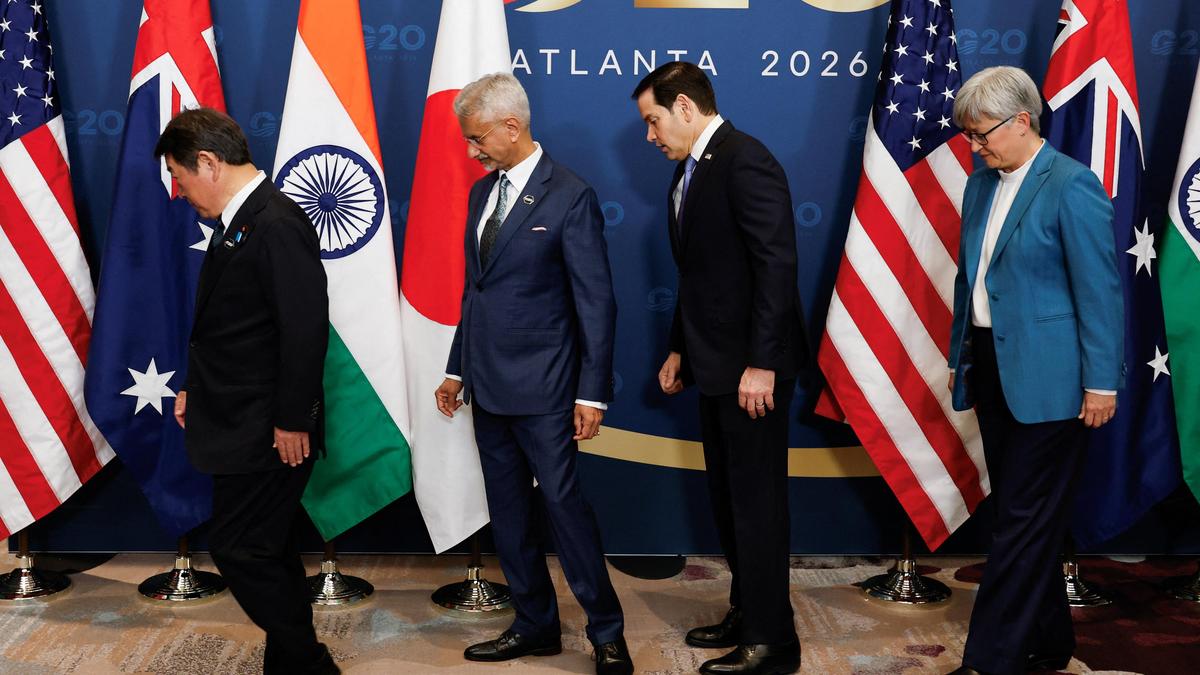
Photo from the source report: Quad Critical Minerals Cooperation: India’s Economic Security and Indo-Pacific Strategy
Image: The Hindu
Why in news
The Atlanta meeting was the third Quad Foreign Ministers’ Meeting of 2026, following meetings in New Delhi and Manila. Preparations were also underway for a possible Quad leaders’ summit in the Philippines in mid-November; the report did not confirm its convening.
3
Quad foreign ministers’ meetings in 2026
Background
The Quadrilateral Security Dialogue, or Quad, brings together India, Australia, Japan and the United States. It is a diplomatic partnership rather than a collective-defence alliance. Its Indo-Pacific cooperation connects maritime concerns with technology and economic issues. Critical minerals are inputs whose economic or strategic importance, combined with vulnerability to supply disruption, makes their availability a policy concern. Criticality varies across countries and over time; securing these minerals requires attention to processing, components and recycling as well as mineral deposits.
What the Atlanta meeting established
The supplied report records a review of progress in converting shared Quad priorities into practical benefits for the Indo-Pacific. U.S. Secretary of State Marco Rubio highlighted reliable and open supply chains, next-generation technologies, maritime cooperation and critical minerals.
The report does not specify a new treaty, financing commitment, mineral-specific allocation or implementation schedule. Its immediate significance is therefore political signalling and coordination ahead of a prospective leaders’ summit, rather than evidence of a newly operational supply arrangement.
- Distinguish the Quad’s collective priorities from Jaishankar’s separately reported stocktaking of India–U.S. bilateral cooperation.
- Treat the proposed Philippines summit as under preparation, not as a confirmed or completed event.
- Assess delivery through subsequent projects and implementation disclosures rather than declarations alone.
Infographic
Diversify
Broaden suppliers, routes and processing options.
Build capability
Link mineral access with domestic technology and manufacturing.
Secure connectivity
Connect economic resilience with reliable maritime logistics.
Source responsibly
Embed environmental safeguards and community participation.
Preserve autonomy
Expand choices through open, commercially viable partnerships.
AI-assisted infographic by Pragnya IAS Academy, based on the cited sources.
Why critical minerals are an economic-security issue
Critical minerals connect resource security with industrial and technological capability. Lithium and graphite are used in lithium-ion battery technologies, while certain rare-earth elements are used in high-performance permanent magnets. Disruption of essential inputs can affect manufacturing, clean-energy deployment and strategic industries.
Access to ore does not by itself ensure security. A supply chain can remain vulnerable if separation, refining, component production or transport depends on a narrow set of suppliers. Resilience therefore requires diversification across stages of the value chain, not merely additional mining agreements.
- Economic security concerns reliable access, manageable costs and the ability to sustain essential production during disruption.
- Diversification reduces dependence on a single source but does not eliminate market, logistical or geopolitical risk.
- Recycling and material substitution can complement primary mineral supplies.
How cooperation can support India’s Indo-Pacific strategy
For India, Quad cooperation offers a platform to connect external partnerships with domestic industrial objectives. Potential areas include supply-risk assessment, diversified procurement, processing technology, skills and investment. These are analytical opportunities, not newly announced commitments in the supplied report.
The economic and maritime dimensions reinforce each other: reliable mineral supplies also depend on functioning ports, secure sea routes and predictable logistics. Delivering useful economic partnerships can strengthen India’s regional engagement beyond a narrowly military conception of the Indo-Pacific.
India’s strategic autonomy would be strengthened if cooperation expands its choices rather than replacing dependence on one external source with dependence on another. Quad engagement should therefore complement wider partnerships and ASEAN-centred regional institutions.
- Use partnerships to build Indian value addition rather than remain only a buyer of imported processed materials.
- Keep supply-chain cooperation open to commercially viable partners beyond the Quad.
- Offer regional partners tangible benefits through skills, connectivity and responsible investment.
The implementation test: resilience without fragmentation
Diversified supply chains may initially cost more than established sourcing arrangements. Mining and processing projects also face long development periods, financing uncertainty, technical constraints and environmental concerns. Political endorsement alone cannot establish commercial viability.
The policy objective should be risk reduction rather than complete economic separation. Opaque subsidies, exclusive procurement and competing technical requirements could undermine the stated commitment to open supply chains. Transparent standards and predictable investment rules are therefore important.
Responsible sourcing must be integral to security policy. Mineral extraction and processing can create land, water, waste and community impacts; weakening safeguards can generate conflict and delays that ultimately make supply less reliable.
- Separate urgent disruption-management measures from long-term industrial capacity building.
- Evaluate bottlenecks at processing and component stages alongside access to mineral deposits.
- Judge resilience by supplier diversity, alternative processing options and recovery capacity after disruption.
| Stage | Security concern | Policy response |
|---|---|---|
| Exploration and extraction | Concentrated sourcing or uncertain project development | Diversify procurement and support responsible exploration and investment. |
| Processing and refining | Ore access without adequate conversion capacity | Build commercially viable processing capacity and technical expertise. |
| Components and manufacturing | Dependence persists despite access to processed minerals | Connect mineral policy with industrial capabilities, skills and research. |
| Transport and logistics | Disruption of ports, sea routes or delivery networks | Improve logistics planning and identify alternative routes and suppliers. |
| Recycling and substitution | Continued exposure to primary-resource supply risks | Strengthen collection, material recovery and alternative-material research. |
- 1. Map critical inputs and identify supplier, processing and logistics dependencies.
- 2. Coordinate risk information and identify commercially viable alternatives.
- 3. Develop diversified sourcing and responsible investment partnerships.
- 4. Build domestic processing, manufacturing and recycling capabilities.
- 5. Test contingency arrangements and review resilience against actual disruptions.
May 2026
Quad foreign ministers met in New Delhi, according to the supplied report.
July 2026
Quad foreign ministers met in Manila.
October 31, 2026
Quad foreign ministers met in Atlanta on the sidelines of the G20 Foreign Ministers’ Meeting and reviewed cooperation priorities.
Mid-November 2026, proposed
Preparations were underway for a Quad leaders’ summit in the Philippines alongside the ASEAN–East Asian summit meetings; convening remained prospective.
Significance, challenges & way forward
Significance
- Supply-chain diversification can reduce the exposure of essential Indian industries to disruptions affecting individual suppliers or locations.
- Cooperation on minerals and technology can connect India’s external partnerships with domestic industrial upgrading.
- Linking maritime cooperation with economic connectivity gives India’s Indo-Pacific engagement a practical development dimension.
- A wider range of sourcing and technology options can strengthen strategic autonomy.
- Regional delivery can help establish the Quad’s relevance through public benefits rather than geopolitical signalling alone.
Challenges
- The supplied report provides no project-level details with which to independently assess the scale of claimed progress.
- Diversifying mineral extraction without diversifying processing can leave the main vulnerability unresolved.
- Higher initial costs and uncertain demand can deter investment in alternative supply chains.
- Technology access, commercial confidentiality and differing domestic regulations can complicate cooperation.
- Environmental damage and inadequate community participation can weaken the legitimacy and reliability of mineral projects.
- Excessively exclusive arrangements could fragment trade and constrain India’s wider economic choices.
Way forward
- Undertake mineral-by-mineral and stage-by-stage vulnerability assessments rather than treat all critical inputs identically.
- Translate political coordination into transparent project pipelines with identifiable responsibilities and review mechanisms.
- Combine overseas sourcing with domestic processing, research, skills and component manufacturing.
- Use predictable procurement and financing arrangements where justified by demonstrated supply risks and commercial feasibility.
- Embed environmental safeguards, traceability and community consultation in mineral partnerships.
- Develop recycling and substitution alongside primary sourcing to broaden the available policy toolkit.
- Maintain diversified partnerships beyond the Quad and align regional projects with partner-country priorities.
Key terms
- Critical minerals
- Minerals considered economically or strategically important whose supply vulnerability creates significant policy concerns.
- Supply-chain resilience
- The ability of a production and delivery network to anticipate, absorb, adapt to and recover from disruptions.
- Economic security
- The capacity to protect essential economic functions and strategic capabilities against serious disruption or coercion.
- De-risking
- Reducing specific vulnerabilities through diversification and safeguards without necessarily ending economic engagement.
- Offtake agreement
- An arrangement under which a buyer agrees to purchase specified future output, helping provide demand certainty for a project.
- Strategic autonomy
- The ability to make independent policy choices while engaging with different international partners.
- Circular economy
- An approach that retains material value through reuse, repair and recycling while reducing waste and primary-resource demand.
Link with static syllabus
Prelims practice MCQs
Q1. Consider the following statements about the Quad: 1. India, Australia, Japan and the United States are its members. 2. It is a collective-defence alliance requiring automatic military assistance to members. 3. The supplied report on the Atlanta meeting identifies critical minerals and reliable supply chains among its cooperation priorities. Which of the statements given above are correct?
Q2. With reference to critical-mineral security, consider the following statements: 1. Access to mineral deposits alone guarantees a resilient supply chain. 2. Processing and refining can constitute supply-chain bottlenecks. 3. Recycling can complement primary mineral supplies. Which of the statements given above are correct?
Q3. Which of the following best describes de-risking in the context of international supply chains?
Q4. Consider the following pairs: 1. Lithium and graphite — Inputs used in lithium-ion battery technologies 2. Certain rare-earth elements — Materials used in high-performance permanent magnets 3. Offtake agreement — An arrangement to purchase specified future output How many of the above pairs are correctly matched?
Mains practice questions
GS 2 · 15 marks · 250 words
Assess how Quad cooperation on critical minerals and supply-chain diversification can strengthen India’s economic security and Indo-Pacific strategy. What safeguards should guide India’s approach?
Frequently asked questions
Did the Atlanta meeting announce a new Quad critical-minerals treaty?
The supplied report describes a review of progress and identifies critical minerals as a cooperation priority. It does not report a new treaty, quantified funding package or mineral-specific implementation agreement.
Why is critical-mineral cooperation important for India?
It can help India diversify essential industrial inputs and develop processing, technology and manufacturing capabilities. Benefits depend on implementation and domestic capacity building, not sourcing agreements alone.
Are critical minerals and rare-earth elements the same?
No. Rare-earth elements are a particular group of elements, whereas critical minerals are a policy category based on importance and supply vulnerability; some rare-earth elements may fall within that category.
Does supply-chain resilience require ending international trade?
No. Resilience can be strengthened through diversified trade, alternative processing capacity, recycling and contingency planning rather than complete self-sufficiency.
Sources
- The Hindu: Quad delivering results for people in Indo-Pacific: Rubio
- Indian Express: Quad building reliable, open supply chains and securing critical minerals, says Marco Rubio
Analysis prepared by the Pragnya IAS Academy current-affairs desk with AI assistance from the cited reports. Verify figures with the original sources.
Turn current affairs into marks
Join Pragnya IAS Academy's mentorship for daily answer-writing evaluation on stories like this — classroom programmes from a trusted name in IAS coaching in Hyderabad.