
Maharashtra Women Farmers’ Bill: Recognition Beyond Land Ownership
Revise the static topic: UPSC Agriculture notes · UPSC Economy notes
In short: Maharashtra passed the Women Farmers’ Empowerment Bill in July 2026, providing for independent recognition of women as farmers irrespective of land ownership through a Woman Farmer Certificate. This can help address their exclusion from agricultural services, but effective access will require changes in scheme eligibility, lending practices and administrative records.
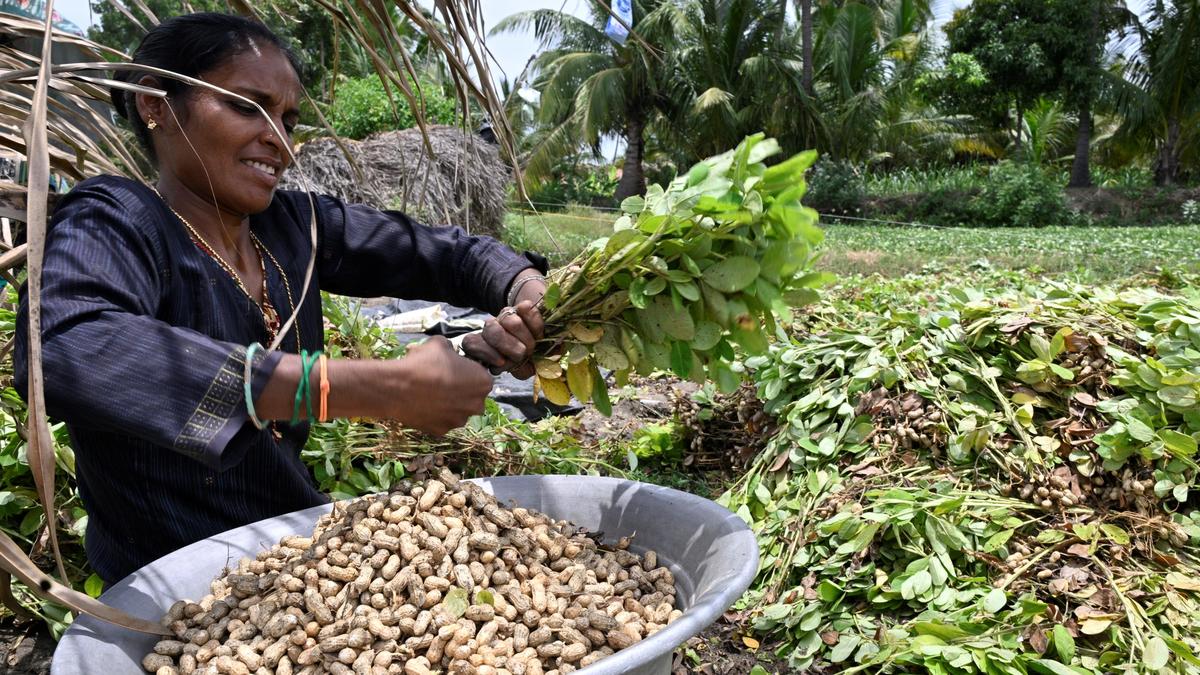
Reference image on recognising women as farmers beyond land ownership; not a photograph of the Bill’s passage.
Image: The Hindu
Why in news
The Hindu’s analysis highlights Maharashtra’s move towards activity-based recognition of women farmers and the need for a database linking them to welfare schemes. The supplied report establishes passage of the Bill, but does not specify assent, commencement or detailed implementation rules.
110 million
Approximate rural women employed in agriculture in 2025
127 million
Approximate rural men employed in agriculture in 2025
Background
Agricultural work, operational control over cultivation and legal ownership of land are distinct. Women may cultivate, perform agricultural labour and participate in farm decisions without appearing as owners in land records. Administrative reliance on ownership documents can consequently make their economic contribution invisible. The National Policy for Farmers, 2007 articulated an activity-based definition of farmers beyond landowners; the supplied report notes that this approach was not operationalised. Maharashtra’s initiative seeks to bridge the gap between performing agricultural work and receiving independent recognition as a farmer.
What the Bill changes—and what remains unverified
According to the supplied report, Maharashtra passed the Women Farmers’ Empowerment Bill in July 2026. Its central innovation is a Woman Farmer Certificate recognising women independently as farmers, irrespective of land ownership.
The Hindu describes it as the first State legislation to give enforceable legal form to the land-delinked, activity-based approach articulated in the National Policy for Farmers, 2007. However, passage should not be equated with confirmed commencement: the supplied material does not establish assent, operational rules or benefits already delivered.
- The reported change concerns recognition as a farmer; it should not be confused with transfer of land ownership.
- The source does not establish automatic eligibility for every agricultural scheme or a guaranteed right to a bank loan.
- A database of women farmers is an implementation priority highlighted by the analysis, not a verified operational feature of the Bill.
Infographic
Independent identity
Recognise agricultural work without requiring land ownership.
Inclusive records
Build accessible, secure and updateable farmer registers.
Effective access
Align credit pathways, extension outreach and scheme rules.
Accountability
Provide appeals and measure actual service delivery.
Asset equality
Advance land rights and women’s control over benefits.
AI-assisted infographic by Pragnya IAS Academy, based on the cited sources.
Why land-linked identification excludes women
The source reports that rural agriculture employed roughly 110 million women and 127 million men in 2025, using PLFS-based, Census-adjusted estimates. This near parity in employment contrasts with the persistent tendency to imagine and identify the farmer primarily as a male landowner.
Where ownership records serve as the main gateway to recognition, women’s work may remain administratively invisible. Recognising a household as agricultural is also not equivalent to recognising each woman who farms within it as an independent beneficiary.
- Unrecorded cultivators can face difficulties demonstrating their agricultural role.
- Women’s participation in production does not necessarily translate into control over farm income or institutional services.
- Individual recognition can improve visibility, but eligibility must reflect different agricultural roles rather than assume that all women farmers have identical needs.
How recognition can improve credit, extension and welfare
For credit, a recognised farmer identity can help establish an applicant’s agricultural occupation and support outreach by formal lenders. It cannot by itself provide collateral, establish repayment capacity or override lending conditions. Suitable collateral-free lending arrangements, group-based approaches and cash-flow assessment would therefore remain important.
For extension, an individual register can help departments directly invite women to training, demonstrations and advisory services. Benefits will depend on practical design: convenient timings, accessible venues, locally relevant content and options for women without independent digital access.
For welfare, recognition can create a basis for identifying eligible women rather than treating them only as dependants of recorded landowners. However, schemes governed by ownership or other restrictive conditions require explicit administrative or policy changes before the certificate can function as an accepted gateway.
- Identity reform must be followed by scheme-wise review of eligibility and documentation.
- Credit outreach should measure actual sanction, suitability and repayment conditions, not merely applications.
- Extension programmes should assess women’s participation and adoption of advice, not only registration.
- A farmer database should support service delivery without becoming another exclusionary documentation requirement.
Constitutional and institutional significance
The initiative is consistent with substantive equality: formally identical treatment can perpetuate disadvantage when women have unequal access to land titles. Article 14 guarantees equality before the law and equal protection of the laws, while Article 15(3) permits special provisions for women and children. Article 39(a), a Directive Principle, calls for adequate means of livelihood for men and women equally.
Agriculture and rights in or over land fall within the State List, providing an important basis for State-level intervention. Nevertheless, a State certificate cannot automatically amend Union scheme conditions or banking rules; coordinated acceptance across institutions is necessary.
Recognition without ownership and reform of women’s property rights are complementary. The former addresses immediate exclusion from services; the latter concerns enduring control over productive assets, inheritance and bargaining power.
- Farmer status, land title and scheme entitlement are legally and administratively distinct.
- Gender-responsive policy should address both access to services and control over assets.
- Implementation requires coordination among agriculture departments, local administration, financial institutions and scheme authorities.
| Area | Potential contribution of recognition | Additional requirement |
|---|---|---|
| Farmer identity | Makes women visible independently of land ownership | Accessible activity-based verification and an appeal mechanism |
| Agricultural credit | Helps establish agricultural occupation and enables lender outreach | Suitable loan products, accepted documentation and repayment assessment |
| Extension services | Enables direct identification and invitation of women farmers | Gender-responsive training, accessible delivery and relevant advice |
| Welfare schemes | Provides a basis for identifying women as potential beneficiaries | Scheme-specific acceptance and revision of restrictive eligibility rules |
| Land rights | Separates farmer recognition from ownership | Independent action on inheritance, titles and control over land |
- 1. Identify women engaged in agriculture through accessible, activity-based verification.
- 2. Provide independent farmer recognition without requiring land ownership.
- 3. Build a secure, updateable register with correction and appeal facilities.
- 4. Align scheme documentation, extension outreach and lender acceptance with the recognised identity.
- 5. Deliver appropriate services and monitor actual access, control and outcomes.
2007
The National Policy for Farmers articulated an activity-based definition of farmers beyond land ownership.
2011
A comparable national-level Bill was introduced in the Rajya Sabha; the supplied report states that it subsequently lapsed.
2025
PLFS-based, Census-adjusted estimates cited in the source placed rural agricultural employment at roughly 110 million women and 127 million men.
July 2026
Maharashtra passed the Women Farmers’ Empowerment Bill, providing for independent recognition through a Woman Farmer Certificate.
Significance, challenges & way forward
Significance
- Independent recognition shifts policy attention from who owns the land to who contributes to agricultural production.
- Direct identification can make women visible to extension agencies, financial institutions and welfare administrators.
- Better gender-disaggregated records can improve planning and reveal gaps between participation in agriculture and access to public support.
- Recognition can strengthen women’s voice in agricultural institutions, although greater agency will depend on implementation and social conditions.
- The initiative offers a State-level approach to operationalising the broader farmer definition articulated in national policy.
Challenges
- Verification may reproduce exclusion if officials continue to insist on ownership records or certification controlled by household gatekeepers.
- Existing scheme rules may remain tied to land ownership, limiting the practical value of the certificate.
- Lenders may continue to require security or other conditions that independent farmer recognition does not satisfy.
- Digital-only registration can disadvantage women with limited device access, literacy or connectivity.
- A database can become outdated or expose personal information unless correction, security and purpose-limitation safeguards are built in.
- Recognition may remain symbolic if women lack control over benefits, farm income or household agricultural decisions.
Way forward
- Clarify the legislation’s operative status, rules, responsible authorities and application procedure through accessible public communication.
- Design activity-based verification with alternative evidence, assisted offline access and safeguards against arbitrary rejection.
- Audit agricultural schemes individually and specify where the certificate is accepted, where rules require amendment and which authority must act.
- Coordinate with lenders to develop suitable credit pathways rather than treating the certificate as a substitute for a lending framework.
- Use the database for direct, gender-responsive extension while collecting only necessary information and enabling correction of records.
- Measure service uptake, access to appropriate credit and women’s control over benefits rather than treating certificate issuance as the final outcome.
- Pursue land and inheritance rights alongside recognition so that immediate inclusion does not substitute for long-term asset equality.
Key terms
- Activity-based farmer recognition
- Identification based on engagement in agricultural activity rather than exclusively on ownership of agricultural land.
- Woman Farmer Certificate
- The instrument of independent recognition for women farmers reported under Maharashtra’s Bill.
- Land title
- Legal ownership of land, which is distinct from working on or operating that land.
- Agricultural extension
- Services that communicate agricultural knowledge, skills and advice to improve farm decisions and practices.
- Substantive equality
- An approach to equality that addresses structural disadvantage rather than relying only on identical treatment.
- Gender-disaggregated data
- Data presented separately by gender to identify differences in participation, access and outcomes.
- PLFS
- The Periodic Labour Force Survey, an official survey providing estimates of employment and unemployment in India.
Link with static syllabus
Prelims practice MCQs
Q1. With reference to Maharashtra’s Women Farmers’ Empowerment Bill, as described in the supplied report, consider the following statements: 1. It provides for independent recognition of women as farmers irrespective of land ownership. 2. A Woman Farmer Certificate necessarily transfers ownership of cultivated land to its holder. 3. Passage of the Bill alone establishes automatic eligibility under every agricultural welfare scheme. Which of the statements given above is/are correct?
Q2. Which of the following provisions of the Constitution expressly permits the State to make special provisions for women and children?
Q3. Consider the following statements: 1. Agricultural extension includes communicating knowledge and advice to farmers. 2. Independent farmer recognition necessarily satisfies all collateral requirements imposed by lenders. 3. A database of women farmers can support targeted outreach without itself changing scheme eligibility rules. Which of the statements given above are correct?
Q4. With reference to the National Policy for Farmers, 2007, which of the following best describes the approach highlighted in the supplied report?
Mains practice questions
GS 3 · 15 marks · 250 words
Independent recognition of women as farmers is necessary but insufficient for agricultural empowerment. Discuss with reference to Maharashtra’s Women Farmers’ Empowerment Bill.
Frequently asked questions
What is the main change proposed by Maharashtra’s Women Farmers’ Empowerment Bill?
It provides for women to be recognised independently as farmers irrespective of land ownership through a Woman Farmer Certificate.
Does the Woman Farmer Certificate give women ownership of agricultural land?
The supplied report describes recognition as a farmer, not transfer of land ownership. Farmer identity and property rights are distinct.
Will recognition automatically provide agricultural loans and welfare benefits?
No automatic entitlement is established by the supplied material. Access will depend on lending conditions, scheme eligibility and acceptance of the certificate by implementing institutions.
Why is a database of women farmers important?
It can make women visible for direct outreach, extension and welfare delivery. It must remain accessible, updateable and secure so that registration does not become another barrier.
Sources
- The Hindu: Towards recognising women farmers
Analysis prepared by the Pragnya IAS Academy current-affairs desk with AI assistance from the cited reports. Verify figures with the original sources.
Turn current affairs into marks
Join Pragnya IAS Academy's mentorship for daily answer-writing evaluation on stories like this — classroom programmes from a trusted name in IAS coaching in Hyderabad.