
Nepal’s Loss and Damage Fund Allocation: Climate Justice and Finance Gaps
Revise the static topic: UPSC Environment notes
In short: The Fund for Responding to Loss and Damage has earmarked $21.6 million for Nepal following its August 2026 floods, marking its first country-specific allocation. This is not an actual disbursement: Nepal must submit a funding request for further Board approval, highlighting the gap between climate finance commitments and timely recovery support.
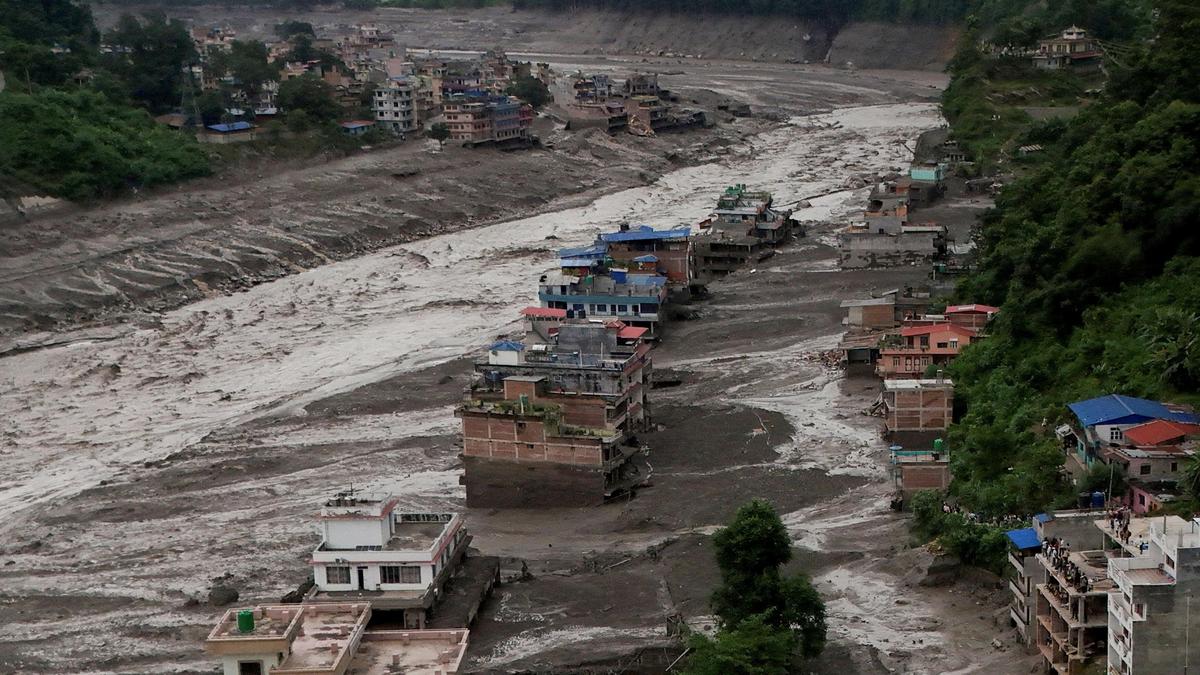
Reference image for reporting on Nepal’s loss-and-damage funding. The $21.6 million allocation is earmarked, not disbursed; Nepal must submit a funding request for further Board approval.
Image: The Hindu
Why in news
At an extraordinary virtual meeting on October 22, 2026, the Fund’s Board approved Nepal’s allocation and an exceptional route for submitting a request outside the closed funding window. The decision brings the adequacy, accessibility and predictability of loss-and-damage finance into focus ahead of COP31 in Turkiye.
$21.6 million
Allocation earmarked for Nepal
$1.6 million
Oversight fees within Nepal allocation
$822.06 million
Pledges as of March 15, 2026
$629.70 million
Reported grant contributions
$2.8 billion
Demand in first funding call
$4.71 billion
Nepal’s minimum estimated recovery needs
Background
The UN Framework Convention on Climate Change provides the institutional framework for international climate cooperation, guided by equity and common but differentiated responsibilities and respective capabilities. Mitigation addresses the causes of climate change, while adaptation reduces vulnerability to its impacts. Loss and damage concerns adverse impacts that are not avoided through mitigation and adaptation, including both economic losses and non-economic harms. The Paris Agreement recognises loss and damage under Article 8. Governments agreed to establish the Fund at COP27 in 2022, and its Governing Instrument was adopted at COP28 in 2023.
What has actually been approved for Nepal?
On August 26, 2026, an ice-and-rock avalanche triggered flooding along the Bhotekoshi–Trishuli–Narayani river system. Experts cited in the report linked the event to human-driven warming. Nepal estimates economic losses of at least $2.69 billion and recovery needs of at least $4.71 billion.
The Board earmarked $21.6 million, including $1.6 million in oversight fees paid to implementing organisations for supervising expenditure. Nepal has been invited to submit a funding request for consideration at the Board’s December meeting in Manila. Release of money remains conditional on that further approval.
- The decision is the Fund’s first country-specific earmarking, not a completed transfer to Nepal.
- Economic losses measure damage suffered, whereas recovery needs estimate the resources required for recovery and rebuilding.
- The distinction between an allocation, an approved funding request and disbursement is central to assessing delivery.
Infographic
Purpose
Respond to economic and non-economic climate losses.
Milestone
$21.6 million earmarked; not yet disbursed.
Access
Exceptional submission route; further approval required.
Scale
Nepal’s recovery needs are at least $4.71 billion.
Reform
Predictable grants, rapid access and transparent oversight.
AI-assisted infographic by Pragnya IAS Academy, based on the cited sources.
Purpose and access arrangements of the Fund
Formally called the Fund for Responding to Loss and Damage, the mechanism operates under the UNFCCC’s financial mechanism. It supports developing countries particularly vulnerable to climate change in responding to economic and non-economic losses arising from extreme weather and slow-onset events. The World Bank hosts the Fund and serves as its interim trustee.
During the start-up phase, the Board has allowed Nepal to submit a request outside the closed submission window. Further exceptional submissions require separate Board decisions, while the Secretariat will assess lessons for the long-term operating model. Nepal’s treatment therefore does not establish an automatic emergency-access entitlement.
- The start-up allocation is $342 million, with at least half reserved for small island developing States and least developed countries.
- Non-economic losses may include loss of cultural heritage, community identity and biodiversity.
- Loss-and-damage support complements, rather than replaces, mitigation, adaptation and disaster preparedness.
Financing gaps: commitments, available resources and needs
As of March 15, 2026, 27 countries had pledged $822.06 million, with $629.70 million reported in grant contributions. The source notes that the Fund has not publicly disclosed how much cash it holds beyond signed contributions. Pledges and reported contributions should therefore not be treated as a transparent measure of immediately deployable resources.
The first funding call received 176 requests from 119 countries seeking about $2.8 billion. In July, decisions on those requests were deferred to December. This demand exceeds the start-up allocation, while Nepal’s recovery needs alone run into billions against an allocation measured in millions.
- Adequacy concerns whether resources match the scale of losses and recovery requirements.
- Predictability concerns whether donors honour commitments and sustain funding over time.
- Accessibility concerns whether affected countries can secure support without excessive procedural burdens.
- Speed concerns whether finance reaches communities when it can meaningfully support recovery.
Climate justice and the speed-accountability dilemma
The climate-justice argument is that vulnerable developing countries should not carry disproportionate recovery burdens from a crisis driven substantially by historical emissions elsewhere. Grant-based support is especially important where disaster recovery could otherwise deepen debt stress. However, the Fund should not be described as a legal compensation tribunal: the decision adopting the Paris Agreement states that Article 8 does not provide a basis for liability or compensation.
Nepal’s allocation demonstrates that the Board can respond flexibly, but a country-by-country exception is not equivalent to a permanent rapid-response system. Technical review and expenditure oversight protect public money; procedures designed mainly around conventional development projects can nevertheless delay urgent assistance. Institutional reform must preserve accountability while making access faster and more predictable.
- A permanent emergency window would reduce dependence on exceptional diplomatic mobilisation.
- Country ownership should be accompanied by participation of affected communities.
- For India, Himalayan climate risks make resilient infrastructure, early warning and regional cooperation important complementary priorities.
| Dimension | Core purpose | Illustrative action |
|---|---|---|
| Mitigation | Reduce emissions or enhance carbon sinks | Replace fossil-fuel generation with renewable energy |
| Adaptation | Reduce vulnerability to climate impacts | Strengthen flood forecasting and climate-resilient infrastructure |
| Loss-and-damage response | Address impacts that have not been avoided | Support recovery after destructive climate-related flooding |
- 1. Flood-related losses and recovery needs establish the context for assistance.
- 2. The Board earmarks funding and permits a request outside the closed submission window.
- 3. Nepal submits a funding request.
- 4. The Board considers the request at its scheduled December meeting.
- 5. Money can be released only after approval, with disbursement dependent on available donor-funded resources.
2022
COP27 agreed to establish a fund for responding to loss and damage.
2023
COP28 adopted the Fund’s Governing Instrument.
March 15, 2026
Reported pledges reached $822.06 million from 27 countries, with $629.70 million in grant contributions.
July 2026
The Board deferred decisions on requests from the first funding call to December.
August 26, 2026
An ice-and-rock avalanche triggered flooding along Nepal’s Bhotekoshi–Trishuli–Narayani river system.
October 22, 2026
An extraordinary Board meeting earmarked $21.6 million for Nepal and allowed an out-of-window funding request.
December 2026, scheduled
The Board is expected to consider Nepal’s funding request at its meeting in Manila; disbursement remains conditional on approval.
Significance, challenges & way forward
Significance
- The first country-specific allocation moves the Fund towards operational delivery rather than institution-building alone.
- The exceptional access route provides practical lessons for designing support after sudden-onset disasters.
- The decision brings the disproportionate recovery burdens of vulnerable developing countries into climate-finance negotiations.
- Nepal’s experience illustrates the urgency of addressing cascading climate-related hazards in mountain regions.
Challenges
- The allocation is small relative to Nepal’s estimated recovery needs, limiting what it can finance.
- Further approval requirements mean the announcement does not provide immediate cash for recovery.
- Separate Board decisions for future exceptional requests make emergency access uncertain.
- Incomplete visibility over deployable cash complicates assessment of the Fund’s actual financing capacity.
- Complex appraisal requirements can disadvantage countries with limited administrative capacity.
- Non-economic losses are difficult to value and may be neglected if assessment focuses narrowly on monetary damage.
Way forward
- Create a standing rapid-response window with transparent eligibility criteria and predictable decision timelines.
- Combine expedited initial support with fuller recovery financing, while retaining proportionate fiduciary safeguards.
- Publish a dashboard distinguishing pledges, signed contributions, cash received, allocations and disbursements.
- Secure predictable grant-based resources so that climate-related recovery does not worsen debt vulnerability.
- Provide technical assistance for applications and ensure affected communities help identify recovery priorities.
- Assess non-economic losses alongside infrastructure and livelihood damage.
- Use lessons from Nepal’s pilot to develop general access rules rather than relying on repeated exceptions.
Key terms
- Loss and damage
- Adverse climate impacts not avoided through mitigation and adaptation, encompassing economic and non-economic harms.
- Climate justice
- An approach that links climate action and support to responsibility, capacity, vulnerability and fairness.
- Common but differentiated responsibilities and respective capabilities
- The principle that countries share responsibility for climate action but differ in their responsibilities and capacities.
- Slow-onset events
- Gradually developing climate-related processes such as sea-level rise, glacier retreat and salinisation.
- Non-economic losses
- Harms not readily expressed in monetary terms, including losses of cultural heritage, identity and biodiversity.
- Disbursement
- The actual release of funds, distinct from a pledge or an earmarked allocation.
- Oversight fees
- Payments to implementing organisations for supervising how project money is used.
- Interim trustee
- An institution temporarily entrusted with holding and administering a fund’s financial resources under agreed arrangements.
Link with static syllabus
Prelims practice MCQs
Q1. With reference to the Fund for Responding to Loss and Damage, consider the following statements: 1. Governments agreed to establish it at COP27. 2. It addresses only losses that can be valued in monetary terms. 3. Its mandate includes impacts of slow-onset events. Which of the statements given above are correct?
Q2. Regarding the Fund’s October 2026 decision on Nepal, consider the following statements: 1. The allocation includes oversight fees. 2. Nepal has been permitted to submit a funding request outside the closed submission window. 3. Money can be released only after further Board approval of the funding request. Which of the statements given above are correct?
Q3. Consider the following pairs: 1. Mitigation — Reducing greenhouse gas emissions 2. Adaptation — Reducing vulnerability to climate impacts 3. Non-economic loss — Loss of cultural heritage How many of the above pairs are correctly matched?
Q4. With reference to loss and damage in international climate governance, consider the following statements: 1. Article 8 of the Paris Agreement recognises loss and damage. 2. The decision adopting the Paris Agreement establishes Article 8 as a basis for liability and compensation. 3. The World Bank serves as the Loss and Damage Fund’s interim trustee. Which of the statements given above are correct?
Mains practice questions
GS 3 · 15 marks · 250 words
Nepal’s allocation from the Fund for Responding to Loss and Damage highlights the gap between climate justice and climate-finance delivery. Examine and suggest reforms.
Frequently asked questions
Has Nepal already received the $21.6 million?
The reported decision earmarks the amount; it does not confirm disbursement. Nepal must submit a funding request for further Board approval before money can be released.
How does loss-and-damage finance differ from adaptation finance?
Adaptation finance helps reduce vulnerability to climate impacts. Loss-and-damage finance addresses impacts that have not been avoided, including economic damage and non-economic harms.
Does Nepal’s exception create an automatic route for other countries?
No. Further out-of-window submissions require separate Board decisions, and lessons from Nepal’s pilot will inform the Fund’s long-term model.
Why is the allocation important despite its limited size?
It is the Fund’s first country-specific earmarking and demonstrates operational flexibility. Its limited scale and pending approval also reveal the financing and access reforms needed for credible climate-justice delivery.
Sources
Analysis prepared by the Pragnya IAS Academy current-affairs desk with AI assistance from the cited reports. Verify figures with the original sources.
Turn current affairs into marks
Join Pragnya IAS Academy's mentorship for daily answer-writing evaluation on stories like this — classroom programmes from a trusted name in IAS coaching in Hyderabad.