
Shenzhen Summit: Nuclear Risk Reduction, Great-Power Bargains and India's Strategic Autonomy
Revise the static topic: UPSC International Relations notes
In short: According to the supplied reports, Xi Jinping, Donald Trump and Vladimir Putin met in Shenzhen on November 19, 2026, and agreed to launch a dialogue on reducing nuclear risks. The summit produced broad commitments rather than substantive settlements on Ukraine or Iran, raising the question of whether great-power cooperation will strengthen international security or marginalise other states.
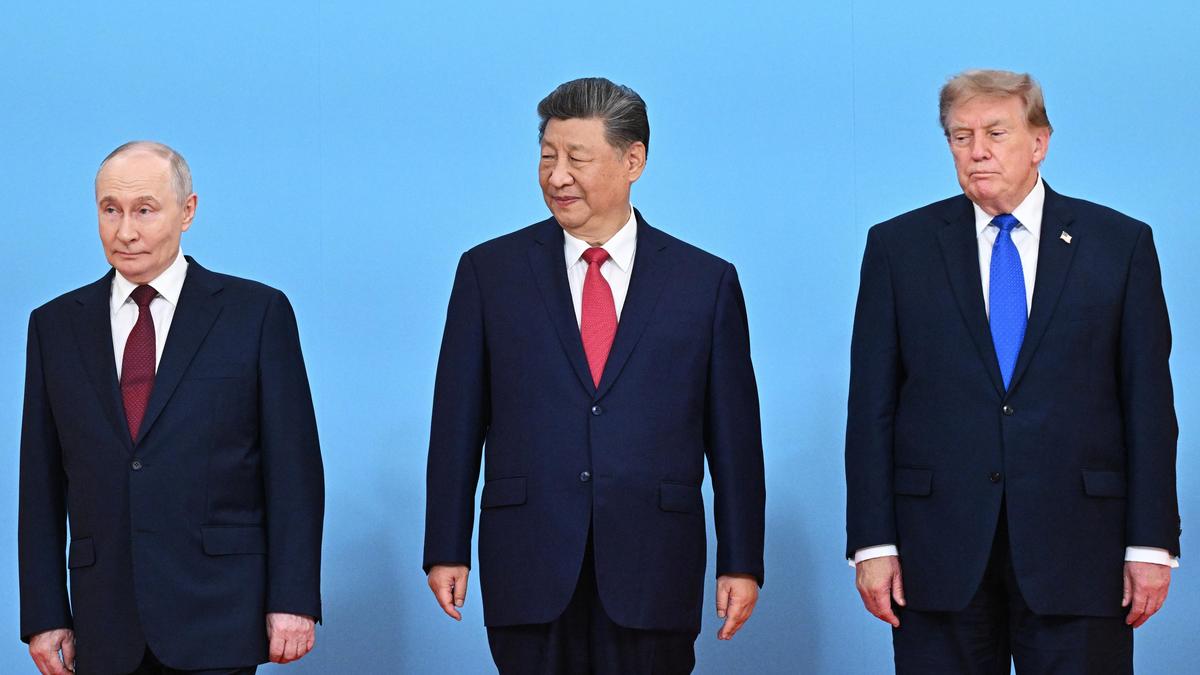
According to the supplied reports, Xi Jinping, Donald Trump and Vladimir Putin met in Shenzhen to launch a nuclear-risk dialogue, without substantive settlements on Ukraine or Iran.
Image: The Hindu
Why in news
The first formal U.S.–China–Russia leaders' trilateral issued a declaration on peace, nuclear risk reduction and energy supplies. Its emphasis on respecting major powers' red lines has prompted debate over spheres of influence and the future of inclusive multilateralism.
3
Countries in the leaders' trilateral
Background
The United States, China and Russia are nuclear-weapon states recognised under the Nuclear Non-Proliferation Treaty and permanent members of the UN Security Council. Their cooperation can reduce security risks, but the UN Charter rests on the sovereign equality of all member states, not exclusive management by major powers. The Shenzhen meeting took place alongside the broader Asia-Pacific Economic Cooperation gathering; APEC is an economic cooperation forum, not a collective-security institution. India's relevant foreign-policy framework is strategic autonomy: preserving independent judgement while cooperating with different partners according to national interests.
What was agreed, and what remains unproven
The China-Russia-U.S. Heads of State Declaration toward Peace committed the countries to launch a dialogue on reducing nuclear risks and reaffirmed that a nuclear war cannot be won and must never be fought. It also expressed an intention to increase the production and supply of refined petroleum products.
These are political commitments, not evidence of an operational arms-control arrangement or an assured increase in fuel availability. The reports identify no agreed nuclear reductions, verification framework or substantive settlement concerning Ukraine or Iran. Putin also said that regular meetings in this trilateral format had not been agreed.
- The diplomatic breakthrough was direct engagement among the leaders, rather than a negotiated resolution of ongoing conflicts.
- The declaration's criticism of potential jurisdictional abuse by the International Criminal Court reflected a shared political position, not a change in international law.
- Implementation must be assessed through subsequent negotiations and observable measures, rather than summit symbolism.
Infographic
Strategic stability
Nuclear-risk dialogue offers a channel to reduce miscalculation.
Implementation gap
Broad commitments are not verified arms cuts or conflict settlements.
Sovereign equality
Red-line diplomacy must not become exclusive spheres of influence.
Multilateral legitimacy
Great-power talks should support institutions and include affected states.
India's autonomy
Combine independent partnerships with stronger domestic capabilities.
AI-assisted infographic by Pragnya IAS Academy, based on the cited sources.
Strategic stability: opening a channel without ending rivalry
Strategic stability concerns reducing incentives for a nuclear first strike and avoiding destabilising arms competition. Direct communication can help clarify intentions, prevent miscalculation and contain escalation, even when underlying political disputes persist. Nuclear risk reduction is therefore valuable independently of immediate disarmament.
However, nuclear risk reduction and nuclear disarmament are not interchangeable. The former seeks to reduce the likelihood of nuclear use; the latter concerns reducing and ultimately eliminating nuclear weapons. The sources describe China's longstanding position that the United States and Russia should first reduce their larger arsenals, indicating the difficulty of negotiating reciprocal obligations across unequal capabilities.
Technology competition also remains unresolved. Reported disputes over semiconductors, access to advanced AI chips and rare earths show that diplomatic engagement can coexist with economic-security restrictions. Strategic stability will require sustained institutional communication, not reliance solely on personal rapport among leaders.
- Possible follow-up measures include crisis hotlines, incident-prevention arrangements and clearer communication of nuclear doctrines.
- Any future arms-reduction agreement would require agreed definitions, verification and procedures for addressing non-compliance.
- The reported call to keep AI under human control should not be treated as an agreed trilateral military-AI framework.
Spheres of influence versus a rules-based international order
Xi's call to respect sovereignty and territorial integrity is consistent with core principles of the UN Charter. His accompanying emphasis on not challenging each other's red lines is more ambiguous: clarification of security concerns can reduce conflict, but acceptance of exclusive regional privileges could restrict the choices of smaller states.
Comparisons with the Yalta Conference reflect concern about major powers negotiating the future of other countries without their participation. They remain an analogy, not evidence that Shenzhen produced a territorial bargain or a new division of the world. Ukraine's participation and consent would be essential to a legitimate settlement concerning its territory and security.
The summit also reveals tension between sovereignty and international criminal accountability. The declaration stressed state consent and officials' immunities, but ICC jurisdiction is governed by the Rome Statute and applicable international law. Non-party status does not automatically exclude jurisdiction: relevant routes can include conduct on a state party's territory, acceptance of jurisdiction or a UN Security Council referral. Official capacity does not itself bar responsibility under the Rome Statute, while cooperation and immunity questions require careful legal analysis.
- Permanent membership of the Security Council does not authorise a trilateral grouping to decide other states' political futures.
- Great-power consultations can complement multilateral institutions when they facilitate lawful, inclusive decisions.
- Multipolarity does not necessarily imply democratisation of global governance; several dominant powers can still exclude smaller states.
India's strategic autonomy: support de-escalation, resist exclusion
India has an interest in reduced nuclear danger, stable energy supplies and less disruptive great-power competition. However, any understanding that privileges exclusive spheres of influence could narrow India's choices in its neighbourhood and the Indo-Pacific. The key distinction is between supporting dialogue and endorsing decisions taken over the heads of affected countries.
The reports place Trump's Quad engagement with India, Australia and Japan immediately before his visit to China. This illustrates that competitive partnerships and direct engagement with rivals can coexist. India should therefore avoid treating either Quad cooperation or U.S.–China dialogue as an automatic guarantee of how Washington will respond to every regional contingency.
Strategic autonomy requires capabilities as well as diplomatic flexibility. Diversified defence and energy partnerships, stronger domestic technological capacity and engagement with multiple institutions can reduce vulnerability to abrupt great-power bargains. India should combine issue-based cooperation with consistent support for sovereignty, peaceful dispute settlement and representative global governance.
- Maintain independent engagement with Washington, Moscow and Beijing without assuming that their interests will remain permanently aligned or opposed.
- Work with other affected states to prevent Indo-Pacific arrangements from becoming exclusive major-power bargains.
- Use the UN, G20, BRICS and other relevant platforms to advance inclusive consultation and institutional reform.
| Issue | Reported position | What cannot yet be inferred |
|---|---|---|
| Nuclear risks | Agreement to launch a dialogue and rejection of nuclear war | A verified arms-reduction agreement or agreed arsenal cuts |
| Regional conflicts | Expressions of shared interest in conflict resolution | A substantive Ukraine or Iran settlement |
| Energy security | Intention to increase refined petroleum production and supply | Specified additional supplies, implementation schedules or lower prices |
| International criminal justice | Emphasis on state consent, official immunities and avoiding jurisdictional abuse | An amendment to the Rome Statute or automatic exclusion of ICC jurisdiction |
| Trilateral diplomacy | A leaders' meeting and joint declaration | An agreed permanent forum or schedule of regular summits |
- 1. Convert the political declaration into an agreed negotiating agenda.
- 2. Establish sustained official and technical communication channels.
- 3. Negotiate crisis-management and incident-prevention measures.
- 4. Define verification and compliance arrangements for any arms-control commitments.
- 5. Review implementation and consult affected states on regional security questions.
1945
The Yalta Conference became a historical reference point for great-power bargaining over the post-war order; its comparison with Shenzhen remains interpretative.
2022
Russia's invasion of Ukraine intensified confrontation with Western countries and triggered sanctions.
November 17, 2026
According to the supplied reports, Trump met the Quad leaders in the Philippines before travelling to China.
November 18, 2026
Xi, Trump and Putin exchanged greetings at the APEC welcome gathering in Shenzhen.
November 19, 2026
The leaders held their formal trilateral and issued a declaration including a commitment to nuclear-risk dialogue.
Significance, challenges & way forward
Significance
- Direct engagement creates an opportunity to reduce miscalculation among major nuclear powers.
- The summit demonstrates that strategic competition does not rule out selective cooperation.
- Energy cooperation could benefit importing economies if political commitments translate into reliable supplies.
- The meeting highlights the difference between a multipolar distribution of power and genuinely inclusive global governance.
- For India, reduced confrontation offers diplomatic space, while exclusive great-power bargaining creates risks of marginalisation.
Challenges
- Broad declarations lack credibility unless followed by institutions, agreed measures and implementation.
- Differences in nuclear capabilities and negotiating priorities complicate reciprocal arms-control commitments.
- Undefined red lines can become claims to exclusive influence rather than instruments of mutual restraint.
- Settlements negotiated without affected countries may lack legitimacy and durability.
- Trade restrictions and technology rivalry can undermine confidence generated by political dialogue.
- Selective treatment of sovereignty and accountability can weaken trust in international institutions.
Way forward
- Translate the nuclear-risk dialogue into sustained working-level negotiations and practical crisis-management measures.
- Ensure that any regional settlement involves the affected states and respects the UN Charter.
- Use limited-group diplomacy to support, rather than displace, legitimate multilateral institutions.
- Assess ICC-related claims through the Rome Statute and applicable international law rather than political declarations alone.
- India should diversify critical supply chains, strengthen domestic capabilities and preserve independent decision-making.
- India should build issue-based coalitions for representative global governance without abandoning engagement with major powers.
Key terms
- Strategic stability
- A condition in which states have reduced incentives for nuclear first use or destabilising arms competition.
- Nuclear risk reduction
- Measures intended to lower the likelihood of nuclear use through miscalculation, accident, unauthorised action or escalation.
- Sphere of influence
- A region in which a major power seeks privileged influence, potentially limiting other states' independent choices.
- Strategic autonomy
- The ability to take foreign-policy and security decisions independently according to national interests.
- Minilateralism
- Cooperation among a limited group of states to address selected issues.
- Multipolarity
- A distribution of international power among several major centres rather than a single dominant power.
- Thucydides Trap
- An analytical idea that rivalry between an established power and a rising power can generate conflict, not an inevitable historical law.
- Complementarity
- The principle that the ICC complements national criminal jurisdictions, subject to the Rome Statute's admissibility conditions.
Link with static syllabus
Prelims practice MCQs
Q1. With reference to the reported Shenzhen trilateral summit, consider the following statements: 1. The leaders agreed to launch a dialogue on reducing nuclear risks. 2. The declaration established verified numerical limits on nuclear arsenals. 3. The leaders agreed to hold regular summits in the same format. Which of the statements given above is/are correct?
Q2. Consider the following statements about international institutions: 1. China, Russia and the United States are permanent members of the UN Security Council. 2. APEC is a collective-security alliance. 3. The International Criminal Court was established under the Rome Statute. Which of the statements given above are correct?
Q3. With reference to the International Criminal Court, consider the following statements: 1. A person's nationality in a non-party state always excludes ICC jurisdiction. 2. Conduct on the territory of a state party may provide a basis for ICC jurisdiction, subject to applicable requirements. 3. A UN Security Council referral is a recognised route for triggering ICC jurisdiction. Which of the statements given above are correct?
Q4. Which of the following best describes strategic autonomy in India's foreign policy?
Mains practice questions
GS 2 · 15 marks · 250 words
Great-power dialogue can strengthen strategic stability while weakening inclusive multilateralism. Discuss in the context of the Shenzhen trilateral summit and examine the implications for India's strategic autonomy.
Frequently asked questions
Did the Shenzhen summit produce a nuclear disarmament agreement?
No such agreement is established by the supplied reports. The leaders agreed to launch nuclear-risk dialogue and reaffirmed their opposition to nuclear war, without reported verified arsenal reductions.
Why is the summit being compared with Yalta?
The comparison reflects fears that major powers could bargain over other countries' security and political futures. It does not establish that Shenzhen produced a territorial division or an agreed system of spheres of influence.
What does the summit mean for India's strategic autonomy?
It offers potential benefits from de-escalation but also raises the risk of decisions that exclude India and other affected states. India should preserve independent partnerships while strengthening its economic, technological and security capabilities.
Can the declaration restrict the ICC's jurisdiction?
The declaration does not itself amend the Rome Statute or determine ICC jurisdiction. Jurisdiction and immunity questions must be assessed under the applicable legal framework.
Sources
- The Hindu: U.S., China, Russia hold historic summit in Shenzhen
- The Hindu: Xi-Trump-Putin trilateral meeting highlights: Xi-Trump-Putin summit in China ends; major powers must not touch each other's bottom lines on sensitive issues, says Xi
- The Hindu: Xi, Trump, Putin exchange greetings before historic China summit
- The Hindu: Xi-Putin-Trump trilateral: Why is it being compared to 1945 Yalta Conference?
Analysis prepared by the Pragnya IAS Academy current-affairs desk with AI assistance from the cited reports. Verify figures with the original sources.
Turn current affairs into marks
Join Pragnya IAS Academy's mentorship for daily answer-writing evaluation on stories like this — classroom programmes from a trusted name in IAS coaching in Hyderabad.