
Supreme Court’s Food Warning Label Ruling: FSSAI, Nutrition and Corporate Accountability
Revise the static topic: UPSC Social Justice notes · UPSC Science & Technology notes
In short: The Supreme Court has directed FSSAI to implement front-of-package nutrition warnings within four months, replacing the earlier star-rating approach with separate warnings for high sugar, saturated fat and salt. The ruling prioritises accessible consumer information, science-based thresholds and regulatory accountability in addressing unhealthy diets and non-communicable diseases.
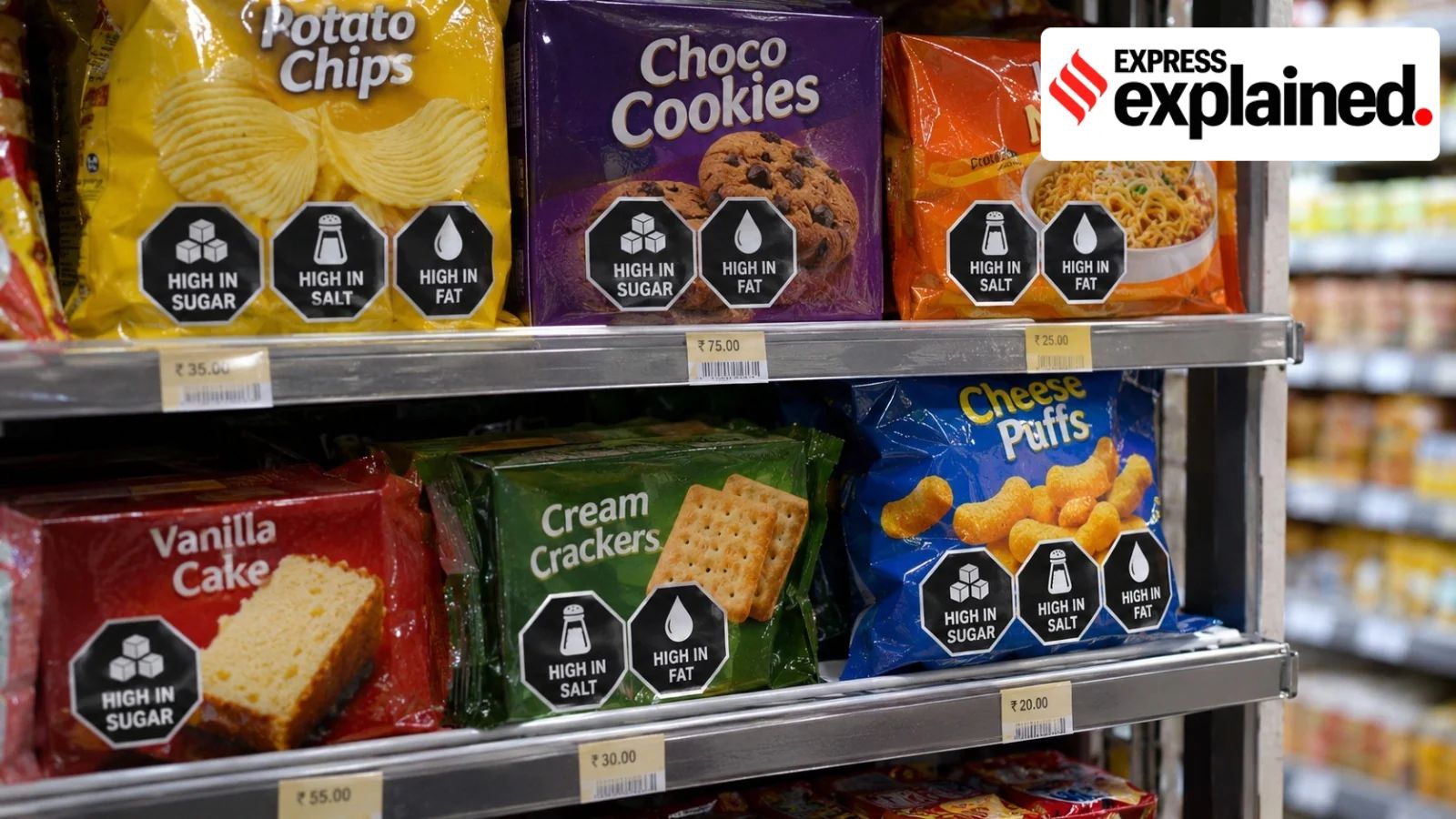
Reference illustration of separate nutrient-warning symbols for food packaging. Distinct warnings can help consumers identify products high in sugar, saturated fat or salt without relying on an overall star rating.
Image: Indian Express
Why in news
On November 26, 2026, the Supreme Court prescribed the design and implementation requirements for front-of-package nutrition labelling. It asked FSSAI to adhere to its stated four-month regulatory timeline and prevent misuse of the transition period.
4 months
Timeline for regulations
3
Nutrients of concern
2022
Earlier star-rating draft
Background
The Food Safety and Standards Authority of India is a statutory body established under the Food Safety and Standards Act, 2006, and functions under the Union Ministry of Health and Family Welfare. It lays down science-based food standards and regulates food safety, including labelling requirements. Front-of-package nutrition labelling places easily interpretable nutritional information on the principal display panel, unlike detailed nutrient declarations that require consumers to interpret quantities. Its public-health rationale is to reduce information asymmetry and help consumers identify foods high in nutrients associated with diet-related health risks.
What the Supreme Court has directed
The ruling moves away from an overall nutritional star rating towards nutrient-specific warning labels. Each applicable warning must appear in a separate hexagon, accompanied by a standardised pictorial representation and the words “High Fat”, “High Sugar” or “High Salt”.
Thresholds must assess total sugars and saturated fat, rather than added sugars and added fat, alongside salt. Importantly, the prescribed “High Fat” wording does not mean that total fat replaces saturated fat as the relevant threshold parameter.
FSSAI must determine conspicuous text size and make the hexagons proportional to the package’s display panel. The source reports a minimum panel-share reference of “4% or 5%”; the precise operational specification must be made unambiguous in the regulations.
- Products may carry separate warnings for each nutrient that crosses the applicable threshold.
- Beverages without high sugar must not carry category labels identical or deceptively similar to high-sugar warnings.
- FSSAI must publish an exhaustive and reasoned list of exempt solid and liquid foods.
- The regulator must address any use of preservatives or additives that defeats the objectives of the warnings.
Infographic
Clear disclosure
Separate hexagons, warning text and standardised pictures.
Scientific thresholds
Assess total sugars, saturated fat and salt.
Time-bound regulation
Adhere to the stated four-month regulatory timeline.
Business accountability
Verify composition and prevent transition misuse.
Wider prevention
Combine labels with healthier food access and nutrition education.
AI-assisted infographic by Pragnya IAS Academy, based on the cited sources.
Why warning design and nutrient thresholds matter
A star rating summarises overall nutritional value, whereas a warning identifies a specific nutrient-related concern. Public-health advocates opposed the earlier proposal because even a low star rating could be interpreted as a positive endorsement. Separate warnings avoid presenting an overall score as a substitute for disclosing individual nutrient risks.
Pictorial representations can improve accessibility across literacy, education and age groups. However, their effectiveness should be tested with consumers: a symbol is useful only if people notice and correctly understand it.
Threshold calibration is the decisive technical issue. Excessively permissive thresholds leave risky products unlabelled; excessively stringent thresholds can place warnings on almost everything, creating label fatigue. The court therefore required reformulation of thresholds using scientific evidence.
- Total-sugar assessment reduces dependence on distinguishing naturally occurring sugars from sugars added during manufacture.
- The source identifies fruit juice concentrate and fruit pulp as potential routes for avoiding an added-sugar-based warning.
- The judgment does not itself supply final numerical nutrient cut-offs.
- References by health advocates to Chile, Mexico and WHO are inputs for consideration, not evidence that their thresholds have already been adopted.
Constitutional basis and regulatory responsibility
The right to health has been recognised within the judicial interpretation of Article 21. Article 47, a Directive Principle of State Policy, places improvement of nutrition and public health among the State’s primary duties. Together, these provide a constitutional foundation for preventive health regulation, although Article 47 is not independently enforceable like a Fundamental Right.
The court characterised interpretive nutrition labelling as a reasonable measure to realise fundamental and statutory rights in the context of non-communicable diseases. Mandatory warnings address an information imbalance: manufacturers know product composition, while consumers may lack the time or expertise to interpret detailed nutrition panels.
The judicial direction does not eliminate FSSAI’s technical role. The regulator must still specify thresholds, exemptions and implementation details, while ensuring that stakeholder consultation does not become indefinite regulatory delay.
- Public-health objectives should guide regulatory decisions rather than depend on unanimous industry agreement.
- Transparent scientific reasoning can strengthen both regulatory legitimacy and legal defensibility.
- Implementation requires coordination between FSSAI and State food-safety authorities.
Corporate accountability and the implementation test
Mandatory warnings can create incentives for manufacturers to reduce excessive sugar, saturated fat and salt. However, reformulation must improve nutritional quality rather than merely manipulate thresholds, exemptions or consumer perceptions.
FSSAI had indicated that it needed at least four months to bring the regulations into force, and the court required adherence to that timeline. This should not be confused with a separately specified universal deadline for exhausting existing stocks: the supplied report does not provide such a transition deadline.
The court also required monitoring of food business operators during transition. Petitioners had warned that businesses could flood the market with unlabelled products before implementation. Corporate accountability therefore extends from compliant label design to verifiable composition, production records and responsible transition practices.
- Audits should check whether declared nutrient content corresponds to tested composition.
- Exemptions should be narrow, reasoned and resistant to product reclassification.
- Technical support for smaller enterprises can reduce compliance difficulties without making warnings voluntary.
- Labels should complement healthier food availability, nutrition education and broader NCD prevention.
| Issue | Earlier proposal or approach | Court-directed approach |
|---|---|---|
| Core format | Overall nutritional star rating in the 2022 draft | Separate nutrient-specific warnings |
| Multiple nutrient risks | A single hexagon carrying multiple warnings | A separate hexagon for each applicable warning |
| Sugar assessment | Added sugars | Total sugars |
| Fat assessment | Added fat | Saturated fat |
| Accessibility | Concern that written warnings alone would exclude some consumers | Standardised pictorial representation alongside warning text |
| Beverage categories | Category-identification hexagons | No identical or deceptively similar category labels for beverages without high sugar |
- 1. FSSAI specifies scientific thresholds, label requirements and reasoned exemptions.
- 2. A packaged product is assessed for coverage under the regulations.
- 3. Its total sugars, saturated fat and salt are compared with the applicable thresholds.
- 4. Each threshold breach triggers a separate hexagonal warning with text and a standardised picture.
- 5. Food-safety authorities verify composition and labelling compliance.
- 6. Consumer comprehension and compliance evidence inform regulatory review.
2022
FSSAI proposed a nutritional star-rating system through a draft notification.
Subsequent consultations
Consumer groups and public-health experts supported warnings, while food businesses largely argued for voluntary labelling.
November 26, 2026
The Supreme Court directed separate nutrient warnings, revised scientific thresholds and safeguards against transition misuse.
Within the stated four-month timeline
FSSAI is required to bring the warning-label regulations into force; detailed transition arrangements must be distinguished from this regulatory timeline.
Significance, challenges & way forward
Significance
- Nutrient-specific warnings make potentially harmful product characteristics more visible at the point of purchase.
- Pictorial communication can make nutrition information more accessible to consumers with differing literacy levels.
- Mandatory disclosure can encourage healthier product reformulation and strengthen manufacturer accountability.
- The ruling links consumer information with preventive healthcare rather than treating diet-related disease solely as a matter of individual choice.
- A time-bound regulatory obligation can reduce delays caused by prolonged stakeholder disagreement.
Challenges
- Weak thresholds could leave high-risk products without warnings, while overly broad thresholds could cause label fatigue.
- Inadequate laboratory capacity and uneven enforcement could create a gap between declared and actual nutrient content.
- Poorly defined exemptions could enable avoidance through product reclassification.
- Advance production of unlabelled stocks could undermine implementation during transition.
- Warning labels cannot by themselves overcome the price, availability and marketing advantages of unhealthy foods.
- Reformulation focused only on avoiding labels may not necessarily improve overall dietary quality.
Way forward
- Publish the scientific rationale for thresholds and assess relevant international experience against Indian consumption patterns.
- Test warning visibility and comprehension across languages, age groups and literacy levels before finalising operational specifications.
- Clarify label dimensions, exemptions and transition rules in enforceable regulations.
- Require auditable production and packaging records to detect misuse of the transition period.
- Strengthen risk-based inspections, nutrient testing and proportionate action against non-compliance.
- Provide compliance guidance to smaller enterprises while maintaining uniform public-health requirements.
- Integrate warning labels with nutrition education, healthier public food procurement and wider NCD-prevention measures.
Key terms
- Front-of-package nutrition labelling
- Prominent nutrition information on the front of a food package to support quick consumer understanding.
- Interpretive warning label
- A label that translates nutrient content into an immediately understandable signal, such as “High Sugar”.
- Nutrient threshold
- The specified nutrient-content cut-off beyond which a product must carry an applicable warning.
- Total sugars
- All sugars present in a food, including naturally occurring and added sugars.
- Saturated fat
- A category of dietary fat whose fatty acids contain no carbon-to-carbon double bonds.
- HFSS foods
- Foods high in fat, sugar or salt under the relevant assessment criteria.
- Food business operator
- The person responsible for ensuring compliance with food law within a food business.
- Label fatigue
- Reduced attention or responsiveness when warnings become excessively common or repetitive.
Link with static syllabus
Prelims practice MCQs
Q1. With reference to the reported Supreme Court directions on food warning labels, consider the following statements: 1. Total sugars, rather than only added sugars, must inform the sugar-warning threshold. 2. A single hexagon must combine all applicable nutrient warnings. 3. Saturated fat is the relevant fat parameter for determining thresholds. Which of the statements given above are correct?
Q2. Consider the following statements regarding the Food Safety and Standards Authority of India: 1. It is a statutory body established under the Food Safety and Standards Act, 2006. 2. It functions under the Union Ministry of Health and Family Welfare. 3. It is a constitutional body established under Article 47. Which of the statements given above are correct?
Q3. Which of the following best explains the importance of calibrating nutrient thresholds for front-of-package warnings?
Q4. With reference to the constitutional basis of public-health regulation, consider the following statements: 1. The right to health has been recognised within the interpretation of Article 21. 2. Article 47 places improvement of nutrition and public health among the State’s primary duties. 3. Article 47 is independently enforceable in the same manner as a Fundamental Right. Which of the statements given above are correct?
Mains practice questions
GS 2 · 15 marks · 250 words
Mandatory front-of-package nutrition warnings can strengthen public health only when supported by scientific regulation and corporate accountability. Discuss in the context of the Supreme Court’s directions to FSSAI.
Frequently asked questions
What will the new front-of-package warnings show?
Each applicable nutrient warning must appear in a separate hexagon with a standardised picture and the words “High Fat”, “High Sugar” or “High Salt”. Threshold assessment must use saturated fat, total sugars and salt.
Has the Supreme Court fixed the final nutrient cut-offs?
No final numerical nutrient cut-offs are provided in the supplied report. The court directed FSSAI to revisit and reformulate thresholds using scientific evidence.
What does the four-month deadline cover?
It concerns bringing the regulations into force within FSSAI’s stated timeline. The supplied report does not specify a separate universal deadline for exhausting existing stocks, but requires safeguards against transition misuse.
Will every packaged food necessarily carry a warning?
No. Warnings depend on applicable nutrient thresholds and regulatory coverage; FSSAI must also publish a clear, reasoned list of exempt foods.
Sources
- Indian Express: Salt, sugar and fat warnings on food packets: What changes after the Supreme Court ruling?
- Times of India: Supreme Court raps MNCs for ‘double standard’ on food quality
- Times of India: Supreme Court sets timer for FSSAI, companies to implement warning labels
Analysis prepared by the Pragnya IAS Academy current-affairs desk with AI assistance from the cited reports. Verify figures with the original sources.
Turn current affairs into marks
Join Pragnya IAS Academy's mentorship for daily answer-writing evaluation on stories like this — classroom programmes from a trusted name in IAS coaching in Hyderabad.