
Bengal Electoral-Roll Revision: Voting Rights, Pending Cases and Appeal Safeguards
Revise the static topic: UPSC Polity notes · UPSC Governance notes
In short: An Indian Express report describes West Bengal voters whose eligibility remains “under adjudication” after electoral-roll revision, leaving them reportedly unable to vote or access the tribunal appeal route available against deletion. The issue exposes a procedural gap: accurate rolls require verification, but unresolved cases and inaccessible remedies can effectively exclude eligible citizens without a final decision.
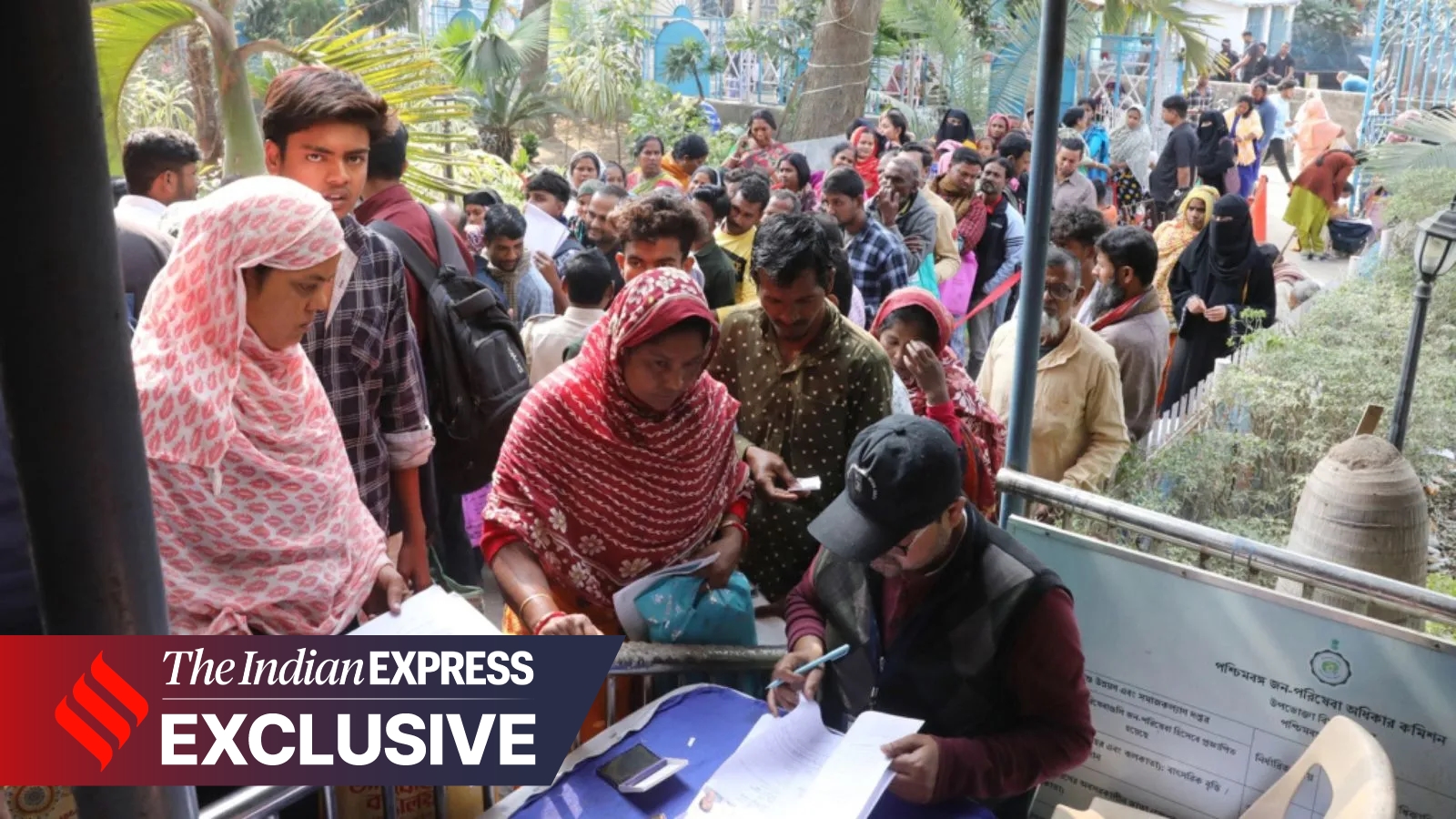
The Indian Express report on West Bengal voters whose eligibility remains under adjudication after electoral-roll revision, reportedly leaving them unable to vote or use the tribunal appeal route available against deletion.
Image: Indian Express
Why in news
The report highlights unresolved cases despite hearings and an administrative direction to complete pending decisions and electronic signatures. It also records a substantial backlog before the appellate tribunals established following Supreme Court directions.
Over 25,000
Estimated pending cases; official total uncertain
Around 60 lakh
Voters flagged for logical discrepancies
Around 27 lakh
Voters deleted after adjudication
17
Appellate tribunals
38.31 lakh
Appeals filed, as reported on September 18
1.26 lakh
Appeals disposed of by September 18
Background
Electoral rolls identify persons entitled to vote in a constituency. Article 324 places the superintendence, direction and control of electoral-roll preparation and election conduct with the Election Commission of India. Article 325 provides for one general electoral roll for every territorial constituency and prohibits exclusion on grounds only of religion, race, caste or sex; Article 326 establishes adult suffrage for elections to the Lok Sabha and State Legislative Assemblies, subject to constitutional and statutory qualifications. The Representation of the People Act, 1950 governs electoral-roll preparation and registration, while the Representation of the People Act, 1951 governs election conduct and the statutory exercise of voting rights. Roll accuracy and protection against wrongful exclusion are therefore complementary obligations.
What the report establishes
The report identifies a group whose cases remain “under adjudication”, distinct from voters whose deletion has been decided and can be challenged before the tribunals. Affected residents describe attending hearings and submitting documents but receiving no completed decision.
Sources cited by the newspaper estimate that over 25,000 people are affected across Murshidabad, Malda, Nadia and Howrah. Election officials acknowledged uncertainty about the total; the estimate should not be treated as a verified statewide count.
Officials attributed the problem to cases not properly disposed of by judicial officers. According to the report, court orders restrict administrative intervention, and the Chief Electoral Officer’s office has informed the Calcutta High Court and the Election Commission.
- The October 29 communication sought reactivation of judicial officers’ login IDs for cases with pending decisions or electronic signatures.
- Individual testimonies establish reported hardship, but they do not independently establish every affected person’s legal eligibility.
- Political allegations of targeted exclusion remain allegations; the report does not establish discriminatory intent.
Infographic
Accurate verification
Treat discrepancies as questions, not verdicts.
Fair hearing
Explain the issue and enable a meaningful response.
Completed decision
Authenticate and communicate a reasoned order.
Accessible remedy
Address both adverse orders and non-disposal.
Timely accountability
Track pendency, outcomes and implementation.
AI-assisted infographic by Pragnya IAS Academy, based on the cited sources.
The procedural trap: no decision, no effective appeal
A person whose eligibility has been rejected can ordinarily challenge an identifiable adverse order. A person awaiting a decision may lack the very order needed to activate that appeal route. Administrative delay can consequently produce the practical effects of exclusion without a final determination.
The reported problem has two layers: unfinished initial adjudication and delayed appellate adjudication. Faster tribunal hearings alone cannot resolve cases that have not reached the tribunal stage.
The statement that affected voters “cannot appeal” should be understood in relation to the reported tribunal route, not as proof that every legal remedy is unavailable. Constitutional judicial review may remain available, but litigation costs make it an inadequate substitute for an accessible routine remedy.
- Decision-making must end in an authenticated, reasoned order that is communicated to the person concerned.
- A case-status label should clearly distinguish a pending hearing, a pending decision, an unsigned order and a completed disposal.
- A grievance route for prolonged non-disposal is as important as an appeal against a final adverse order.
Constitutional and statutory safeguards
Article 14 requires non-arbitrary state action, while Articles 325 and 326 provide the constitutional framework for electoral inclusion and adult suffrage. The exercise of voting rights is regulated by statute; constitutional democracy nevertheless requires the registration process to be fair and accessible.
Under the Representation of the People Act, 1950, Section 19 addresses registration eligibility, Section 22 concerns correction and deletion of entries, Section 23 concerns inclusion, and Section 24 provides the ordinary statutory appeal framework. Section 22 requires proper verification and, for specified adverse action, a reasonable opportunity of being heard. The court-directed tribunal arrangement reported in Bengal must be distinguished from this ordinary statutory framework.
Natural justice requires a meaningful opportunity to respond to the proposed adverse action. A hearing is incomplete as a safeguard if it is not followed by a decision, communication and an effective means of challenge.
- A discrepancy flag is a reason for verification, not by itself a legal finding of ineligibility.
- Officials must comply with judicial directions; resolving institutional deadlock may require clarification from the supervising court.
- Pending status neither automatically proves eligibility nor justifies indefinite procedural uncertainty.
Balancing electoral integrity with inclusion
Removing deceased, duplicate and otherwise ineligible entries protects electoral integrity. However, a system that prioritises deletion or disposal volumes without measuring erroneous exclusion can undermine the same legitimacy it seeks to strengthen.
The tribunal backlog also requires careful interpretation. Of the appeals reported to the Supreme Court, 22.21 lakh were filed by deleted voters and 16.10 lakh were objections against inclusion. The overall appeal figure is therefore not a count solely of excluded voters.
Reported concentration in minority-dominated areas warrants scrutiny of unequal burdens, access to assistance and consistency of verification. Aggregate geography alone cannot establish intentional discrimination.
- Evaluate revision through both accuracy and accessibility, rather than treating them as competing goals.
- Publish anonymised information on pending cases, reasons for delay and outcomes without exposing personal documents.
- Measure whether remedies arrive in time to be meaningful for electoral participation.
| Case status | Central concern | Appropriate safeguard |
|---|---|---|
| Flagged for verification | An administrative discrepancy may be mistaken for proven ineligibility. | Explain the issue, verify records and provide a meaningful hearing. |
| Under adjudication | No completed decision may mean no effective tribunal appeal. | Provide time-bound disposal and a route to escalate non-disposal. |
| Decision or electronic signature pending | A technical or completion-stage failure may prolong uncertainty. | Identify the authorised officer and complete authentication under court directions. |
| Deletion ordered | An eligible voter may be wrongly excluded. | Communicate reasons and provide an accessible appeal. |
| Appeal pending | Delay may make an eventual remedy electorally ineffective. | Strengthen adjudicatory capacity and track timely implementation. |
- 1. Identify a discrepancy without presuming ineligibility.
- 2. Communicate the issue and provide accessible verification assistance.
- 3. Give the affected person a meaningful opportunity to respond.
- 4. Issue, authenticate and communicate a reasoned decision.
- 5. Enable appeal against adverse orders and escalation of prolonged non-disposal.
- 6. Implement the final outcome and confirm the updated roll status.
October 27, 2025
The SIR began with 7.66 crore voters, according to the report.
December 2025–January 2026
Affected residents reported hearings or unresolved cases dating from this period.
February 2026
The Supreme Court ordered judicial-officer adjudication of eligibility for voters flagged for logical discrepancies.
March 20, 2026
The Supreme Court ordered the establishment of appellate tribunals for deleted voters.
September 18, 2026
The Election Commission told the Supreme Court that 1.26 lakh of 38.31 lakh tribunal appeals had been disposed of.
October 29, 2026
The Additional Chief Electoral Officer sought reactivation of judicial officers’ login IDs for pending decisions and electronic signatures.
November 3, 2026
The October 29 letter required submission of the status of disposal by this date; the supplied report does not establish completion.
Significance, challenges & way forward
Significance
- Electoral legitimacy depends on excluding ineligible entries without excluding eligible citizens.
- An available appeal is meaningful only when citizens can identify the decision, reach the forum and obtain timely relief.
- The episode highlights how digital workflow failures can become barriers to democratic participation.
- Independent adjudication strengthens confidence only when institutional responsibility and case completion are clear.
Challenges
- The absence of a verified total of unresolved cases weakens planning and public accountability.
- Court-directed allocation of authority can leave administrative officials unable to remedy unfinished judicial decisions independently.
- Large appellate pendency risks making relief too late for the election concerned.
- Legal costs, travel and repeated documentation demands can disproportionately burden vulnerable citizens.
- Politicised allegations can obscure the distinction between verified procedural failures and unproven discriminatory intent.
Way forward
- Reconcile pending-case records across judicial officers, district election authorities and the Chief Electoral Officer’s office.
- Seek appropriate judicial directions assigning responsibility and fixing disposal schedules for unresolved cases.
- Separate technical completion failures from cases requiring substantive adjudication so that each receives the appropriate intervention.
- Communicate reasoned orders with clear information on the available appeal forum and filing process.
- Provide local help desks, accessible status tracking and legal assistance, including through legal services institutions for eligible applicants.
- Publish anonymised pendency and outcome data and audit exclusion errors alongside roll-cleaning results.
- Ensure that additional adjudicatory capacity improves both disposal speed and the quality of individual scrutiny.
Key terms
- Special Intensive Revision
- An intensive electoral-roll revision exercise intended to verify entries and update the roll.
- Under adjudication
- A status indicating that a case awaits completion of determination, rather than recording a final eligibility outcome.
- Logical discrepancy
- An inconsistency flagged in electoral records for further scrutiny; it is not itself proof of ineligibility.
- Natural justice
- Principles of fair decision-making, including an unbiased decision-maker and a meaningful opportunity to be heard.
- Reasoned order
- A decision explaining its factual and legal basis so that the affected person can understand and challenge it.
- Booth Level Officer
- A field-level functionary assisting electoral authorities with verification and updating of electoral rolls.
- De facto exclusion
- Practical denial of participation even without a formally completed exclusion decision.
Link with static syllabus
Prelims practice MCQs
Q1. With reference to the constitutional framework of elections, consider the following statements: 1. Article 324 covers the superintendence, direction and control of the preparation of electoral rolls. 2. Article 325 permits separate general electoral rolls on the ground of religion. 3. Article 326 provides for adult suffrage for elections to the Lok Sabha and State Legislative Assemblies. Which of the statements given above are correct?
Q2. Which of the following correctly describes the principal statutory framework governing electoral registration in India?
Q3. Consider the following statements concerning fairness in electoral-roll revision: 1. A discrepancy flag conclusively establishes that a voter is ineligible. 2. A hearing without a completed and communicated decision may leave access to an appeal ineffective. 3. Pending cases and cases decided by deletion require distinct procedural responses. Which of the statements given above are correct?
Q4. Consider the following pairs relating to the Representation of the People Act, 1950: 1. Section 19 — Conditions of registration 2. Section 22 — Correction of entries in electoral rolls 3. Section 24 — Appeals Which of the pairs given above are correctly matched?
Mains practice questions
GS 2 · 15 marks · 250 words
Electoral-roll accuracy and protection against wrongful exclusion are complementary democratic obligations. Discuss with reference to procedural fairness and access to remedies in electoral-roll revision.
Frequently asked questions
Why are voters marked “under adjudication” facing a special problem?
Their cases reportedly lack a completed decision, making the tribunal appeal route against deletion inaccessible. The problem is unfinished adjudication, not simply delay in hearing an already-filed appeal.
Does a logical discrepancy prove that a person is ineligible to vote?
No. It identifies an inconsistency requiring verification; eligibility must be determined through the applicable legal process.
Are all the reported tribunal appeals filed by deleted voters?
No. The reported total includes appeals by deleted voters and objections by others against inclusion.
Can administrative officials simply restore all pending names?
Not on that basis alone. Eligibility must be lawfully determined, and officials must comply with the court-directed allocation of authority reported in these cases.
Sources
- Indian Express: ‘Can’t appeal, can’t vote’: The forgotten voters of Bengal SIR
Analysis prepared by the Pragnya IAS Academy current-affairs desk with AI assistance from the cited reports. Verify figures with the original sources.
Turn current affairs into marks
Join Pragnya IAS Academy's mentorship for daily answer-writing evaluation on stories like this — classroom programmes from a trusted name in IAS coaching in Hyderabad.