
Colombo Security Conclave Roadmap: India’s Indian Ocean Security Strategy
Revise the static topic: UPSC Internal Security notes
In short: The Colombo Security Conclave adopted a Roadmap of Cooperation for 2026-2027 at its eighth National Security Advisor-level meeting hosted by the Maldives. Covering five pillars from maritime security to disaster relief, it seeks to strengthen regional capacities against shared threats and advance India’s neighbourhood-centred Indian Ocean strategy.
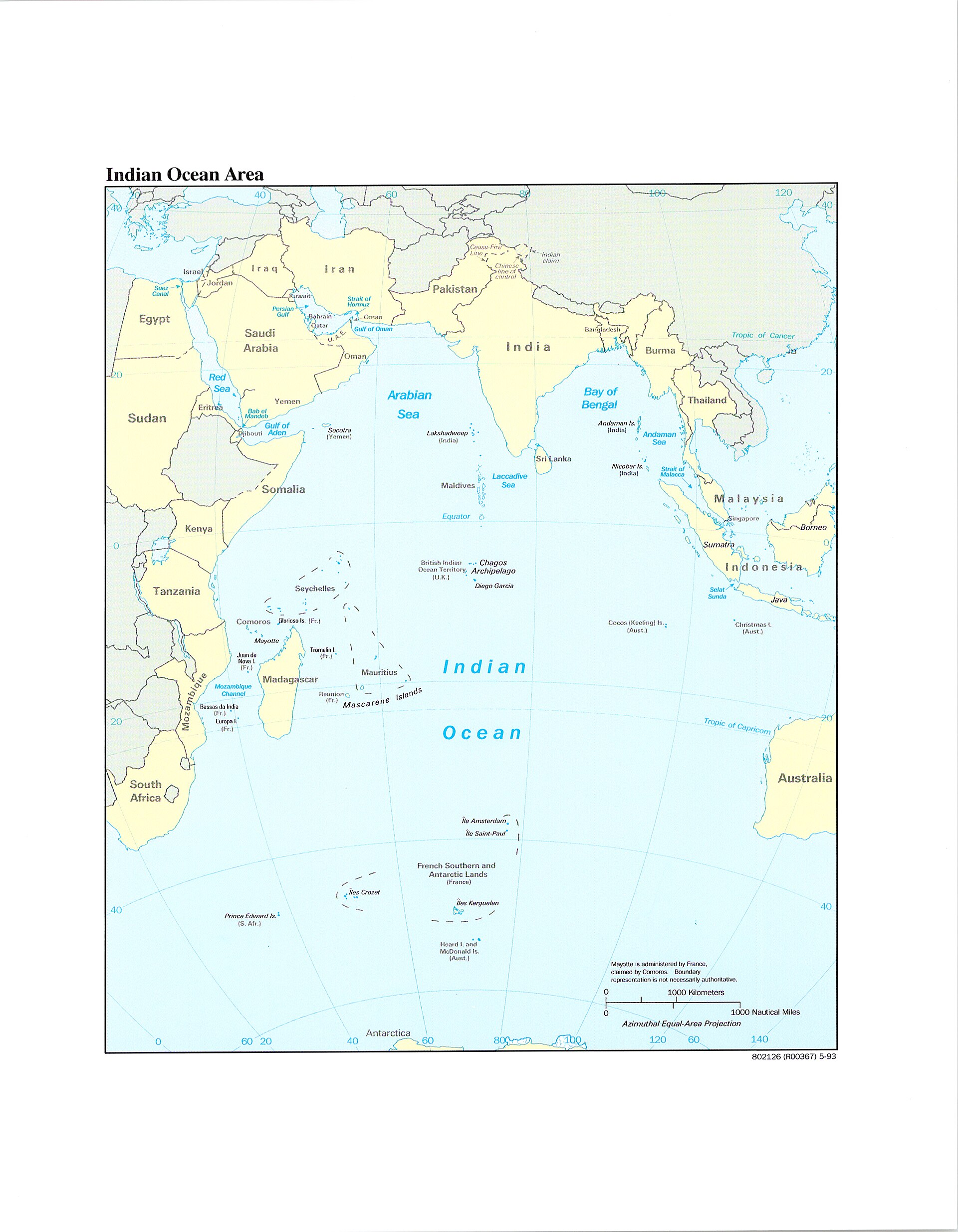
Reference map of the Indian Ocean region, showing India, Sri Lanka, the Maldives and surrounding island states and sea areas—the geographic setting for the Colombo Security Conclave’s regional security cooperation. Historical labels and boundaries may differ from current ones.
Image: Central Intelligence Agency · Public domain
Why in news
The Ministry of External Affairs announced the roadmap following deliberations in Male. India’s National Security Advisor Ajit Doval reaffirmed support for collective capacity-building and linked the Conclave to India’s Neighbourhood First policy and MAHASAGAR vision.
2026-2027
Cooperation roadmap period
8th
NSA-level meeting
5
Core cooperation pillars
23
IORA member states
Background
The Indian Ocean connects major trade routes, energy flows and coastal economies, making maritime stability central to India’s security and prosperity. Threats such as trafficking, terrorism, cyberattacks and disasters cross national jurisdictions and require cooperation among coastal and island states. The Colombo Security Conclave brings together India, the Maldives, Mauritius, Sri Lanka, Bangladesh and Seychelles. Its security-focused cooperation complements broader regional diplomacy through platforms such as the Indian Ocean Rim Association.
What the new roadmap establishes
The eighth NSA-level meeting adopted a Roadmap of Cooperation for 2026-2027 containing key deliverables and planned activities across the Conclave’s five core pillars. Participants emphasised training, sharing best practices and capacity-building as practical instruments of cooperation.
India, the Maldives, Sri Lanka and Bangladesh participated through high-level delegations, while Mauritius joined virtually. Australia and Malaysia participated as guest nations; guest participation should not be confused with membership.
The Conclave’s first Secretary-General, Vice Admiral (Retd.) S N Ghormade, reviewed implementation of decisions from the seventh NSA-level meeting held in New Delhi on November 20, 2025. The secretariat and Secretary-General provide an institutional basis for follow-up, but the supplied reports do not disclose the roadmap’s detailed targets, funding or operational protocols.
- The agreement prioritises sustained cooperation rather than isolated diplomatic engagement.
- A roadmap identifies a programme of work; its adoption alone does not demonstrate that planned activities have been implemented.
- The reported outcome does not establish an automatic mutual-defence obligation.
Infographic
Maritime safety
Strengthen safety and security in the shared maritime domain.
Counterterrorism
Cooperate against terrorism and radicalisation.
Transnational crime
Combat trafficking and organised criminal networks.
Cyber resilience
Protect cyberspace, critical infrastructure and technology.
Disaster relief
Strengthen humanitarian assistance and emergency preparedness.
AI-assisted infographic by Pragnya IAS Academy, based on the cited sources.
Why the five pillars must work together
Maritime threats do not operate in separate compartments. Trafficking networks can exploit weak coastal surveillance, criminal groups can use digital channels, and disruptions to ports or communications can affect both security and commerce. Cooperation therefore needs to connect maritime agencies, police, cyber authorities and disaster-management institutions.
The roadmap’s inclusion of humanitarian assistance and disaster relief broadens security beyond military concerns. Training and preparedness can help participating states protect lives and sustain essential services during emergencies.
- Maritime safety and security concern safe navigation, protection of maritime activity and responses to unlawful conduct at sea.
- Countering terrorism and radicalisation requires lawful information exchange and preventive cooperation.
- Combating trafficking and transnational organised crime requires coordination across investigative and border-control jurisdictions.
- Cyber security and protection of critical infrastructure and technology address vulnerabilities that can disrupt interconnected systems.
- Humanitarian assistance and disaster relief connect operational readiness with human security.
Significance for India’s Indian Ocean strategy
For India, the Conclave connects Neighbourhood First with MAHASAGAR, described by the Ministry of External Affairs as Mutual and Holistic Advancement for Security and Growth for All in the Region. The strategic opportunity is to make regional security cooperation responsive to partners’ priorities rather than exclusively to India’s threat perceptions.
The sources identify concern over China’s assertive behaviour in the Indo-Pacific and Indian Ocean. However, the reported roadmap centres on shared security challenges, not an explicitly anti-China mandate. Reducing the Conclave to strategic rivalry would overlook its practical value in policing, cyber resilience and disaster response.
The CSC and IORA offer complementary avenues. The CSC’s security-focused agenda can support practical cooperation, while IORA provides a broader regional setting for dialogue on stability and sustainable development. India’s IORA chairship for 2025-2027 creates an opportunity for coordination without assuming that the organisations have identical memberships or mandates.
- Reliable assistance can strengthen India’s credibility as a regional security partner.
- Shared preparedness can protect maritime commerce and coastal livelihoods.
- Respect for smaller states’ agency is essential to sustain trust and participation.
Legal safeguards and implementation tests
Maritime cooperation must operate within international law and national jurisdiction. The United Nations Convention on the Law of the Sea provides the general framework for maritime zones, navigation and coastal-state rights. Coastal states exercise sovereignty in their territorial sea, subject to applicable international law, but possess specified sovereign rights and jurisdiction rather than full territorial sovereignty in their exclusive economic zones.
Cooperation against terrorism, trafficking and cyber threats also requires domestic legal authority, safeguards for sensitive information and procedures for using evidence across jurisdictions. Political agreement cannot substitute for lawful arrest, investigation, prosecution or data-sharing arrangements.
The roadmap’s effectiveness should be assessed through implementation: useful training, interoperable procedures, timely assistance and stronger institutional capacity. A secretariat can support continuity, but delivery will depend on resources, national ownership and sustained political trust.
- Operational coordination should respect sovereignty and applicable consent requirements.
- Information-sharing arrangements need confidentiality, purpose limitation and accountability.
- Performance assessment should distinguish meetings held from capabilities actually improved.
| Dimension | Colombo Security Conclave | Indian Ocean Rim Association |
|---|---|---|
| Membership | India, Maldives, Mauritius, Sri Lanka, Bangladesh and Seychelles | 23 member states, as reported in the source |
| Principal orientation | Cooperation across five security and disaster-response pillars | Broader Indian Ocean regional cooperation, including sustainable development |
| Forum highlighted in the reports | Eighth NSA-level meeting hosted by the Maldives | Council of Ministers meeting to be hosted by India |
| Policy framework highlighted | Roadmap of Cooperation for 2026-2027 | India’s 2025-2027 chairship theme: Innovation, Openness, Resilience and Adaptability in the Indian Ocean Region |
| Potential complementarity | Security capacity-building and practical coordination | Wider regional dialogue and policy cooperation |
- 1. Identify shared threats and national capability gaps.
- 2. Translate roadmap priorities into nationally agreed work plans.
- 3. Develop lawful information-sharing and coordination procedures.
- 4. Conduct training, capacity-building and preparedness activities.
- 5. Review implementation through the Conclave’s institutions.
- 6. Use lessons from exercises and incidents to improve future cooperation.
November 2020
Doval’s address identified the formation of the Colombo Security Conclave with a collective vision for Indian Ocean safety, security and stability.
November 20, 2025
The seventh NSA-level meeting was held in New Delhi.
Eighth NSA-level meeting
The Maldives hosted deliberations, implementation of earlier decisions was reviewed, and members adopted the Roadmap of Cooperation for 2026-2027.
2026-2027
The adopted roadmap provides the programme period for planned cooperation across the five core pillars.
Significance, challenges & way forward
Significance
- The roadmap gives a structured programme to cooperation on threats that individual states cannot effectively address alone.
- Training and capacity-building can help partners strengthen maritime surveillance, investigation and emergency preparedness.
- The Conclave provides India a platform to align strategic interests with neighbourhood security needs.
- Disaster relief and protection of critical infrastructure connect regional security with public welfare and economic continuity.
- Institutional follow-up can improve continuity beyond individual meetings and political announcements.
Challenges
- Unequal capabilities and resource constraints may produce uneven implementation across participating states.
- Sensitive intelligence and cyber information require trust, secure systems and agreed rules for access and use.
- Differences in domestic laws and procedures can complicate cross-border investigation and prosecution.
- Domestic political changes and sovereignty concerns may affect the continuity of security cooperation.
- Strategic rivalry could weaken cooperation if members perceive the platform as serving an exclusionary geopolitical agenda.
- The absence of detailed implementation information in the supplied reports limits assessment of funding, accountability and measurable deliverables.
Way forward
- Translate the roadmap into agreed work plans identifying responsible agencies, resource needs and review arrangements.
- Make assistance demand-driven so that smaller states retain ownership of their security priorities.
- Develop legally sound information-sharing procedures with confidentiality safeguards and clear operational responsibilities.
- Use joint training and exercises to improve interoperability among maritime, investigative, cyber and disaster-response agencies.
- Coordinate compatible activities with IORA and other regional mechanisms while avoiding duplication.
- Publish appropriate non-sensitive progress updates to demonstrate delivery without compromising operational security.
Key terms
- Colombo Security Conclave
- A regional platform involving India, Maldives, Mauritius, Sri Lanka, Bangladesh and Seychelles for cooperation across five security-related pillars.
- MAHASAGAR
- India’s vision of Mutual and Holistic Advancement for Security and Growth for All in the Region, as described by the Ministry of External Affairs.
- Maritime domain awareness
- An understanding of activities and developments in the maritime domain that can affect security, safety, the economy or the environment.
- Transnational organised crime
- Organised criminal activity involving cross-border operations, links or effects.
- Critical infrastructure
- Assets and systems whose disruption could seriously affect essential services, security or economic functioning.
- HADR
- Humanitarian assistance and disaster relief involving emergency support to affected populations.
- Interoperability
- The ability of different agencies or countries to work together effectively through compatible procedures and systems.
Link with static syllabus
Prelims practice MCQs
Q1. With reference to the Colombo Security Conclave meeting discussed in the news, consider the following statements: 1. Bangladesh and Seychelles are members of the Conclave. 2. Australia and Malaysia participated as guest nations. 3. Mauritius participated virtually. Which of the statements given above are correct?
Q2. Which of the following form part of the Colombo Security Conclave’s five core pillars? 1. Countering terrorism and radicalisation 2. Cyber security and protection of critical infrastructure and technology 3. Humanitarian assistance and disaster relief 4. Common currency and monetary integration Select the correct answer using the code below.
Q3. With reference to maritime jurisdiction under UNCLOS, consider the following statements: 1. A coastal state exercises sovereignty over its territorial sea, subject to applicable international law. 2. A coastal state exercises the same full territorial sovereignty over its exclusive economic zone as over its territorial sea. Which of the statements given above is/are correct?
Q4. Which of the following best describes the relationship between the Colombo Security Conclave and the Indian Ocean Rim Association?
Mains practice questions
GS 2 · 15 marks · 250 words
The Colombo Security Conclave can advance India’s Indian Ocean strategy only if strategic ambition is matched by inclusive and effective regional cooperation. Discuss in the context of its Roadmap of Cooperation for 2026-2027.
Frequently asked questions
What did the Colombo Security Conclave adopt?
It adopted a Roadmap of Cooperation for 2026-2027 at its eighth NSA-level meeting hosted by the Maldives. The roadmap covers planned activities and deliverables across five core pillars.
Which countries are members of the Colombo Security Conclave?
India, the Maldives, Mauritius, Sri Lanka, Bangladesh and Seychelles are members. Australia and Malaysia attended the reported meeting as guest nations.
Is the CSC an anti-China military alliance?
The reported roadmap focuses on shared security challenges and does not establish an anti-China mandate or automatic mutual-defence obligation. Concern over China’s regional behaviour is strategic context, not the same as the Conclave’s declared purpose.
Why is the CSC important for India?
It links India’s neighbourhood engagement with Indian Ocean security through capacity-building and cooperation against common threats. Its effectiveness will depend on trust, partner ownership and implementation.
Sources
- Indian Express: Colombo Security Conclave adopts roadmap to boost Indian Ocean security
- Indian Express: Serious security challenges, promise all help: NSA to Indian Ocean nations
- Times of India: Colombo Security Conclave reaffirms commitment to promote regional peace
Analysis prepared by the Pragnya IAS Academy current-affairs desk with AI assistance from the cited reports. Verify figures with the original sources.
Turn current affairs into marks
Join Pragnya IAS Academy's mentorship for daily answer-writing evaluation on stories like this — classroom programmes from a trusted name in IAS coaching in Hyderabad.