
COP31 Climate Finance: Adaptation Gaps, Developed-Country Duties and India’s Equity Stand
Revise the static topic: UPSC Environment notes
In short: COP31 talks in Antalya, Türkiye, have exposed the gap between climate-finance promises and timely, affordable support for developing countries. Adaptation needs, debt concerns and difficult access to funds are sharpening demands for developed-country accountability, while India has stressed predictable finance, technology transfer and nationally determined climate action.
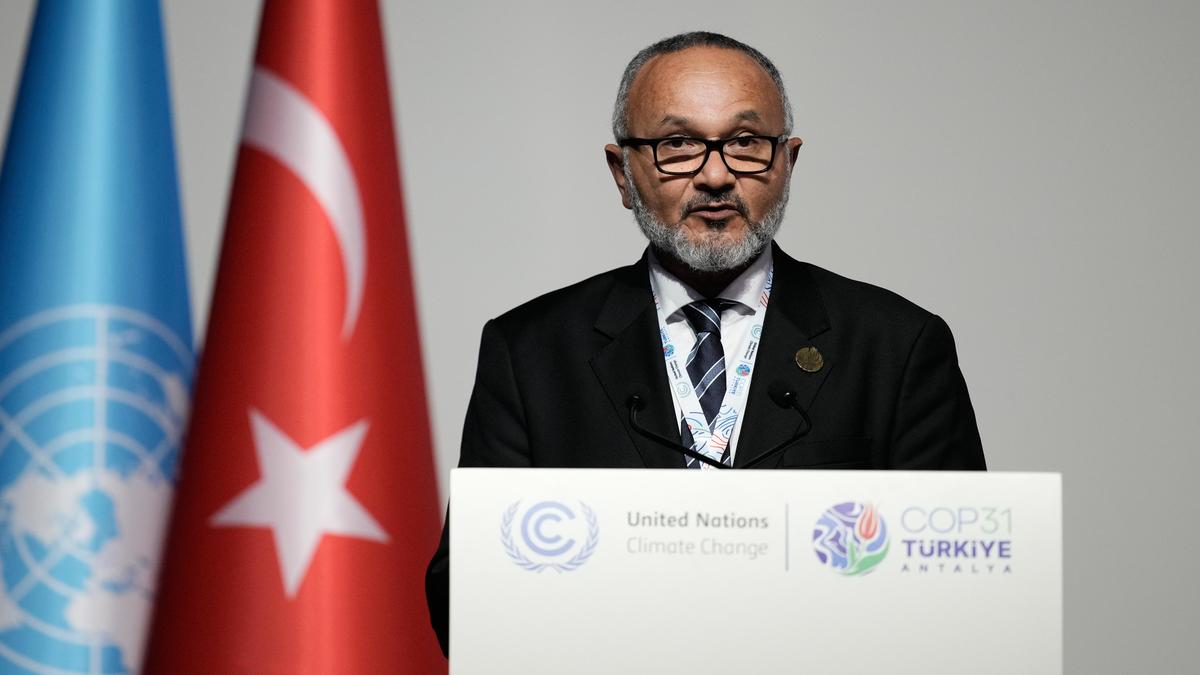
Climate finance at COP31: developing countries seek timely, affordable support to close adaptation gaps without adding to debt burdens.
Image: The Hindu
Why in news
The supplied reports describe COP31 as focused on implementing existing finance commitments rather than announcing another headline target. UN Secretary-General António Guterres warned that even tripling adaptation funding would meet less than a third of vulnerable countries’ needs.
$300 billion annually
Finance goal for developing countries by 2035
$1.3 trillion annually
Broader all-source finance goal by 2035
$137 billion
Finance mobilised in 2024, according to Brazil’s analysis
$840 billion
Projected shortfall against the broader goal
Less than a third
Needs covered even with tripled adaptation funding, per UN warning
$2.89 trillion
World military expenditure in 2025, per SIPRI
Background
The United Nations Framework Convention on Climate Change places equity and common but differentiated responsibilities and respective capabilities at the centre of climate cooperation. The Paris Agreement combines nationally determined climate action with obligations on developed countries to provide financial resources to assist developing countries with mitigation and adaptation. Climate finance can support emissions reduction, resilience and responses to climate-related loss and damage, but these purposes are distinct. The central justice question is whether countries with greater historical responsibility and financial capacity are providing adequate support without transferring disproportionate costs to vulnerable countries.
What COP31 is debating: delivery, not merely declarations
The supplied reports identify implementation of earlier commitments as the central finance issue at COP31. Türkiye is hosting the summit, while Australia is presiding over negotiations. The agenda includes delivering the COP29 finance goal and responding to the COP30 call to triple adaptation finance by 2035.
The $300 billion annual goal and the broader $1.3 trillion annual goal must not be conflated. The former involves developed countries taking the lead in mobilising finance for developing countries; the latter envisages mobilisation from all public and private sources. Neither figure should be presented as an entirely grant-funded transfer from developed-country budgets.
Brazil’s analysis, cited in the source, reports $137 billion mobilised in 2024 but projects an $840 billion shortfall against the broader goal under current trends. This is a climate-finance projection, not a quantified adaptation-only deficit. The reports describe ongoing negotiations, not a completed COP31 finance settlement.
- Headline mobilisation does not establish how much finance has actually been disbursed to recipients.
- According to the supplied editorial, practical arrangements for climate-fund flows have been deferred to COP32.
- A group of multilateral funds announced greater reliance on one another’s assessments for co-financed operations to reduce overlapping procedures.
Infographic
Adequacy
Match support to mitigation and adaptation needs.
Quality
Prioritise grants where repayment is unsuitable.
Access
Simplify procedures and strengthen local capacity.
Equity
Reflect responsibility, capability and vulnerability.
Accountability
Track disbursements, financial terms and resilience outcomes.
AI-assisted infographic by Pragnya IAS Academy, based on the cited sources.
Why adaptation remains the climate-justice test
Adaptation reduces vulnerability to climate impacts through measures such as flood protection, heat preparedness, drought-resilient agriculture and coastal resilience. Many such interventions generate broad social benefits but limited direct revenue, making them less attractive to commercial investors than projects with identifiable cash flows.
Guterres’s warning that even tripled adaptation funding would meet less than a third of needs shows why a relative increase can remain inadequate in absolute terms. Small island developing states face an especially difficult cycle: repeated disasters absorb public resources, fiscal space contracts, and investments in future resilience are postponed.
Adaptation must also be distinguished from loss and damage. Adaptation seeks to reduce harm; loss and damage concerns adverse impacts that are not avoided through mitigation and adaptation. Funding recovery cannot substitute for investment in preparedness, and resilience spending cannot eliminate every climate loss.
- The supplied material does not provide a comprehensive monetary estimate of the adaptation funding gap.
- Climate vulnerability, limited fiscal capacity and weak project-preparation resources can combine to obstruct access to finance.
- Climate justice requires attention to who bears losses, who pays and who can access support.
Developed-country obligations and the grants-versus-loans question
Under the Paris Agreement, developed-country Parties shall provide financial resources to assist developing-country Parties with mitigation and adaptation, continuing their obligations under the Convention. Other Parties are encouraged to provide support voluntarily. Developed countries are also expected to lead efforts to mobilise climate finance from varied sources; mobilisation is not a substitute for the obligation to provide support.
The Paris framework recognises the importance of public and grant-based resources for adaptation, particularly for vulnerable developing countries. A grant does not require repayment, whereas a loan creates debt-service obligations even when its terms are concessional. Consequently, equal headline amounts can imply very different benefits for recipients.
The source reports that Britain linked savings from switching some contributions from grants to loans to a domestic transport measure. This illustrates the tension between donor-budget pressures and recipient-country needs. Counting loans at their face value without separately showing their concessionality can obscure the actual financial support provided.
- The treaty framework does not require all climate finance to take the form of grants.
- Grants are especially appropriate for vulnerable communities and adaptation projects with limited revenue-generating potential.
- Concessional loans may suit viable investments, subject to debt sustainability and fair allocation of risks.
- Historical responsibility supports equity-based burden-sharing, but does not itself specify a universal compensation formula.
India’s position: enabling ambition through equity
According to the supplied editorial, India refused to sign the proposed COP31 electrification pledge and insisted on predictable climate finance, technology transfer and nationally determined approaches to mitigation. This reported position should not be interpreted as rejection of electrification itself; it concerns how international targets are framed and supported.
India’s established negotiating approach stresses equity and common but differentiated responsibilities and respective capabilities. All countries must act, but expectations should reflect historical emissions, capabilities and development needs. Developing countries must expand energy access, infrastructure and employment while also managing adaptation costs.
For India, finance is therefore an enabling condition for affordable climate action, not simply an accounting transfer. Predictable support can help protect farms, cities and workers while facilitating cleaner energy and industrial development. Technology access and domestic implementation capacity are essential complements.
- Nationally determined contributions preserve country-led choices within the Paris Agreement’s collective framework.
- Equity does not exempt developing countries from action; it requires differentiated responsibilities and adequate support.
- New sectoral pledges should be assessed alongside affordability, energy security, technology access and delivery of previous commitments.
Fixing the delivery architecture
The sources identify geopolitical tensions, donor-country fiscal pressures, high capital costs and administrative hurdles as major barriers. Multilateral development banks can leverage shareholder capital, while risk-sharing arrangements can attract private investment. However, increased lending alone does not establish that vulnerable countries are receiving affordable adaptation support.
Private finance is most useful where risks and expected returns can be credibly assessed. Public funds must retain a central role where climate benefits are substantial but commercial returns are weak. The policy objective should be additional, accessible and effective finance, rather than merely maximising the amount labelled as mobilised.
- Use common assessments and proportionate documentation without weakening environmental and social safeguards.
- Link national climate plans to budgets and invest in local project-preparation capacity.
- Disclose grants, loans, private mobilisation, disbursements and grant-equivalent support separately.
- Evaluate success through reduced vulnerability and improved access, alongside financial volumes.
| Instrument | Potential role | Principal concern |
|---|---|---|
| Grants | Public-good adaptation and support for highly vulnerable communities | Insufficient supply and difficult access can limit effectiveness |
| Concessional loans | Investments where affordable repayment is feasible | Debt obligations remain despite favourable terms |
| Commercial loans and equity | Projects with credible revenues and manageable risks | High return requirements can exclude poorer countries and non-commercial adaptation |
| Guarantees and risk-sharing | Reduce selected risks and encourage additional investment | Public resources may absorb risks without adequate public benefits unless carefully designed |
- 1. Identify country-led adaptation priorities and vulnerable communities.
- 2. Translate priorities into costed plans linked to public budgets.
- 3. Match projects with grants, concessional resources or suitable risk-sharing instruments.
- 4. Apply streamlined appraisal with environmental, social and debt-sustainability safeguards.
- 5. Disburse predictable finance through accessible implementing institutions.
- 6. Track financial terms, delivery and measurable resilience outcomes.
COP28, Dubai
Parties reached a consensus on transitioning away from fossil fuels in energy systems.
COP29, Baku
The climate-finance outcome established a $300 billion annual goal by 2035 alongside a broader $1.3 trillion annual mobilisation goal.
COP30
The supplied editorial reports a call to triple adaptation finance by 2035, but no formal roadmap away from fossil fuels.
COP31, November 2026
Talks in Antalya focus on implementing finance promises, improving access and addressing vulnerable countries’ urgent needs.
COP32, prospective
According to the supplied editorial, practical deliberations on how climate funds will flow have been deferred to this conference.
2035
Target year for the reported finance goals and adaptation-finance tripling call.
Significance, challenges & way forward
Significance
- Climate-finance delivery determines whether international climate ambition is credible and implementable.
- Adequate adaptation support can protect livelihoods and reduce the diversion of development budgets towards repeated disaster recovery.
- Grant-based support can prevent vulnerable countries from financing climate resilience through additional debt.
- Fair burden-sharing sustains trust between developed and developing countries within the Paris framework.
- For India, affordable finance and technology access can help reconcile climate action with energy access and development.
Challenges
- Security spending, geopolitical conflict and domestic cost-of-living pressures are weakening political attention to international climate finance.
- Rising mobilisation figures can coexist with lower direct aid, weak disbursement and insufficient grant support.
- Repeated disasters erode fiscal space precisely when countries need to invest more in resilience.
- Fragmented application procedures disproportionately burden small administrations.
- Private investment cannot reliably fill financing gaps in adaptation activities without commercial revenue streams.
- Deferred implementation arrangements risk widening the gap between promises and recipient-country needs.
Way forward
- Developed countries should publish credible delivery pathways for existing commitments, distinguishing public provision from broader mobilisation.
- Prioritise predictable grants for vulnerable countries and adaptation measures with limited capacity to generate repayments.
- Report commitments, disbursements, instrument types and grant-equivalent values transparently to improve accountability.
- Expand common assessments, direct access and project-preparation support while retaining robust safeguards.
- Use multilateral development banks and private capital as complements to public finance, with debt sustainability and additionality tests.
- Align international support with nationally determined priorities, technology needs and local resilience outcomes.
Key terms
- Climate finance
- Public or private financing that supports climate mitigation, adaptation and other climate-response objectives.
- CBDR-RC
- Common but differentiated responsibilities and respective capabilities recognises shared climate duties with differentiated expectations.
- Adaptation
- Adjustment to actual or expected climate effects to reduce harm and strengthen resilience.
- Loss and damage
- Adverse climate impacts that are not avoided through mitigation and adaptation.
- Grant-equivalent value
- A measure of the financial benefit of support, reflecting concessionality rather than simply a loan’s face value.
- Concessional finance
- Finance offered on more favourable terms than ordinary market financing.
- Fiscal space
- The capacity of a government to undertake expenditure without undermining fiscal sustainability.
- Additionality
- The extent to which finance or investment adds resources or outcomes that would not otherwise have occurred.
Link with static syllabus
Prelims practice MCQs
Q1. With reference to climate finance under the Paris Agreement, consider the following statements: 1. Developed-country Parties shall provide financial resources to assist developing-country Parties with mitigation and adaptation. 2. Other Parties are encouraged to provide such support voluntarily. 3. All climate finance must be provided exclusively as grants. Which of the statements given above are correct?
Q2. Consider the following pairs: 1. Adaptation — Reducing vulnerability to climate impacts 2. Mitigation — Reducing greenhouse gas emissions or enhancing sinks 3. Loss and damage — Adverse climate impacts not avoided through mitigation and adaptation Which of the pairs given above are correctly matched?
Q3. Regarding the climate-finance figures discussed in the supplied COP31 reports, consider the following statements: 1. The broader $1.3 trillion annual goal includes public and private sources. 2. The projected $840 billion shortfall is specifically an adaptation-only funding estimate. Which of the statements given above is/are correct?
Q4. With reference to common but differentiated responsibilities and respective capabilities, consider the following statements: 1. It recognises shared responsibility for addressing climate change. 2. It requires identical obligations for countries irrespective of their circumstances. 3. It provides a basis for considering different capabilities and development needs. Which of the statements given above are correct?
Mains practice questions
GS 3 · 15 marks · 250 words
Climate finance is a question of quality, accessibility and equity, not merely aggregate mobilisation. Discuss in the context of COP31, with reference to adaptation needs and India’s position.
Frequently asked questions
Did COP31 announce a new climate-finance target in the supplied reports?
The reports describe a focus on implementing existing commitments, not a completed new COP31 finance target. The $300 billion annual goal by 2035 originated at COP29.
Why do vulnerable countries seek grants rather than loans?
Grants do not create repayment obligations, making them particularly suitable for adaptation projects with limited commercial returns. Loans can increase debt burdens even when they finance necessary resilience measures.
Does the $840 billion projected shortfall measure the adaptation gap?
No. It is the reported projected shortfall against the broader $1.3 trillion climate-finance goal; the supplied sources do not give a comprehensive monetary estimate of the adaptation gap.
What is India’s central position in the reported COP31 debate?
India has emphasised predictable climate finance, technology transfer and nationally determined mitigation pathways. Its position reflects the broader principles of equity and differentiated responsibilities.
Sources
- The Hindu: Urgent climate finance pleas at COP31 face a non-urgent response
- The Hindu: Why climate finance remains a recurring flashpoint at UN summits
- The Hindu: New deal: On COP31 and lofty climate goals
- UN News: COP31: Climate finance falls short as calls grow for polluters to pay
Analysis prepared by the Pragnya IAS Academy current-affairs desk with AI assistance from the cited reports. Verify figures with the original sources.
Turn current affairs into marks
Join Pragnya IAS Academy's mentorship for daily answer-writing evaluation on stories like this — classroom programmes from a trusted name in IAS coaching in Hyderabad.