
Demonetisation at Ten: Cash Persistence, UPI Growth and the Evidence Test
Revise the static topic: UPSC Economy notes
In short: Ten years after demonetisation, RBI data cited in the supplied reports show that currency with the public has more than doubled, while the currency-in-circulation-to-GDP ratio has returned to its pre-demonetisation level. Digital payments have expanded alongside cash, but this does not establish demonetisation as their principal cause; evidence on counterfeit detections and formalisation also requires careful interpretation.
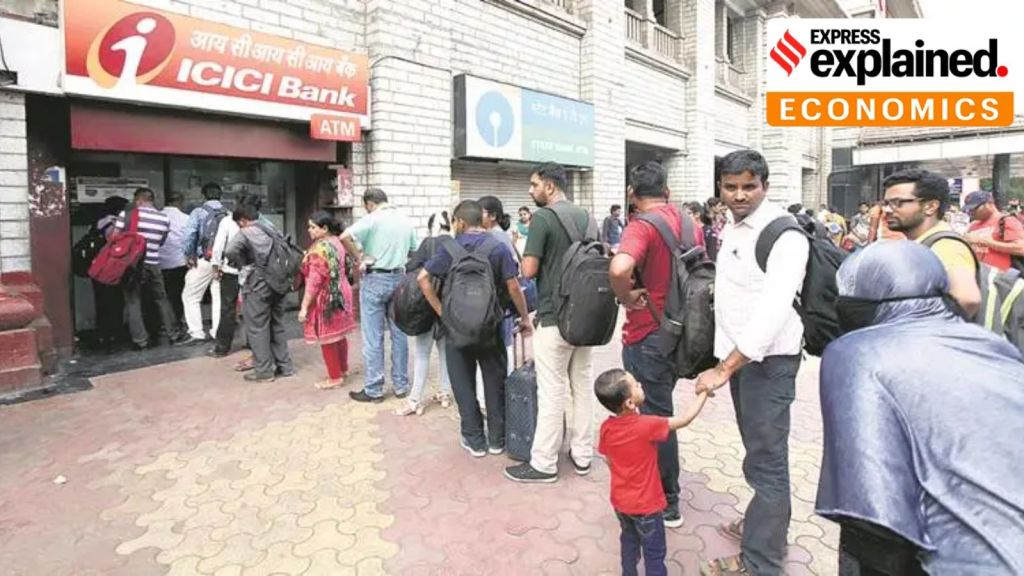
Archival reference image: people queue outside an ATM during India's 2016 demonetisation period. The scene illustrates the immediate disruption to cash access, distinct from the article's evidence on long-term cash use and digital-payment growth.
Image: Indian Express
Why in news
The anniversary of the November 8, 2016 demonetisation announcement has renewed scrutiny of its objectives. Reports drawing on RBI data highlight persistent cash holdings, expanding digital payments and increased detection of counterfeit notes, particularly ₹500 notes.
86%
Share of currency affected in 2016
₹17.97 lakh crore
Currency with public, November 4, 2016
₹7.8 lakh crore
Currency with public, January 2017
₹42.55 lakh crore
Currency with public, October 15, 2026
12.1%
CIC-to-GDP ratio in March 2016 and FY26
₹3,251.04 lakh crore
Total digital payment value, FY2025–26
Background
Demonetisation removes the legal-tender status of specified currency. In November 2016, India demonetised the then-existing ₹500 and ₹1,000 notes, presenting the exercise as a measure against black money, counterfeit currency and financing of illegal activities, alongside expectations of greater digitalisation and formalisation. These are distinct objectives: black money concerns concealed income or wealth, counterfeiting concerns unauthorised currency, and digitalisation concerns payment methods. Cash is not inherently illicit, and unaccounted wealth need not be held as currency. UPI, operated by the National Payments Corporation of India, enables instant bank-account transfers through interoperable payment applications.
Cash recovered: what the data establish
Currency with the public fell sharply after demonetisation and subsequently recovered to well above its earlier nominal level. However, comparing absolute currency holdings across a decade is insufficient because economic expansion and price changes also influence cash demand.
The more informative finding is that the currency-in-circulation-to-GDP ratio stood at 12.1% in FY26, matching March 2016. This weakens the proposition that demonetisation produced a sustained reduction in the economy’s aggregate cash intensity. It does not establish that cash accounts for an unchanged share of everyday payments.
- Currency with the public equals currency in circulation minus cash held by banks; these measures must not be used interchangeably.
- Currency is a stock measured at a point in time, whereas payment value is a flow measured over a period.
- Cash may be held for transactions, precautionary needs or as a store of value.
- A stable cash-to-GDP ratio can coexist with a growing digital share of transactions.
Infographic
Cash
CIC-to-GDP returned to its pre-demonetisation level.
Digital payments
UPI expanded, but independent policy attribution remains unresolved.
Counterfeits
Detections increased; prevalence needs denominator-based assessment.
Formalisation
Payment trails do not automatically establish sustained compliance.
Policy evaluation
Compare durable benefits with disruption using a credible counterfactual.
AI-assisted infographic by Pragnya IAS Academy, based on the cited sources.
Black money and counterfeit currency require separate tests
A currency cancellation directly affects specified notes, not every form of unaccounted wealth. Establishing a durable reduction in black money would require evidence of concealed income being identified, tax liabilities being recovered and subsequent evasion declining. The supplied material does not provide such an outcome series.
The Hindu reports increased counterfeit-note detections, particularly involving ₹500 notes. This indicates that counterfeiting persists, but detected notes are not a complete measure of counterfeit prevalence. Detection totals can change because of circulation volumes, screening intensity or detection capacity.
- Counterfeit detections should be assessed relative to the stock of the relevant denomination and the volume of notes examined.
- Invalidating an existing currency series can disable its counterfeit versions without preventing counterfeiting of replacement notes.
- Neither rising cash holdings nor rising counterfeit detections alone proves a corresponding increase in black money.
- The supplied reports do not establish the long-term effect on financing of illegal activities.
Digital payments grew, but attribution remains unresolved
The reports show substantial digital payment activity, with UPI transaction value rising even relative to GDP. Yet digital payments and cash are not mutually exclusive: users can make routine payments digitally while retaining cash for emergencies or transactions where digital acceptance is limited.
Demonetisation created an immediate incentive to seek non-cash alternatives. Its lasting contribution must nevertheless be separated from other potential drivers, including payment-system design, banking access, smartphone connectivity and merchant acceptance. A before-and-after comparison cannot isolate these influences.
The reported total digital payment value includes RTGS and other payment channels. It is not equivalent to household consumption or a count of unique economic transactions, and it cannot be directly compared with the stock of cash to determine which payment mode dominates.
- Evaluate retail payment volumes, values and merchant acceptance separately from wholesale transfers.
- Assess sustained active usage rather than treating registration or account opening as proof of adoption.
- Distinguish a temporary substitution caused by cash scarcity from durable behavioural change.
Formalisation and welfare need a broader balance sheet
Digital records can improve traceability, but digitalisation is not synonymous with formalisation. Formalisation involves sustained participation in tax, regulatory, employment and accounting systems. The supplied sources do not offer sufficient evidence to quantify demonetisation’s independent contribution to these outcomes.
The Indian Express describes a severe liquidity shortage, disruption to daily commerce and distress among small businesses. A credible evaluation must weigh such adjustment costs against verified, persistent gains rather than judge the policy solely by payment growth or currency holdings.
- Measure formalisation through durable compliance, declared economic activity and worker coverage, not transaction trails alone.
- Account for other policy and economic changes when attributing outcomes to demonetisation.
- Examine distributional effects on cash-dependent households, informal workers and small enterprises.
- Treat financial inclusion and reliable payment choice as policy outcomes, rather than making cash elimination an end in itself.
| Objective | Evidence in supplied material | Assessment |
|---|---|---|
| Reduce cash dependence | CIC-to-GDP returned to 12.1%, its March 2016 level. | No sustained decline in aggregate cash intensity is evident; the cash share of transactions remains unmeasured. |
| Curb counterfeit currency | Detected counterfeit notes increased, particularly ₹500 notes. | Counterfeiting persists, but detection totals do not establish the underlying prevalence rate. |
| Curb black money | No comprehensive evidence on concealed wealth or enduring tax recovery is supplied. | A durable reduction cannot be established from these reports. |
| Promote digital payments | UPI value expanded, including relative to GDP. | Digital growth is evident; demonetisation’s independent contribution is not isolated. |
| Encourage formalisation | No sustained compliance or employment-formalisation series is supplied. | Digital adoption alone is insufficient evidence of formalisation. |
| Disrupt illegal financing | No long-term outcome evidence is supplied. | The objective cannot be conclusively evaluated using the supplied material. |
- 1. Separate objectives: cash dependence, black money, counterfeiting, digitalisation and formalisation.
- 2. Choose objective-specific indicators rather than relying on a single headline number.
- 3. Normalise currency and counterfeit data using appropriate denominators.
- 4. Account for other reforms, economic growth, technology adoption and pandemic effects.
- 5. Compare observed outcomes with a credible estimate of what would have happened without demonetisation.
- 6. Weigh sustained benefits against disruption and distributional costs.
November 4, 2016
Currency with the public stood at ₹17.97 lakh crore.
November 8, 2016
The government announced demonetisation of the then-existing ₹500 and ₹1,000 notes.
January 2017
Currency with the public had fallen to ₹7.8 lakh crore.
2020–21
The reported CIC-to-GDP ratio reached 14.4%; the report links increased cash holdings to precautionary demand during the pandemic.
FY2025–26
The CIC-to-GDP ratio stood at 12.1%, matching March 2016, while digital payments continued to expand.
October 15, 2026
Currency with the public reached ₹42.55 lakh crore, according to RBI data cited by the Indian Express.
Significance, challenges & way forward
Significance
- The anniversary provides a test case for evaluating economic policy through measurable outcomes rather than stated intentions.
- The recovery of the cash-to-GDP ratio challenges the assumption that digital payment growth necessarily displaces aggregate cash holdings.
- Objective-specific evaluation prevents digitalisation from being treated as automatic evidence of reduced black money or greater formalisation.
- The experience highlights the importance of liquidity continuity for informal livelihoods and small enterprises.
Challenges
- Cash transactions are difficult to measure directly, making currency holdings an incomplete proxy for payment behaviour.
- Counterfeit detection data are influenced by both underlying counterfeiting and the effectiveness of screening.
- Simultaneous technological, regulatory and economic changes complicate causal attribution.
- Aggregate payment figures can conceal differences between retail purchases, financial transfers and repeated movement of funds.
- Digital exclusion, unreliable connectivity and fraud risks can limit voluntary adoption of electronic payments.
Way forward
- Publish an objective-wise evaluation separating observed changes from outcomes credibly attributable to demonetisation.
- Use denomination-adjusted counterfeit indicators and disclose detection methodology alongside headline totals.
- Target tax evasion through intelligence-led investigation, risk-based audits and effective enforcement with due process.
- Promote formalisation through simpler compliance, accessible finance and tangible benefits for small enterprises and workers.
- Strengthen digital payment reliability, consumer protection and grievance redress while preserving access to cash.
- Assess future currency interventions for operational readiness, livelihood risks and proportionate alternatives.
Key terms
- Demonetisation
- Removal of the legal-tender status of specified currency.
- Currency in circulation
- The stock of circulating notes and coins, including cash held by banks and the public.
- Currency with the public
- Currency in circulation after deducting cash held by banks.
- CIC-to-GDP ratio
- Currency in circulation relative to nominal GDP, used as an indicator of aggregate cash intensity.
- Black money
- Income or wealth concealed from authorities, including for tax evasion; it is not confined to cash.
- Counterfeit currency
- Unauthorised imitation currency made to pass as genuine.
- Formalisation
- Sustained integration of economic activity into recognised tax, regulatory, accounting or employment systems.
- Counterfactual
- An estimate of what would have happened without a policy, used to identify its causal effect.
Link with static syllabus
Prelims practice MCQs
Q1. With reference to currency measures, consider the following statements: 1. Currency with the public excludes cash held by banks. 2. Currency in circulation is a flow measured over a financial year. 3. The CIC-to-GDP ratio directly measures the percentage of retail payments made in cash. Which of the statements given above is/are correct?
Q2. An increase in detected counterfeit notes necessarily establishes which of the following?
Q3. Consider the following statements: 1. Digital payment values can increase alongside currency holdings. 2. Growth in digital payments after a policy intervention, by itself, proves that the intervention caused the growth. 3. Unaccounted wealth may be held in assets other than currency. Which of the statements given above are correct?
Q4. Which of the following best distinguishes formalisation from digitalisation?
Mains practice questions
GS 3 · 15 marks · 250 words
Ten years after demonetisation, cash persistence and digital payment growth present a complex policy balance sheet. Evaluate its outcomes against its objectives, distinguishing correlation from causation.
Frequently asked questions
Does higher currency with the public prove that demonetisation failed?
It challenges claims of lasting cash displacement, especially when the CIC-to-GDP ratio also returns to its earlier level. It does not independently establish outcomes relating to black money, illegal financing or formalisation.
How can UPI grow while cash holdings remain high?
Digital payments measure transaction flows, whereas cash holdings measure a stock. People can transact digitally while retaining cash for emergencies, savings or purchases where digital acceptance is limited.
Do more counterfeit detections mean counterfeiting has become more widespread?
Not necessarily: higher detections may reflect more counterfeits, better screening or more notes being examined. Prevalence requires suitable denominators and consistent detection methods.
What is the central UPSC takeaway?
Evaluate each policy objective separately and distinguish association from causal impact. Cash reduction, digitalisation, formalisation and control of illicit activity are related but not interchangeable outcomes.
Sources
- The Hindu: 10 years since demonetisation: Cash usage unchanged, fake notes on the rise
- Indian Express: 10 years after demonetisation, cash remains king despite India's digital payments boom
Analysis prepared by the Pragnya IAS Academy current-affairs desk with AI assistance from the cited reports. Verify figures with the original sources.
Turn current affairs into marks
Join Pragnya IAS Academy's mentorship for daily answer-writing evaluation on stories like this — classroom programmes from a trusted name in IAS coaching in Hyderabad.