
Ganga Water Treaty Renewal: Sharing Scarcity, Securing India–Bangladesh Cooperation
Revise the static topic: UPSC International Relations notes
In short: The 1996 Ganga Water Sharing Treaty is due to expire on 12 December 2026, but the recent India–Bangladesh Joint Committee meeting produced no officially confirmed renewal outcome. Renewal requires reconciling dry-season water demands with variable river flows, downstream concerns and the interests of Indian riparian states.
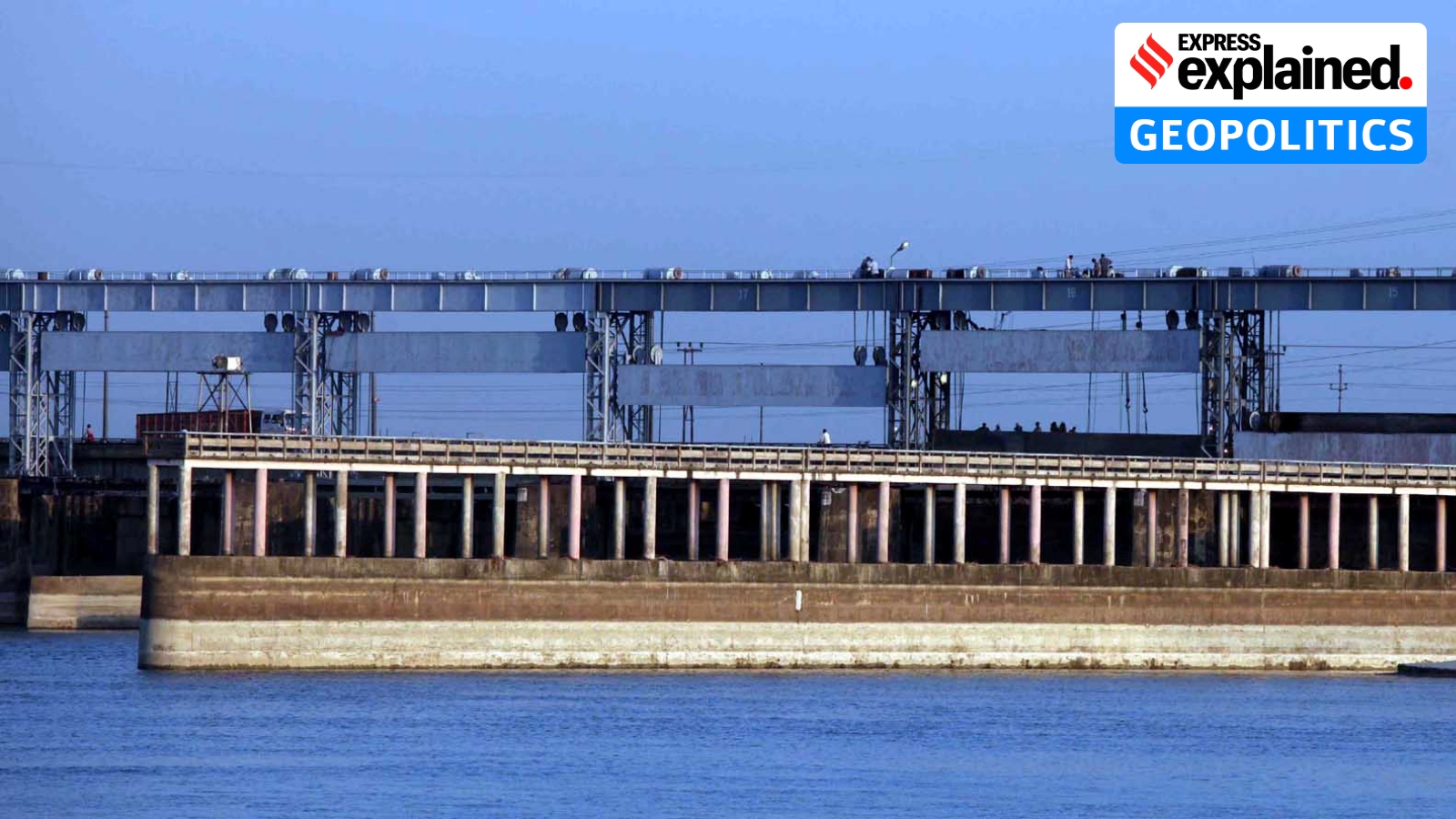
Photo from the source report: Ganga Water Treaty Renewal: Sharing Scarcity, Securing India–Bangladesh Cooperation
Image: Indian Express
Why in news
India and Bangladesh held the 91st routine meeting of their Joint Committee in Dhaka on 21–22 November 2026, shortly before the treaty’s expiry. Reports suggest Bangladesh may favour renewal rather than an entirely fresh agreement, but the negotiating outcome remains unconfirmed.
12 December 2026
Treaty expiry
30 years
Original treaty duration
70,000 cusecs
Equal-sharing threshold
75,000 cusecs
Upper allocation threshold
35,000 cusecs
Alternating lean-season guarantee
Below 50,000 cusecs
Emergency consultation trigger
Background
The dispute centres on dry-season sharing of Ganga waters at Farakka in West Bengal. The barrage diverts water towards the Hooghly to help flush sediment and maintain navigation around Kolkata port, while Bangladesh depends on downstream flows in the Ganga–Padma system. Following earlier temporary arrangements, India and Bangladesh signed the Ganga Water Sharing Treaty in December 1996. It established a time-bound allocation framework and joint implementation machinery, making water cooperation an important component of bilateral relations.
The treaty framework: flow-dependent allocation with safeguards
The treaty governs dry-season sharing from January to May through allocations organised around 10-day periods. Its framework drew on historical flow data for 1949–1988 and uses different allocation rules according to water availability at Farakka.
Between 11 March and 10 May, each country is guaranteed 35,000 cusecs in three alternating 10-day periods. This specific safeguard must not be confused with a general minimum entitlement irrespective of actual river flow.
If flow falls below 50,000 cusecs in any 10-day period, Article II(iii) requires immediate governmental consultations for emergency adjustments based on equity, fair play and no harm to either party.
- The Joint Committee has equal representation from both governments and monitors implementation.
- Disputes unresolved by the Joint Committee are referred to the Joint Rivers Commission.
- Renewal at the end of the original term requires mutual consent; it is not automatic.
Infographic
Equitable allocation
Balance downstream security with actual water availability.
Adaptive safeguards
Clarify drought responses and periodic technical reviews.
Healthy basin
Integrate environmental flows, sediment and water quality.
Trusted diplomacy
Sustain joint institutions and transparent data exchange.
Federal consultation
Involve affected Indian riparian states in shaping commitments.
AI-assisted infographic by Pragnya IAS Academy, based on the cited sources.
Renewal negotiations: who bears the risk of scarcity?
The reported negotiating positions reflect competing demands for greater water security. Earlier reports suggested India sought additional water during the critical March–May period and a shorter renewal term. Bangladesh reportedly sought a guaranteed release of 40,000 cusecs between February and May, a longer renewal period and enhanced flood-data sharing. These remain reported positions, not agreed provisions.
Bangladesh has also sought a minimum guarantee comparable to the 1977 arrangement, which protected at least 80% of its scheduled allocation during specified lean-season periods. Such protection would improve downstream predictability, but a guarantee detached from actual availability could place a disproportionate shortage burden on the upstream country.
The central negotiating question is therefore not simply how much water each side receives, but how hydrological risk is distributed. A credible renewal should distinguish ordinary allocation rules, limited seasonal guarantees and exceptional drought-management procedures.
- Longer treaty duration can support planning certainty but requires effective review mechanisms.
- Shorter duration can facilitate adaptation but may create recurring negotiating uncertainty.
- Reported willingness to renew should not be treated as confirmation that renewal terms have been settled.
Basin sustainability: allocation cannot substitute for river management
A treaty can distribute available water but cannot by itself ensure adequate dry-season flows. Reliance on historical averages becomes less reliable when water demand and hydrological conditions change. Renewal should therefore be supported by updated flow assessment, transparent monitoring and joint evaluation of climate-related risks.
A sustainable approach must consider environmental flows, sediment movement, water quality and upstream water use alongside allocations at Farakka. Flood-data sharing and dry-season scarcity management address different risks, but both can strengthen trust through routine technical cooperation.
- Jointly verified data can reduce disputes over the quantity of water available for sharing.
- Demand management and more efficient irrigation can complement allocation reform.
- Periodic technical reviews can make a renewed agreement more adaptive without reopening every provision.
Diplomacy and federalism: securing consent across borders and within India
Water negotiations operate within a wider relationship affected by political distrust. The source identifies tensions over Sheikh Hasina’s extradition and Bangladeshi caution following India’s decision to place the Indus Waters Treaty in abeyance. These are contextual pressures, not evidence that the Ganga treaty’s renewal has failed or that its legal framework is identical to the Indus arrangement.
Within India, West Bengal’s position is central because Farakka and the Hooghly navigation interests are located there. Bihar’s reported political opposition to renewal also underlines the need to assess upstream state concerns rather than treating negotiations as an exclusively diplomatic exercise.
Constitutionally, foreign affairs and treaty-making fall within the Union’s domain. Water is primarily a State List subject, subject to the Union’s competence over inter-State rivers under Entry 56 of the Union List. Article 253 empowers Parliament to legislate for implementing treaties; this constitutional authority should be complemented by meaningful consultation with affected states.
- State participation improves the evidence base and domestic legitimacy of India’s negotiating position.
- Consultation with states should not be confused with a general constitutional veto over international treaties.
- The Joint Committee and Joint Rivers Commission should remain channels for technical engagement despite wider political friction.
| Available flow | India’s share | Bangladesh’s share |
|---|---|---|
| At or below 70,000 cusecs | Half of available flow | Half of available flow |
| Above 70,000 and below 75,000 cusecs | Balance after Bangladesh’s allocation | 35,000 cusecs |
| 75,000 cusecs or more | 40,000 cusecs | Balance after India’s allocation |
| 11 March–10 May safeguard | 35,000 cusecs in three alternating 10-day periods | 35,000 cusecs in three alternating 10-day periods |
| Below 50,000 cusecs in any 10-day period | Immediate bilateral consultations for emergency adjustment | Immediate bilateral consultations for emergency adjustment |
- 1. Assess available flow at Farakka for the relevant 10-day period.
- 2. Apply the appropriate flow-dependent allocation formula.
- 3. Apply the alternating seasonal guarantee where relevant.
- 4. If flow falls below 50,000 cusecs, initiate immediate governmental consultations for emergency adjustment.
- 5. Address implementation disputes through the Joint Committee, with unresolved matters referred to the Joint Rivers Commission.
1961
Construction of the Farakka barrage began.
1972
India and Bangladesh established the Joint Rivers Commission.
1975
The completed Farakka barrage began diverting Ganga water towards the Hooghly.
1977, 1982 and 1985
Temporary water-sharing arrangements preceded the long-term treaty.
December 1996
The Ganga Water Sharing Treaty established a 30-year framework.
August 2026
The source reports political opposition to renewal from the Janata Dal (United) in Bihar.
21–22 November 2026
The Joint Committee held its 91st routine meeting in Dhaka; renewal discussions were not officially confirmed.
12 December 2026
The treaty is due to expire; renewal requires mutual consent.
Significance, challenges & way forward
Significance
- A mutually agreed renewal would preserve predictability in dry-season water sharing and reduce uncertainty for dependent livelihoods.
- Continued technical cooperation can help stabilise India–Bangladesh relations during periods of political distrust.
- An adaptive agreement could integrate climate-risk management with established bilateral institutions.
- Structured participation by riparian states would strengthen cooperative federalism and the credibility of India’s commitments.
Challenges
- Competing demands cannot be resolved sustainably through allocation promises that ignore actual river availability.
- Historical flow averages may not adequately capture changing demand and hydrological variability.
- A rigid minimum guarantee could distribute scarcity risks unevenly, while weak safeguards could leave downstream users insecure.
- Political friction can delay negotiations even when technical cooperation continues.
- Divergent concerns among Indian riparian states complicate the formation of a durable national negotiating position.
Way forward
- Seek a mutually agreed renewal or continuity arrangement before expiry without presenting reported preferences as settled terms.
- Develop a jointly verified hydrological assessment and transparent protocols for flow measurement and data exchange.
- Negotiate graded scarcity-sharing rules that combine downstream predictability with realistic limits imposed by water availability.
- Institutionalise consultation with West Bengal, Bihar and other relevant riparian stakeholders.
- Integrate environmental-flow assessment, sediment management and water-use efficiency into supporting basin cooperation.
- Provide periodic technical reviews and clearly sequenced dispute-resolution procedures to make the agreement adaptive.
Key terms
- Cusec
- A unit of discharge measuring one cubic foot of water flowing per second.
- Lean season
- The period of relatively low river flow when competition over available water becomes more acute.
- Riparian state
- A country or subnational state situated along a river and affected by its use and management.
- Environmental flows
- The quantity, timing and quality of water flows needed to sustain aquatic ecosystems and associated livelihoods.
- Hydrological risk-sharing
- An agreed distribution of the burdens arising from uncertain or inadequate water availability.
- Joint Rivers Commission
- The bilateral institution established in 1972 for India–Bangladesh cooperation concerning shared rivers.
Link with static syllabus
Prelims practice MCQs
Q1. With reference to the 1996 Ganga Water Sharing Treaty, consider the following statements: 1. It provides for dry-season sharing from January to May. 2. When available flow is at or below 70,000 cusecs, the basic formula provides for equal sharing. 3. It renews automatically at the end of its original term. Which of the statements given above are correct?
Q2. Under Article II(iii) of the Ganga Water Sharing Treaty, a flow below 50,000 cusecs at Farakka in any 10-day period requires which of the following?
Q3. Consider the following pairs: 1. Farakka barrage — West Bengal 2. Joint Rivers Commission — Established in 1972 3. Article 253 — Parliamentary power to implement international agreements through legislation How many of the above pairs are correctly matched?
Q4. With reference to the treaty’s institutional framework, consider the following statements: 1. The Joint Committee consists of an equal number of representatives nominated by both governments. 2. Disputes unresolved by the Joint Committee are referred to the Joint Rivers Commission. 3. The Joint Committee and the Joint Rivers Commission are the same institution. Which of the statements given above are correct?
Mains practice questions
GS 2 · 15 marks · 250 words
Renewal of the Ganga Water Sharing Treaty requires moving beyond volumetric allocation towards shared management of hydrological risks. Discuss with reference to bilateral diplomacy, basin sustainability and Indian riparian states.
Frequently asked questions
Has renewal of the Ganga Water Sharing Treaty been confirmed?
The supplied report does not confirm a renewal agreement. It records the November Joint Committee meeting and reported Bangladeshi openness to renewal, while noting the absence of official confirmation about renewal discussions.
Does the treaty guarantee Bangladesh a minimum flow at all times?
No. It provides a specific alternating seasonal guarantee, but not a general minimum guarantee independent of available flows; exceptionally low flows trigger immediate consultations.
Why are West Bengal and Bihar relevant to renewal?
West Bengal contains Farakka and the Hooghly navigation interests associated with the barrage. Bihar is an upstream riparian state, and reported political opposition there demonstrates the need for wider domestic consultation.
Is the Ganga treaty the same as a Teesta water-sharing agreement?
No. The Ganga treaty concerns dry-season sharing at Farakka; Teesta water sharing is a separate bilateral issue.
Sources
Analysis prepared by the Pragnya IAS Academy current-affairs desk with AI assistance from the cited reports. Verify figures with the original sources.
Turn current affairs into marks
Join Pragnya IAS Academy's mentorship for daily answer-writing evaluation on stories like this — classroom programmes from a trusted name in IAS coaching in Hyderabad.