
IL-76 Landing at Nyoma: Strengthening Heavy-Lift Logistics Along the LAC
Revise the static topic: UPSC Internal Security notes
In short: An Indian Air Force IL-76MD ‘Gajraj’ has landed at Mudh-Nyoma airbase in eastern Ladakh, demonstrating that its upgraded infrastructure can accommodate a heavy strategic transport aircraft. Located close to the Line of Actual Control, Nyoma can strengthen forward logistics and deployment flexibility, although one successful landing does not establish routine operations at the aircraft’s maximum payload.
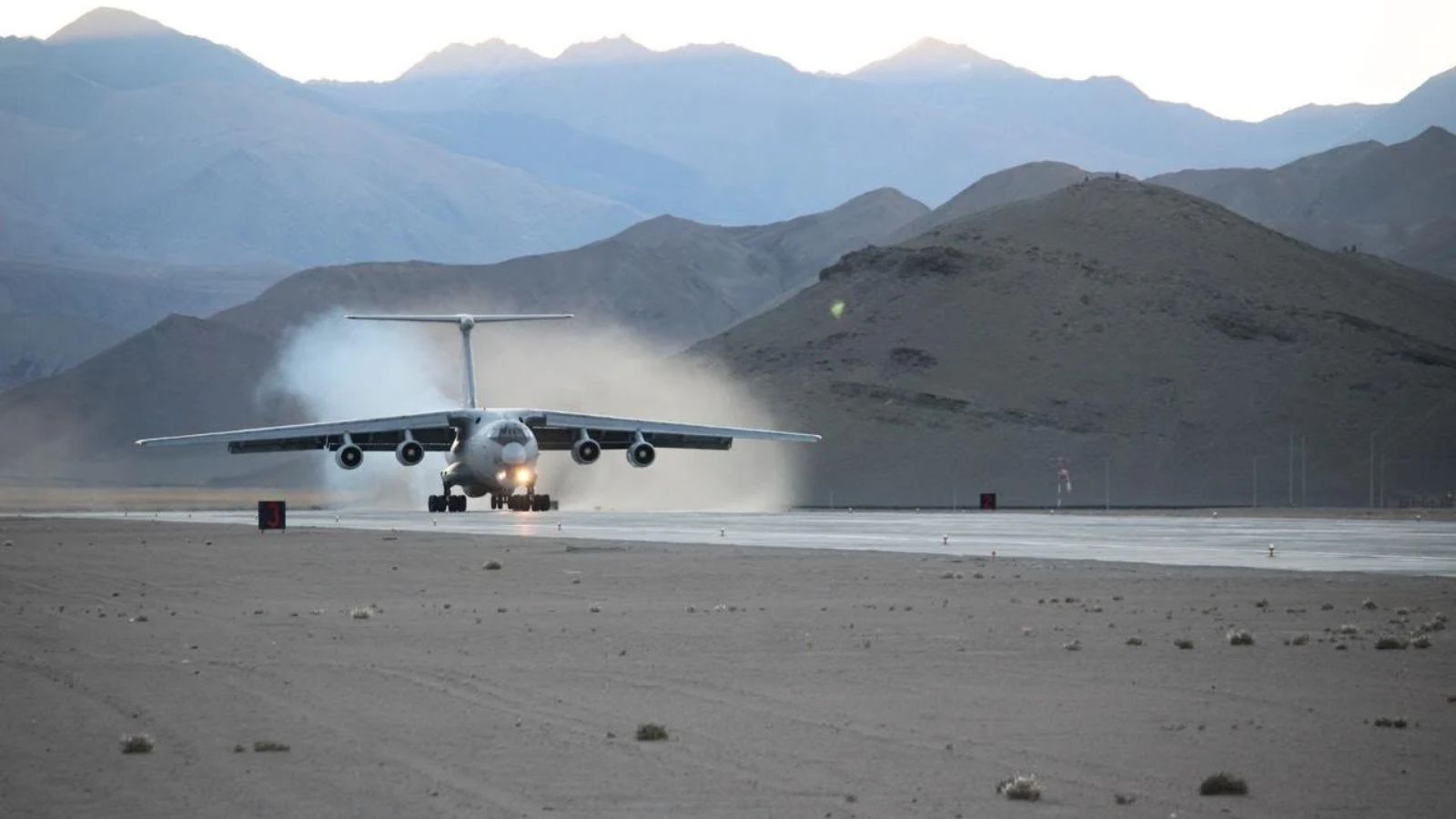
Photo from the source report: IL-76 Landing at Nyoma: Strengthening Heavy-Lift Logistics Along the LAC
Image: Indian Express
Why in news
The Indian Express reports that the IL-76MD landed at Nyoma at an elevation of 13,629 feet, marking the highest-altitude landing by this aircraft type anywhere in the world. The development comes amid continuing military deployments in Ladakh despite disengagement at friction points and the resumption of patrolling since October 2024.
13,629 feet
Nyoma airbase elevation
25 km
Reported distance from the LAC
2.7 km
Upgraded runway length
Rs 218 crore
Airbase upgrade project
40–45 tonnes
IL-76MD capacity, subject to conditions
16,614 feet
Daulat Beg Oldie airstrip elevation
Background
Eastern Ladakh is a high-altitude border region where difficult terrain, severe weather and long supply routes complicate military deployment. The Line of Actual Control separates areas under Indian and Chinese control but is not a mutually agreed international boundary. Airlift complements road-based logistics by moving personnel, equipment and essential supplies across difficult terrain. Strategic transport aircraft provide substantial carrying capacity, while forward airfields help connect this capacity to the operational needs of deployed formations.
What the Nyoma landing demonstrates
The Russian-origin IL-76MD is a four-engine turbofan heavy strategic transport aircraft. Its landing at Mudh-Nyoma demonstrates the upgraded airbase’s ability to accommodate a substantially heavier aircraft class than the tactical transports that previously operated from the older landing ground.
According to the source, the Border Roads Organisation constructed a 2.7-km runway under a Rs 218 crore project following the decision to upgrade Nyoma after the 2020 eastern Ladakh standoff. The reported milestone is specific to the IL-76: it is not the highest-altitude landing by any military transport aircraft.
- A C-130J landed at Daulat Beg Oldie, at an elevation of 16,614 feet, in 2013.
- The IL-76MD’s stated carrying capacity is 40–45 tonnes, depending on configuration and operating conditions.
- The source does not specify the payload carried during the Nyoma landing.
Infographic
Forward access
Heavy strategic transport capability close to the LAC.
Reinforcement
Greater flexibility to move personnel and equipment.
Sustainment
Recurring supplies must connect with ground distribution.
Resilience
Additional airhead capacity needs protection and redundancy.
Operational limits
Altitude, weather, payload and fleet serviceability remain decisive.
AI-assisted infographic by Pragnya IAS Academy, based on the cited sources.
Strategic significance: faster reinforcement and deeper sustainment
Nyoma’s proximity to the LAC can bring heavy-lift access closer to forward deployment areas. This can reduce dependence on lengthy onward surface movement from more distant airheads and improve the flexibility with which personnel and equipment are distributed.
The principal military gain extends beyond rapid reinforcement. Sustained preparedness requires recurring deliveries of stores, spares and equipment, along with casualty evacuation and maintenance support. An additional heavy-transport-capable airbase can strengthen the wider logistics network serving eastern Ladakh.
- Rapid deployment: Direct access to a forward airhead can improve reinforcement options during a contingency.
- Sustainment: Heavy-lift access can support the recurring logistics needs of deployed formations.
- Redundancy: Multiple usable airheads reduce dependence on a limited set of reception points.
- Deterrence: Credible reinforcement and sustainment capacity can strengthen defensive preparedness without implying an offensive intent.
Why high-altitude heavy-lift operations remain demanding
At high-altitude airfields, lower air density affects aircraft performance, including engine thrust and the speed required to generate lift. Temperature, wind, runway conditions and aircraft weight influence safe take-off and landing margins.
A successful landing is therefore a capability demonstration, not proof that the aircraft can routinely deliver its nominal maximum payload at Nyoma. Repeatable operations require validated performance limits, suitable ground support, reliable weather information and arrangements for unloading and onward distribution.
- Runway length alone does not determine an airfield’s heavy-lift capacity; pavement strength and supporting infrastructure also matter.
- Mountain weather and terrain can constrain flight planning and operational availability.
- Airlift supplements rather than replaces roads, bridges, storage facilities and last-mile transport.
Preparedness amid incomplete de-escalation
The source distinguishes disengagement at friction points from full troop de-escalation in Ladakh. Disengagement reduces close confrontation at specific locations; de-escalation involves a broader reduction in military concentration and operational intensity. Progress on the former does not automatically establish the latter.
The landing also highlights the importance of fleet availability. India acquired its IL-76 aircraft between 1985 and 1989, and the source reports serviceability difficulties linked to spare-parts access, aggravated by the Russia-Ukraine war. Forward infrastructure must therefore be matched by airworthy aircraft, trained crews and dependable maintenance.
- Infrastructure readiness and aircraft availability must be planned together.
- Military preparedness should support, not substitute for, diplomatic engagement and crisis-management mechanisms.
- Operational success should be assessed through repeatable logistics performance rather than a single demonstration.
| Aspect | Mudh-Nyoma | Daulat Beg Oldie |
|---|---|---|
| Location | Eastern Ladakh | Eastern Ladakh |
| Reported elevation | 13,629 feet | 16,614 feet |
| Aircraft in the cited landing | IL-76MD Gajraj | C-130J |
| Nature of milestone | Highest-altitude landing reported for the IL-76 aircraft type | High-altitude C-130J landing in 2013 |
| Analytical significance | Demonstrates access for a heavy strategic transport aircraft | Demonstrates tactical transport access at a higher-elevation airstrip |
- 1. Upgrade runway and supporting airfield infrastructure.
- 2. Validate aircraft operations under high-altitude conditions.
- 3. Move personnel, equipment and supplies to the forward airhead.
- 4. Unload, store and distribute consignments through connected surface routes.
- 5. Sustain deployments through repeat sorties, maintenance and replenishment.
1985–1989
India acquired its IL-76 aircraft, establishing a major strategic airlift capability.
2013
A C-130J landed at Daulat Beg Oldie in eastern Ladakh.
After 2020
The decision to upgrade Nyoma followed the military standoff with China in eastern Ladakh.
October 2024
The source identifies this period with the resumption of patrolling following disengagement at friction points.
Latest reported milestone
An IL-76MD landed at the upgraded Mudh-Nyoma airbase, demonstrating access for a heavy strategic transport aircraft.
Significance, challenges & way forward
Significance
- Nyoma expands the potential reach of heavy strategic airlift closer to the LAC.
- An additional heavy-transport-capable airhead can improve logistical flexibility and resilience in eastern Ladakh.
- Closer delivery of equipment and supplies can reduce the burden of onward surface movement.
- Reliable reinforcement and sustainment capacity can strengthen deterrence and defensive preparedness.
Challenges
- High altitude and variable weather constrain aircraft performance and permissible operating loads.
- Proximity to the LAC increases the importance of airfield protection, dispersal and rapid runway repair.
- Ageing aircraft and spare-parts constraints can limit the practical benefits of upgraded infrastructure.
- Insufficient handling, storage or onward transport capacity could create bottlenecks after an aircraft lands.
- A single successful landing does not establish routine sortie capacity, actual payload performance or all-weather availability.
Way forward
- Validate repeatable operations across seasonal conditions using aircraft-specific performance and safety limits.
- Integrate airlift planning with Army requirements, road connectivity, storage capacity and last-mile delivery.
- Strengthen airfield protection, redundant support systems and runway-repair preparedness.
- Improve fleet serviceability through dependable spares, maintenance planning and timely capability renewal.
- Assess readiness through sustainable delivery capacity and turnaround efficiency, not merely landmark landings.
- Maintain credible border preparedness alongside dialogue aimed at de-escalation and stability.
Key terms
- Strategic airlift
- Air transport capability for moving substantial personnel, equipment and supplies over long distances.
- Heavy-lift logistics
- Movement of large or heavy military loads that require aircraft with substantial carrying capacity.
- Airhead
- An airfield or landing area used to receive personnel and supplies for onward deployment.
- Density altitude
- Pressure altitude corrected for temperature, indicating the air-density conditions that affect aircraft performance.
- Disengagement
- Separation of opposing forces at specific confrontation points to reduce immediate contact and risk.
- De-escalation
- A broader reduction in military concentration, readiness or operational intensity beyond local disengagement.
- Serviceability
- The condition of equipment being fit and available for its intended operational use.
Link with static syllabus
Prelims practice MCQs
Q1. With reference to the reported IL-76 landing at Mudh-Nyoma, consider the following statements: 1. It demonstrates that the upgraded airbase can accommodate a heavy strategic transport aircraft. 2. It establishes that the IL-76 can routinely deliver its maximum stated payload at Nyoma. 3. It was the highest-altitude landing by any military transport aircraft. Which of the statements given above is/are correct?
Q2. Consider the following statements about high-altitude aviation: 1. Lower air density affects aircraft lift and engine performance. 2. Aircraft weight, temperature and wind influence operating margins. 3. Runway length alone determines whether an airfield can support routine heavy-lift operations. Which of the statements given above are correct?
Q3. Which one of the following best distinguishes disengagement from de-escalation in a border standoff?
Q4. Consider the following pairs: 1. Mudh-Nyoma — Eastern Ladakh 2. Gajraj — IL-76 3. Border Roads Organisation — Construction of Nyoma’s upgraded runway How many of the pairs given above are correctly matched?
Mains practice questions
GS 3 · 15 marks · 250 words
The strategic value of a forward airbase lies not merely in aircraft access but in sustained logistical capability. Discuss with reference to the IL-76 landing at Nyoma in eastern Ladakh.
Frequently asked questions
Why is the IL-76 landing at Nyoma strategically important?
It demonstrates access for a heavy strategic transport aircraft at a forward airbase close to the LAC. This can improve reinforcement options and the flexibility of logistics support in eastern Ladakh.
Was this the highest-altitude military transport landing ever?
No. The reported record applies to the IL-76 aircraft type; a C-130J landed at the higher-elevation Daulat Beg Oldie airstrip in 2013.
Can the IL-76 carry 40–45 tonnes into Nyoma?
The source gives 40–45 tonnes as the aircraft’s capacity depending on configuration and operating conditions, not as a verified Nyoma payload. It does not disclose the load carried during this landing.
Does Nyoma reduce the need for border roads?
No. Airlift complements roads, which remain essential for onward distribution and sustained movement of supplies to forward positions.
Sources
Analysis prepared by the Pragnya IAS Academy current-affairs desk with AI assistance from the cited reports. Verify figures with the original sources.
Turn current affairs into marks
Join Pragnya IAS Academy's mentorship for daily answer-writing evaluation on stories like this — classroom programmes from a trusted name in IAS coaching in Hyderabad.