
India Bans Black Mass Exports: Critical-Mineral Security and Battery Recycling
Revise the static topic: UPSC Economy notes
In short: The Centre prohibited exports of lithium-ion battery black mass and related battery waste on November 10, with immediate effect, to retain recyclable critical minerals for domestic processing. The measure can strengthen feedstock availability and domestic value addition, but its success depends on refining capacity, efficient collection and environmentally sound recycling.
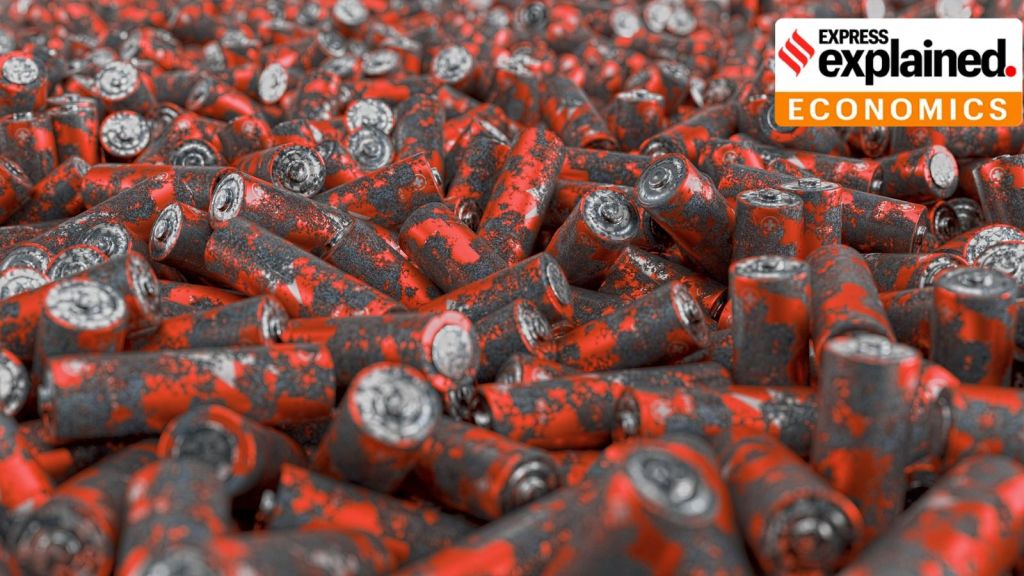
Reference view of battery black mass, a mineral-bearing material recovered from lithium-ion batteries for further processing. India’s export ban aims to retain this recycling feedstock domestically.
Image: Indian Express
Why in news
The export prohibition comes alongside India’s push to develop domestic critical-mineral processing, including recently approved capital expenditure support for lithium and nickel processing. It reflects growing concern over supply disruptions and dependence on overseas mineral refining.
Around 50,000 tonnes
End-of-life lithium-ion batteries generated in India, industry estimate
Around 25,000 tonnes
Potential black mass generation, industry estimate
Around 50%
Estimated black mass share of the cited battery-waste quantity
Background
Lithium-ion batteries power electric vehicles, consumer electronics and energy-storage systems. Their supply chain extends from mineral extraction to refining, battery-material production, cell manufacturing and end-of-life recovery. Critical minerals are economically important materials whose supply may be vulnerable to disruption; their criticality depends on a country’s industrial requirements and supply risks. India’s limited domestic availability and processing capacity make discarded batteries an important secondary resource. Recycling can supplement primary mining, but recovering usable battery materials requires more than dismantling and shredding.
What is black mass, and what has been prohibited?
Black mass is the powder-like, mineral-bearing material obtained after waste lithium-ion batteries are dismantled and mechanically processed. It is an intermediate recycling feedstock, not a finished battery material or a single mineral.
Depending on battery chemistry and the waste stream, it can contain lithium, cobalt, nickel, manganese and graphite, among other materials. Further recovery and purification are needed before suitable materials can re-enter battery manufacturing.
The Centre has prohibited exports of lithium-ion battery black mass and related battery waste with immediate effect. The stated objective is to ensure that material generated in India is recycled and refined domestically, supporting feedstock availability, capacity utilisation, investment and employment.
- Mechanical processing produces black mass; refining recovers and purifies its constituent materials.
- Mineral content varies across battery chemistries, so every batch does not contain the same recoverable materials.
- The reported measure concerns exports; it should not be interpreted as a blanket prohibition on battery recycling or black mass imports.
Infographic
Secure feedstock
Retain recoverable battery materials for domestic processing.
Build refining
Convert mixed material into usable, quality-assured inputs.
Sustain collection
Keep collection viable through fair markets and traceability.
Control pollution
Manage handling risks, effluents and hazardous residues.
Close the loop
Return recovered materials to productive use.
AI-assisted infographic by Pragnya IAS Academy, based on the cited sources.
How retaining black mass can strengthen mineral security
Exporting black mass transfers recoverable minerals and downstream processing opportunities abroad. Retaining it can help Indian firms move from basic dismantling and physical separation to higher-value recovery of metal compounds and other usable materials.
The source reports that India has limited critical-mineral processing capacity and substantial import dependence, while China occupies a dominant position in processing. Domestic recycling can diversify supply and reduce exposure to external restrictions, although it cannot by itself eliminate dependence on imported minerals, technology or equipment.
A more predictable feedstock base may improve utilisation of existing plants and make additional refining investment more viable. However, keeping material within India does not automatically make it battery-grade: recovery efficiency, purity and reliable demand remain decisive.
- Resource security requires domestic recovery capability, not merely domestic possession of waste.
- Circularity is achieved when recovered materials actually substitute for primary inputs in production.
- Recycling should complement primary mineral exploration, overseas sourcing and supply-chain diversification.
Who gains, and where can market distortions arise?
According to industry representatives quoted in the source, domestic refiners and integrated recyclers could benefit from greater feedstock access. Firms limited to dismantling and black mass production lose access to overseas buyers and may face weaker bargaining power.
Restricting export outlets could lower domestic black mass prices, benefiting buyers but potentially squeezing collectors and mechanical processors. If collection becomes commercially unattractive, the policy could weaken the very feedstock supply it seeks to secure.
The source also records an apparent market mismatch: some firms reported difficulty sourcing black mass domestically, while others sought export permission citing a lack of domestic buyers. This suggests that availability must be assessed alongside material quality, location, pricing and processing compatibility.
- Export retention must be matched by adequate domestic absorption and refining capacity.
- Transparent quality testing and price discovery can help connect black mass producers with suitable refiners.
- Industrial support should encourage efficient recovery rather than simply shifting value from smaller suppliers to larger buyers.
Environmental regulation and the circular-economy test
The source reports that the Ministry of Environment, Forest and Climate Change’s Technical Review Committee treated black mass as hazardous waste unless processed on the same premises for critical-mineral recovery. It stated that transboundary movement should be regulated under the Hazardous and Other Wastes (Management and Transboundary Movement) Rules, 2016, with permission and actual-user requirements.
This environmental-control framework must be distinguished from the new export prohibition. The former governs hazardous-waste handling and transboundary movement; the latter restricts an export channel to retain domestic resources.
As static policy context, the Battery Waste Management Rules, 2022 establish an extended producer responsibility framework for waste batteries. Linking collection obligations with traceable processing can support the export ban’s objectives, provided recovery operations also control emissions, effluents and residues.
- Resource value does not remove the environmental risks of a waste stream.
- Unsafe storage and handling of spent batteries can create fire and pollution risks.
- A circular economy requires safe collection, efficient recovery and reuse of recovered materials—not merely domestic stockpiling.
| Stakeholder or stage | Potential effect of the export prohibition | Condition for a positive outcome |
|---|---|---|
| Collectors and dismantlers | Reduced access to overseas demand may indirectly affect procurement prices. | Collection must remain commercially viable and environmentally compliant. |
| Black mass producers | Sales become dependent on domestic buyers. | Accessible refiners, transparent testing and fair price discovery are needed. |
| Domestic refiners | Greater feedstock access may improve capacity utilisation. | Plants must recover materials efficiently and meet required purity standards. |
| Battery manufacturers | Potential access to domestically recovered battery inputs. | Recovered materials must meet manufacturing specifications. |
| Environment and resource security | Potential reduction in waste leakage and dependence on primary inputs. | Safe processing and actual reintegration into production are essential. |
- 1. Collect spent batteries through traceable channels.
- 2. Safely sort, discharge and dismantle batteries.
- 3. Mechanically process suitable battery components to produce black mass.
- 4. Recover and purify valuable materials in domestic facilities.
- 5. Test recovered materials against manufacturing specifications.
- 6. Return suitable materials to battery and other industrial production.
2016
The Hazardous and Other Wastes (Management and Transboundary Movement) Rules established the relevant framework for regulating hazardous-waste movements.
2022
The Battery Waste Management Rules established an extended producer responsibility framework for waste batteries.
November 10, as reported in the source
The Centre prohibited exports of lithium-ion battery black mass and related battery waste with immediate effect.
Significance, challenges & way forward
Significance
- Retaining black mass can create a domestic secondary source of critical minerals and improve supply resilience.
- Moving beyond shredding to recovery and refining can retain more industrial value within India.
- More dependable feedstock availability can support investment, capacity utilisation and skilled employment.
- Environmentally sound recycling can reduce waste leakage and supplement primary mineral supplies.
Challenges
- Limited refining capacity could turn retained feedstock into inventories rather than usable mineral supply.
- Lower domestic black mass prices could weaken the economics of collection and mechanical processing.
- Differences in battery chemistry and feedstock quality complicate valuation, recovery and plant compatibility.
- Hazardous residues, effluents and unsafe handling can undermine the environmental benefits of recycling.
- Recycling cannot alone meet mineral requirements because recoverable supply depends on batteries reaching end of life.
Way forward
- Align feedstock retention with commissioning of efficient domestic recovery and purification capacity.
- Develop transparent sampling, assay and pricing practices to reduce disputes between black mass suppliers and refiners.
- Strengthen producer-responsibility implementation and traceability from collection to final material recovery.
- Help smaller collectors and processors enter compliant supply chains without undermining their commercial viability.
- Link public support to verified recovery performance, product quality and environmental compliance.
- Monitor material availability, plant utilisation, supplier prices and waste inventories to identify unintended consequences.
- Combine recycling with diversified overseas sourcing and responsible development of primary mineral resources.
Key terms
- Black mass
- A powder-like intermediate produced from processed waste batteries that contains recoverable minerals and other materials.
- Secondary raw material
- A usable production input recovered from waste or previously used products rather than directly extracted from nature.
- Critical minerals
- Materials whose economic importance and exposure to supply disruption make secure availability strategically significant.
- Extended producer responsibility
- A framework assigning producers responsibility for the management of products after they become waste.
- Battery-grade material
- Material meeting the purity and other technical specifications required for battery production.
- Urban mining
- Recovery of valuable materials from discarded products and other resources accumulated through human use.
Link with static syllabus
Prelims practice MCQs
Q1. With reference to battery black mass, consider the following statements: 1. It is an intermediate material obtained during the processing of waste batteries. 2. Its mineral composition can vary with battery chemistry. 3. It can invariably be used directly in new battery cells without further processing. Which of the statements given above are correct?
Q2. Which of the following best describes the principal objective of India’s reported prohibition on black mass exports?
Q3. Consider the following pairs: 1. Battery Waste Management Rules, 2022 — Extended producer responsibility for waste batteries 2. Hazardous and Other Wastes Rules, 2016 — Regulation of hazardous-waste transboundary movement 3. Urban mining — Extraction of minerals exclusively from newly discovered underground deposits How many of the pairs given above are correctly matched?
Q4. With reference to the economic effects of restricting black mass exports, consider the following statements: 1. Domestic refiners may gain improved access to feedstock. 2. The measure automatically guarantees battery-grade output. 3. Black mass producers may lose access to overseas buyers. Which of the statements given above are correct?
Mains practice questions
GS 3 · 15 marks · 250 words
India’s prohibition on black mass exports seeks to convert battery waste into a strategic resource. Assess its implications for critical-mineral security and domestic value addition, and suggest measures to ensure an environmentally sound circular economy.
Frequently asked questions
Is black mass the same as lithium?
No. Black mass is a mixed intermediate that may contain lithium, cobalt, nickel, manganese, graphite and other materials, depending on the batteries processed.
Why does India want to retain black mass?
Retaining it can supply domestic recyclers and refiners, support higher-value processing and provide a secondary source of critical minerals.
Will the export ban make India self-sufficient in battery minerals?
Not by itself. Mineral security also requires collection, recovery technology, adequate refining capacity, suitable product quality and diversified primary supplies.
Does recycling automatically make black mass environmentally safe?
No. Safe handling, pollution control and proper management of processing residues are essential; recoverable value does not eliminate hazardous-waste concerns.
Sources
Analysis prepared by the Pragnya IAS Academy current-affairs desk with AI assistance from the cited reports. Verify figures with the original sources.
Turn current affairs into marks
Join Pragnya IAS Academy's mentorship for daily answer-writing evaluation on stories like this — classroom programmes from a trusted name in IAS coaching in Hyderabad.