
India–Netherlands Strategic Partnership: Chips, Water and Clean Energy
Revise the static topic: UPSC International Relations notes
In short: India and the Netherlands elevated bilateral relations to a Strategic Partnership during Prime Minister Narendra Modi’s visit on May 16–17, 2026, signing 17 agreements and MoUs. Cooperation in semiconductors, water, renewable energy and critical minerals offers India opportunities to strengthen industrial capabilities and climate resilience, although implementation details remain limited in the supplied report.
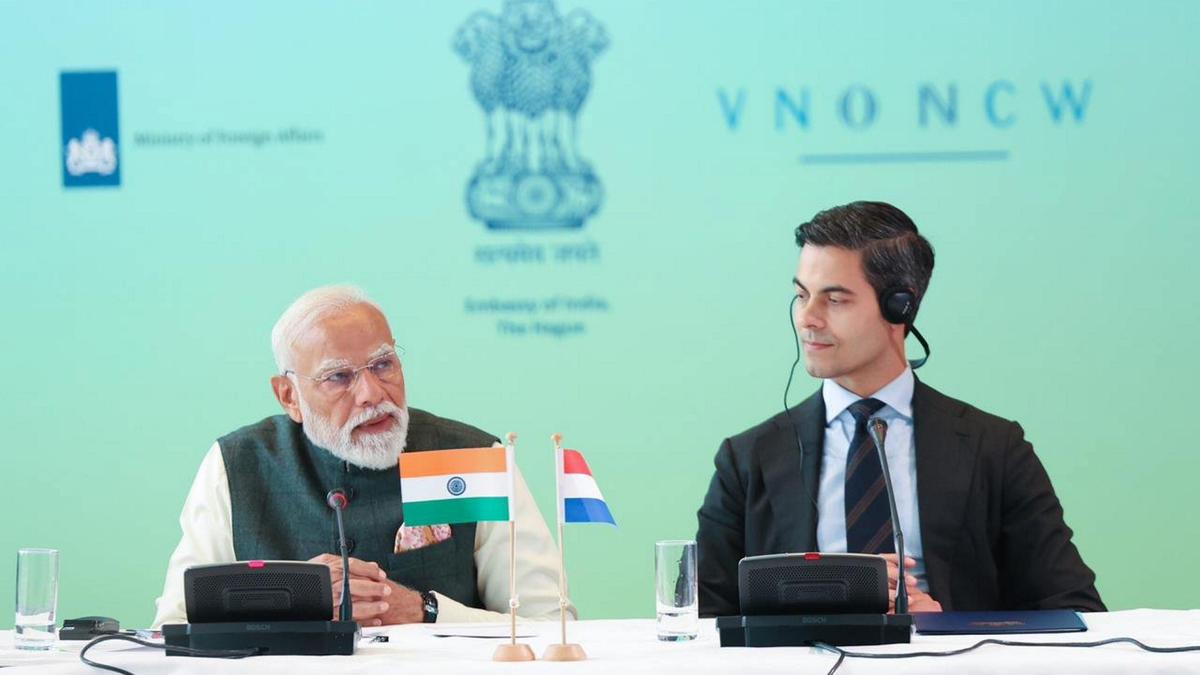
India and the Netherlands upgraded ties to a Strategic Partnership, signing 17 agreements and MoUs covering areas including semiconductors, water and renewable energy.
Image: The Hindu
Why in news
The partnership upgrade included a semiconductor fabrication project involving TATA Electronics and Dutch company ASML. The visit also brought diplomatic differences into view, with the MEA pushing back on concerns about press freedom and minority rights attributed to the Dutch Prime Minister in Dutch media reports.
17
Agreements and MoUs signed
Background
The Netherlands is a member of the European Union and a low-lying country with extensive experience in flood protection and water management. Its technology ecosystem includes ASML, a supplier of lithography equipment used in semiconductor manufacturing. These strengths complement India’s priorities of developing manufacturing capabilities, managing water stress and expanding clean energy. Bilateral engagement with European countries can provide specialised partnerships alongside India’s wider engagement with the EU.
What the partnership upgrade establishes
India and the Netherlands upgraded their relationship to a Strategic Partnership during the May 2026 visit. The reported agreements cover water, agriculture and health, grouped as WAH, alongside renewable energy, critical minerals and a semiconductor fabrication project.
The upgrade gives these areas a broader political framework. However, a Strategic Partnership is not, by itself, a defence alliance or a guarantee of technology transfer, investment disbursement or project completion.
- The supplied report identifies TATA Electronics and ASML as parties to the semiconductor fabrication project.
- It does not specify project investment, location, production capacity, technology node or commissioning schedule.
- The legal effect of an MoU depends on its wording and the parties’ intention; the label alone does not establish enforceability.
Infographic
Semiconductors
Connect manufacturing ambitions with equipment expertise and skills.
Water
Adapt flood protection and integrated planning to Indian conditions.
Clean energy
Link renewable deployment with reliable grids and responsible mineral sourcing.
European partnerships
Complement EU-level engagement through specialised bilateral cooperation.
Implementation
Judge success by delivered capabilities, not agreement counts alone.
AI-assisted infographic by Pragnya IAS Academy, based on the cited sources.
Semiconductors: access to a critical manufacturing ecosystem
Semiconductor fabrication depends on a specialised international ecosystem of design, equipment, materials, manufacturing and testing. Lithography transfers circuit patterns onto semiconductor wafers, making equipment capability a crucial input into chip production.
Engagement involving ASML could help connect India’s manufacturing ambitions with European equipment expertise. Its strategic value should be assessed through operational capability, workforce development, maintenance support and domestic supplier linkages—not merely the signing of an agreement.
- Domestic fabrication capacity does not eliminate dependence on imported equipment, software, materials or components.
- Technology access may be shaped by export licensing, intellectual property conditions and commercial arrangements.
- The report does not establish access to a particular class of lithography equipment or a specific semiconductor technology node.
Water and renewable energy: development gains with strategic relevance
Dutch water-management experience offers useful lessons for flood-risk reduction, drainage and integrated water planning. Application in India must nevertheless reflect local river systems, monsoon variability, groundwater dependence, settlement patterns and institutional capacity rather than reproduce Dutch models mechanically.
Renewable-energy cooperation can support India’s energy transition through technology partnerships and industrial collaboration. Critical-mineral cooperation is also relevant because several clean-energy technologies depend on specialised mineral inputs, but the report does not identify particular minerals, projects or supply commitments.
- Water cooperation can connect climate adaptation with agricultural productivity and public health.
- Reliable electricity and water services are also enabling conditions for semiconductor manufacturing.
- Renewable-energy collaboration should be evaluated alongside storage, grid integration, financing and environmental safeguards.
Europe, strategic autonomy and diplomatic differences
The partnership illustrates how India can pursue strategic technology cooperation through complementary European channels: EU-level engagement and country-specific industrial strengths. Diversifying partners can improve resilience, but dependence on a single critical supplier remains a vulnerability even within a friendly relationship.
Dutch Prime Minister Rob Jetten said he raised sensitive topics, including a child-custody and abduction case. Dutch media also reported that he raised concerns about press freedom and minority rights in India; the MEA subsequently pushed back. These are reported diplomatic exchanges, not independently established findings about the underlying allegations.
- Functional cooperation and political disagreements can coexist within a strategic partnership.
- Institutionalised dialogue can help prevent individual disputes from disrupting long-term projects.
- India should distinguish diversification of technology access from complete technological self-sufficiency.
| Area | What the source establishes | Potential benefit and key caveat |
|---|---|---|
| Semiconductors | A fabrication project involving TATA Electronics and ASML | Access to equipment expertise; technology specifications and delivery terms are not disclosed |
| Water, agriculture and health | Agreements within the WAH grouping | Climate resilience and development gains; implementation must suit Indian conditions |
| Renewable energy | Included among the areas covered by agreements and MoUs | Clean-energy collaboration; financing and grid integration remain important |
| Critical minerals | Included among the areas of cooperation | Potential supply-chain diversification; no specific mineral or supply commitment is reported |
- 1. Define project scope, responsibilities and measurable outcomes
- 2. Resolve financing, regulatory approvals and applicable export-licensing requirements
- 3. Build infrastructure, skills and supplier linkages
- 4. Implement projects with environmental and social safeguards
- 5. Review operational performance and expand successful cooperation
May 16–17, 2026
During Prime Minister Modi’s visit, India and the Netherlands elevated ties to a Strategic Partnership and signed 17 agreements and MoUs.
Significance, challenges & way forward
Significance
- The partnership broadens India’s European engagement through targeted cooperation in strategically important sectors.
- Semiconductor collaboration could strengthen domestic manufacturing capabilities and participation in global technology networks.
- Water-management cooperation can support adaptation to floods, water stress and other climate-related risks.
- Renewable-energy and critical-mineral engagement can connect decarbonisation with industrial and supply-chain resilience.
- The combination of commercial and public-policy cooperation gives bilateral relations a wider implementation base.
Challenges
- The absence of detailed project terms in the report limits assessment of investment, technology access and implementation timelines.
- Semiconductor manufacturing requires specialised skills, dependable utilities, supporting suppliers and sustained commercial demand.
- Export controls and intellectual property arrangements can constrain access to advanced equipment and know-how.
- Water projects require coordination across Union, state and local institutions, with clear maintenance responsibilities.
- Clean-energy expansion must address financing, grid integration and environmental impacts across mineral supply chains.
- Differences over rights-related concerns and individual legal cases require careful diplomatic management.
Way forward
- Translate the partnership into sector-specific implementation road maps with identified agencies, milestones and review mechanisms.
- Evaluate semiconductor agreements against delivered equipment, operational capacity, workforce training and domestic supplier development.
- Diversify critical inputs and service arrangements while respecting applicable licensing and intellectual property requirements.
- Develop locally adapted water-management pilots with state governments, urban bodies, technical institutions and affected communities.
- Link renewable-energy cooperation with grid readiness, storage, responsible mineral sourcing and lifecycle sustainability.
- Maintain structured political dialogue so that disagreements are addressed without automatically disrupting functional cooperation.
Key terms
- Strategic Partnership
- A political framework for sustained cooperation in priority areas; its practical content depends on the commitments made by the partners.
- WAH
- Water, agriculture and health, the cooperation grouping identified in the report.
- Semiconductor fabrication
- The manufacturing process through which electronic circuits are formed on semiconductor wafers.
- Lithography
- A semiconductor-manufacturing process used to transfer circuit patterns onto a wafer.
- Critical minerals
- Minerals considered important for economic or strategic activities whose supply may face significant disruption risks.
- Integrated water resources management
- Coordinated management of water, land and related resources to balance social, economic and ecological objectives.
- Supply-chain resilience
- The ability to withstand, adapt to and recover from disruptions in the supply of essential inputs or services.
Link with static syllabus
Prelims practice MCQs
Q1. With reference to the India–Netherlands partnership upgrade reported in May 2026, consider the following statements: 1. Bilateral relations were elevated to a Strategic Partnership. 2. WAH refers to water, agriculture and health. 3. The report specifies the semiconductor project’s production capacity and commissioning schedule. Which of the statements given above are correct?
Q2. Consider the following pairs: 1. ASML — Semiconductor lithography equipment 2. WAH — Water, aviation and hydrogen 3. Critical minerals — Inputs potentially relevant to clean-energy supply chains Which of the pairs given above are correctly matched?
Q3. With reference to water governance under the Constitution of India, consider the following statements: 1. State List Entry 17 covers water, subject to Union List Entry 56. 2. Union List Entry 56 concerns regulation and development of inter-State rivers and river valleys under the conditions specified in that entry. Which of the statements given above is/are correct?
Q4. Which of the following best describes the relationship between domestic semiconductor fabrication and strategic autonomy?
Mains practice questions
GS 2 · 15 marks · 250 words
Assess how India–Netherlands cooperation in semiconductors, water management and renewable energy can advance India’s strategic technology partnerships with Europe. Identify the principal implementation challenges.
Frequently asked questions
What was the main outcome of the India–Netherlands visit?
The countries elevated bilateral ties to a Strategic Partnership and signed 17 agreements and MoUs covering areas including water, renewable energy, critical minerals and semiconductors.
Does the TATA Electronics–ASML project guarantee access to the most advanced chipmaking technology?
The supplied report does not establish this. It gives no equipment specifications, technology node, licensing terms or production schedule.
Why is Dutch water expertise relevant to India?
Dutch experience in flood protection and water management can inform Indian adaptation efforts. Its application must reflect India’s hydrology, monsoon patterns and governance arrangements.
How does this partnership support strategic autonomy?
It can diversify India’s technology relationships and strengthen domestic capabilities. Strategic autonomy still requires resilient supply chains, skilled workers and the capacity to manage external dependencies.
Sources
- The Hindu: India, Netherlands upgrade ties; sign 17 MoUs on water, renewable energy, and semiconductors
Analysis prepared by the Pragnya IAS Academy current-affairs desk with AI assistance from the cited reports. Verify figures with the original sources.
Turn current affairs into marks
Join Pragnya IAS Academy's mentorship for daily answer-writing evaluation on stories like this — classroom programmes from a trusted name in IAS coaching in Hyderabad.