
Myanmar Genocide Verdict: ICJ Accountability, Enforcement and Rohingya Return
Revise the static topic: UPSC International Relations notes
In short: According to the supplied reports, the International Court of Justice held Myanmar responsible for committing genocide against the Rohingya on November 19, 2026, and ordered measures for redress and safe return. The judgment establishes state responsibility, but implementation depends on political cooperation, while sustainable repatriation requires security, equal rights and accountable governance in Myanmar.
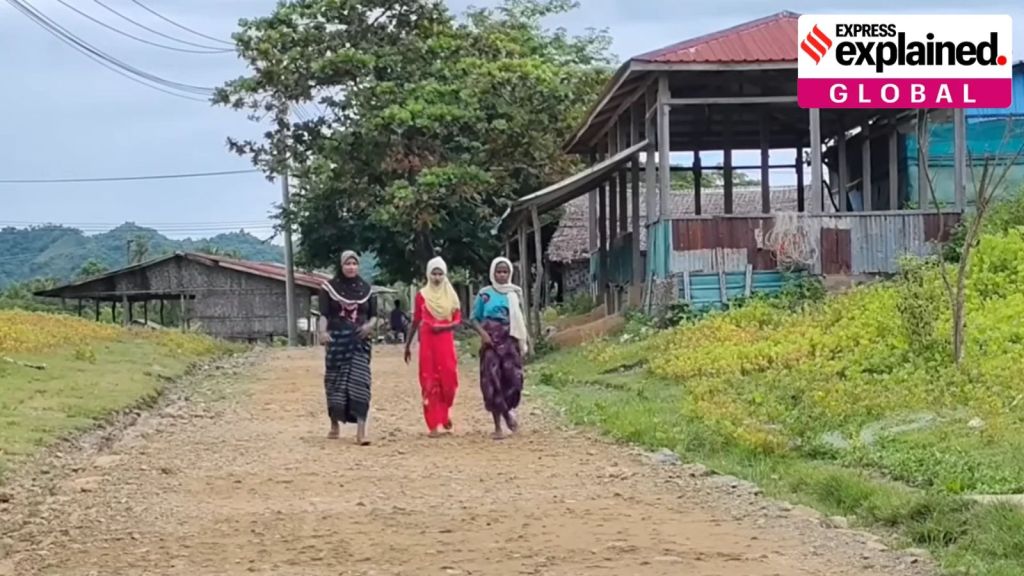
Reference image for the Rohingya crisis in Myanmar, providing context for the genocide case before the International Court of Justice—not a view of the reported judgment.
Image: Indian Express
Why in news
The reported judgment concludes a case instituted by The Gambia in 2019 under the Genocide Convention. It brings the gap between binding international adjudication and effective enforcement into focus.
9–6
Reported verdict division
At least 10,000
Rohingya killed in 2017, as reported
392
Villages destroyed, as reported
Over 730,000
Displaced by 2017 operations
More than 1.2 million
Rohingya in Bangladesh
Two years
Reported compliance-report deadline
Background
The Rohingya are a predominantly Muslim minority associated with Myanmar's Rakhine State, which borders Bangladesh. Their displacement is rooted in longstanding exclusion, denial of citizenship and successive military campaigns. The Genocide Convention obliges its parties to prevent and punish genocide, while the International Court of Justice, the principal judicial organ of the United Nations, adjudicates disputes between states on a recognised jurisdictional basis. Its determination of state responsibility is distinct from criminal proceedings against individuals.
What the reported judgment establishes
The supplied reports describe Myanmar as the first state held directly responsible by the ICJ for committing genocide. The qualification matters: direct commission is distinct from a state's failure to prevent or punish genocide, which can independently breach the Convention.
The Indian Express account describes directions to enact genocide legislation, prosecute those responsible, provide guarantees against repetition, facilitate safe return, restore property, search for disappeared persons and provide medical care. It also reports a requirement to submit a report within two years so that compensation can be determined. The judgment should therefore not be presented as an already quantified compensation award.
The court reportedly declined to order the grant of citizenship. This leaves a major implementation gap: physical return alone cannot resolve the legal exclusion that made the Rohingya vulnerable.
- State responsibility attaches to Myanmar as a state and is not extinguished merely by a change of government.
- The judgment does not itself constitute a criminal conviction of military commanders or political leaders.
- Restitution, compensation and guarantees of non-repetition address different dimensions of redress.
Infographic
Responsibility
State liability is distinct from individual criminal guilt.
Implementation
Binding orders need domestic action and international cooperation.
Safety
End persecution and verify protection in return areas.
Voluntariness
Ensure informed consent without coercion or deprivation.
Dignity
Secure legal status, equal rights, property and livelihoods.
Political settlement
Build inclusive, accountable and peaceful governance.
AI-assisted infographic by Pragnya IAS Academy, based on the cited sources.
Genocide: prohibited acts plus specific intent
Genocide requires specified acts committed with intent to destroy, in whole or in part, a national, ethnic, racial or religious group as such. Mass killing is not the only prohibited act: serious bodily or mental harm and deliberately imposed conditions calculated to bring about physical destruction can also qualify.
The decisive issue is specific intent. According to The Hindu account, where intent was inferred from conduct rather than an explicit plan, the court required genocidal intent to be the only reasonable inference from the established facts. It considered attacks on civilians, killing of children, firing on fleeing people and the wider history of discrimination.
A counter-insurgency justification cannot legalise prohibited acts against a protected group. However, forced displacement and genocide are not interchangeable legal categories: displacement may provide evidence, but the required intent to destroy must still be established.
- The Convention protects national, ethnic, racial and religious groups; political groups are not separately included.
- Cultural destruction is not a standalone category of genocide under the Convention, although it may be relevant evidence of intent.
- The Gambia's case illustrates the common legal interest of Convention parties in compliance, even without direct territorial injury.
State responsibility and the enforcement gap
The International Law Commission's 2001 Articles on State Responsibility provide the general framework for consequences of internationally wrongful acts. Article 1 establishes responsibility, Article 30 concerns cessation and appropriate assurances or guarantees of non-repetition, and Article 31 requires full reparation. The Articles are not themselves a treaty, although several provisions reflect customary international law.
Under Article 94(1) of the UN Charter, UN members undertake to comply with ICJ decisions in cases to which they are parties. Article 94(2) permits the other party to approach the Security Council over non-compliance. The Council may recommend or decide measures, but action is discretionary and substantive decisions can encounter a permanent-member veto.
The ICJ has no independent enforcement apparatus. Nevertheless, the absence of automatic coercion does not make its judgment advisory or legally optional. Diplomatic engagement, lawful collective pressure, domestic implementation and cooperation with accountability mechanisms remain relevant beyond the Security Council route.
- Articles 40 and 41 address serious breaches of obligations arising under peremptory norms, including cooperation to end such breaches and duties of non-recognition and non-assistance.
- The 1986 Nicaragua judgment illustrates how a permanent member's veto can obstruct Security Council-backed compliance.
- Possible Chinese or Russian protection of Myanmar is an enforcement risk identified by the sources, not an inevitable legal outcome.
Repatriation must restore rights, not merely move people
Safe return requires an end to persecution and credible protection against renewed violence. The Hindu reports that much of Rakhine is controlled by the Arakan Army, which also faces allegations of atrocities against the Rohingya. Commitments from Myanmar's central authorities alone therefore cannot establish safety across return areas.
Voluntariness requires an informed, uncoerced decision by refugees. Deteriorating assistance or restrictions in host locations must not be used to manufacture consent. Dignity requires secure legal status, freedom of movement, access to services, family unity and effective remedies for dispossession.
The editorial's call for a democratic, federal, plural and peaceful Myanmar is a structural political argument, not a formal treaty precondition labelled 'democracy'. Its substantive point is that return will remain fragile without equal rights, minority protection, civilian accountability and a political settlement.
- Independent assessment and continued monitoring should verify conditions before and after return.
- Citizenship reform and protection against statelessness are central to preventing renewed exclusion.
- Property restitution, documentation and livelihood support should accompany physical relocation.
- Refugees must participate meaningfully in designing and assessing any repatriation arrangement.
India's policy choices
India has legitimate interests in border stability, connectivity and relations with Myanmar and Bangladesh. These interests should be pursued alongside civilian protection and support for accountability, rather than by treating engagement with Myanmar's authorities as sufficient evidence of normalisation.
A practical approach would combine sustained humanitarian support, coordination with Bangladesh and relevant UN agencies, support for inclusive political dialogue, and insistence that any return be voluntary and independently assessed. Regional stability is better served by resolving exclusion than by repeatedly managing its displacement consequences.
- Maintain channels of engagement without overlooking abuses or legitimising discriminatory arrangements.
- Avoid treating refugee repatriation targets as substitutes for verified protection outcomes.
- Support humanitarian access and a political settlement that includes minority communities.
| Dimension | International Court of Justice | International Criminal Court |
|---|---|---|
| Institutional character | Principal judicial organ of the United Nations | Treaty-based criminal court established by the Rome Statute |
| Who faces proceedings | States in contentious cases | Individuals accused of crimes within its jurisdiction |
| Genocide-related function | Determines state breaches of the Genocide Convention where jurisdiction exists | Determines individual criminal responsibility where jurisdiction exists |
| Possible outcomes | Declarations of breach, cessation and reparation | Acquittal or conviction, sentence and applicable reparations |
| Implementation constraint | Relies on state compliance; the Security Council route is politically constrained | Relies substantially on state cooperation for arrests and enforcement |
- 1. The ICJ determines a treaty breach and specifies legal consequences.
- 2. Myanmar is obliged to comply and undertake domestic implementation.
- 3. Compliance must translate into cessation, redress and protection against repetition.
- 4. If Myanmar fails to comply, The Gambia may approach the Security Council under Article 94(2).
- 5. The Council may recommend or decide measures, subject to political agreement and veto constraints.
- 6. Diplomacy, humanitarian support and lawful accountability efforts remain necessary alongside the formal enforcement route.
1948
The Genocide Convention established treaty obligations to prevent and punish genocide.
1978
A military campaign drove large numbers of Rohingya into Bangladesh, according to the editorial.
1982
Myanmar's citizenship framework entrenched the exclusion of the Rohingya.
1991–92
Another military campaign caused substantial Rohingya displacement into Bangladesh.
2015
The Rohingya were disenfranchised, according to the editorial.
2017
Military clearance operations in northern Rakhine caused mass atrocities and displacement.
2019
The Gambia instituted proceedings against Myanmar under the Genocide Convention.
November 19, 2026
The supplied reports describe an ICJ judgment finding Myanmar responsible for committing genocide and ordering remedial measures.
Significance, challenges & way forward
Significance
- The reported ruling places responsibility on the state, rather than reducing atrocities to isolated misconduct by individual personnel.
- Judicial recognition strengthens victims' claims to truth, restitution, compensation and protection against repetition.
- The case demonstrates how treaty parties can invoke obligations protecting a common interest beyond bilateral injury.
- The judgment provides an authoritative legal record, although other courts must apply their own jurisdictional and evidentiary requirements.
- The crisis connects international justice with citizenship, minority rights and durable solutions to displacement.
Challenges
- Security Council discretion and veto politics can obstruct coercive enforcement of a binding judgment.
- Continuing conflict and fragmented territorial control make return guarantees difficult to implement.
- Denial of wrongdoing can undermine credible reporting, investigations and reparations.
- Citizenship exclusion and discriminatory restrictions can reproduce persecution even after physical return.
- Reduced international aid in Bangladesh risks worsening vulnerability and distorting refugees' choices.
Way forward
- Translate the judgment into verifiable implementation commitments covering protection, investigations, restitution and reporting.
- Sustain assistance in Bangladesh so that refugees are not pushed towards unsafe return by deprivation.
- Make repatriation conditional on independently verified safety and informed individual consent, not diplomatic deadlines.
- Pursue citizenship reform, equal rights, freedom of movement and effective remedies against discrimination.
- Ensure protection commitments extend to actors exercising effective control over potential return areas.
- Combine accountability with an inclusive political settlement and meaningful Rohingya participation.
Key terms
- Genocide
- Specified acts committed with intent to destroy, wholly or partly, a protected national, ethnic, racial or religious group as such.
- Specific intent
- The particular intent to destroy a protected group that distinguishes genocide from other international wrongs.
- State responsibility
- The international legal consequences of conduct attributable to a state that breaches an international obligation.
- Erga omnes partes obligations
- Treaty obligations owed to all parties collectively, giving each party a legal interest in their observance.
- Reparation
- Measures addressing injury caused by an internationally wrongful act, including restitution, compensation and satisfaction.
- Non-refoulement
- The principle prohibiting return to a place where a person faces persecution or other prohibited serious harm under applicable law.
- Statelessness
- The condition of not being considered a national by any state under the operation of its law.
Link with static syllabus
Prelims practice MCQs
Q1. Which of the following is not separately included among the groups protected by the Genocide Convention?
Q2. Consider the following statements about the International Court of Justice: Statement I: States are parties in its contentious proceedings. Statement II: It can impose prison sentences on military commanders. Which is correct?
Q3. Consider the following statements about Article 94 of the UN Charter: Statement I: UN members undertake to comply with ICJ decisions in cases to which they are parties. Statement II: The Security Council must automatically impose sanctions whenever an ICJ judgment is not implemented. Which is correct?
Q4. Consider the following statements about the ILC's 2001 Articles on State Responsibility: Statement I: They are themselves a treaty binding all UN members. Statement II: Several provisions reflect customary international law. Which is correct?
Mains practice questions
GS 2 · 15 marks · 250 words
A binding international judgment is necessary but insufficient for atrocity accountability. Discuss with reference to the reported ICJ verdict against Myanmar and the requirements for durable Rohingya repatriation.
Frequently asked questions
Does an ICJ genocide judgment convict Myanmar's leaders?
No. It determines Myanmar's responsibility as a state; criminal convictions of individuals require separate proceedings before a competent criminal court.
Is an ICJ judgment optional because the Court cannot directly enforce it?
No. A judgment in a contentious case is binding on the parties, but enforcement can depend on domestic compliance, international cooperation and politically constrained Security Council action.
Did the reported judgment settle citizenship and compensation?
The supplied Indian Express account says the court declined to order citizenship and required a report within two years so that compensation could be determined. It should not be described as having granted citizenship or fixed a final compensation amount.
What makes Rohingya repatriation sustainable?
Return must be safe, informed and voluntary, with secure legal status, equal rights, restored livelihoods and independent monitoring. Ending conflict and discriminatory exclusion is essential to preventing renewed displacement.
Sources
- The Hindu (Editorial): Just verdict: on Myanmar and the International Court of Justice
- Indian Express: Rohingya genocide: Why the ICJ's verdict against Myanmar may never be enforced
Analysis prepared by the Pragnya IAS Academy current-affairs desk with AI assistance from the cited reports. Verify figures with the original sources.
Turn current affairs into marks
Join Pragnya IAS Academy's mentorship for daily answer-writing evaluation on stories like this — classroom programmes from a trusted name in IAS coaching in Hyderabad.