
Parliament Reconvening: Delimitation, Women’s Reservation and Federal Representation
Revise the static topic: UPSC Polity notes · UPSC Governance notes
In short: The government has requested that the Lok Sabha reconvene on November 30, 2026, and the Rajya Sabha on December 2 for essential government business, with sittings expected to conclude on December 3. Reports indicate a renewed push on delimitation and women’s reservation, but the announcement does not identify specific Bills. The central constitutional questions concern representation among States, the conditions for implementing women’s reservation, and reconvening Houses that were adjourned but not prorogued.
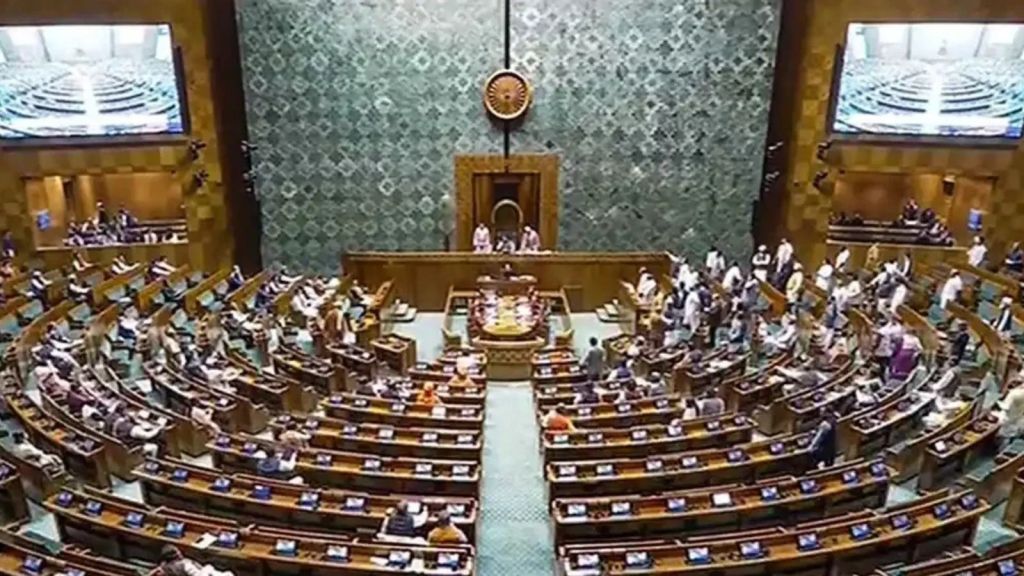
Reference view of India’s Parliament. The government has requested that the Lok Sabha reconvene on November 30, 2026, and the Rajya Sabha on December 2; the announcement does not identify specific Bills.
Image: Indian Express
Why in news
As of November 27, 2026, an amended delimitation package is reportedly being prepared after an earlier constitutional amendment failed in April. The Monsoon Session has remained unprorogued since both Houses adjourned sine die on August 13.
50%
Reported uniform increase in Lok Sabha seats
25 years
Reported extension of inter-State allocation freeze
1971 Census
Population basis for frozen inter-State seat allocation
2011 Census
Reported basis for redrawing constituencies within States
One-third
Women’s reservation under the constitutional framework
2023
Year women’s reservation amendment was passed
Background
Delimitation means fixing or readjusting the boundaries of territorial constituencies; the wider constitutional framework also governs allocation of legislative seats. Articles 81 and 82 address Lok Sabha representation and readjustment following a Census, while Article 170 governs State Legislative Assemblies. The existing framework separates the frozen allocation of Lok Sabha seats among States, based on the 1971 Census, from the later population basis used for constituency boundaries. The Constitution (Eighty-fourth Amendment) Act, 2001 extended the allocation freeze, while the Eighty-seventh Amendment enabled boundary readjustment using the 2001 Census. The Constitution (One Hundred and Sixth Amendment) Act, 2023 provides women’s reservation in the Lok Sabha, State Assemblies and the Delhi Assembly, with its operation linked to a subsequent Census and delimitation.
What is confirmed, and what remains a reported proposal?
The confirmed announcement concerns reconvening the Houses for essential government business. The Lok Sabha is to meet from November 30 and the Rajya Sabha from December 2, with both potentially concluding on December 3. The official announcement does not specify the legislative agenda.
The Hindu reports that the revised package may provide a uniform increase in Lok Sabha seats, extend the freeze protecting existing inter-State allocation, and use the 2011 Census to redraw constituencies within States. These are reported features, not enacted provisions; the precise constitutional and statutory changes must be assessed against the published text.
The Indian Express reports that the Constitution (131st Amendment) Bill, 2026 failed in the Lok Sabha in April. The accompanying Delimitation Bill and Union Territories Laws (Amendment) Bill were subsequently not taken up because the government treated them as linked measures.
- A Cabinet meeting was reported as scheduled for November 27; the supplied material does not establish that approval has occurred.
- Neither the final seat distribution nor the date of implementation can be inferred from the reports.
- The report’s comparison with the earlier freeze arrangement should not obscure that the proposal to use the 2011 Census is a distinct reported feature.
Infographic
State shares
Separate allocation among States from boundary revision within States.
Census trigger
The existing freeze is linked to post-2026 Census figures, not the calendar alone.
Women’s inclusion
Article 334A ties operation to the specified Census and delimitation sequence.
Federal consent
Changes to State representation require Article 368 safeguards and State ratification.
Parliamentary procedure
Adjournment suspends sittings; prorogation ends the session.
AI-assisted infographic by Pragnya IAS Academy, based on the cited sources.
The constitutional framework: population, seats and federal consent
Article 81 establishes population-based principles for allocating Lok Sabha seats among States and distributing constituencies within States, subject to constitutional qualifications. Article 82 provides for readjustment after a Census by an authority and in a manner determined by Parliament. Article 170 provides the corresponding framework for State Assemblies.
The present freeze is not scheduled to disappear merely because the calendar year 2026 ends. The relevant constitutional trigger is publication of the figures of the first Census taken after 2026. Actual readjustment must still follow the prescribed constitutional and statutory process.
An ordinary Delimitation Bill cannot override constitutional rules on allocation, population references or representation. A constitutional amendment requires, in each House separately, a majority of the total membership and at least two-thirds of members present and voting. An amendment changing the representation of States in Parliament also requires ratification by at least half of the State legislatures under Article 368.
- The required voting strength is not a fixed headline number: attendance and votes cast affect the present-and-voting threshold, while the total-membership requirement remains separate.
- There is no joint sitting to resolve disagreement between the Houses on a constitutional amendment.
- The exact ratification requirements should be checked against the provisions altered by the final package.
Federal representation: protecting shares while updating boundaries
The underlying tension is between population-based electoral equality and the concern that States which achieved lower population growth could lose relative influence in Parliament. The existing freeze prevents population changes from automatically determining a new inter-State distribution of seats.
A uniform proportional expansion could broadly preserve States’ relative shares while increasing their absolute representation. However, population differences would remain reflected in unequal numbers of people represented by each MP across States. Integer seat allocation also means that the precise formula matters.
Using a newer Census to redraw constituencies within States addresses a different problem: unequal constituency populations and changing settlement patterns. It does not, by itself, settle how many Lok Sabha seats each State should receive. Even the proposed 2011 baseline would need justification against subsequent demographic and urban changes.
- An increase in a State’s absolute seats does not necessarily prevent a decline in its relative parliamentary share.
- Inter-State allocation and intra-State boundary revision must be evaluated separately.
- Claims about individual States losing seats remain projections unless supported by an official allocation formula.
Women’s reservation: delimitation is an implementation condition
The 2023 amendment inserted Articles 330A and 332A for reservation in the Lok Sabha and State Assemblies, amended Article 239AA for Delhi, and inserted Article 334A governing operation. It provides, as nearly as may be, one-third reservation for women, including within seats reserved for Scheduled Castes and Scheduled Tribes.
Article 334A links operation to a delimitation exercise undertaken for this purpose after publication of the relevant figures of the first Census taken after commencement of the amendment. Consequently, the existing law is not made operational merely by announcing new parliamentary sittings or introducing a Delimitation Bill.
A proposal relying on the 2011 Census must explicitly address its compatibility with this constitutional trigger. If Parliament intends to change the trigger, it must amend the Constitution rather than attempt to bypass the condition through ordinary legislation.
- The reservation framework does not cover the Rajya Sabha or State Legislative Councils.
- The published package must clarify commencement, allocation of reserved constituencies and the applicable rotation framework.
- Women’s representation and federal representation are connected through the proposed package, but they remain distinct constitutional questions.
Adjournment, prorogation and the meaning of a special sitting
Adjournment suspends a House’s sitting without ending its session. Adjournment sine die means that no date has been fixed for the next sitting; it does not itself terminate the session. Since the Houses were not prorogued, their presiding officers can reconvene them under the applicable parliamentary rules.
Prorogation, ordered by the President under Article 85 on ministerial advice, terminates a session. A new session requires presidential summoning. The expression special sitting is descriptive and does not create a separate constitutional procedure or dilute legislative voting requirements.
Article 85 also limits the interval between the last sitting of one session and the first sitting of the next to six months. An unusually long unprorogued session raises questions about planning, transparency and legislative scrutiny, but the reported gap alone does not establish a constitutional violation.
- Prorogation does not by itself cause pending Bills to lapse.
- Dissolution ends the Lok Sabha’s tenure and attracts separate rules on the lapsing of Bills.
- The Rajya Sabha is a continuing House and is not subject to dissolution.
| Procedure | Authority | Effect |
|---|---|---|
| Adjournment | Presiding officer | Suspends a sitting; the session continues. |
| Adjournment sine die | Presiding officer | Ends a sitting without fixing the next date; the session remains open unless prorogued. |
| Prorogation | President | Terminates a session; pending Bills do not lapse merely for this reason. |
| Dissolution | President, or expiry of the Lok Sabha’s term | Ends the Lok Sabha; specified categories of pending Bills lapse. |
- 1. The first Census after commencement of the 2023 amendment is taken.
- 2. The relevant Census figures are published.
- 3. Delimitation is undertaken for the purpose of implementing women’s reservation.
- 4. Reserved constituencies are identified under the applicable constitutional and statutory framework.
- 5. Reservation operates in the relevant elections, subject to constitutional transition provisions.
2001
The Eighty-fourth Amendment extended the freeze on inter-State allocation of Lok Sabha seats.
2023
The women’s reservation constitutional amendment was passed, linking operation to a subsequent Census and delimitation.
April 2026
According to the supplied reporting, the constitutional amendment in the earlier package failed in the Lok Sabha; linked Bills were not taken up.
August 13, 2026
Both Houses adjourned sine die; the session remained unprorogued.
November 26, 2026
The Parliamentary Affairs Minister announced the request to reconvene the Houses for essential government business.
November 30–December 3, 2026
Proposed sitting window: Lok Sabha from November 30 and Rajya Sabha from December 2, with conclusion subject to government business.
Significance, challenges & way forward
Significance
- Delimitation determines the territorial distribution of democratic voice, not merely constituency boundaries.
- A negotiated allocation formula can reduce conflict between population-based representation and States’ concerns about demographic performance.
- Operationalising women’s reservation can broaden participation in directly elected legislatures.
- Separating State seat entitlements from constituency boundaries enables a more precise assessment of competing reform objectives.
- The proposed reconvening illustrates why a sitting, a session and the tenure of a House are legally distinct.
Challenges
- The absence of a published final draft prevents a definitive assessment of seat allocation, implementation dates and constitutional changes.
- Preserving existing State shares while expanding seats may retain significant inter-State differences in population per representative.
- Using the 2011 Census would require justification in light of later migration, urbanisation and population changes.
- A short sitting could constrain scrutiny of changes affecting electoral representation and the federal balance.
- The reported merger disputes and pending Speaker proceedings make political headcounts an uncertain guide to passage; legality must be assessed under the Tenth Schedule.
- Changing the Census or delimitation conditions for women’s reservation requires clarity about the relationship between constitutional amendments and ordinary legislation.
Way forward
- Publish the complete package with a clause-by-clause explanation distinguishing constitutional amendments from statutory provisions.
- Disclose State-wise allocation scenarios and explain their implications for both absolute seats and relative representation.
- Consult States across demographic and political divides, and secure State ratification where Article 368 requires it.
- Provide meaningful parliamentary scrutiny rather than treating the proposed sitting window as a substitute for deliberation.
- Specify an unambiguous, constitutionally valid implementation pathway for women’s reservation.
- Ensure that delimitation uses transparent criteria, public objections and an institutionally independent decision-making process.
Key terms
- Delimitation
- The fixing or readjustment of territorial constituency boundaries under a constitutional and statutory framework.
- Inter-State allocation
- The distribution of Lok Sabha seats among States.
- Intra-State delimitation
- The drawing or redrawing of constituency boundaries within a State.
- Population freeze
- A constitutional arrangement retaining an earlier population reference for specified representation calculations.
- Adjournment sine die
- Ending a sitting without fixing a date for the next sitting, without necessarily ending the session.
- Prorogation
- The President’s termination of a parliamentary session.
- Special majority under Article 368
- A majority of the total membership of a House together with at least two-thirds of its members present and voting.
- State ratification
- Approval by at least half of State legislatures for constitutional amendments affecting specified federal provisions.
Link with static syllabus
Prelims practice MCQs
Q1. With reference to parliamentary procedure, consider the following statements: 1. Adjournment sine die necessarily terminates a session of Parliament. 2. Prorogation is ordered by the President. 3. Pending Bills lapse solely because a House is prorogued. Which of the statements given above is/are correct?
Q2. Consider the following statements about delimitation: 1. Allocation of Lok Sabha seats among States and redrawing constituencies within a State are distinct exercises. 2. The existing constitutional freeze automatically ends on the last day of 2026. 3. Article 82 provides for readjustment following a Census through an authority and manner determined by Parliament. Which of the statements given above are correct?
Q3. Under the existing constitutional framework for women’s reservation, which of the following statements is correct?
Q4. With reference to Article 368, consider the following statements: 1. A constitutional amendment requires a majority of the total membership of each House and at least two-thirds of members present and voting. 2. A joint sitting may resolve a deadlock over a constitutional amendment. 3. An amendment changing the representation of States in Parliament requires ratification by at least half of State legislatures. Which of the statements given above are correct?
Mains practice questions
GS 2 · 15 marks · 250 words
Delimitation is simultaneously an exercise in electoral equality, federal accommodation and democratic inclusion. Discuss with reference to the reported delimitation proposals and the implementation of women’s reservation.
Frequently asked questions
Has Parliament approved the revised delimitation package?
The supplied material does not establish approval. As of November 27, 2026, it reports proposed sittings and likely legislation, while the official announcement refers only to essential government business.
Does the delimitation freeze automatically expire at the end of 2026?
No. The relevant constitutional condition concerns publication of the figures of the first Census taken after 2026; readjustment must then follow the applicable legal process.
Can the reported use of the 2011 Census automatically activate women’s reservation?
No. The existing Article 334A trigger requires a Census taken after commencement of the 2023 amendment and subsequent delimitation; a different pathway would require appropriate constitutional change.
Why can the Houses reconvene after adjournment sine die?
Adjournment sine die does not terminate a session. Because the Houses were not prorogued, their presiding officers can reconvene them under the applicable parliamentary rules.
Sources
- The Hindu: Amended Delimitation Bill likely to be tabled in special Parliament sitting from November 30
- Indian Express: Special Parliament session from next week amid delimitation, quota buzz
- Times of India: Opposition worried, feels government won’t risk another defeat
- Times of India: Special Parliament session from November 30; women’s quota on agenda
Analysis prepared by the Pragnya IAS Academy current-affairs desk with AI assistance from the cited reports. Verify figures with the original sources.
Turn current affairs into marks
Join Pragnya IAS Academy's mentorship for daily answer-writing evaluation on stories like this — classroom programmes from a trusted name in IAS coaching in Hyderabad.