
Rice Stock Declarations and Limits: Tackling Hoarding Without Hurting Farmers
Revise the static topic: UPSC Agriculture notes · UPSC Economy notes
In short: The Centre has mandated nationwide disclosure of rice and paddy stocks by specified commercial entities and authorised five southern States to impose stock limits amid rising prices. Together with additional public-stock releases, these measures seek to improve availability, but their effectiveness depends on distinguishing hoarding from legitimate storage and addressing regional and variety-specific shortages.
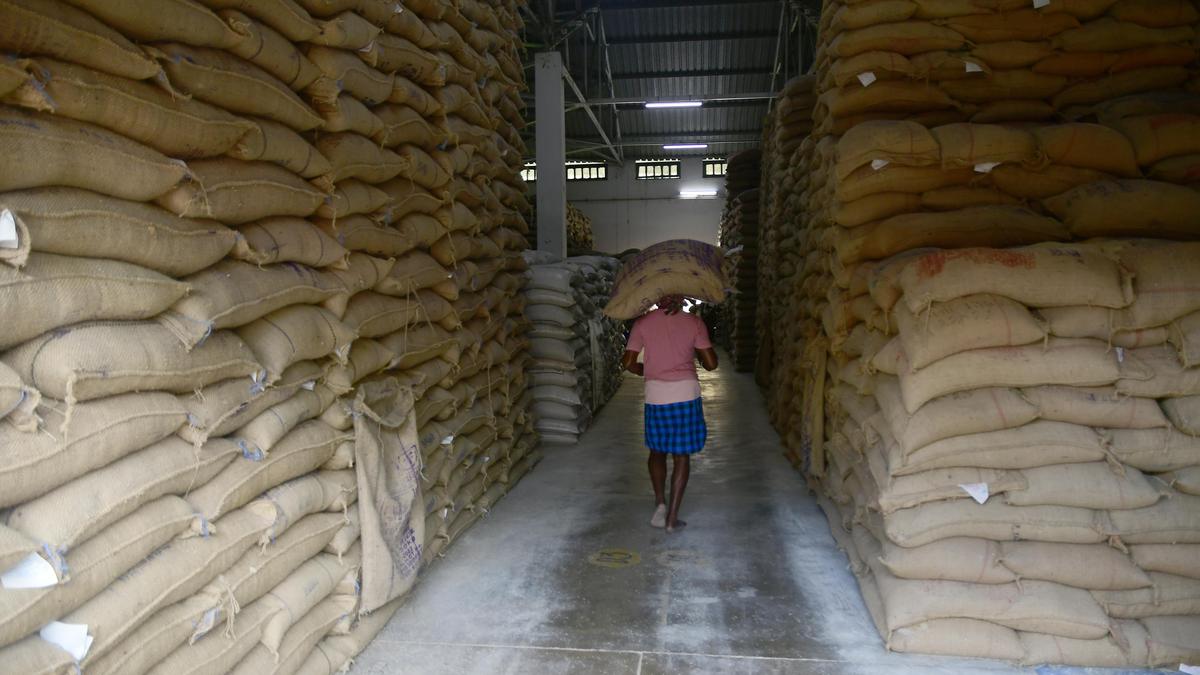
Rice and paddy stock declarations aim to improve market transparency as the Centre seeks to curb hoarding amid rising prices.
Image: The Hindu
Why in news
According to the supplied report, the Centre announced mandatory stock disclosures on November 7, 2026, following an order dated November 6. It separately consented to stock limits in Andhra Pradesh, Karnataka, Kerala, Tamil Nadu and Telangana, with the limits to remain in force until January 31, 2027.
8.25%
September retail rice inflation, year-on-year
5.89%
August retail rice inflation, year-on-year
50 lakh tonnes
Revised OMSS rice sales target for 2026-27
25 lakh tonnes
Previous OMSS rice sales target for 2026-27
42.68 million hectares
Reported kharif paddy acreage for 2026-27
147 million tonnes
Trade estimate of rice output for 2026-27
Background
Paddy is rice in its husk, while milling produces rice for consumption. Since harvests are seasonal but consumption continues throughout the year, storage by farmers, traders and millers performs an essential market function. India combines public procurement and buffer stocks with private trade to support food security. The Essential Commodities Act, 1955 provides a framework for regulating the production, supply and distribution of essential commodities. Stock declarations improve visibility of inventories; stock limits restrict the quantities that specified entities may hold. The two instruments serve different purposes and should not be treated as interchangeable.
What has been announced
The nationwide disclosure requirement covers traders, wholesalers, retailers, large retail chains, processors and millers across States and Union Territories. Every covered stockholding unit must update its inventory details on the Food Stock Portal every Friday.
Separately, the Centre has authorised Andhra Pradesh, Karnataka, Kerala, Tamil Nadu and Telangana to impose rice and paddy stock limits through control orders. Authorisation is not the same as a uniform nationwide ceiling: the supplied report does not specify numerical holding limits or establish that every authorised State has already issued its order.
- Declarations must distinguish Basmati rice, non-Basmati premium rice, non-Basmati rice, parboiled rice, broken rice and paddy.
- The reported duration of the authorised stock limits extends until January 31, 2027.
- The Centre is allocating additional rice to NAFED, NCCF and Kendriya Bhandar for sale as Bharat Rice.
- The OMSS rice sales target for 2026-27 has been raised from 25 lakh tonnes to 50 lakh tonnes.
Infographic
Transparency
Weekly, category-wise stock declarations
Targeted enforcement
Verify breaches rather than presume all storage is hoarding
Supply support
OMSS releases and Bharat Rice distribution
Farmer incentives
Protect legitimate procurement and farmgate returns
Periodic review
Assess regional prices, availability and continued need
AI-assisted infographic by Pragnya IAS Academy, based on the cited sources.
Why prices are rising: aggregate stocks versus local shortages
Retail rice inflation increased from 5.89% year-on-year in August to 8.25% in September. The report links price pressures to deficient and uneven rainfall, reduced paddy acreage and tighter supplies, particularly of premium non-Basmati varieties. Its output projection is a trade estimate, not an established final production figure.
Experts cited in the report describe government rice stocks as comfortable and reject the characterisation of a nationwide crisis. This distinction matters: adequate aggregate stocks can coexist with shortages in particular regions or varieties. Releasing ordinary rice may ease broad market pressure without fully correcting a premium-variety shortage.
- Price increases alone do not establish hoarding; weather-related supply losses can also raise prices.
- Variety-wise disclosures can reveal whether inventories are concentrated where prices are rising most sharply.
- Market releases must be assessed by location, quality and consumer preference, not merely aggregate tonnage.
Legal framework and cooperative enforcement
Section 3 of the Essential Commodities Act provides the principal power to regulate or prohibit production, supply and distribution through orders, while Section 7 provides penalties for contravention of orders made under Section 3. Trade, production, supply and distribution of foodstuffs fall within the Concurrent List, making Centre–State coordination important.
The supplied report cites Sections 6 and 7 in its enforcement warning. For legal precision, Section 6 concerns the overriding effect of orders under Section 3; confiscation provisions begin with Section 6A. Enforcement must therefore identify the applicable order, the specific breach and the relevant statutory procedure rather than treating every referenced section as a penalty provision.
- State control orders should clearly identify covered entities, permissible holdings and compliance requirements.
- Non-registration or non-compliance should be addressed under the applicable order and statutory safeguards.
- Verification, notice and reasoned action are necessary to distinguish genuine breaches from reporting errors.
Economic assessment: transparency first, calibrated restrictions next
Stock disclosure reduces information asymmetry and can help authorities identify unusual accumulation or discrepancies between reported stocks and market arrivals. Stock limits go further by constraining inventory holdings. They may encourage release of withheld supplies, but cannot replace grain lost through adverse weather.
Legitimate inventories support milling, transport and year-round supply. Overly restrictive ceilings could discourage purchases during harvest, weaken farmgate prices and increase supply-chain uncertainty. Predictable public-stock releases can complement enforcement by adding supply rather than relying solely on restrictions.
- Differentiate normal working stocks from deliberate withholding intended to exploit scarcity.
- Calibrate limits to milling capacity, seasonal procurement and normal business requirements.
- Track retail prices and farmgate prices together to identify who bears the cost of intervention.
- Use time-bound restrictions with periodic review to avoid making emergency controls permanent.
| Instrument | Primary function | Main limitation |
|---|---|---|
| Stock declaration | Makes covered private inventories visible to authorities | Accuracy depends on reporting, verification and compliance |
| Stock limit | Caps permissible holdings to discourage excessive accumulation | Poor calibration can disrupt legitimate storage and procurement |
| Public-stock release | Adds market supply through channels such as OMSS and Bharat Rice | Impact depends on timing, distribution and suitability of available rice |
- 1. Covered units report category-wise rice and paddy inventories every Friday.
- 2. Authorities compare declarations with prices, arrivals and normal business requirements.
- 3. Verification distinguishes reporting errors, legitimate storage and suspected violations.
- 4. Applicable control orders guide targeted enforcement where breaches are established.
- 5. Public-stock releases supplement supply in affected markets.
- 6. Price and availability trends guide review of restrictions.
August 2026
Retail rice inflation stood at 5.89% year-on-year.
September 2026
Retail rice inflation increased to 8.25% year-on-year.
October 31, 2026
Around 25 lakh tonnes of rice had been sold to private parties through OMSS, according to the report.
November 6, 2026
The stock-declaration order and separate consent letter for southern State stock limits were dated.
November 7, 2026
The Centre announced the stock-disclosure requirement and associated market interventions.
January 31, 2027
The announced period for the authorised rice and paddy stock limits ends.
Significance, challenges & way forward
Significance
- Regular inventory disclosure can improve the evidence base for food-price management.
- Coordinated Central and State action can address regional shortages more precisely than a uniform national response.
- Additional public-stock releases can protect consumers while reducing exclusive reliance on coercive controls.
- Category-wise monitoring recognises that rice markets differ by variety, processing and consumer preference.
Challenges
- Self-reported stocks require verification to prevent under-reporting or misclassification.
- Storage is economically necessary, making the distinction between normal inventories and hoarding crucial.
- Restrictive ceilings during procurement periods may reduce traders’ willingness to buy from farmers.
- Available public rice may not closely substitute for premium varieties facing the sharpest price increases.
- Differing State requirements can increase compliance uncertainty for businesses operating across markets.
- Supply losses caused by deficient rainfall cannot be fully corrected through enforcement alone.
Way forward
- Use declarations to map regional and variety-specific pressures before intensifying restrictions.
- Publish clear State control orders with realistic compliance periods and accessible guidance.
- Design ceilings around normal turnover, processing needs and seasonal procurement, with transparent review criteria.
- Combine targeted enforcement with predictable OMSS releases and effective Bharat Rice distribution.
- Monitor farmgate prices, market arrivals, retail prices and trader margins to assess distributional effects.
- Improve irrigation resilience, storage infrastructure and market connectivity to address recurring supply vulnerabilities.
Key terms
- Stock declaration
- Mandatory reporting of inventories held by specified entities to improve official visibility of supplies.
- Stock limit
- A legally prescribed ceiling on the quantity of a commodity that a covered entity may hold.
- Hoarding
- In this policy context, accumulation or withholding of supplies to exploit scarcity; ordinary commercial storage is not automatically hoarding.
- OMSS (Domestic)
- The Open Market Sale Scheme (Domestic), through which public foodgrain stocks are sold in the domestic market to improve availability.
- Bharat Rice
- Rice sold through designated agencies as a government-supported consumer supply intervention.
- Farmgate price
- The price received by a farmer at the point of sale before subsequent distribution and retail costs.
- Information asymmetry
- A situation in which market participants or regulators possess unequal information about conditions such as inventories.
Link with static syllabus
Prelims practice MCQs
Q1. With reference to the reported rice and paddy measures, consider the following statements: 1. The disclosure requirement covers specified commercial entities across States and Union Territories. 2. The Centre has imposed an identical numerical stock ceiling throughout India. 3. Covered stockholding units must update declarations every Friday. Which of the statements given above are correct?
Q2. Which of the following groups consists entirely of States authorised in the report to impose rice and paddy stock limits?
Q3. Consider the following pairs concerning the Essential Commodities Act, 1955: 1. Section 3: Power to regulate production, supply and distribution through orders 2. Section 6: Overriding effect of orders under Section 3 3. Section 7: Penalties for contravention of orders under Section 3 Which of the pairs given above are correctly matched?
Q4. With reference to agricultural market intervention, consider the following statements: 1. Stock declarations and stock limits perform identical regulatory functions. 2. Comfortable aggregate public stocks can coexist with shortages of particular rice varieties. 3. Excessively restrictive stock limits may discourage harvest-season procurement by private buyers. Which of the statements given above are correct?
Mains practice questions
GS 3 · 15 marks · 250 words
Stock declarations and stock limits can help stabilise food prices, but poorly designed controls may weaken agricultural markets. Discuss with reference to the recent rice and paddy measures.
Frequently asked questions
Does mandatory stock declaration itself impose a holding ceiling?
No. Declaration requires covered entities to report inventories; a stock limit separately restricts how much they may hold under an applicable control order.
Have uniform rice stock limits been imposed across India?
The supplied report does not establish uniform nationwide limits. It reports nationwide disclosures and Central consent for five southern States to impose limits through control orders.
Why can rice prices rise despite comfortable government stocks?
Stocks may not match the location or varieties facing scarcity. Weather-related supply disruption and consumer preferences can sustain regional or premium-variety price pressures.
How can anti-hoarding controls affect farmers?
If ceilings constrain legitimate harvest-season purchases, private buyers may reduce procurement and weaken farmgate prices. Calibration and review are therefore essential.
Sources
Analysis prepared by the Pragnya IAS Academy current-affairs desk with AI assistance from the cited reports. Verify figures with the original sources.
Turn current affairs into marks
Join Pragnya IAS Academy's mentorship for daily answer-writing evaluation on stories like this — classroom programmes from a trusted name in IAS coaching in Hyderabad.