
WMO Climate Warning: Earth’s Energy Imbalance and India’s Adaptation Priorities
Revise the static topic: UPSC Economy notes · UPSC International Relations notes
In short: The WMO State of the Climate Update 2026 indicates that 2026 is likely to be among the four warmest years on record, with January–September temperatures approximately 1.47°C above the pre-industrial average. Rising planetary heat accumulation, record ocean warmth, retreating glaciers and rising seas make heat preparedness and climate-resilient development urgent priorities for India.

Reference view of the ocean at sunset. Oceans store much of Earth’s excess heat; this photograph does not itself demonstrate record sea temperatures.
Image: UN News
Why in news
The WMO climate update, highlighted during COP31 in Antalya, Türkiye, warns that a very strong El Niño could sustain exceptional temperatures and extreme-weather risks into 2027. It estimates that approximately 146.5 million people in India were exposed to an extreme heatwave in April 2026.
1.47°C
January–September 2026 warming above pre-industrial average
90%
Approximate ocean share of excess heat absorption
426.8 ppm
Atmospheric carbon dioxide concentration in 2025
146.5 million
People exposed to India’s April 2026 extreme heatwave
10th consecutive year
Record ocean warmth projected for 2026
136 countries
Essential multi-hazard early warning systems in 2025
Background
The World Meteorological Organization is a specialised agency of the United Nations concerned with meteorology, climate, operational hydrology and related geophysical sciences. Earth’s climate depends on the balance between absorbed solar energy and energy emitted back to space. Greenhouse gases absorb and re-emit outgoing infrared radiation, warming the surface and lower atmosphere. Human-driven increases in these gases disturb the energy balance, while natural variability such as the El Niño–Southern Oscillation influences how heat is distributed between the ocean and atmosphere. The WMO update uses the average temperature of 1850–1900 as its pre-industrial reference.
What the WMO update establishes—and what remains provisional
The update places January–September 2026 global average surface temperature approximately 1.47°C above the pre-industrial average. It reports exceptional ocean warmth, record global sea level and continuing glacier retreat. The final ranking of 2026 is not yet settled because the observation period does not cover the full calendar year.
The report warns that the developing El Niño could increase temperatures further and influence extreme weather into 2027. This is a forecast, not confirmation that 2027 will set a temperature record. The final State of the Global Climate 2026 report is scheduled for March 2027.
- A partial-year average should not be treated as directly equivalent to a full-year average.
- A single year or shorter period near or above 1.5°C does not by itself establish that the Paris Agreement’s long-term temperature limit has been crossed.
- Global mean warming is not the temperature increase experienced uniformly by every location.
Infographic
Understand the driver
Positive energy imbalance means sustained planetary heat accumulation.
Track stored heat
Ocean warmth reveals climate stress beyond surface-temperature rankings.
Protect against heat
Connect forecasts with water, shade, worker safeguards and healthcare.
Secure coasts and mountains
Plan for rising seas, glacier-related hazards and cascading impacts.
Turn warnings into action
Fund local response while cutting emissions to limit future risk.
AI-assisted infographic by Pragnya IAS Academy, based on the cited sources.
Earth’s energy imbalance: the mechanism behind accumulating heat
Earth’s energy imbalance is the difference between incoming solar energy absorbed by the Earth system and outgoing energy radiated to space. A positive imbalance means that the planet gains more energy than it loses. The WMO update reports that this imbalance has reached its highest level since monitoring began, with the Earth system accumulating heat at an accelerating rate.
Higher greenhouse-gas concentrations impede the escape of outgoing infrared energy at a given temperature. The resulting excess energy warms the ocean, land and atmosphere and melts ice. The ocean absorbs approximately 90% of this excess heat, making ocean heat content a crucial indicator of sustained planetary warming rather than merely short-term weather.
El Niño principally redistributes existing heat between the tropical Pacific Ocean and atmosphere; it is not the underlying source of the long-term accumulation of planetary heat. By acting on an already warmer climate, it can amplify surface temperatures and alter rainfall and extreme-weather risks.
- Greenhouse-gas-driven warming and natural climate variability operate together, but they are not interchangeable explanations.
- Loss of reflective snow and ice can increase solar-energy absorption, reinforcing warming through the ice–albedo feedback.
- Surface temperature alone does not capture the full extent of heat stored within the Earth system.
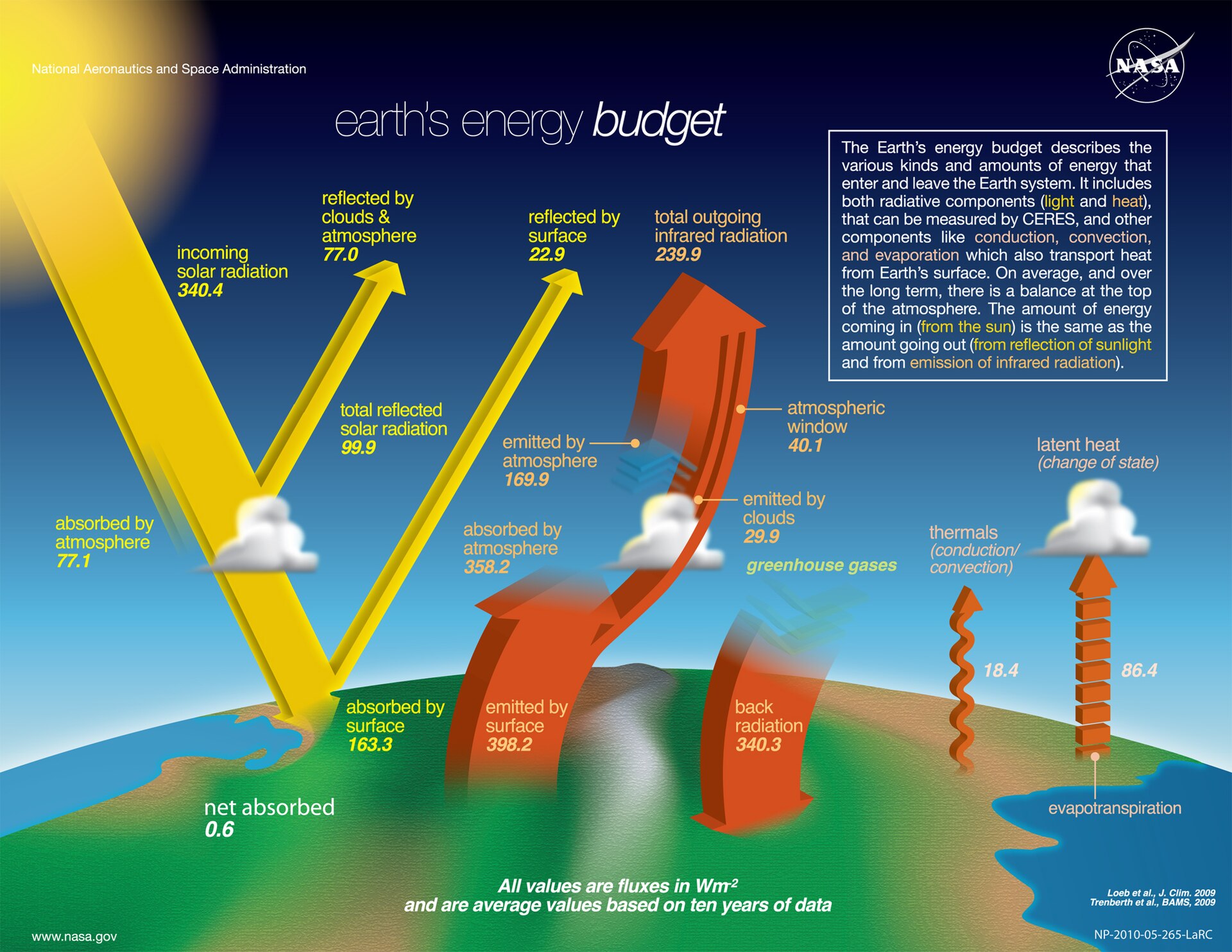
NASA diagram of Earth’s energy budget, showing incoming sunlight, reflected radiation and outgoing infrared heat. The illustrated fluxes explain heat accumulation, rather than reporting 2026 measurements.
Image: NASA · Public domain
Melting ice and rising seas: interconnected but distinct risks
Ocean warming raises sea level through thermal expansion, while melting land-based glaciers and ice sheets add water to the ocean. Floating sea-ice melt has little direct effect on sea level, although its loss affects reflectivity and polar ecosystems. These distinctions are important for understanding why ocean warming and cryosphere decline must be monitored together.
For India, higher mean sea level can worsen coastal inundation, erosion, saline intrusion and storm-surge impacts. Local consequences also depend on land subsidence, sediment supply, coastal ecosystems and settlement patterns; a global sea-level indicator cannot substitute for location-specific risk assessment.
In the Himalayas, glacier retreat and unstable ice, rock and glacial lakes can create cascading hazards. The update’s account of a catastrophic ice-and-rock collapse and downstream flash flood in Nepal illustrates regional mountain risks, but it should not be treated as a prediction of an identical event in India.
- Coastal adaptation requires both sea-level information and local assessments of exposure and vulnerability.
- Mountain risk management should connect glacier and lake monitoring with downstream warning and evacuation arrangements.
- Changes in glacier storage can affect the seasonal availability of water, with implications for ecosystems, agriculture and hydropower.

Reference view of mountain glaciers in Papua, Indonesia. Melting land ice contributes to sea-level rise, alongside the expansion of warming seawater.
Image: UN News
India’s adaptation challenge: convert climate information into protection
The estimated exposure of 146.5 million people during India’s April 2026 heatwave highlights the scale of heat risk. Exposure is not the same as illness or mortality. Health outcomes depend on humidity, duration, night-time temperatures, access to cooling and water, working conditions and the vulnerability of exposed people.
Heat action plans should therefore link forecasts to operational decisions by local governments, health departments, employers and utilities. Priority measures include drinking water, shaded rest spaces, work–rest arrangements, passive cooling, heat-illness surveillance and reliable essential services. Outdoor workers, older persons, children and residents of poorly ventilated housing need targeted protection.
The WMO reports an increase in countries with essential multi-hazard early warning systems from 55 in 2015 to 136 in 2025. This progress does not automatically establish that every vulnerable person receives or can act on a warning. India’s priority should be an end-to-end system combining observation, forecasting, understandable communication and funded local response.
- El Niño can influence the Indian summer monsoon, but it does not make drought inevitable; other ocean–atmosphere conditions also matter.
- Preparedness should address compound stresses such as heat alongside water scarcity or electricity disruption.
- Adaptation should complement emissions reduction because continued warming increases future risks and adaptation burdens.
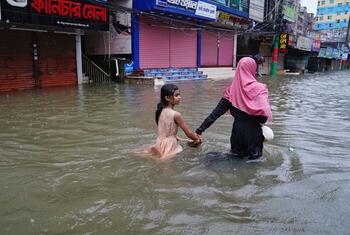
Reference view of a mother and child wading through floodwater in Feni, Bangladesh—not India. Flood exposure underscores the importance of early warnings, safe evacuation and resilient infrastructure across South Asia.
Image: UN News
| Climate signal | Mechanism or implication | Priority for India |
|---|---|---|
| Positive energy imbalance | Absorbed solar energy exceeds outgoing radiation, increasing stored planetary heat. | Use forward-looking climate risk in infrastructure and development planning. |
| Exceptional surface heat | Heat exposure can strain health, labour productivity and essential services. | Operationalise heat action plans, occupational safeguards and heat-health surveillance. |
| Ocean warming | Stored heat expands seawater and can support marine heatwaves. | Strengthen ocean observations and coastal ecosystem and livelihood preparedness. |
| Land-ice loss | Melting land ice contributes to sea-level rise; glacier changes can destabilise mountain terrain. | Monitor glaciers and glacial lakes and protect downstream settlements. |
| Rising sea level | A higher coastal water baseline can worsen inundation and storm-surge impacts. | Apply risk-sensitive coastal zoning, ecosystem restoration and resilient infrastructure. |
| Strong El Niño | Ocean–atmosphere heat redistribution can amplify warming and alter rainfall patterns. | Update seasonal advisories and contingency plans without assuming deterministic outcomes. |
- 1. Rising greenhouse-gas concentrations reduce outgoing infrared energy at a given temperature.
- 2. A positive planetary energy imbalance causes net heat accumulation.
- 3. The ocean stores most excess heat while the land and atmosphere warm and ice melts.
- 4. Ocean warming and land-ice loss raise sea level, while warming increases several climate-related hazards.
- 5. Exposure and vulnerability determine impacts on health, livelihoods, ecosystems and infrastructure.
- 6. Emissions reduction limits future warming, while anticipatory adaptation reduces harm.
1750
The source gives atmospheric carbon dioxide at approximately 278 ppm as a historical reference.
1850–1900
The average temperature of this period provides the pre-industrial baseline used in the update.
2015
The WMO comparison records 55 countries with essential multi-hazard early warning systems.
2025
Atmospheric carbon dioxide reached approximately 426.8 ppm, while reported early warning system coverage increased to 136 countries.
April 2026
Approximately 146.5 million people in India were exposed to an extreme heatwave, according to the update.
January–September 2026
Global average surface temperature was approximately 1.47°C above the pre-industrial average.
November 2026
The WMO update and UN warnings highlighted exceptional warming and adaptation needs during COP31 in Türkiye.
March 2027
The final State of the Global Climate 2026 report is scheduled for release.
Significance, challenges & way forward
Significance
- The energy-imbalance perspective explains why climate assessment must extend beyond annual surface-temperature rankings.
- Record ocean warmth indicates accumulated climate-system stress with consequences for sea level and marine ecosystems.
- India’s large reported heat exposure makes heat preparedness a public-health, labour-protection and development priority.
- Climate risks connect sectors: heat can affect health, electricity demand, water availability and agricultural livelihoods simultaneously.
- Expanded early warning systems show that protective capacity can improve, provided warnings lead to timely action.
Challenges
- Infrastructure designed only around historical conditions may be inadequate under a changing climate.
- Unequal access to safe housing, water, healthcare and cooling makes the same heat hazard more damaging for vulnerable groups.
- Warnings may fail to protect people who lack understandable information, safe shelter or the financial ability to stop working.
- Fragmented responsibility across health, labour, urban development, water and disaster-management authorities can weaken response.
- Energy-intensive cooling without efficiency and cleaner electricity can increase emissions and strain power systems.
- Global indicators and seasonal forecasts require careful translation into local decisions without overstating certainty.
Way forward
- Make heat action plans operational through assigned departmental responsibilities, budgeted measures and locally appropriate response triggers.
- Link IMD forecasts with health surveillance, hospital readiness and targeted communication to vulnerable communities.
- Protect outdoor workers through accessible water, shade, rest arrangements and emergency protocols adapted to local heat conditions.
- Prioritise passive building design, cool roofs, urban shade and efficient cooling while maintaining reliable essential electricity services.
- Integrate coastal inundation, glacier-related hazards and compound climate risks into land-use and infrastructure appraisal.
- Invest in sustained observations, open climate data and last-mile warning systems supported by drills and evacuation capacity.
- Combine domestic adaptation with faster emissions reduction and international demands for accessible climate finance and technology.
Key terms
- Earth’s energy imbalance
- The difference between absorbed incoming solar energy and outgoing radiation; a positive balance means net planetary heat gain.
- Ocean heat content
- The thermal energy stored in the ocean, distinct from temperature measured only at the sea surface.
- El Niño
- The warm phase of the El Niño–Southern Oscillation, involving anomalous warming in the central and eastern equatorial Pacific and associated atmospheric changes.
- Thermal expansion
- The increase in seawater volume as it warms, contributing to sea-level rise.
- Cryosphere
- The frozen components of the Earth system, including glaciers, ice sheets, sea ice, snow and permafrost.
- Compound climate risk
- Risk arising when multiple hazards or stressors interact, such as extreme heat occurring alongside water shortages.
- Exposure
- The presence of people, livelihoods, ecosystems or assets in places where hazards may affect them.
- Multi-hazard early warning system
- An integrated arrangement linking risk knowledge, monitoring, forecasting, warning communication and preparedness for multiple hazards.
Link with static syllabus
Prelims practice MCQs
Q1. With reference to Earth’s energy imbalance, consider the following statements: 1. A positive imbalance means that the Earth system absorbs more energy than it radiates to space. 2. The ocean absorbs most of the excess heat accumulating in the Earth system. 3. El Niño is the fundamental cause of the long-term increase in planetary heat associated with rising greenhouse-gas concentrations. Which of the statements given above are correct?
Q2. Consider the following pairs: 1. Warming seawater — Thermal expansion contributing to sea-level rise 2. Melting land-based glaciers — Addition of water to the ocean 3. Melting floating sea ice — A major direct addition to global sea level Which of the pairs given above are correctly matched?
Q3. Which of the following is the most accurate interpretation of a global temperature estimate for January–September?
Q4. With reference to climate adaptation, consider the following statements: 1. Issuing a technically accurate forecast alone is sufficient to constitute an effective early warning system. 2. Risk knowledge, warning communication and response capacity are essential components of effective early warning. 3. Heat exposure estimates are equivalent to confirmed heat-related mortality estimates. Which of the statements given above is/are correct?
Mains practice questions
GS 3 · 15 marks · 250 words
Explain Earth’s energy imbalance. In the light of the WMO’s warning on exceptional warming, discuss how India should integrate heat preparedness with coastal and Himalayan climate adaptation.
Frequently asked questions
What does Earth’s energy imbalance mean?
It means that the Earth system absorbs more solar energy than it releases to space. The resulting excess energy warms the ocean, land and atmosphere and melts ice.
Does El Niño create the additional heat driving long-term global warming?
El Niño principally redistributes existing heat between the ocean and atmosphere. Rising greenhouse-gas concentrations are the underlying driver of the long-term heat accumulation discussed in the WMO update.
Does the reported 1.47°C warming establish a breach of the Paris Agreement’s temperature limit?
No. The figure is a January–September global temperature anomaly, whereas the Paris temperature goal concerns long-term warming; even an individual year above 1.5°C would not alone establish a long-term breach.
What is the central lesson for India’s climate preparedness?
India should connect climate forecasts to funded protection for people, livelihoods and infrastructure. Heat action, coastal resilience and Himalayan hazard management should form an integrated adaptation strategy.
Sources
- The Hindu: 2026 to be one of four warmest years on record: World Meteorological Organization
- The Hindu: World entering ‘age of climate extremes’: UN chief
- UN News: ‘Exceptional’ extreme temperatures to continue into next year, UN reports
Analysis prepared by the Pragnya IAS Academy current-affairs desk with AI assistance from the cited reports. Verify figures with the original sources.
Turn current affairs into marks
Join Pragnya IAS Academy's mentorship for daily answer-writing evaluation on stories like this — classroom programmes from a trusted name in IAS coaching in Hyderabad.