
Delimitation Bills 2026: Women’s Quota, Federal Balance and Presidential Elections
Revise the static topic: UPSC Polity notes · UPSC Governance notes
In short: The proposed Constitution (132nd Amendment) Bill, 2026, and Delimitation (Second) Bill, 2026, seek to expand the Lok Sabha, preserve inter-State seat distribution through an extended freeze, and operationalise women’s reservation. Their significance extends beyond constituency boundaries to federal representation, the independence of delimitation and the relative influence of the two Houses in presidential elections.
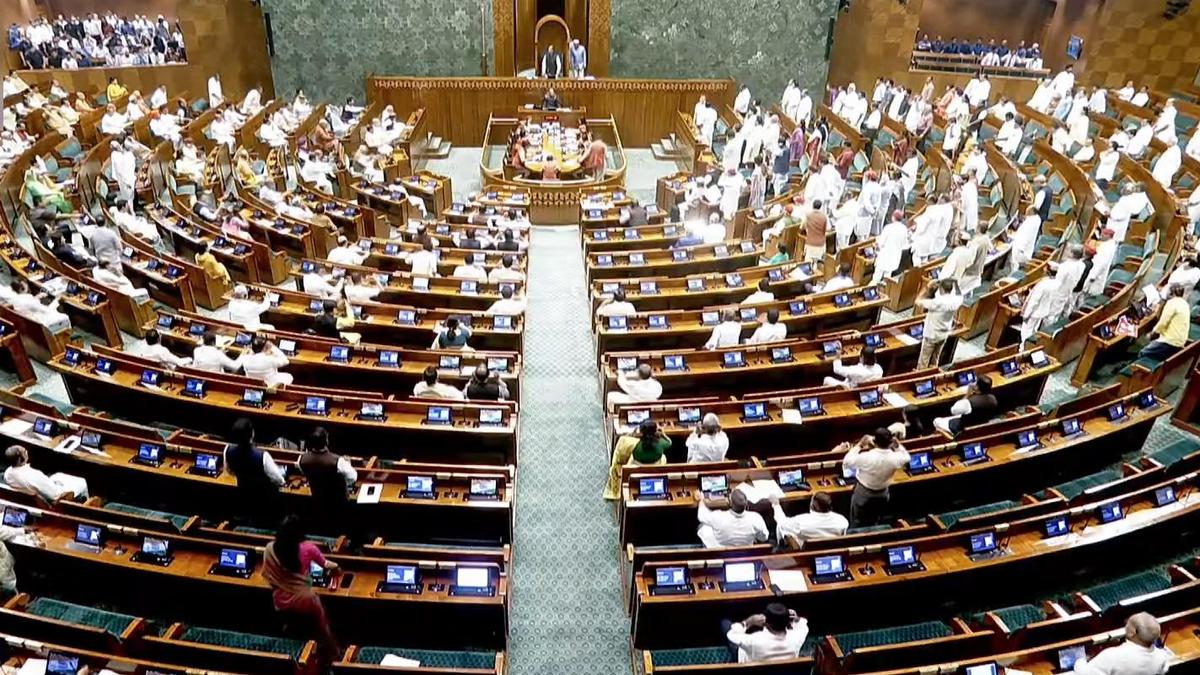
Photo from the source report: Delimitation Bills 2026: Women’s Quota, Federal Balance and Presidential Elections
Image: The Hindu
Why in news
Draft Bills were made public on November 27, ahead of the Lok Sabha session beginning November 30. In a November 28 letter, former civil servants, constitutional experts and civil society representatives sought a minimum 30-day consultation and stronger institutional safeguards.
850
Proposed Lok Sabha ceiling
650
Proposed State Assembly ceiling
2051
Proposed inter-State freeze horizon
2011
Proposed census basis for boundaries within States
33%
Women’s reservation described in the source
30 days
Minimum consultation sought
Background
Delimitation determines the territorial boundaries of electoral constituencies, while seat allocation determines how representation is distributed among States. Articles 81 and 82 govern Lok Sabha representation and its readjustment; Article 170 addresses State Assemblies. The existing constitutional framework freezes inter-State Lok Sabha seat allocation on the basis of the 1971 Census until the relevant figures of the first census taken after 2026 are published. This does not mean that constituency boundaries have remained unchanged since 1971: later exercises redrew boundaries without changing the frozen inter-State allocation. The Constitution (106th Amendment) Act, 2023, provides for women’s reservation in the Lok Sabha, State Assemblies and the Delhi Assembly, with implementation linked to a census-based delimitation process.
What the proposals seek to change
According to the supplied reports, the proposals envisage increasing the Lok Sabha from its present strength of 543 to a maximum of 850 and raising the ceiling for State Assemblies to 650. A higher constitutional ceiling permits expansion; it does not by itself establish the final strength of every legislature.
The reported design extends the freeze on inter-State Lok Sabha seat distribution until 2051, while using the 2011 Census to demarcate constituencies within each State. It also seeks to bring women’s reservation into operation through the delimitation exercise.
As of this edition, these are proposals, not enacted changes. The supplied material does not establish final State-wise allocations, the complete implementation schedule or the detailed operation of every clause.
- Distinguish the total size of the House from each State’s share of seats.
- Distinguish inter-State seat allocation from constituency demarcation within a State.
- Do not interpret a proposed ceiling as a confirmed final seat total.
Infographic
Representative capacity
Proposed Lok Sabha ceiling of 850; final allocation remains to be established.
Federal protection
Reported freeze until 2051 seeks to protect inter-State representation.
Census choice
The 2011 Census is proposed for boundaries within States.
Gender inclusion
Women’s reservation requires a constitutionally clear implementation route.
Bicameral balance
Lok Sabha expansion can reduce the Rajya Sabha’s presidential electoral share.
Procedural legitimacy
Independent delimitation, public consultation and parliamentary scrutiny are essential.
AI-assisted infographic by Pragnya IAS Academy, based on the cited sources.
Census basis and the federal bargain
Population-based representation promotes electoral equality, but reallocating seats according to newer population patterns could reduce the relative representation of States that have stabilised their populations. The proposed freeze seeks to protect the existing federal bargain while accommodating a larger Lok Sabha.
Maintaining States’ relative shares does not mean retaining their existing absolute seat counts. An enlarged House can provide additional seats while broadly preserving relative shares, although the final allocation method and rounding rules require scrutiny.
Using the 2011 Census for boundaries within States would separate the immediate exercise from publication of the Census 2027 figures. The trade-off is between earlier implementation and the representational accuracy of older data, especially in areas affected by migration and urbanisation.
- Federal protection concerns States’ relative political weight, not merely whether any State loses existing seats.
- Population equality and protection of States’ interests are related but distinct constitutional objectives.
- Clear rules are needed for the eventual transition beyond the proposed freeze.
Women’s reservation and the constitutional route
The women’s reservation amendment already provides the constitutional framework for reserving seats for women. Article 334A links its commencement to delimitation undertaken after publication of the relevant figures of the first census taken after that amendment’s commencement.
The reported proposal to use an earlier census and activate reservation therefore requires scrutiny of the accompanying constitutional changes. An ordinary delimitation law cannot, on its own, override an existing constitutional condition.
Article 368 requires a special parliamentary majority for constitutional amendments. Amendments affecting the representation of States in Parliament also require ratification by at least half of the State legislatures. Federalism and democracy remain relevant basic-structure constraints.
- The existing women’s reservation framework covers the Lok Sabha, State Assemblies and the Delhi Assembly.
- It does not create a corresponding reservation in the Rajya Sabha or State Legislative Councils.
- Gender inclusion should be implemented through clear constitutional sequencing rather than treated as a substitute for scrutiny of delimitation.
Presidential elections and the bicameral balance
Under Article 54, the President is elected by elected members of both Houses of Parliament and elected members of State Legislative Assemblies, including those of Delhi and Puducherry. Nominated members and members of State Legislative Councils do not participate. Article 55 provides for weighted votes rather than equal vote values for all electors.
An MLA’s vote value depends on the applicable population base and the number of elected Assembly members. If an Assembly expands while that population base remains unchanged, the value of each MLA’s vote generally falls, while the State’s aggregate value remains broadly stable, subject to rounding. The common value of an elected MP’s vote is derived from the aggregate MLA vote value and the total number of elected MPs.
Consequently, expanding the Lok Sabha without a corresponding Rajya Sabha expansion can lower each MP’s vote value and reduce the Rajya Sabha’s aggregate share of the parliamentary component. An elected Rajya Sabha MP would nevertheless retain the same individual vote value as an elected Lok Sabha MP. This change concerns presidential electoral influence; it does not automatically diminish the Rajya Sabha’s legislative powers.
- A larger electoral college does not necessarily mean a proportionately larger aggregate vote value.
- Lower individual vote values do not automatically imply a loss of a State’s relative electoral weight.
- The supplied reports do not provide enough information to calculate revised vote values.
Delimitation safeguards and meaningful consultation
The November 28 letter identifies unresolved concerns about the Delimitation Commission’s independence, transparency and accountability. It specifically flags reported Union government control over the appointment of the chairperson and determination of tenure, alongside risks of partisan boundary drawing.
The signatories invoke the 2014 Pre-Legislative Consultation Policy, which provides for publication of draft legislation with explanatory material for at least 30 days. Their demand also includes publication in English, Hindi and major regional languages. This policy-based consultation expectation should not be confused with the constitutional requirements for passing an amendment.
Article 329(a) restricts judicial challenges to laws relating to delimitation or seat allotment made, or purported to be made, under Articles 327 and 328. This strengthens the case for effective safeguards before boundaries are finalised; it should not be read as blanket immunity for every constitutional issue connected with the exercise.
- Publish proposed maps, population data and reasons for boundary choices.
- Provide accessible hearings and reasoned responses to objections.
- Use parliamentary committee examination and structured consultations with States to build legitimacy.
| Issue | Reported proposal or mechanism | Principal scrutiny point |
|---|---|---|
| Lok Sabha strength | Expansion to a maximum of 850 | Final allocation, legislative capacity and constituency accessibility |
| Inter-State distribution | Extension of the freeze until 2051 | Protection of relative State shares and the eventual transition |
| Boundaries within States | Use of the 2011 Census | Population shifts, transparent criteria and partisan manipulation |
| Women’s reservation | Operationalisation through delimitation | Compatibility with constitutional commencement requirements |
| State Assemblies | Ceiling increased to 650 | Actual State-wise expansion and its institutional implications |
| Presidential election | More electors and recalculated individual vote values | State weight, Union-State parity and the Rajya Sabha’s aggregate share |
- 1. Actual expansion increases the number of elected MPs and, where Assemblies expand, elected MLAs.
- 2. With an unchanged applicable population base, a larger Assembly generally means a lower vote value per MLA.
- 3. Aggregate State vote values remain broadly stable, subject to statutory rounding.
- 4. The aggregate MLA vote value is distributed across a larger number of elected MPs to determine their common vote value.
- 5. Without Rajya Sabha expansion, its members form a smaller share of the parliamentary electoral component.
1971
The Census provides the population basis underlying the frozen inter-State allocation of Lok Sabha seats.
1976
The constitutional freeze on inter-State seat readjustment is introduced.
2001
The freeze is extended through a constitutional amendment.
2023
Parliament approves the constitutional framework for women’s reservation linked to a subsequent census-based delimitation.
April 2026
Earlier Bills are introduced and debated, according to the supplied reports.
November 27, 2026
The revised draft Bills are placed in the public domain.
November 28, 2026
Civil society representatives and former officials seek deferral and a minimum 30-day consultation.
November 30, 2026
The Lok Sabha session is scheduled to begin; this is not an established date of passage.
Significance, challenges & way forward
Significance
- A larger Lok Sabha can improve constituency accessibility if additional seats reduce representational burdens.
- Protecting relative State shares can reconcile parliamentary expansion with concerns arising from uneven population growth.
- Operationalising women’s reservation can broaden participation in directly elected legislatures.
- The proposals reveal how legislative size affects institutions beyond Parliament, particularly the presidential electoral college.
- Transparent delimitation can strengthen electoral legitimacy by making boundary decisions publicly verifiable.
Challenges
- Older census data may inadequately reflect migration, urban growth and population shifts within States.
- A freeze protects an existing federal compromise but postpones rather than resolves the long-term allocation dilemma.
- Executive influence over appointments and tenure can weaken confidence in the Delimitation Commission’s independence.
- Partisan boundary drawing can distort electoral competition even when inter-State seat shares remain protected.
- Lok Sabha expansion without Rajya Sabha expansion can reduce the latter’s relative influence in presidential elections.
- Compressed consultation can undermine informed parliamentary scrutiny and public acceptance.
- A larger legislature requires stronger committee systems, research support and procedural capacity.
Way forward
- Provide the minimum 30-day consultation sought, with accessible explanatory notes and translations in major regional languages.
- Refer the Bills to a parliamentary committee and formally consult State governments and political parties.
- Publish State-wise seat-allocation illustrations and presidential vote-value simulations before final decisions.
- Specify objective boundary criteria and disclose maps, data, objections and reasoned responses.
- Strengthen the Commission’s independence through transparent appointments and secure, clearly defined tenure.
- Explain precisely how the proposed census basis and women’s reservation commencement conditions fit together constitutionally.
- Assess bicameral consequences separately from Lok Sabha expansion rather than assuming the Rajya Sabha is unaffected.
- Create a predictable framework for reviewing the freeze before its proposed endpoint.
Key terms
- Delimitation
- The determination or readjustment of territorial boundaries of electoral constituencies.
- Seat allocation
- The distribution of legislative seats among territorial units, distinct from drawing constituency boundaries.
- Inter-State freeze
- A constitutional restriction on population-based readjustment of seats among States.
- Gerrymandering
- Manipulation of electoral boundaries to advantage a party or group.
- Weighted electoral college
- An electoral body in which members’ votes carry values determined by constitutional rules rather than necessarily counting equally.
- Bicameralism
- A legislative structure with two Houses performing distinct and overlapping representative functions.
- Pre-legislative consultation
- Public and stakeholder scrutiny of draft legislation before its introduction or consideration.
- Basic structure doctrine
- The principle that constitutional amendments cannot destroy the Constitution’s essential features.
Link with static syllabus
Prelims practice MCQs
Q1. With reference to the election of the President of India, consider the following statements: 1. Elected members of the Rajya Sabha participate in the electoral college. 2. Nominated members of the Lok Sabha participate in the electoral college. 3. Elected members of State Legislative Councils participate in the electoral college. Which of the statements given above is or are correct?
Q2. Consider the following statements about delimitation: 1. Inter-State allocation of Lok Sabha seats and demarcation of constituencies within a State are distinct exercises. 2. A freeze on inter-State seat allocation necessarily prohibits every change in constituency boundaries. 3. A higher constitutional ceiling does not by itself establish the final strength of every legislature. Which of the statements given above are correct?
Q3. If the Lok Sabha expands without a corresponding expansion of the Rajya Sabha, and the aggregate MLA vote value remains broadly unchanged, which outcome is most consistent with Article 55?
Q4. With reference to women’s reservation and constitutional amendment, consider the following statements: 1. Article 334A links commencement of women’s reservation to a census-based delimitation process. 2. An ordinary parliamentary law can override this constitutional commencement condition without a constitutional amendment. 3. Constitutional amendments affecting the representation of States in Parliament require State ratification under Article 368. Which of the statements given above are correct?
Mains practice questions
GS 2 · 15 marks · 250 words
Delimitation is not merely a technical exercise in redrawing constituencies but a constitutional negotiation over representation. Examine with reference to the proposed delimitation package, women’s reservation and presidential elections.
Frequently asked questions
Has the Lok Sabha already been expanded to 850 seats?
No. The supplied reports describe a proposed maximum of 850; they do not establish enactment or a final operative seat allocation.
Why do the proposals refer to both the 1971 and 2011 Censuses?
The 1971 Census underlies the frozen inter-State seat allocation. The proposed use of the 2011 Census concerns constituency boundaries within States, a different representational exercise.
Would a Rajya Sabha MP’s presidential vote become less valuable than a Lok Sabha MP’s vote?
No. Elected MPs of both Houses have the same individual vote value; the concern is that the Rajya Sabha’s aggregate share would decline if only the Lok Sabha expands.
Does women’s reservation require constitutional implementation steps beyond passage of the original amendment?
Yes. Article 334A links commencement to a specified census-based delimitation process, so the proposed earlier-census route must be examined alongside the accompanying constitutional changes.
Sources
- The Hindu: New Bills will expand Presidential electoral college, dilute value of MP-MLA votes
- The Hindu: Former civil servants, activists seek 30-day consultation on 132nd Constitution Amendment, Delimitation Bills
- The Hindu (Editorial): Fair play: on a hurried delimitation of Lok Sabha constituencies
- Indian Express: Delimitation Bill full text: 850 Lok Sabha seats, women's quota, 25-year freeze
Analysis prepared by the Pragnya IAS Academy current-affairs desk with AI assistance from the cited reports. Verify figures with the original sources.
Turn current affairs into marks
Join Pragnya IAS Academy's mentorship for daily answer-writing evaluation on stories like this — classroom programmes from a trusted name in IAS coaching in Hyderabad.