
India–Denmark Action Plan 2027–31: Green Partnership, Defence and Europe Ties
Revise the static topic: UPSC International Relations notes
In short: India and Denmark have adopted a Joint Action Plan for 2027–31 to broaden cooperation in defence, emerging technologies, space and mobility of people, building on their Green Strategic Partnership. The plan connects bilateral cooperation with India’s development priorities and wider European engagement, while the formal announcement of an elevated Comprehensive Green Strategic Partnership remains pending.
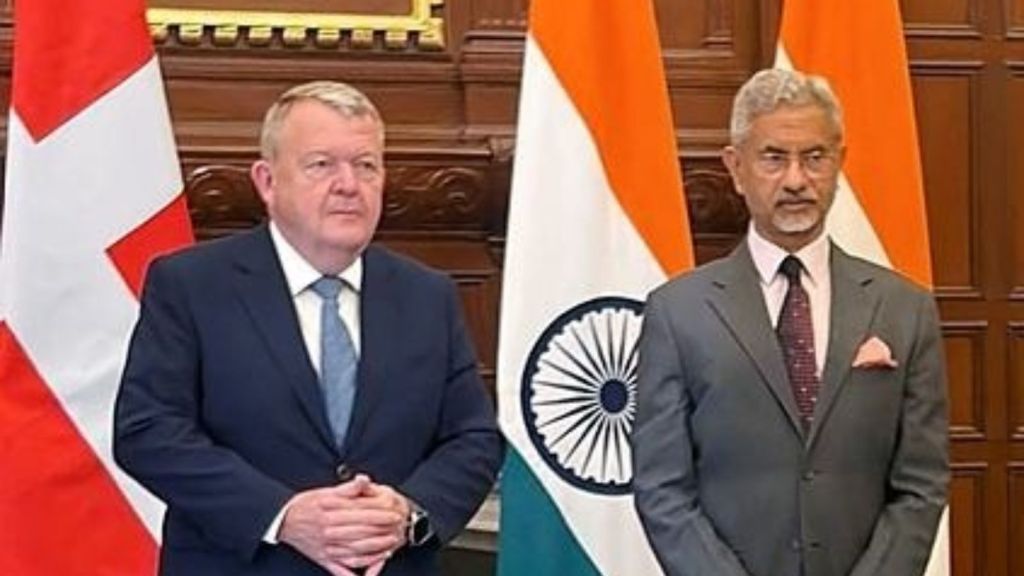
External Affairs Minister S. Jaishankar meets Danish Foreign Minister Lars Løkke Rasmussen in New Delhi. India and Denmark have adopted a Joint Action Plan for 2027–31 to broaden bilateral cooperation. Photo: ANI.
Image: Indian Express
Why in news
External Affairs Minister S Jaishankar and visiting Danish Foreign Minister Lars Lokke Rasmussen adopted the new action plan and witnessed exchanges of instruments covering skills, culture and financial regulation. They also agreed to initiate new Tech and Climate Dialogues.
2027–2031
New action plan period
2020
Green Strategic Partnership established
2047
Viksit Bharat target cited
Background
India and Denmark established their Green Strategic Partnership in 2020. Denmark is a Nordic country and a member of both the European Union and NATO, with established capabilities in wind energy and clean technologies. The partnership offers a framework for linking India’s development and sustainability requirements with Danish expertise and business participation. Bilateral engagement complements, rather than substitutes for, India’s relations with the EU: Denmark can facilitate sectoral cooperation and political support, while EU-level institutions shape the bloc’s common trade policy.
What has been agreed, and what remains pending
The ministers adopted the Joint Action Plan for 2027–31 to guide the next phase of bilateral cooperation. They looked forward to a later prime ministerial-level announcement of an elevated Comprehensive Green Strategic Partnership; the elevation should therefore not be described as already formally announced.
The meeting combined a forward-looking roadmap with specific institutional instruments. The source reports the exchange of renewed arrangements on skills and culture, alongside an MoU between the International Financial Services Centres Authority and the Danish Financial Supervisory Authority.
- New Tech and Climate Dialogues are to be initiated.
- The renewed skills MoU covers skill development, vocational education and entrepreneurship.
- The renewed Cultural Exchange Programme supports people-to-people engagement.
- The detailed obligations under the financial-regulatory MoU are not specified in the supplied report.
Infographic
Green foundation
Build on the 2020 partnership through a new Climate Dialogue.
Security
Explore defence cooperation and deepen maritime-security dialogue.
Technology
Initiate a Tech Dialogue and explore space cooperation.
Economic links
Connect bilateral business ties with wider India–EU opportunities.
People and skills
Advance vocational cooperation and healthcare mobility.
Delivery
Implement the 2027–31 roadmap; formal partnership elevation remains pending.
AI-assisted infographic by Pragnya IAS Academy, based on the cited sources.
Defence and space: Diversification without an alliance commitment
The two countries agreed to explore further defence and security cooperation, welcomed the inaugural Maritime Security Dialogue held in June 2026, and sought stronger dialogue on defence industry and counterterrorism. This broadens the relationship beyond its green-development foundation but does not establish a military alliance or confirm defence procurement contracts.
Rasmussen’s Bengaluru engagements illustrate possible industrial and technological linkages. At HAL, he visited facilities associated with Indian aviation programmes; the report states that components from Danish company HBK are used in the Dhruv Advanced Light Helicopter and the Light Combat Helicopter. His interaction with senior ISRO officials covered space cooperation.
- Existing component linkages provide a practical basis for exploring deeper industrial cooperation.
- Maritime dialogue could help build a shared understanding of risks affecting sea-based commerce.
- Future projects would need clarity on export controls, technology access, intellectual property and end-use conditions.
- Visits and discussions should not be equated with agreed joint production or technology-transfer commitments.
Trade, technology and mobility: Connecting markets with capabilities
The ministers recognised the potential for stronger trade and investment under the India–EU Free Trade Agreement. Jaishankar referred to its conclusion, while the Danish readout looked forward to its upcoming signing. These statements do not establish that the agreement has entered into force or that tariff concessions are already operational.
The proposed Tech Dialogue can provide a platform for identifying mutually useful emerging-technology partnerships, while the Climate Dialogue can retain the green transition as the relationship’s organising principle. Financial-regulatory cooperation may support a more predictable investment environment, but specific financing commitments are not reported.
The ministers also welcomed the January 2026 agreement concerning training and recruitment of healthcare professionals from Kerala. Together with renewed skills cooperation, this creates scope for linking workforce preparation with overseas demand, subject to professional recognition, language requirements and worker protection.
- Bilateral commercial cooperation can prepare firms to use future EU-level trade opportunities.
- Technology partnerships should prioritise deployment, affordability and domestic capability creation.
- Healthcare mobility should balance overseas opportunities with workforce needs in India.
Strategic assessment: A sectoral bridge to Europe
Denmark’s advocacy of a stronger European partnership with India reflects the value it attaches to India’s economic and geopolitical rise amid global uncertainty. For India, cooperation with a specialised European economy can widen access to technology, investment and industrial networks without requiring an exclusive strategic alignment.
The ministers discussed Ukraine, the Middle East and the Indo-Pacific, and reaffirmed international law, the UN Charter, rules-based trade and a rules-based international order. Such shared principles support dialogue but should not be treated as proof of identical positions on every conflict.
The action plan’s strategic merit lies in adding defence, technology and mobility to the green partnership rather than displacing its original purpose. Its effectiveness will depend on whether broader diplomatic ambition produces implementable projects and durable institutional coordination.
- Denmark can act as a sectoral bridge within India’s wider European engagement, but cannot replace EU-level negotiations.
- Green cooperation should remain central as the agenda expands.
- Issue-based cooperation is compatible with India’s strategic autonomy.
| Area | Reported development | Status or analytical caution |
|---|---|---|
| Overall partnership | Joint Action Plan for 2027–31 adopted | Formal announcement of the elevated partnership is expected later at prime ministerial level. |
| Defence and security | Further cooperation to be explored; defence-industry and counterterrorism dialogue to be strengthened | No new procurement contract or joint-production agreement is reported. |
| Technology and climate | New Tech Dialogue and Climate Dialogue agreed | Specific projects, funding and delivery targets are not detailed. |
| Trade | Ministers highlighted opportunities under the India–EU FTA | Conclusion was referenced and signing was anticipated; entry into force is not established. |
| Skills and mobility | Skills MoU renewed; Kerala healthcare training and recruitment agreement welcomed | Professional recognition and worker safeguards remain important implementation considerations. |
| Financial regulation | MoU exchanged between IFSCA and the Danish Financial Supervisory Authority | Detailed regulatory obligations are not provided in the report. |
- 1. Translate the adopted action plan into sector-specific priorities.
- 2. Use bilateral dialogues to identify projects and regulatory obstacles.
- 3. Assign responsible agencies and involve businesses, researchers and relevant Indian states.
- 4. Resolve financing, standards, skills and technology-access requirements.
- 5. Review delivery against agreed outcomes and address implementation gaps.
2020
India and Denmark established the Green Strategic Partnership.
January 2026
An agreement was signed on training and recruitment of healthcare professionals from Kerala.
May 2026
Prime Ministers Narendra Modi and Mette Frederiksen met in Oslo.
June 2026
The inaugural India–Denmark Maritime Security Dialogue was held.
Latest ministerial meeting
The foreign ministers adopted the Joint Action Plan for 2027–31 and agreed to initiate Tech and Climate Dialogues.
2027–2031
The adopted action plan is intended to guide the next phase of bilateral cooperation.
Significance, challenges & way forward
Significance
- The action plan expands a green-focused partnership into a broader framework covering economic, technological and security cooperation.
- Danish expertise and business participation can support India’s development and sustainability priorities.
- Defence-industry and space engagement create opportunities to diversify international technological relationships.
- Skills cooperation and healthcare recruitment connect foreign policy with employment opportunities and human-capital development.
- Bilateral cooperation reinforces India’s wider European engagement while preserving scope for issue-based strategic autonomy.
Challenges
- A wider agenda may disperse administrative attention unless priorities and responsibilities are clearly defined.
- Technology cooperation may encounter intellectual-property restrictions, export controls and commercial confidentiality concerns.
- Trade gains cannot be assumed before relevant agreement procedures and implementation requirements are completed.
- Professional licensing, language proficiency and ethical recruitment requirements can constrain healthcare mobility.
- Shared support for international law does not eliminate differences over geopolitical conflicts.
- The supplied material does not provide project-wise budgets or quantified delivery benchmarks, limiting assessment of implementation readiness.
Way forward
- Create a jointly monitored project pipeline with clearly assigned institutions, milestones and outcome indicators.
- Keep clean technology and climate implementation central while integrating defence, space and emerging technologies.
- Prepare Indian firms, including MSMEs, for European standards and potential trade opportunities without assuming immediate tariff benefits.
- Pursue feasible industrial and research projects with explicit arrangements for intellectual property, technology access and commercialisation.
- Develop transparent healthcare recruitment pathways with recognition support, worker safeguards and attention to domestic staffing needs.
- Involve Indian states and technical institutions so that bilateral commitments translate into local skills, investment and service-delivery gains.
Key terms
- Green Strategic Partnership
- The India–Denmark cooperation framework established in 2020, centred on green development and sustainability.
- Joint Action Plan
- A time-bound roadmap for implementing agreed cooperation priorities; its adoption does not by itself establish project delivery.
- Comprehensive Green Strategic Partnership
- The proposed elevated form of the bilateral partnership, whose formal prime ministerial-level announcement remains pending.
- International Financial Services Centres Authority
- The statutory unified regulator for financial products, financial services and financial institutions in India’s international financial services centres.
- EU common commercial policy
- The framework under which external trade policy is an exclusive competence of the European Union.
- Strategic autonomy
- The capacity to make independent foreign-policy choices while cooperating with different partners on shared interests.
- Entry into force
- The stage at which an agreement becomes legally operative after its prescribed conditions are fulfilled.
Link with static syllabus
Prelims practice MCQs
Q1. With reference to the latest India–Denmark ministerial meeting, consider the following statements: 1. The Joint Action Plan covers 2027–2031. 2. The elevated Comprehensive Green Strategic Partnership was formally announced at prime ministerial level during this meeting. 3. The ministers agreed to initiate Tech and Climate Dialogues. Which of the statements given above are correct?
Q2. Consider the following statements about Denmark: 1. It is a Nordic country. 2. It is a member of the European Union. 3. It is a member of NATO. Which of the statements given above are correct?
Q3. Which of the following best describes the International Financial Services Centres Authority?
Q4. With reference to developments reported alongside the India–Denmark action plan, consider the following statements: 1. The inaugural Maritime Security Dialogue was held in June 2026. 2. A January 2026 agreement concerned training and recruitment of healthcare professionals from Kerala. 3. The ministerial readouts establish that the India–EU FTA had already entered into force. Which of the statements given above are correct?
Mains practice questions
GS 2 · 15 marks · 250 words
Evaluate how the India–Denmark Joint Action Plan for 2027–31 broadens the Green Strategic Partnership and supports India’s wider engagement with Europe.
Frequently asked questions
What is the India–Denmark Joint Action Plan for 2027–31?
It is an adopted roadmap for the next phase of bilateral cooperation, broadening the Green Strategic Partnership into areas including defence, emerging technologies, space and mobility.
Has the Comprehensive Green Strategic Partnership already been formally announced?
No. The ministers adopted the action plan but envisaged the formal announcement of the elevated partnership at prime ministerial level later.
Does the action plan create a defence alliance?
No defence alliance is reported. The commitments concern exploring cooperation and strengthening maritime-security, defence-industry and counterterrorism dialogue.
How does the plan relate to the India–EU Free Trade Agreement?
It positions bilateral trade and investment cooperation to benefit from wider India–EU economic engagement. The source refers to the FTA’s conclusion and upcoming signing, not confirmed entry into force.
Sources
- Indian Express: Amid global uncertainty, Denmark pushes Europe for a stronger India partnership
- Times of India: India, Denmark adopt 5-year action plan to boost defence, trade and technology ties
Analysis prepared by the Pragnya IAS Academy current-affairs desk with AI assistance from the cited reports. Verify figures with the original sources.
Turn current affairs into marks
Join Pragnya IAS Academy's mentorship for daily answer-writing evaluation on stories like this — classroom programmes from a trusted name in IAS coaching in Hyderabad.