
ECI’s Electoral Roll Revision Defence: Article 324, CEC Safeguards and Voter Due Process
Revise the static topic: UPSC Polity notes · UPSC Governance notes
In short: The Election Commission of India has told the Supreme Court that its Special Intensive Revision orders were unanimously approved, statutory Form 6 was not amended, and the Chief Election Commissioner enjoys constitutional protection against removal. The dispute brings together institutional independence, collective decision-making and the safeguards needed to prevent wrongful voter exclusion; the reported affidavit presents the Commission’s submissions, not a final judicial determination.
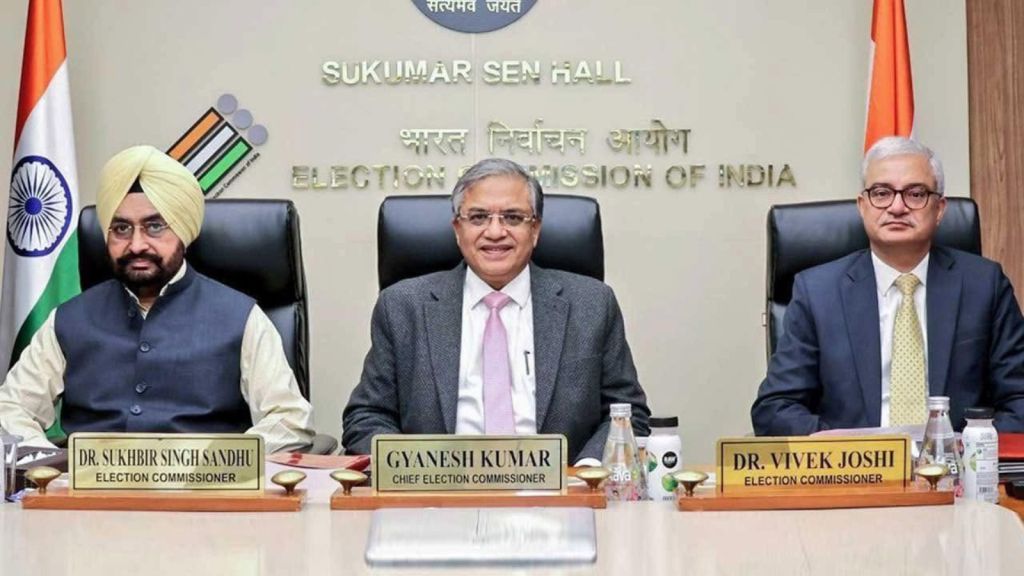
Reference image of Chief Election Commissioner Gyanesh Kumar with Election Commissioners Sukhbir Singh Sandhu and Vivek Joshi. The three-member Commission’s collective decision-making is central to its submission that the revision orders were unanimously approved; the image does not document the disputed decisions.
Image: Indian Express
Why in news
In a joint affidavit filed on October 26, 2026, the ECI, CEC Gyanesh Kumar and Election Commissioners Sukhbir Singh Sandhu and Vivek Joshi defended electoral roll revision procedures and the Commission’s internal functioning before the Supreme Court.
16.10 lakh
West Bengal inclusion appeals acknowledged by ECI
97
Goa voters allegedly initially omitted
88
Goa voters whose Form 6 applications ECI said were accepted
Background
Article 324 vests the superintendence, direction and control of electoral roll preparation and specified elections in the Election Commission of India. Article 326 establishes adult suffrage for elections to the Lok Sabha and State Legislative Assemblies, subject to constitutional and statutory qualifications. The Representation of the People Act, 1950 governs electoral registration, while the Registration of Electors Rules, 1960 prescribe procedures and forms. The Chief Election Commissioner and Other Election Commissioners (Appointment, Conditions of Service and Term of Office) Act, 2023 governs institutional matters, including the transaction of Commission business. Electoral independence therefore operates within, rather than outside, a framework of statutory procedures and judicial review.
What the ECI has submitted—and what remains contested
The ECI states that the SIR scheduling orders issued on June 24, 2025, October 27, 2025 and May 14, 2026 were unanimously approved. It argues that individual commissioners’ questions, observations or suggestions during deliberations cannot automatically be treated as the Commission’s final position.
The affidavit also acknowledges that the Election Commissioners separately wrote to the Cabinet Secretary about an internal work-allocation order issued on July 28, 2026. According to the Commission, that order was never implemented. This distinction matters: disagreement during deliberation and a legally operative institutional decision are different categories.
The supplied reports do not establish that the Supreme Court has accepted the ECI’s defence. Claims about unanimity, the legality of additional declarations and the adequacy of safeguards must remain attributed to the Commission until adjudicated.
- The ECI disputes the evidentiary value of media reports alleging unilateral functioning.
- A unanimous affidavit establishes the Commission’s stated litigation position; it does not by itself resolve every procedural allegation.
- The central legal question is whether institutional decisions and their implementation comply with constitutional and statutory requirements.
Infographic
Independence
Article 324 protects electoral authority and the CEC’s tenure.
Collegiality
Unanimity is preferred; majority decisions remain lawful.
Legality
Revision instructions and digital systems must respect statutory powers.
Due process
Verification, hearing and reasoned decisions protect eligible electors.
Effective remedies
Accessible appeals and timely correction make safeguards meaningful.
AI-assisted infographic by Pragnya IAS Academy, based on the cited sources.
Article 324: Security of tenure is not immunity from review
Article 324(5) protects the CEC from removal except in the same manner and on the same grounds as a Supreme Court judge. Read with Article 124(4), this requires a presidential removal order following an address by each House of Parliament supported by the constitutionally prescribed special majority, on grounds of proved misbehaviour or incapacity. The CEC’s conditions of service cannot be varied to the incumbent’s disadvantage after appointment.
Other Election Commissioners do not enjoy the identical judge-like removal mechanism: Article 324(5) provides that they cannot be removed except on the CEC’s recommendation. This is a safeguard against arbitrary executive removal, but it is constitutionally distinct from the CEC’s protection.
The affidavit argues that restraining the CEC’s functioning would be contrary to law. Analytically, however, removal from office must be distinguished from judicial review of a particular decision or procedure. Security of tenure protects institutional independence; it does not place electoral administration beyond constitutional scrutiny.
- Article 324 is a source of electoral authority, not a licence to override enacted law.
- The CEC’s stronger tenure protection does not confer unilateral supremacy over a multi-member Commission.
- A judicial remedy must be assessed according to its legal basis and effect, rather than automatically equated with removal.
Collective decisions and digital accountability
Section 18 of the 2023 Act provides for unanimity as far as possible and majority decision-making when opinions differ. The affidavit describes files moving to one Election Commissioner, then the other and finally the CEC, with approved decisions recorded and signed before implementation by the Secretariat. In urgent situations, it says electronic approvals are obtained and subsequently recorded.
The Commission also states that ECINet is an enabling tool and that no electoral roll entry is added, deleted or modified without an Electoral Registration Officer’s order. The legal test is therefore not merely whether a portal operates efficiently, but whether it preserves the statutory officer’s access, discretion and accountability.
- Recorded dissent is compatible with lawful institutional decision-making; unanimity is not mandatory in every case.
- Urgent electronic approvals should leave a verifiable record of participation and authorisation.
- Internal work allocation must not displace powers vested by law in Electoral Registration Officers.
- Technical administrators should implement lawful decisions, not independently determine electoral eligibility.
Form 6 and mapping: Assistance or an additional barrier?
The ECI denies amending statutory Form 6 and says that only the additional declaration used during SIR was modified. It acknowledges that the declaration’s presentation on the online system could have created the impression that Form 6 itself had been amended. Form 6 is prescribed under the Registration of Electors Rules, and its amendment belongs to the Central Government’s statutory rule-making process.
According to the affidavit, mapping connects an applicant’s details with entries relating to the applicant, parents or grandparents in earlier SIR records. The ECI describes this as a means of dispensing with further verification documents where the linkage is available. It says the additional declaration applies to SIR, rather than every routine electoral roll update.
The relevant legal distinction is between facilitating proof of existing eligibility and creating a new substantive qualification for registration. Calling a document an annexure does not, by itself, settle its legality: its authority, practical burden and consequences for applicants must also be examined.
- Inability to establish a historical family linkage should not automatically be equated with ineligibility.
- Applicants need clear information about alternative routes to establish their entitlement.
- Online presentation should distinguish the statutory form from supplementary requirements.
Due process against wrongful voter exclusion
The Representation of the People Act, 1950 provides for revision and correction of rolls, inclusion of eligible persons and appeals. Section 22 requires a reasonable opportunity of being heard before specified adverse action, including deletion on the ground that a person has ceased to be ordinarily resident or is otherwise not entitled to registration. Temporary absence does not, by itself, terminate ordinary residence.
The ECI acknowledges that officers of the West Bengal Chief Electoral Officer filed 16.10 lakh appeals against inclusions, stating that they acted as statutory authorities under Supreme Court orders. These are appeals against inclusion, not an established count of deletions or ineligible voters.
For Goa, the ECI says that 88 of the 97 allegedly omitted voters submitted Form 6 and their applications were accepted. It describes the remaining voters as being abroad or holding Portuguese passports. These categories require legally distinct assessments: absence concerns residence, while foreign citizenship concerns eligibility. Corrective registration is important, but does not by itself establish that the initial exclusion followed due process.
- Adverse decisions should rest on individual verification rather than an assumption based on missing documents or failed mapping.
- Notice and a meaningful hearing must precede adverse action wherever required by law.
- Reasoned orders and accessible appeals are essential to make remedies effective.
- Roll accuracy requires both removal of ineligible entries and protection of eligible electors.
| Issue | Governing position | Exam-relevant distinction |
|---|---|---|
| CEC’s removal | Article 324(5) applies the manner and grounds governing removal of a Supreme Court judge. | Security of tenure does not exempt decisions from judicial review. |
| Other Election Commissioners’ removal | Removal requires the CEC’s recommendation under Article 324(5). | Their protection is not identical to the CEC’s judge-like removal procedure. |
| Commission decisions | Section 18 of the 2023 Act favours unanimity, with majority decisions when opinions differ. | The CEC’s position does not authorise unilateral substitution for a collective decision. |
| Electoral roll entries | Statutory registration authorities exercise powers under electoral law. | A digital platform cannot replace the Electoral Registration Officer’s legal authority. |
| Form 6 and supplementary declaration | Form 6 is statutory; the ECI describes the SIR declaration as a separate document. | Formal separation does not eliminate scrutiny of the declaration’s legal basis or burden. |
- 1. Identify a specific statutory ground and verify the relevant facts.
- 2. Issue an intelligible notice wherever required, identifying the proposed action and its basis.
- 3. Provide a meaningful opportunity to respond and submit relevant evidence.
- 4. Ensure an independent determination by the competent statutory registration authority.
- 5. Record and communicate a reasoned decision, with information on available remedies.
- 6. Enable timely appeal and correction so that an eligible elector’s remedy is effective.
June 24, 2025
The first of the SIR orders discussed in the affidavit was issued; the ECI says the decision was unanimous.
October 27, 2025
A further SIR scheduling order was issued, also described by the ECI as unanimously approved.
May 14, 2026
Another SIR scheduling order was issued; the affidavit defends its collective approval.
July 28, 2026
An internal work-allocation order was issued; the ECI subsequently stated that it was never implemented.
July 29, 2026
The two Election Commissioners separately wrote to the Cabinet Secretary regarding the order and the officer’s conduct.
October 22, 2026
The West Bengal CEO sent a communication on which the ECI based its submission about appeals against voter inclusions.
October 26, 2026
The joint affidavit defending SIR procedures and institutional functioning was filed before the Supreme Court.
Significance, challenges & way forward
Significance
- The dispute tests how constitutional independence can coexist with judicial scrutiny and statutory accountability.
- Collective decision-making prevents the Commission’s institutional authority from becoming personalised.
- Reliable electoral rolls protect both electoral integrity and the effective participation of eligible citizens.
- The case highlights that digital design can affect substantive rights when access, documentation and approval pathways shape registration outcomes.
Challenges
- Historical roll linkage may be difficult for eligible applicants who lack accessible family records.
- A formally separate declaration may still impose an exclusionary burden if alternative verification routes are unclear.
- Large volumes of appeals can strain adjudicatory capacity and delay final resolution of eligibility disputes.
- Poorly documented emergency approvals can weaken the auditability of collective decisions.
- Restoration through a fresh application may correct an omission without addressing why the original exclusion occurred.
- Treating media allegations as established facts, or treating an affidavit as a judicial finding, can distort public understanding.
Way forward
- Publish clear, legally grounded SIR instructions distinguishing statutory qualifications from methods of proving them.
- Provide accessible alternative verification routes where historical mapping is unavailable.
- Preserve notice, hearing, reasoned orders and effective appeal mechanisms for adverse registration decisions.
- Maintain auditable records of collective approval, dissent and emergency electronic authorisation.
- Ensure that ECINet access and permissions enable Electoral Registration Officers to exercise their statutory functions fully.
- Review wrongful exclusions and corrective applications to identify systemic procedural failures, while protecting personal data.
- Keep judicial scrutiny focused on legality, procedural fairness and effective remedies without conflating these with removal from constitutional office.
Key terms
- Special Intensive Revision
- An intensive exercise to verify and revise electoral rolls, whose procedures remain subject to electoral law.
- Security of tenure
- Legal protection against arbitrary removal, intended to support independent performance of public functions.
- Collective decision-making
- Institutional determination through participation of the Commission’s members, with majority resolution where opinions differ.
- Form 6
- The statutory application form for inclusion of a name in an electoral roll.
- Mapping
- In the reported SIR process, linkage of an applicant’s details with earlier electoral entries of self or specified family members.
- Electoral Registration Officer
- The statutory authority responsible for preparing and revising electoral rolls within the assigned jurisdiction.
- Ordinary residence
- The residence-based statutory connection used for electoral registration, which temporary absence alone does not terminate.
- Natural justice
- Principles of fair decision-making, including an unbiased authority and an opportunity to be heard before relevant adverse action.
Link with static syllabus
Prelims practice MCQs
Q1. With reference to Article 324, consider the following statements: 1. The CEC can be removed only in the same manner and on the same grounds as a Supreme Court judge. 2. Every Election Commissioner enjoys the identical parliamentary removal procedure applicable to the CEC. 3. The CEC’s conditions of service cannot be varied to the incumbent’s disadvantage after appointment. Which of the statements given above are correct?
Q2. Regarding decision-making in the Election Commission under Section 18 of the 2023 Act, consider the following statements: 1. The Commission should transact its business unanimously as far as possible. 2. Where opinions differ, the matter is decided according to the majority opinion. 3. The CEC may override the majority solely because the office enjoys stronger removal protection. Which of the statements given above are correct?
Q3. Consider the following pairs: 1. Article 324 — Superintendence, direction and control of electoral roll preparation and specified elections 2. Article 326 — Adult suffrage for Lok Sabha and State Legislative Assembly elections 3. Representation of the People Act, 1950 — Electoral registration framework Which of the pairs given above are correctly matched?
Q4. With reference to electoral registration, consider the following statements: 1. Temporary absence from a place necessarily terminates a person’s ordinary residence there. 2. A digital platform may independently delete an electoral entry without an order of the competent statutory authority. 3. Form 6 is a statutory form for inclusion in the electoral roll. Which of the statements given above is/are correct?
Mains practice questions
GS 2 · 15 marks · 250 words
Constitutional independence of the Election Commission must be accompanied by collective accountability and procedural fairness. Examine with reference to electoral roll revision.
Frequently asked questions
Does the CEC’s removal protection prevent courts from reviewing ECI decisions?
No. Constitutional protection against removal and judicial review of a decision are different matters; the legality of a particular judicial remedy must be assessed separately.
Must every Election Commission decision be unanimous?
No. Section 18 of the 2023 Act favours unanimity as far as possible but provides for majority decisions when opinions differ.
Did the ECI admit that Form 6 was amended?
No. It says the supplementary SIR declaration was modified, not statutory Form 6, while acknowledging that the online presentation could have suggested otherwise.
Do the West Bengal appeal figures represent confirmed voter deletions?
No. The ECI described them as appeals against inclusion filed by CEO officers; the reported figure does not establish the outcome of those appeals.
Sources
- The Hindu: CEC can be removed only like a Supreme Court judge, ECI tells top court
- Indian Express: Acted ‘unanimously' on electoral roll revision orders: Election Commission tells Supreme Court
- Times of India: June 2025 decision to hold SIR taken unanimously, EC tells SC
- Times of India: No action on deleted voters using Form 6: Supreme Court
Analysis prepared by the Pragnya IAS Academy current-affairs desk with AI assistance from the cited reports. Verify figures with the original sources.
Turn current affairs into marks
Join Pragnya IAS Academy's mentorship for daily answer-writing evaluation on stories like this — classroom programmes from a trusted name in IAS coaching in Hyderabad.