
E100 Flex-Fuel Rules: Engine Compatibility, Energy Security and Ethanol’s Ecological Costs
Revise the static topic: UPSC Science & Technology notes
In short: The Centre has amended the Central Motor Vehicles Rules, 1989, to enable certification of specially designed flex-fuel vehicles for fuels up to E100, which is almost pure ethanol. This does not authorise ordinary petrol or E20-certified vehicles to use E100. The change could support domestic fuel substitution, but its benefits depend on vehicle compatibility, cost per kilometre and the land, water and emissions footprint of ethanol production.
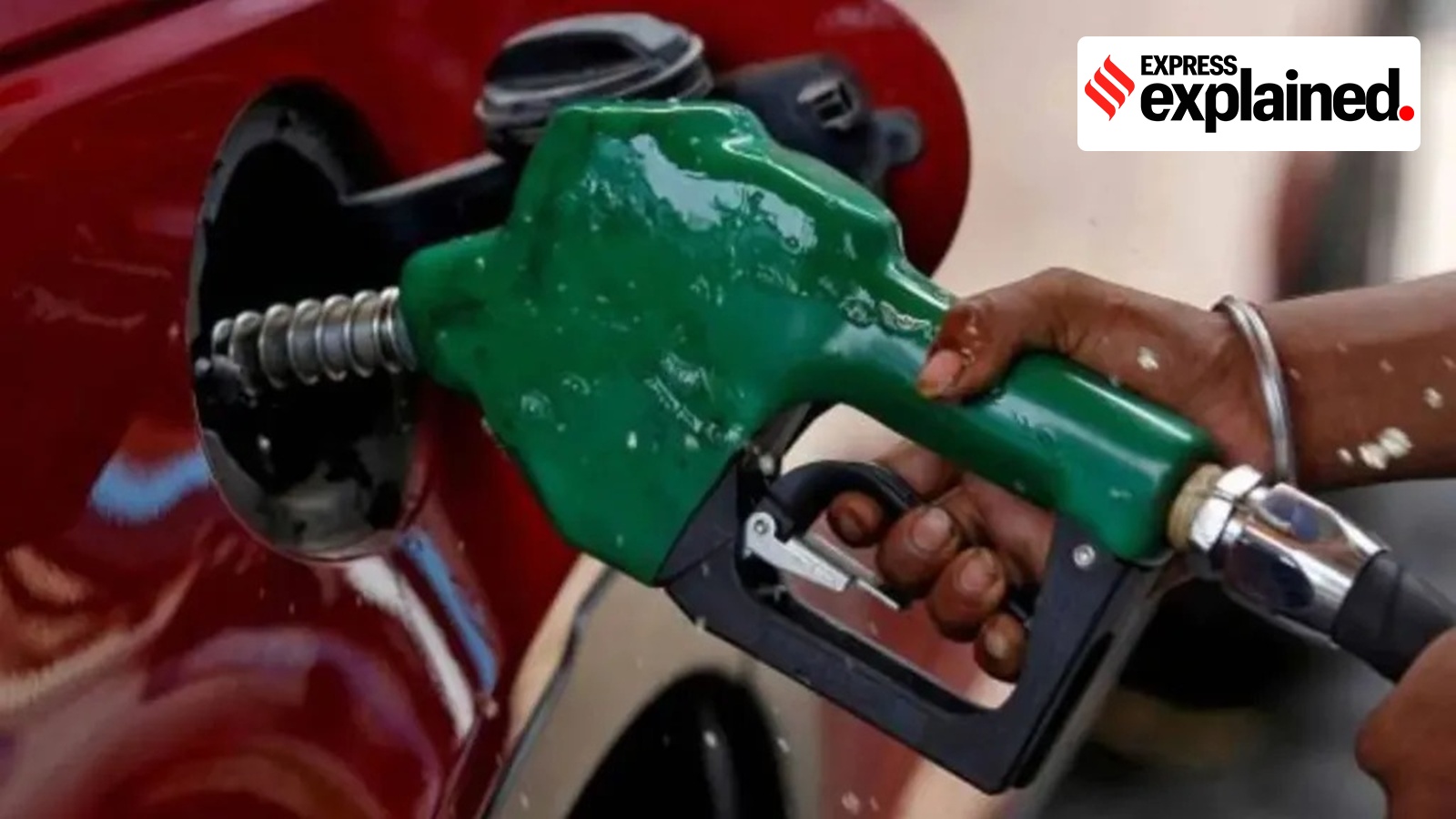
Photo from the source report: E100 Flex-Fuel Rules: Engine Compatibility, Energy Security and Ethanol’s Ecological Costs
Image: Indian Express
Why in news
The amendment expands the regulatory framework for high-ethanol flex-fuel vehicles. It also raises the weight threshold for light petrol and diesel vehicles from 3,000 kg to 3,500 kg under the relevant technical and classification provisions.
20%
Ethanol content in E20 petrol
About 30%
Lower energy per gallon in E100 than petrol
3,000 kg
Previous light-vehicle weight threshold
3,500 kg
Revised light-vehicle weight threshold
Background
Ethanol is a combustible alcohol produced through fermentation of sugars or starches; it can also be produced from agricultural residues and other plant material using appropriate processing. Sugarcane and grains are common Indian feedstocks. Petrol, by contrast, is refined from crude oil. Ethanol blending substitutes part of petrol with a renewable biological feedstock, while flex-fuel technology allows a suitably designed vehicle to operate across a certified range of petrol–ethanol mixtures. The Central Motor Vehicles Rules, 1989, form part of India’s vehicle regulatory framework under the Motor Vehicles Act.
What the amendment enables—and what it does not
The regulatory change permits specially designed vehicles to be certified for operation on fuels up to E100. It expands permissible fuel compatibility within the vehicle certification framework; it does not physically modify existing engines or fuel systems.
An E20-certified petrol vehicle cannot be assumed to support E85 or E100. Vehicle design, testing and certification—not merely the availability of ethanol at a filling station—determine which fuel can safely be used.
- Regulatory permission is an enabling step, not evidence of universal vehicle readiness or nationwide E100 availability.
- The revised light-vehicle weight threshold is a separate technical classification change, not an ethanol-compatibility standard.
- Owners should follow the manufacturer’s certified fuel specification rather than treating all petrol–ethanol blends as interchangeable.
Infographic
Compatibility
Use only certified blends with suitable materials and engine controls.
Affordability
Compare cost per kilometre, not merely price per litre.
Energy security
Displace petrol through reliable and sustainable domestic ethanol supply.
Climate integrity
Assess lifecycle emissions rather than assuming carbon neutrality.
Resource security
Protect food supplies, water availability, soil health and biodiversity.
AI-assisted infographic by Pragnya IAS Academy, based on the cited sources.
How a flex-fuel engine works
A flex-fuel vehicle generally uses one fuel system, with ethanol-compatible components and electronic controls that accommodate different fuel mixtures. Its engine control unit adjusts fuel injection and ignition timing to suit the fuel’s properties. Fuel pumps, pipes, seals and injectors must tolerate high ethanol concentrations.
Ethanol contains less energy per unit volume than petrol, so more fuel generally needs to be injected for comparable power. The source cites a US Department of Energy estimate that E100 contains about 30% less energy per gallon than petrol. This is an energy-content comparison, not a prediction of an identical mileage reduction in every vehicle.
Ethanol’s high octane rating improves resistance to engine knocking. An engine optimised for ethanol can exploit this property, but octane rating and energy content are different measures. Reliable starting and operation across temperatures also require suitable calibration.
- Fuel delivery must accommodate the larger fuel volume generally needed for comparable output.
- Material compatibility is necessary alongside electronic calibration; software changes alone do not establish E100 readiness.
- Flex-fuel capability concerns fuel choice, whereas hybrid capability concerns the combination of an engine and electric propulsion.
Energy security and consumer economics
Domestic ethanol can displace part of petrol consumption and reduce exposure to imported crude oil and international supply disruptions. It can also create markets for agricultural feedstocks and ethanol producers. However, benefits depend on reliable domestic supply rather than regulatory approval alone.
For consumers, the relevant comparison is cost per kilometre, not price per litre. Lower energy content can reduce kilometres travelled on the same volume of fuel; actual running costs depend on fuel prices and vehicle efficiency. A cheaper litre of E100 is therefore not automatically cheaper mobility.
- Fuel diversification can strengthen energy resilience without making ethanol a complete substitute for all petroleum uses.
- Clear fuel labelling, credible mileage information and servicing capacity are necessary for informed adoption.
- A gradual transition can preserve usability of the existing fleet while new vehicles enter the market.
Lifecycle emissions and the food–water–energy nexus
Ethanol combustion is not emission-free. Its overall climate performance must be assessed across feedstock cultivation, fertiliser use, processing energy, transport and vehicle operation. Carbon absorbed during crop growth does not by itself establish that the entire fuel pathway is carbon-neutral.
Crop-based ethanol also draws on land and water. Sugarcane cultivation requires substantial water, while diversion of food crops or expansion into other land uses can create pressures on food availability, prices and biodiversity. The source cites the International Energy Agency’s caution about these consequences of crop-based biofuels.
Agricultural residues offer a route to diversify feedstocks and potentially reduce direct competition with food crops. Their sustainability still depends on collection, processing energy and competing uses, including retaining sufficient residues for soil health.
- Tailpipe pollutant reduction and lifecycle greenhouse gas reduction are distinct outcomes.
- Environmental performance should be assessed by feedstock and production pathway rather than by the ethanol label alone.
- Oil-import savings should be evaluated alongside groundwater stress, land-use effects and food-system resilience.
| Vehicle or technology | Fuel-use implication | Critical distinction |
|---|---|---|
| Conventional petrol vehicle | Use only the blend approved by its manufacturer | Petrol operation does not establish high-ethanol compatibility |
| E20-certified petrol vehicle | Certified for petrol containing 20% ethanol | E20 approval does not authorise E85 or E100 |
| Flex-fuel vehicle | Can use different petrol–ethanol mixtures within its certified range | The flex-fuel label alone should not be read as universal E100 approval |
| E100-capable flex-fuel vehicle | Can operate on almost pure ethanol within its certification | Requires compatible materials, fuel delivery and engine calibration |
| Hybrid flex-fuel vehicle | Combines certified fuel flexibility with hybrid propulsion | Hybridisation and fuel flexibility are separate capabilities |
- 1. A petrol–ethanol fuel within the vehicle’s certified range enters the compatible fuel system.
- 2. The engine-management system determines the required operating adjustments for the mixture.
- 3. Fuel injection is adjusted to account for the fuel’s oxygen content and energy characteristics.
- 4. Ignition and starting controls are calibrated for reliable operation.
- 5. The engine delivers power, with efficiency and fuel consumption depending on the blend and engine design.
1989
The Central Motor Vehicles Rules establish the regulatory framework subsequently amended for vehicle-related technical requirements.
Current reported amendment
The Centre enables certification of specially designed flex-fuel vehicles for fuels up to E100 and revises the relevant light-vehicle weight threshold.
Significance, challenges & way forward
Significance
- The amendment creates a regulatory pathway for vehicles capable of using very high ethanol concentrations.
- Domestic ethanol can diversify transport fuel supply and reduce part of India’s exposure to imported crude oil.
- Flex-fuel technology can support innovation in engine controls, compatible materials and fuel-delivery systems.
- Ethanol demand can provide markets for farmers and processors, subject to food and resource safeguards.
- The transition brings energy security, agricultural policy and environmental sustainability into a common policy framework.
Challenges
- Using high-ethanol fuel in an uncertified vehicle risks material incompatibility and improper engine operation.
- Lower energy content per litre complicates mileage expectations and consumer comparisons of running costs.
- Vehicle deployment must be matched by suitable dispensing, storage, fuel-quality assurance and servicing arrangements.
- Water-intensive feedstocks can transfer energy-security pressures to already stressed agricultural resources.
- Crop diversion and land-use changes can create food-price and biodiversity trade-offs.
- Lifecycle emissions vary with cultivation practices, processing energy and logistics, preventing blanket claims of climate superiority.
Way forward
- Make certified fuel ranges prominent on vehicles, owner documentation and dispensing equipment to prevent misfuelling.
- Communicate real-world efficiency and cost per kilometre rather than relying only on retail fuel prices.
- Sequence vehicle deployment with dependable fuel supply, quality assurance and trained service networks.
- Assess ethanol pathways through lifecycle greenhouse gas accounting and locally relevant water-stress indicators.
- Avoid incentivising water-intensive feedstock expansion in water-stressed regions and safeguard food-system resilience.
- Support residue-based ethanol where technically and environmentally viable while protecting soil needs and existing residue uses.
- Treat ethanol as one component of a broader transport strategy alongside efficiency, public transport and electrification.
Key terms
- E100
- A designation for almost pure ethanol fuel in the reported regulatory context.
- E20
- Petrol containing 20% ethanol.
- Flex-fuel vehicle
- A vehicle designed to operate on different petrol–ethanol mixtures within its certified fuel range.
- Engine control unit
- The electronic controller that manages engine functions such as fuel injection and ignition timing.
- Octane rating
- A measure of a fuel’s resistance to engine knocking, not its energy content.
- Lifecycle emissions
- Emissions assessed across a fuel’s production, processing, transport and use, including relevant land-use effects.
- Lignocellulosic ethanol
- Ethanol produced from structural plant material, including agricultural residues, after suitable processing.
- Food–water–energy nexus
- The interdependence of food production, water availability and energy supply.
Link with static syllabus
Prelims practice MCQs
Q1. With reference to the reported E100 regulatory change, consider the following statements: 1. Every vehicle certified for E20 can now legally and safely operate on E100 without modification. 2. The amendment enables certification of specially designed vehicles for fuels up to E100. 3. A flex-fuel vehicle must use separate tanks for petrol and ethanol. Which of the statements given above is/are correct?
Q2. Consider the following statements about ethanol as an automotive fuel: 1. It has lower energy content per unit volume than petrol. 2. Its high octane rating helps resist engine knocking. 3. Its high octane rating necessarily means that it delivers more kilometres per litre than petrol in every engine. Which of the statements given above are correct?
Q3. Which of the following provides the most appropriate basis for assessing the climate benefit of E100?
Q4. Consider the following pairs: 1. E20 — Petrol containing 20% ethanol 2. Flex-fuel capability — Ability to operate on different certified petrol–ethanol mixtures 3. Hybrid propulsion — Combination of an internal combustion engine and electric propulsion Which of the pairs given above are correctly matched?
Mains practice questions
GS 3 · 15 marks · 250 words
The regulatory push for E100 flex-fuel vehicles can strengthen energy security, but does not automatically ensure sustainable mobility. Explain the technology and critically examine the conditions for its adoption in India.
Frequently asked questions
Can an existing E20 petrol car use E100 after the amendment?
No. The amendment does not change the vehicle’s materials, engine calibration or certified fuel range; E100 requires a vehicle specifically designed and certified for it.
Does E100 automatically make driving cheaper?
No. Running cost depends on fuel price and kilometres travelled per litre, so the correct comparison is cost per kilometre.
Is ethanol a zero-emission fuel?
No. Ethanol combustion produces emissions, and its overall climate impact also depends on cultivation, processing, transport and land-use effects.
Is a flex-fuel vehicle the same as a hybrid vehicle?
No. Flex-fuel refers to compatibility with different certified fuel mixtures, while hybrid refers to combining an engine with electric propulsion; a vehicle can have both capabilities.
Sources
- Indian Express: In graphics: Centre's new E100 fuel rule change and what it means for you
- Times of India: E100 flex-fuel vehicles get regulatory push ahead of launch
Analysis prepared by the Pragnya IAS Academy current-affairs desk with AI assistance from the cited reports. Verify figures with the original sources.
Turn current affairs into marks
Join Pragnya IAS Academy's mentorship for daily answer-writing evaluation on stories like this — classroom programmes from a trusted name in IAS coaching in Hyderabad.