
Nepal’s First Loss and Damage Fund Allocation: Access, Adequacy and Climate Justice
Revise the static topic: UPSC Environment notes
In short: The Fund for Responding to Loss and Damage has earmarked $21.6 million for Nepal following its August 2026 floods, comprising $20 million in support and $1.6 million in oversight fees. This is its first country-specific allocation, not a completed disbursement: Nepal must submit a funding request for further Board approval before money is released. The decision tests whether climate-finance commitments can translate into timely, adequate assistance for vulnerable developing countries.
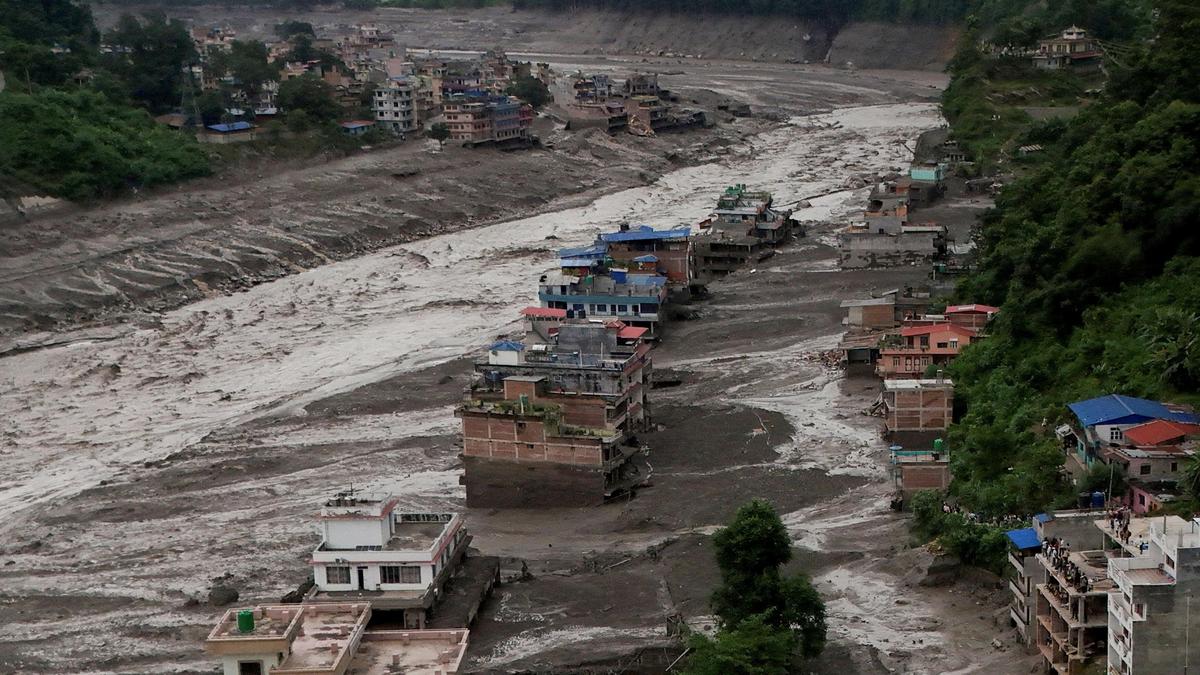
Reference image from explanatory coverage of Nepal’s loss-and-damage funding, not a verified view of the August 2026 floods. The $21.6 million allocation includes $20 million in support and $1.6 million in oversight fees; release requires a funding request and further Board approval.
Image: The Hindu
Why in news
At an extraordinary virtual meeting on October 22, 2026, the Fund’s Board approved a special allocation for Nepal outside its closed application window. As of this edition, release remains conditional on approval of Nepal’s funding request, which is to be considered in December.
$21.6 million
Nepal allocation including oversight
$1.6 million
Oversight fees within allocation
$822.06 million
Pledges as of March 15, 2026
$629.70 million
Reported grant contributions
$342 million
Fund’s start-up allocation
$2.8 billion
Requests in first funding call
Background
Climate action has distinct but connected functions: mitigation reduces greenhouse gas emissions or enhances sinks; adaptation reduces vulnerability to climate impacts; and responding to loss and damage addresses adverse consequences that are not avoided through mitigation and adaptation. Developing countries have sought dedicated support because those with low historical emissions often face severe impacts and limited fiscal capacity. The UNFCCC principle of equity and common but differentiated responsibilities and respective capabilities provides the broader context. Article 8 of the Paris Agreement recognises the importance of averting, minimising and addressing loss and damage, while the dedicated Fund was established at COP27 and its Governing Instrument adopted at COP28.
What Nepal has secured: an allocation, not money already received
An ice-and-rock avalanche on August 26, 2026 triggered flooding along the Bhotekoshi–Trishuli–Narayani river system. The Hindu reports that experts link the event to human-driven warming. Nepal estimates economic losses of at least $2.69 billion and recovery needs of at least $4.71 billion.
The apparent difference between the reported $20 million and $21.6 million packages is explained by oversight fees. The Board’s allocation includes $1.6 million for organisations supervising implementation, alongside $20 million in support.
Nepal has been invited to submit a funding request for consideration at the Board’s December meeting in Manila. Therefore, descriptions such as ‘first payout’ should not be read as proof that funds have already reached the government.
- The October decision is the Fund’s first earmarking of money for a specific country.
- The special route allows a submission outside the closed application window.
- Further approval is required before disbursement.
Infographic
First allocation
$21.6 million earmarked, including oversight fees.
Conditional release
Further Board approval is needed before disbursement.
Exceptional access
Out-of-window pilot, not an automatic emergency entitlement.
Funding gap
Million-dollar support faces billion-dollar recovery needs.
Reform imperative
Predictable finance, rapid access and transparent accounting.
AI-assisted infographic by Pragnya IAS Academy, based on the cited sources.
Climate-finance architecture and access arrangements
The Fund for Responding to Loss and Damage operates under the UNFCCC financial mechanism and supports developing countries particularly vulnerable to climate change. Its mandate covers economic and non-economic losses associated with extreme weather and slow-onset events. The World Bank hosts the Fund and serves as its interim trustee; allocation decisions are taken by the Fund’s Board.
Its start-up allocation is $342 million, with at least half reserved for small island developing States and least developed countries. The first call attracted 176 requests from 119 countries, seeking about $2.8 billion. In July, the Board deferred decisions on those requests to December.
Nepal’s exceptional access is a pilot during the start-up phase, not a standing emergency entitlement. Any further out-of-window submissions require separate Board decisions, while the Secretariat will assess lessons for the long-term operating model.
- Vulnerability-based earmarking seeks to protect access for countries with particularly limited resources.
- Board approval, implementation oversight and trustee functions are distinct elements of the architecture.
- An exceptional allocation demonstrates flexibility but does not establish an automatic rapid-response mechanism.
Loss and damage is distinct from mitigation and adaptation
Mitigation addresses the causes of climate change, while adaptation manages exposure and vulnerability to its impacts. Loss and damage concerns consequences that are not avoided, including destroyed infrastructure, lost livelihoods, displacement and damage to cultural or ecological assets. Non-economic losses cannot be adequately captured through market prices alone.
These categories overlap in implementation without becoming interchangeable. Rebuilding a flood-damaged health facility responds to loss and damage; making the rebuilt facility flood-resilient also serves adaptation. Early warning systems are primarily adaptation and disaster-risk-reduction tools, even when included in a wider recovery proposal.
Loss and damage finance should not automatically be described as legally enforceable compensation. The decision adopting the Paris Agreement specifies that Article 8 does not provide a basis for liability or compensation. This does not remove the political and ethical case for predictable support grounded in equity.
- Extreme events include floods and storms; slow-onset processes include sea-level rise and glacial retreat.
- Economic losses include damage to assets and income; non-economic losses include cultural identity and psychological well-being.
- Recovery finance should complement, rather than substitute for, mitigation and adaptation finance.
Adequacy, predictability and the emergency-response test
As of March 15, 2026, 27 countries had pledged $822.06 million, with $629.70 million reported in grant contributions. These categories should not be treated as identical to cash immediately available for disbursement: the Fund has not publicly specified its cash holdings beyond signed contributions, and delivery depends on donors honouring commitments.
The mismatch is visible at two levels. Nepal’s recovery requirements run into billions of dollars, whereas its allocation is in millions; globally, the first funding call sought about $2.8 billion against a much smaller start-up allocation. Moreover, the Fund has no mobilisation target and depends on voluntary contributions.
The central institutional tension is between fiduciary scrutiny and disaster urgency. Technical appraisal and oversight protect public money, but a conventional project cycle can delay support when governments urgently need to restore services and livelihoods. For India, which has submitted three requests totalling slightly more than $52 million, the outcome also has direct relevance for access and regional climate resilience.
- Pledges demonstrate intent; contributions and actual disbursements determine operational credibility.
- Small allocations can initiate recovery but cannot meet reconstruction needs at scale.
- A permanent emergency window would require explicit rules rather than reliance on exceptional Board meetings.
| Dimension | Mitigation | Adaptation | Responding to loss and damage |
|---|---|---|---|
| Core purpose | Limit the causes of climate change | Reduce vulnerability to climate impacts | Address consequences not avoided |
| Typical intervention | Renewable energy and emission reduction | Early warning and flood-resilient infrastructure | Livelihood restoration and rebuilding damaged services |
| Nepal illustration | Low-carbon energy choices | Monitoring mountain hazards and safer infrastructure | Support for losses and recovery after the floods |
| Important qualification | Cannot eliminate existing climate risks immediately | Has practical limits and cannot prevent every loss | Can incorporate resilience-building without replacing adaptation finance |
- 1. Flood disaster creates substantial losses and recovery needs.
- 2. Nepal seeks exceptional consideration outside the closed application window.
- 3. The Board earmarks support and permits an out-of-window request.
- 4. Nepal submits its funding request for Board consideration.
- 5. Funds are released only after approval, with implementation oversight.
2022
Countries agreed to establish the Fund at COP27.
2023
The Fund’s Governing Instrument was adopted at COP28.
2025
The first call for funding applications was launched during COP30 in Brazil.
June 15, 2026
The first application window closed, having attracted 176 requests from 119 countries.
July 2026
The Board deferred decisions on the first-round requests to December.
August 26, 2026
An ice-and-rock avalanche triggered flooding along Nepal’s Bhotekoshi–Trishuli–Narayani river system.
October 22, 2026
An extraordinary Board meeting earmarked $21.6 million for Nepal, including oversight fees.
December 2026, scheduled
The Board is to consider Nepal’s funding request in Manila; release remains conditional on approval.
Significance, challenges & way forward
Significance
- The first country-specific allocation moves the Fund from institutional design towards practical support.
- The decision recognises that vulnerable developing countries require international assistance for climate-related losses.
- Nepal’s case tests whether access rules can accommodate disasters occurring after an application window closes.
- Recovery support for a Himalayan country highlights mountain hazards alongside the vulnerabilities of island and coastal states.
- The decision creates an operational learning opportunity before COP31 in Turkiye.
Challenges
- Available resources are far below both Nepal’s recovery needs and aggregate demand from applicant countries.
- Voluntary pledges do not ensure predictable contributions or immediately available cash.
- Further procedural approval can delay assistance even after a headline allocation is announced.
- Exceptional access may favour countries able to mobilise sustained diplomatic support unless rules are standardised.
- Non-economic losses are difficult to assess and may receive less attention than readily priced infrastructure damage.
- Overlap between recovery and resilience measures can blur the boundary between loss and damage and adaptation finance.
Way forward
- Establish a rules-based rapid-response window with clear eligibility, simplified applications and proportionate safeguards.
- Separate immediate recovery support from longer-term reconstruction appraisal so that urgent needs are not held up by full project preparation.
- Publish distinct figures for pledges, signed contributions, cash received, allocations and disbursements.
- Secure predictable replenishment, with developed countries taking the lead and loss and damage support additional to adaptation and mitigation finance.
- Support national institutions in preparing requests and assessing both economic and non-economic losses.
- Use transparent vulnerability criteria and community participation to ensure assistance reaches affected populations.
- Incorporate risk-sensitive rebuilding so that recovery does not recreate pre-disaster vulnerability.
Key terms
- Fund for Responding to Loss and Damage
- A UNFCCC-linked fund supporting particularly vulnerable developing countries in responding to climate-related economic and non-economic losses.
- Mitigation
- Action to reduce greenhouse gas emissions or enhance their removal through sinks.
- Adaptation
- Adjustment to actual or expected climate impacts to reduce harm and vulnerability.
- Non-economic loss
- Harm that cannot be adequately expressed through market prices, including losses of cultural identity or psychological well-being.
- Slow-onset event
- A climate-related process that develops progressively, such as sea-level rise or glacial retreat.
- Interim trustee
- An institution temporarily entrusted with managing financial assets under a fund’s agreed governance arrangements.
- Disbursement
- The actual release of money, distinct from a pledge or an allocation.
- Common but differentiated responsibilities and respective capabilities
- The principle that all states share environmental responsibilities, differentiated by their contributions to the problem and capabilities to respond.
Link with static syllabus
Prelims practice MCQs
Q1. With reference to the Fund for Responding to Loss and Damage, consider the following statements: 1. It operates under the financial mechanism of the UNFCCC. 2. It addresses only losses caused by sudden extreme weather events. 3. Its mandate includes non-economic losses. Which of the statements given above are correct?
Q2. Regarding Nepal’s October 2026 allocation from the Loss and Damage Fund, consider the following statements: 1. The announced $21.6 million includes oversight fees. 2. The allocation automatically creates a permanent emergency-access entitlement for all eligible countries. 3. Release requires further approval of Nepal’s funding request. Which of the statements given above are correct?
Q3. Consider the following pairs: 1. Mitigation — Reducing greenhouse gas emissions 2. Adaptation — Installing early warning systems 3. Responding to loss and damage — Restoring livelihoods lost in a climate-related disaster How many of the above pairs are correctly matched?
Q4. With reference to the Fund’s start-up arrangements, consider the following statements: 1. At least half of its start-up allocation is reserved for small island developing States and least developed countries. 2. The World Bank serves as its interim trustee. 3. A donor pledge necessarily means that the corresponding cash is immediately available for disbursement. Which of the statements given above are correct?
Mains practice questions
GS 3 · 15 marks · 250 words
Nepal’s first allocation from the Fund for Responding to Loss and Damage exposes the gap between climate justice and climate-finance delivery. Examine its significance and suggest reforms to improve access and adequacy.
Frequently asked questions
Has Nepal already received the Loss and Damage Fund money?
The supplied reporting establishes an allocation, not a completed transfer. Nepal’s funding request requires further Board approval before the money can be released.
Why do reports mention both $20 million and $21.6 million?
The $21.6 million total comprises $20 million in support and $1.6 million in fees for implementation oversight.
How is loss and damage different from adaptation?
Adaptation reduces vulnerability to climate impacts, while loss and damage support addresses consequences that are not avoided. A recovery project can also include adaptation measures, such as rebuilding infrastructure to withstand future floods.
Does Nepal’s allocation create automatic emergency access for other countries?
No. It is a pilot during the start-up phase, and further submissions outside the application window require separate Board decisions.
Sources
- The Hindu: What is the importance of the UN Loss and Damage Fund’s payout to Nepal? | Explained
- Indian Express: Where Nepal’s $20 million flood relief money is coming from: the loss and damage fund’s first payout
Analysis prepared by the Pragnya IAS Academy current-affairs desk with AI assistance from the cited reports. Verify figures with the original sources.
Turn current affairs into marks
Join Pragnya IAS Academy's mentorship for daily answer-writing evaluation on stories like this — classroom programmes from a trusted name in IAS coaching in Hyderabad.