
India–Poland Partnership: Defence, Critical Minerals and the India–EU Trade Agenda
Revise the static topic: UPSC International Relations notes
In short: Polish Prime Minister Donald Tusk’s visit to India highlighted plans to expand trade and cooperation in technology, defence, critical minerals and clean energy. Poland can help diversify India’s European partnerships, but progress depends on implementing business agreements, protecting sensitive information and managing differences involving Russia and Pakistan.
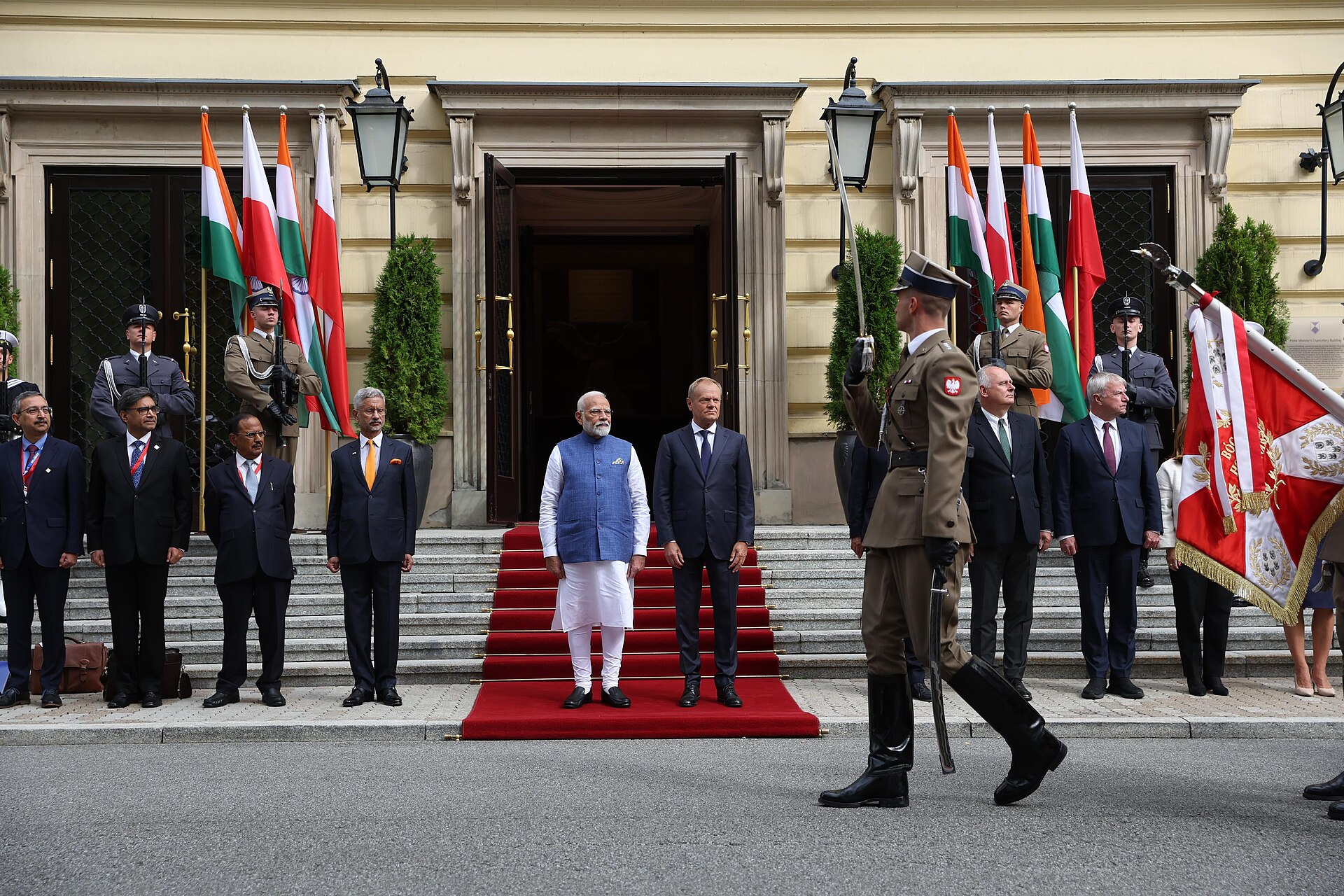
Reference view: Polish Prime Minister Donald Tusk welcomes Indian Prime Minister Narendra Modi in Warsaw on August 22, 2024, during the first visit by an Indian prime minister to Poland in 45 years. This photograph is not from Tusk’s visit to India.
Image: Chancellery of the Prime Minister of Poland · CC BY 3.0 pl
Why in news
During Tusk’s visit, India and Poland agreed to establish a Defence Industry Dialogue and sought to double bilateral trade by 2030. The engagement comes amid preparations, described in the supplied reports, for concluding the India–EU Free Trade Agreement.
$6 billion
Reported bilateral trade
2030
Target year for doubling trade
$1 trillion
Nominal GDP milestone crossed by Poland
$120 billion
Reported Polish technology economy
Sixth
Poland’s reported economic rank within the EU
Background
Poland is a Central European country bordering Germany and Ukraine, with access to the Baltic Sea. As a member of both the European Union and NATO, it connects economic integration in Europe with the continent’s security concerns. For India, closer ties with individual EU members complement engagement with EU institutions. However, the EU’s common commercial policy means that an India–EU trade agreement is negotiated at the Union level, rather than through a separate Polish tariff arrangement.
What the engagement has produced
The reported outcomes combine an economic ambition with institutional mechanisms: doubling bilateral trade by 2030, establishing a Defence Industry Dialogue and exploring a dialogue on counter-terrorism cooperation. Technology, artificial intelligence, critical minerals, renewable energy and nuclear energy were identified as areas for closer collaboration.
These outcomes must be distinguished from completed projects. The source reports business discussions and MoUs, but also stresses the need to translate them into joint ventures. Negotiations on protecting classified information remain unfinished.
- The Defence Industry Dialogue provides a channel for discussing industrial cooperation; it does not itself constitute a procurement contract.
- Counter-terrorism dialogue remains an area to be explored, rather than a completed institutional arrangement.
- The supplied reports discuss the India–EU FTA in the context of anticipated conclusion and signing; they do not establish that it has entered into force.
Infographic
Trade
Pursue the 2030 doubling target through stronger business and production links.
Defence
Use industrial dialogue alongside classified-information safeguards.
Critical minerals
Assess extraction, processing and recycling opportunities.
Clean energy
Develop viable renewable and nuclear cooperation projects.
European engagement
Complement India–EU cooperation without bypassing EU institutions.
Strategic trust
Manage third-country sensitivities while preserving strategic autonomy.
AI-assisted infographic by Pragnya IAS Academy, based on the cited sources.
Why Poland matters to India’s European strategy
Poland offers India an additional economic partner within Europe beyond its established major relationships. The source identifies Poland as the EU’s sixth-largest economy, with a growing technology sector and an industrial base linked closely to Germany.
Polish machinery and components exported to Germany create scope for India–Poland–Germany manufacturing partnerships. Such collaboration could combine Polish industrial capabilities, German production networks and Indian demand and manufacturing scale. This is a potential pathway, not an announced trilateral programme.
- Bilateral commercial networks could help businesses use opportunities created by an eventual India–EU FTA.
- Cooperation in manufacturing and mining technology could deepen production linkages rather than merely expand finished-goods trade.
- Poland’s support can contribute to a favourable political environment within the EU, but cannot substitute for Union-level decision-making.
Defence, critical minerals and clean energy: the strategic core
Defence cooperation could support India’s effort to diversify industrial partnerships and strengthen domestic manufacturing. Its strategic value will depend on the content of projects, including technology access, maintenance capabilities, intellectual property arrangements and safeguards against unauthorised disclosure.
Critical minerals cooperation should be assessed across the value chain: exploration, extraction technology, processing, recycling and supply reliability. The source identifies cooperation in this field but does not specify minerals, deposits, supply volumes or concluded offtake agreements.
Renewable and nuclear energy cooperation could connect energy security with industrial development. Opportunities should be evaluated project by project for commercial viability, technology maturity, safety requirements and their contribution to domestic capabilities.
- Prioritise joint development and sustainable lifecycle support over dependence on imported equipment alone.
- Link mineral cooperation with processing and recycling capabilities, not only access to raw materials.
- Treat renewable energy and nuclear energy as distinct cooperation tracks with different technical and regulatory requirements.
Geopolitical convergence without identical alignments
The Ukraine war is central to Poland’s security outlook, while India has emphasised its wider consequences, including those affecting the Global South. The source reports Polish support for India’s efforts towards an arrangement acceptable to Kyiv and Moscow concerning grain exports and seafarers’ safety.
Nevertheless, third-country relationships complicate trust. India maintains an enduring partnership with Russia, including defence engagement, while Poland’s defence relationship with Pakistan is a concern for India. Closer bilateral ties therefore require accommodation of differing strategic relationships rather than an assumption of complete geopolitical convergence.
- Cooperation on food security and maritime safety can proceed without agreement on every aspect of the Ukraine conflict.
- India’s strategic autonomy requires issue-based cooperation rather than automatic alignment with a partner’s external positions.
- Dialogue on third-country sensitivities should establish practical safeguards and avoid making all cooperation conditional on geopolitical agreement.
From diplomatic intent to measurable delivery
The principal implementation challenge is to turn political engagement into commercially viable projects. The Bengaluru business interaction highlighted this gap between discussions and actual joint ventures.
A sector-specific implementation framework would be more useful than a broad catalogue of aspirations. Defence projects need information-security arrangements; technology ventures need clear intellectual property rules; mineral and energy projects need feasibility assessment, financing and environmental safeguards.
- Identify firms, implementing agencies and deliverables for each proposed collaboration.
- Assess logistics, certification requirements and after-sales support before launching projects.
- Track realised investment, functioning joint ventures and technology outcomes rather than MoUs alone.
| Area | Potential value for India | Key condition |
|---|---|---|
| Trade and manufacturing | Diversified European partnerships and stronger industrial value-chain links | Commercial matchmaking, standards compliance and viable logistics |
| Defence industry | Broader technology partnerships and stronger domestic industrial capacity | Classified-information safeguards and clear technology-access terms |
| Critical minerals | More resilient supply chains and better mining and processing capabilities | Mineral-specific feasibility studies and transparent project commitments |
| Renewable and nuclear energy | Energy diversification and low-carbon industrial cooperation | Separate assessment of costs, technology maturity and regulatory requirements |
| Ukraine-related coordination | Cooperation on grain exports and seafarers’ safety | Arrangements acceptable to the parties concerned |
- 1. Identify complementary capabilities and commercially relevant projects.
- 2. Resolve information-security, intellectual property and regulatory requirements.
- 3. Connect firms, research institutions and financing partners.
- 4. Undertake feasibility studies and negotiate project-specific agreements.
- 5. Launch joint ventures or pilot projects and review measurable outcomes.
2017
Donald Tusk visited India as President of the European Council for the EU–India summit.
2018
Poland and Pakistan signed a defence cooperation agreement, according to the supplied editorial.
September, as reported in the editorial
External Affairs Minister S. Jaishankar outlined an initiative in Warsaw concerning the Ukraine conflict; its grain-export and seafarer-safety dimensions were subsequently discussed by Modi and Tusk.
Tusk’s visit covered in the supplied reports
India and Poland agreed to establish a Defence Industry Dialogue and pursue an expansion of trade and sectoral cooperation.
2030
Target year for doubling bilateral trade from the level reported in the editorial.
Significance, challenges & way forward
Significance
- Closer ties with Poland diversify India’s European engagement and broaden its network of partners within the EU.
- Industrial cooperation could strengthen India’s domestic capabilities in defence, machinery and emerging technologies.
- Critical minerals and clean energy partnerships could connect supply-chain resilience with energy-transition objectives.
- Commercial cooperation with Poland could complement an India–EU FTA by building firm-level partnerships.
- Coordination on grain exports and seafarers’ safety provides space for practical diplomacy despite geopolitical differences.
Challenges
- India’s defence relationship with Russia and Poland’s defence ties with Pakistan create reciprocal strategic sensitivities.
- The unfinished classified-information arrangement complicates the conditions for sensitive defence cooperation.
- MoUs and political commitments do not automatically generate financed, commercially viable joint ventures.
- Distance, logistics and regulatory compliance can raise the costs of bilateral business.
- The supplied material does not identify concrete critical-mineral supply agreements or detailed energy projects, limiting assessment of immediate gains.
- An anticipated FTA should not be treated as operational before its legal procedures and entry-into-force requirements are completed.
Way forward
- Complete the classified-information arrangement with clear rules for access, handling, onward transfer and breach response.
- Use the Defence Industry Dialogue to identify feasible projects that strengthen Indian manufacturing and lifecycle support.
- Develop mineral-specific cooperation proposals covering technology, processing, recycling and environmental safeguards.
- Explore commercially viable India–Poland–Germany partnerships in manufacturing and mining technology.
- Create sectoral implementation mechanisms that monitor realised investment and operating projects.
- Sustain frank discussions on Russia and Pakistan while protecting mutually beneficial cooperation from avoidable political spillovers.
- Prepare businesses for prospective India–EU trade opportunities without assuming that the FTA is already in force.
Key terms
- Strategic autonomy
- The capacity to make foreign-policy and security choices according to national interests without automatic alignment with another power.
- Common commercial policy
- The EU framework under which trade policy towards non-member countries is exercised at the Union level.
- Critical minerals
- Minerals whose economic or strategic importance, combined with supply risks, makes reliable access a policy priority.
- Defence Industry Dialogue
- An institutional channel for discussing defence-industrial opportunities, requirements and constraints.
- Classified-information protection arrangement
- An arrangement establishing safeguards for sensitive information exchanged between participating governments or authorised entities.
- Global value chain
- A production network in which different stages of creating a good or service are distributed across countries.
- Entry into force
- The point at which an agreement becomes legally operative under its stipulated conditions.
Link with static syllabus
Prelims practice MCQs
Q1. With reference to Poland, consider the following statements: 1. It is a member of both the European Union and NATO. 2. It has access to the Baltic Sea. 3. It shares a land border with India. Which of the statements given above are correct?
Q2. With reference to India’s trade engagement with the European Union, consider the following statements: 1. Trade policy towards non-EU countries falls within the EU’s common commercial policy. 2. Poland can independently replace the EU’s common external tariff with a preferential national tariff agreement covering Indian goods. Which of the statements given above is/are correct?
Q3. According to the supplied reports on India–Poland engagement, consider the following statements: 1. The two sides agreed to establish a Defence Industry Dialogue. 2. The arrangement concerning confidentiality of classified information was still under negotiation. 3. The proposed dialogue on counter-terrorism had already become a joint military alliance. Which of the statements given above are correct?
Q4. Which of the following best explains why critical minerals cooperation may extend beyond securing access to mineral deposits?
Mains practice questions
GS 2 · 15 marks · 250 words
Assess Poland’s importance to India’s European engagement through defence, critical minerals, clean energy and trade cooperation. What constraints must be addressed to realise this potential?
Frequently asked questions
Why is Poland strategically important for India?
Poland combines EU membership, industrial links with Germany and opportunities in technology, defence and energy. A stronger partnership can diversify India’s European engagement without requiring identical geopolitical positions.
Has the India–EU FTA entered into force according to these sources?
The supplied reports discuss anticipated conclusion and signing, but do not establish entry into force. Signature, applicable approval procedures and entry into force are distinct legal stages.
What is the main obstacle to deeper India–Poland defence cooperation?
Trust is complicated by India’s defence engagement with Russia and Poland’s defence ties with Pakistan. The unfinished classified-information arrangement is also an important institutional issue.
Do the reports confirm a critical minerals supply deal?
No. They identify critical minerals as a cooperation area but provide no specific minerals, supply volumes or concluded offtake agreements.
Sources
- The Hindu: Why Poland wants a stronger relationship with India | The Hindu Editorial
- The Hindu (Editorial): Old values, new avenues: On India-Poland ties
Analysis prepared by the Pragnya IAS Academy current-affairs desk with AI assistance from the cited reports. Verify figures with the original sources.
Turn current affairs into marks
Join Pragnya IAS Academy's mentorship for daily answer-writing evaluation on stories like this — classroom programmes from a trusted name in IAS coaching in Hyderabad.