
e-Sanjeevani Crosses 50 Crore Consultations: Telemedicine and Universal Health Coverage
Revise the static topic: UPSC Social Justice notes · UPSC Science & Technology notes
In short: e-Sanjeevani has reportedly crossed 50 crore consultations, highlighting the scale of public telemedicine in India. Its contribution to universal health coverage depends on whether remote consultations translate into equitable access, appropriate treatment, completed referrals and lower patient expenditure.
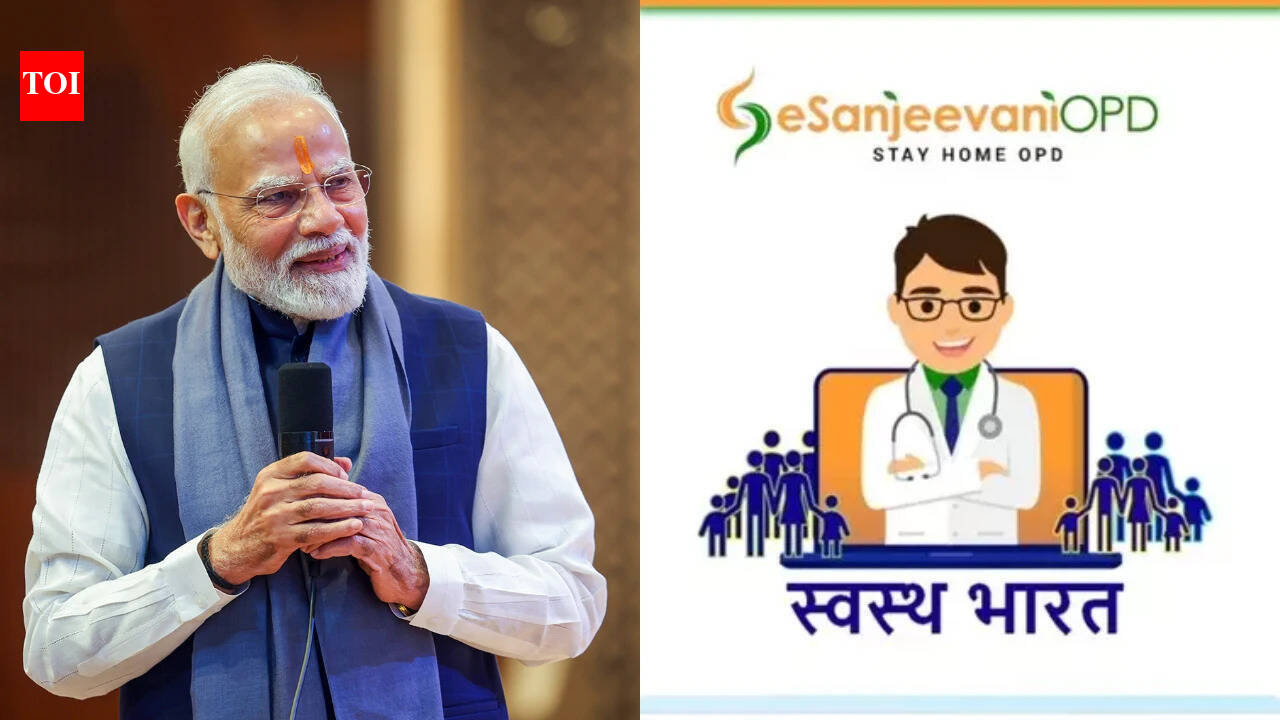
Photo from the source report: e-Sanjeevani Crosses 50 Crore Consultations: Telemedicine and Universal Health Coverage
Image: Times of India
Why in news
The Times of India reports that e-Sanjeevani has crossed 50 crore consultations, highlighting its role in bridging geographical distances from the Andaman Islands to Zanskar. The milestone invites scrutiny of service quality and continuity of care alongside consultation volumes.
50 crore
Reported consultation milestone
Background
e-Sanjeevani is the Ministry of Health and Family Welfare’s national telemedicine service, developed by the Centre for Development of Advanced Computing. It supports provider-to-provider consultations through a hub-and-spoke arrangement and patient-to-provider online consultations. Telemedicine uses communication technologies to deliver healthcare across distance. Universal health coverage means access to needed, quality health services without financial hardship; it therefore requires more than the availability of a digital consultation.
What the milestone establishes—and what it does not
The reported milestone demonstrates the scale of consultation activity on a public telemedicine platform. The geographical examples in the report illustrate its relevance where islands, mountainous terrain and travel constraints complicate physical access to healthcare.
Consultations are service encounters, not necessarily unique patients or successfully treated cases. The supplied source does not establish improvements in health outcomes, referral completion or household expenditure. These must be evaluated separately rather than inferred from platform usage.
- Repeated consultations may represent follow-up care, but consultation totals alone cannot establish continuity or quality.
- Remote access can reduce the need to travel for suitable consultations; it cannot eliminate the need for physical examination, diagnostics or hospital care.
- Programme assessment should distinguish service volume, equitable access, clinical outcomes and financial protection.
Infographic
Scale
50 crore consultations reported; encounters are not unique patients.
Inclusion
Assisted access, accessible design and non-digital alternatives.
Quality
Clinical triage, safe prescribing and timely physical care.
Continuity
Connect advice with medicines, diagnostics and completed referrals.
Trust
Protect patient information through minimal, secure and accountable processing.
Outcomes
Assess health gains and financial protection, not volume alone.
AI-assisted infographic by Pragnya IAS Academy, based on the cited sources.
Contribution to universal health coverage
Telemedicine can bring clinical advice closer to underserved communities and support frontline providers with specialist inputs. For suitable cases, it can facilitate follow-up, counselling and review of existing reports while reducing travel and time away from work.
Its financial-protection effect is conditional. Even an accessible consultation may leave patients paying for transport, medicines, tests or subsequent treatment. Telemedicine therefore advances universal health coverage most effectively when embedded in a functioning public health system.
- Access: Remote consultations can overcome some geographical barriers to medical advice.
- Quality: Specialist support can strengthen primary care when backed by adequate clinical information.
- Continuity: Scheduled follow-up can support ongoing management of suitable conditions.
- Financial protection: Potential savings depend on affordable medicines, diagnostics and referral services.
Digital exclusion and clinical safety
Direct online access may disadvantage people without reliable connectivity, suitable devices, digital literacy or a private space for consultation. Language barriers, disability and unequal control over household phones can deepen exclusion. Assisted access at public health facilities can mitigate these barriers, provided staff and infrastructure are available.
Clinical suitability must determine whether a case can be managed remotely. The inability to perform a complete physical examination creates diagnostic limitations. Telemedicine should support timely escalation rather than become a compulsory digital gatekeeper for in-person care.
- Retain walk-in and other non-digital routes to care.
- Use accessible interfaces, local-language support and trained facilitators.
- Apply triage protocols to identify warning signs and conditions requiring examination.
- Audit clinical appropriateness, prescribing practices and patient complaints rather than rewarding consultation counts alone.
Referral integration, accountability and patient privacy
A consultation becomes meaningful when the patient can obtain the recommended test, medicine or physical assessment. Referral integration requires a defined receiving facility, clear urgency, feasible transport and feedback to the referring provider. Otherwise, telemedicine risks becoming an isolated advisory service.
The constitutional framework supports both access and safeguards: Article 21 underpins the right to health through judicial interpretation and protects privacy, while Article 47 directs the State to improve public health. Public health and hospitals fall primarily within the State List, making Centre–State coordination essential for implementation.
The Digital Personal Data Protection Act, 2023 provides a statutory framework for digital personal-data protection; specific compliance obligations must be assessed against provisions and rules in force. Operational safeguards should include clear notices, an appropriate legal basis for processing, data minimisation, restricted access, security controls and grievance redress. Consent to clinical care should not be treated as blanket permission for unrelated data use.
- Interoperability should enable necessary clinical exchange without unrestricted access to patient records.
- Consent to teleconsultation and authorisation for data processing serve distinct purposes.
- Responsibility for clinical decisions, technical failures and data incidents should be clearly assigned.
| Dimension | Telemedicine contribution | Necessary safeguard or complementary service |
|---|---|---|
| Geographical access | Remote medical advice | Connectivity and assisted access near the patient |
| Clinical quality | Specialist inputs and suitable follow-up | Triage, documentation and timely physical examination |
| Continuity of care | Repeat contact and review | Referral completion and feedback to the primary provider |
| Financial protection | Potential reduction in travel and wage loss | Affordable diagnostics, medicines and subsequent treatment |
| Trust and privacy | Digital exchange of clinical information | Purpose limitation, secure access and accountable data handling |
- 1. Enable direct or assisted access with clear information and appropriate consent.
- 2. Triage the patient and identify urgent or examination-dependent conditions.
- 3. Conduct and document a clinically suitable remote consultation.
- 4. Arrange medicines, diagnostics or referral according to clinical need.
- 5. Confirm referral completion and communicate findings to the referring provider.
- 6. Provide follow-up and assess outcomes, patient expenditure and experience.
Significance, challenges & way forward
Significance
- Public telemedicine can extend medical advice to communities facing substantial geographical barriers.
- Provider-to-provider consultations can strengthen clinical support available at primary-care facilities.
- Suitable remote follow-up can reduce avoidable travel and opportunity costs for patients.
- Large-scale use makes quality assurance, digital inclusion and privacy central public-health governance concerns.
Challenges
- Connectivity, device access, literacy and language barriers can reproduce existing inequalities in healthcare access.
- Remote consultations cannot substitute for every physical examination, diagnostic procedure or emergency intervention.
- Weak referral systems and shortages of medicines or diagnostics can prevent advice from translating into treatment.
- Consultation totals do not reveal unique beneficiaries, clinical appropriateness or financial protection.
- Inadequate access controls or excessive data sharing can compromise patient confidentiality and public trust.
- High service volumes without adequate staffing and clinical oversight may undermine consultation quality.
Way forward
- Adopt an assisted-first inclusion strategy in underserved areas while preserving non-digital access to healthcare.
- Integrate teleconsultations with primary care, diagnostics, medicine dispensing and referral facilities.
- Establish clear triage, emergency escalation and in-person examination protocols.
- Track referral completion, patient-reported outcomes, safety incidents and expenditure alongside consultation volumes.
- Evaluate access across geography, gender, age and disability using privacy-preserving methods.
- Implement privacy-by-design through minimal data collection, role-based access, secure systems, audit trails and clear accountability.
- Strengthen Centre–State coordination, frontline training and independent clinical-quality audits.
Key terms
- Telemedicine
- Delivery of healthcare services across distance using information and communication technologies.
- Universal health coverage
- Access to needed, quality health services without financial hardship.
- Hub-and-spoke model
- An arrangement connecting peripheral service points with a central facility offering clinical expertise.
- Digital exclusion
- Inability to use digital services effectively because of barriers such as connectivity, affordability, literacy or accessibility.
- Closed-loop referral
- A referral process that confirms whether recommended care was received and returns relevant information to the referring provider.
- Data minimisation
- Limiting personal-data collection and processing to what is necessary for a specified purpose.
Link with static syllabus
Prelims practice MCQs
Q1. With reference to e-Sanjeevani, consider the following statements: 1. It is a national telemedicine service of the Ministry of Health and Family Welfare. 2. Its cumulative consultation count necessarily represents the same number of unique beneficiaries. 3. Telemedicine can support provider-to-provider consultations. Which of the statements given above are correct?
Q2. Which of the following best describes universal health coverage?
Q3. Consider the following pairs: 1. Article 21 — Judicially recognised protection of health and privacy 2. Article 47 — Duty of the State to improve public health 3. Public health and hospitals — Primarily a Union List subject How many of the above pairs are correctly matched?
Q4. With reference to safe telemedicine delivery, consider the following statements: 1. Consent to a teleconsultation automatically permits unrelated commercial use of patient data. 2. Referral completion is relevant to evaluating continuity of care. 3. Telemedicine should provide for escalation to in-person care when clinically necessary. Which of the statements given above are correct?
Mains practice questions
GS 2 · 15 marks · 250 words
e-Sanjeevani’s consultation milestone demonstrates the scale of telemedicine, but not necessarily universal health coverage. Discuss with reference to digital inclusion, clinical quality, referral integration and patient-data protection.
Frequently asked questions
Does 50 crore consultations mean 50 crore different patients?
No. A consultation total may include multiple encounters involving the same patient; the supplied source does not establish the number of unique beneficiaries.
Can telemedicine replace physical healthcare facilities?
No. It can support suitable consultations and follow-up, but physical facilities remain essential for examinations, diagnostics, procedures and emergency care.
How can e-Sanjeevani contribute to universal health coverage?
It can improve access to medical advice and reduce some travel-related burdens. Its contribution depends on quality care, inclusive access and links to affordable medicines, diagnostics and referrals.
What should be measured beyond consultation numbers?
Evaluation should examine equitable access, clinical appropriateness, referral completion, patient outcomes, expenditure, safety and privacy protection.
Sources
Analysis prepared by the Pragnya IAS Academy current-affairs desk with AI assistance from the cited reports. Verify figures with the original sources.
Turn current affairs into marks
Join Pragnya IAS Academy's mentorship for daily answer-writing evaluation on stories like this — classroom programmes from a trusted name in IAS coaching in Hyderabad.