
PSLV-N1 Launch Likely in Early 2027: Industry-Led Manufacturing and Space Reforms
Revise the static topic: UPSC Science & Technology notes
In short: The maiden flight of PSLV-N1, manufactured by a Hindustan Aeronautics Limited–Larsen & Toubro consortium, is now likely in early 2027, with EOS-10 as its intended payload. The programme marks a shift towards industry-led production of an ISRO-designed launcher, but delays and recent PSLV failures underline the importance of technology absorption, component quality and mission readiness.
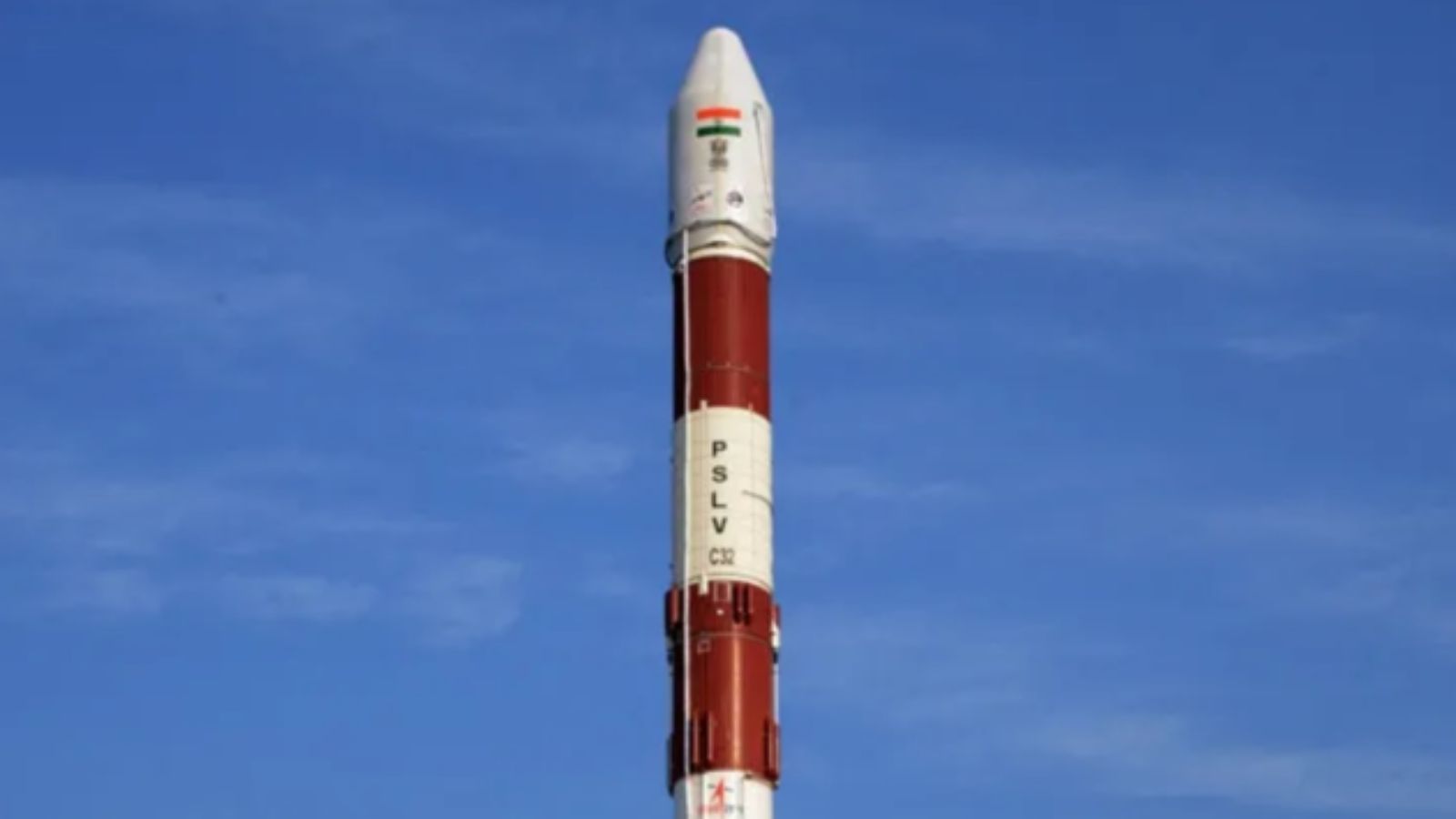
Reference view of a PSLV launcher. PSLV-N1, manufactured by the HAL–L&T consortium, is intended to carry EOS-10 on its maiden flight, now likely in early 2027.
Image: Indian Express
Why in news
Reports indicate that the first industry-manufactured PSLV is ready, but its maiden launch is likely to move to early 2027. Payload coordination, launch-window availability and caution following successive PSLV failures have affected the schedule.
Early 2027
Likely maiden launch
2022
Manufacturing contract awarded
5
PSLVs contracted
2 years
Original first-vehicle production period
6 months
Planned subsequent delivery interval
65
PSLV launches reported by the source
Background
The Polar Satellite Launch Vehicle is an ISRO-developed launcher widely used for Earth-observation and other satellite missions. It uses alternating solid and liquid propulsion stages. Indian industry has long supplied components and subsystems to the space programme; transferring responsibility for complete vehicle manufacturing represents a deeper industrial role. Under India’s space-reform framework, ISRO focuses on research, technology development and national space objectives, NewSpace India Limited undertakes commercial activities, and IN-SPACe promotes and authorises non-governmental space activities. PSLV-N1 should therefore be understood as industry-led production of an established launcher, not as an entirely new privately designed rocket.
What is changing in the PSLV programme?
A consortium led by HAL and L&T received a contract in 2022 to manufacture five PSLVs. The first vehicle was to be manufactured within two years, followed by deliveries at six-month intervals. The maiden vehicle, PSLV-N1, was intended to carry ISRO’s Earth-observation satellite EOS-10.
Although widely described as a privately built PSLV, the institutional description needs precision: HAL is a public-sector enterprise, while L&T is a private-sector company. The key change is consortium-led manufacturing of an ISRO-developed vehicle, rather than the creation of a wholly private launch system.
- Complete vehicle manufacturing requires coordination across suppliers, assembly, testing and documentation.
- Manufacturing readiness does not by itself establish payload readiness or authorisation to launch.
- The reported early-2027 flight remains an expectation, not a confirmed launch date.
Infographic
Technology absorption
Transfer process knowledge, not just drawings.
Quality assurance
Qualify suppliers and verify corrective changes.
Component sovereignty
Build capabilities in strategically critical inputs.
Mission coordination
Align vehicles, payloads and launch readiness.
Commercial credibility
Deliver reliable missions on predictable schedules.
AI-assisted infographic by Pragnya IAS Academy, based on the cited sources.
Why has the launch slipped?
L&T’s representative attributed delays to issues including payload coordination and the available launch window. The Indian Express also reported, citing sources, that ISRO may clear the industry-built vehicle only after a successful launch of its own PSLV.
PSLV-C61 on May 18, 2025 and PSLV-C62 on January 12, 2026 failed following third-stage anomalies. The report says ISRO maintains that the causes were different. It also reports component-supplier changes following failure-assessment recommendations and states, through sources, that corrective changes have been made.
- The reported anomalies occurred on earlier PSLV missions; they are not evidence of a manufacturing defect in PSLV-N1.
- Corrective action must be distinguished from demonstrated reliability, which requires verification and flight performance.
- The evidence does not support attributing the entire delay to the manufacturing consortium.
Technology transfer must become technology absorption
Industry-led production can allow ISRO to devote more attention to advanced technology while an industrial ecosystem handles repeat manufacturing. However, transferring drawings and specifications is insufficient: successful production also requires process knowledge, tooling competence, supplier qualification and the ability to investigate deviations.
The deeper test is whether industry can consistently reproduce flight-worthy hardware and manage approved changes without weakening configuration control. Manufacturing responsibility should therefore be accompanied by training, access to test infrastructure and clearly defined technical interfaces with ISRO.
- Technology absorption should be measured through repeatable manufacturing capability, not merely delivery of documentation.
- Production contracts should clarify intellectual-property use, technical support, acceptance criteria and responsibility for non-conformities.
- Lessons from assembly, testing and flight should feed back into both design review and industrial processes.
Component sovereignty and quality assurance
At the conclave, L&T’s representative proposed a Space Components Mission covering space-grade electronics, sensors, propulsion, materials and mechanisms. This is an industry proposal reported in the source, not an announced government programme.
Its policy rationale is that domestic assembly can coexist with dependence on critical imported inputs. Strategic autonomy requires the ability to design, manufacture, qualify, operate and upgrade essential systems. However, the source does not establish that imported components caused the recent PSLV failures.
- Maintain traceability from raw material and component batches to the assembled vehicle.
- Require qualification and verification of replacement suppliers rather than treating substitution as sufficient proof of safety.
- Prioritise critical components according to mission risk, import vulnerability and domestic technological feasibility.
- Preserve independent quality review even when production responsibility shifts to industry.
Commercial competitiveness depends on dependable delivery
An industrial production line can potentially improve capacity, standardise manufacturing and support a more predictable launch cadence. These benefits are not automatic: customers assess launch reliability, schedule certainty, price, payload compatibility and contractual accountability together.
Repeated postponements can weaken commercial confidence and disrupt satellite deployment plans. Conversely, rushing a flight to demonstrate reform success would expose the programme to greater reputational and financial risk. The immediate priority is a credible return to reliable service, followed by predictable industrial delivery.
- Launch capacity must be matched with payload readiness, testing facilities and launch infrastructure.
- Stable procurement and a credible mission pipeline can encourage investment in specialised manufacturing.
- Commercial claims should be based on demonstrated performance rather than the manufacturing model alone.
| Dimension | Correct interpretation |
|---|---|
| Vehicle design | PSLV is an ISRO-developed launcher; PSLV-N1 is not a wholly new privately designed rocket. |
| Manufacturing | The HAL–L&T consortium is responsible for contracted vehicle production. |
| Ownership description | The consortium combines a public-sector enterprise with a private-sector company. |
| Launch readiness | A completed vehicle still requires mission-level readiness, including payload integration and launch clearance. |
| Reliability | Industrial production does not remove the need for qualification, acceptance testing and flight validation. |
| Component mission | A Space Components Mission has been proposed by industry; the source does not report its government approval. |
- 1. Transfer approved design documents, process knowledge and acceptance requirements.
- 2. Qualify suppliers, materials, components and manufacturing processes.
- 3. Manufacture and integrate hardware with traceable inspection records.
- 4. Conduct acceptance tests and verify closure of identified anomalies.
- 5. Complete payload integration and mission-level readiness reviews.
- 6. Use flight data to strengthen subsequent production and quality controls.
2022
The HAL–L&T consortium was awarded a contract to manufacture five PSLVs.
2024
The first vehicle was due under the original two-year manufacturing schedule.
May 18, 2025
PSLV-C61 failed following a third-stage anomaly.
January 12, 2026
PSLV-C62 failed following a third-stage anomaly; ISRO reportedly maintained that its cause differed from the earlier failure.
2026
At least two launches under the industry-manufacturing programme had been planned for the year.
Early 2027
The maiden flight of PSLV-N1 is now considered likely, with EOS-10 as the intended payload.
Significance, challenges & way forward
Significance
- Industry-led vehicle production can deepen India’s space-industrial capability beyond component supply.
- A capable manufacturing ecosystem can allow ISRO to focus greater effort on advanced research and strategic missions.
- Repeat production can create opportunities for specialised suppliers, skilled technicians and systems engineers.
- Domestic capability in critical components can reduce exposure to supply restrictions and external disruptions.
- Reliable industrial delivery can strengthen India’s position in commercial launch services.
Challenges
- Transferring tacit manufacturing knowledge is harder than transferring drawings and specifications.
- Recent PSLV failures make verified corrective action and transparent reliability assessment especially important.
- Coordination failures between vehicle production, payload preparation and launch scheduling can delay missions.
- Supplier changes can introduce new risks unless supported by qualification and configuration control.
- Uncertain demand can discourage long-term investment in specialised facilities and skilled personnel.
- Fragmented responsibility can complicate decisions on defect correction, acceptance and launch readiness.
Way forward
- Separate production milestones from mission-readiness milestones and assign clear responsibility for each.
- Publish appropriate non-sensitive findings on failures and corrective-action verification to build confidence.
- Institutionalise technology-absorption programmes through training, joint reviews and access to test facilities.
- Evaluate a targeted component-development initiative based on criticality, strategic vulnerability and qualification needs.
- Maintain independent quality assurance, end-to-end traceability and rigorous control over supplier changes.
- Align procurement, payload pipelines and infrastructure availability to support predictable launch schedules.
- Judge industrialisation through reliability, delivery performance and lifecycle efficiency rather than launch announcements alone.
Key terms
- PSLV
- Polar Satellite Launch Vehicle, an ISRO-developed launcher using alternating solid and liquid propulsion stages.
- Technology absorption
- The ability to understand and reliably apply transferred technology in production, testing and problem-solving.
- Qualification
- Demonstration that a design, component or process meets specified requirements under relevant operating conditions.
- Acceptance testing
- Testing of produced hardware to verify that it conforms to prescribed requirements.
- Configuration control
- The disciplined recording, review and approval of changes to a system’s design, components and processes.
- Launch window
- The period during which a launch can satisfy the mission’s orbital and operational requirements.
- Radiation-hardened electronics
- Electronic components designed to resist radiation effects encountered in environments such as space.
- IN-SPACe
- Indian National Space Promotion and Authorisation Centre, which promotes and authorises non-governmental space activities.
Link with static syllabus
Prelims practice MCQs
Q1. With reference to PSLV-N1, consider the following statements: 1. It is being manufactured by a consortium led by HAL and L&T. 2. It is a wholly new launcher designed independently of ISRO. 3. EOS-10 is its intended payload according to the report. Which of the statements given above are correct?
Q2. Consider the following pairs: 1. ISRO — Space research and technology development 2. NSIL — Commercial space activities 3. IN-SPACe — Promotion and authorisation of non-governmental space activities How many of the above pairs are correctly matched?
Q3. With reference to quality assurance in launch-vehicle manufacturing, consider the following statements: 1. Changing a component supplier automatically establishes the reliability of the replacement component. 2. Configuration control helps track and approve changes to a vehicle’s design and components. 3. Acceptance testing verifies whether produced hardware conforms to prescribed requirements. Which of the statements given above are correct?
Q4. Regarding the proposed Space Components Mission mentioned in the report, which one of the following statements is correct?
Mains practice questions
GS 3 · 15 marks · 250 words
Industry-led launch-vehicle manufacturing is necessary but insufficient for a globally competitive Indian space sector. Discuss with reference to technology transfer, quality assurance and component sovereignty.
Frequently asked questions
Is PSLV-N1 India’s first privately designed PSLV?
No. It is an industry-manufactured version of the ISRO-developed PSLV, built by a consortium combining public-sector HAL and private-sector L&T.
When is PSLV-N1 expected to launch?
The supplied reports indicate that its maiden flight is likely in early 2027. This is an expected timeframe, not a confirmed launch date.
Why can a completed rocket still face a launch delay?
Launch readiness also depends on payload integration, launch-window availability and mission-level safety clearance. The report additionally links caution to recent PSLV failures.
Has the government launched a Space Components Mission?
The supplied material reports an industry proposal for such a mission. It does not establish government approval or implementation.
Sources
- Indian Express: Maiden flight of privately built PSLV-N1 delayed again, likely early next year
- Times of India: 1st privately built PSLV set for launch early next year: Isro chief
Analysis prepared by the Pragnya IAS Academy current-affairs desk with AI assistance from the cited reports. Verify figures with the original sources.
Turn current affairs into marks
Join Pragnya IAS Academy's mentorship for daily answer-writing evaluation on stories like this — classroom programmes from a trusted name in IAS coaching in Hyderabad.