
Thirupparankundram Lamp Order: Contempt, Religious Freedom and Executive Duty
Revise the static topic: UPSC Polity notes · UPSC Governance notes
In short: The Supreme Court directed lamp-lighting at the disputed deepathoon on Thirupparankundram hill on November 28, 2026, ordered CRPF security, suspended the temple’s Board of Trustees and appointed judicial receivers. It also issued contempt notices to senior State officials and temple authorities, bringing judicial compliance, equal religious protection and the limits of executive discretion into focus.
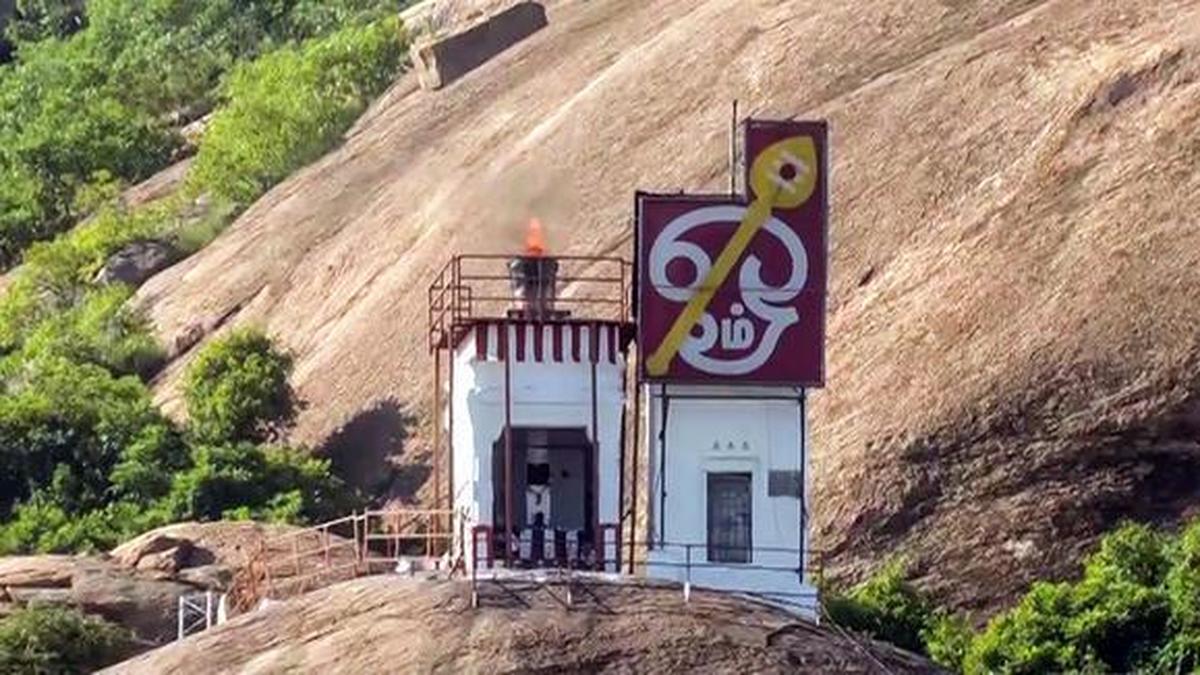
Photo from the source report: Thirupparankundram Lamp Order: Contempt, Religious Freedom and Executive Duty
Image: The Hindu
Why in news
CRPF personnel reached Thirupparankundram on Friday night following the Supreme Court’s directions. The supplied reports describe preparations for the November 28 ceremony, not its completion, and identify December 15 as the next hearing.
Background
Thirupparankundram is in Madurai, Tamil Nadu. The reported dispute concerns lamp-lighting at a hill site associated with Sri Subramania Swamy Temple, while security arrangements also cover a dargah and access for Muslim worshippers. Constitutionally, freedom of religion coexists with public order and lawful regulation of secular administration. Public order and police are primarily State subjects, but State authorities must also act in aid of the Supreme Court. The Hindu Religious and Charitable Endowments framework provides the statutory setting for temple administration in Tamil Nadu.
What the Supreme Court directed
According to the supplied reports, the Supreme Court directed that the lamp be lit at the deepathoon on November 28 using the flame from the Uchipillaiyar Mandapam, where customary lighting had occurred earlier in the week. The temple’s Board of Trustees was suspended, and former Madras High Court judges S. Vaidyanathan and V. Parthiban were appointed receivers to oversee temple affairs and ensure that the ritual proceeds without obstruction.
CRPF personnel were directed to secure the area, protect both the temple and the dargah, and preserve unobstructed access for Muslim worshippers while regulating participation in the lamp-lighting ceremony. The reports also identify contempt notices and a direction requiring senior officials and temple authorities to attend the next hearing.
- The officials identified include the Tamil Nadu Chief Secretary, Director General of Police and Madurai District Collector.
- The supplied headline reports the court’s observation of a ‘pre-meditated conspiracy’; this must not be treated as a final adjudication of contempt liability.
- The full judicial order is not supplied, so its precise statutory reasoning, duration of receivership and detailed operational conditions cannot be independently established here.
Infographic
Binding compliance
Article 144 requires authorities to act in aid of the Supreme Court.
Fair contempt scrutiny
A notice is not guilt; wilfulness and explanations matter.
Equal religious protection
Facilitate the ceremony while safeguarding dargah access.
Proportionate security
Coordinate CRPF and State agencies without unnecessary exclusion.
Reviewable intervention
Clarify receivership, responsibilities and restoration of ordinary administration.
AI-assisted infographic by Pragnya IAS Academy, based on the cited sources.
Judicial compliance and contempt jurisdiction
Article 129 makes the Supreme Court a court of record with power to punish for contempt of itself. Under the Contempt of Courts Act, 1971, civil contempt includes wilful disobedience of a judgment, decree, direction, order, writ or other court process, as well as wilful breach of an undertaking given to a court. A show-cause notice initiates scrutiny; it does not establish guilt.
Article 144 requires all civil and judicial authorities in India to act in aid of the Supreme Court. An authority disagreeing with an order must seek appropriate judicial relief, rather than assume a power to disregard it. Filing a review petition does not by itself stay the order under challenge.
Contempt scrutiny must distinguish deliberate defiance from genuine inability to comply. The clarity of the direction, the official’s responsibility, practical capacity and documented compliance efforts are relevant. Public-order concerns require evidence and a request for judicial accommodation, not unilateral suspension of a binding direction.
- Article 137 provides for Supreme Court review of its judgments and orders, subject to the applicable legal framework.
- Article 142 empowers the Court to make orders necessary for complete justice in a pending cause or matter; the supplied reports do not establish whether this provision was expressly invoked.
- Fair criticism of judicial reasoning should be distinguished from obstruction of justice or disobedience of judicial directions.
Religious freedom and public order must be reconciled
Article 25 protects freedom of conscience and the right freely to profess, practise and propagate religion, subject to public order, morality, health and the other provisions of Part III. Article 26 protects specified rights of religious denominations, subject to public order, morality and health. Neither provision creates an unrestricted entitlement to determine access or ritual arrangements at a disputed site.
The reported security mandate combines facilitation of the lamp-lighting ceremony with protection of the dargah and Muslim worshippers’ access. This is constitutionally significant: administration should enable lawful worship without treating one community’s protection as requiring another community’s exclusion.
Political responses describe the disputed structure differently, including as a deepathoon and as a survey pillar. These descriptions and competing claims about tradition are not independently resolved by the supplied material. Analysis should therefore avoid presenting contested historical, ownership or customary claims as established facts.
- Restrictions on worship should have a lawful basis and be proportionate to demonstrated public-order risks.
- Article 25 permits regulation of economic, financial, political and other secular activities associated with religious practice.
- Security management should distinguish peaceful worshippers from persons attempting obstruction, intimidation or mobilisation for violence.
Executive responsibility, receivership and federal balance
Public order and police are primarily State responsibilities under the Seventh Schedule. The reported deployment of a Central Armed Police Force and appointment of receivers therefore raise questions about the scope of judicially supervised intervention. However, State administrative authority does not include a right to disregard Supreme Court directions.
A receiver administers property or affairs under court authority within the assigned mandate. Appointment of receivers is distinct from a final determination of ownership, and the reported suspension of trustees does not itself establish a permanent restructuring of temple administration.
The appropriate institutional balance is effective enforcement with clearly defined responsibilities. Judicial directions should be translated into workable security arrangements, while exceptional supervisory measures should have a reviewable scope and a clear relationship with ordinary statutory administration.
- CRPF deployment at the site does not by itself establish a general transfer of Tamil Nadu’s public-order powers to the Union.
- Operational coordination should clearly allocate responsibilities among the CRPF, district administration, police and receivers.
- Temporary intervention should preserve administrative accountability rather than create uncertainty over who must act.
Political reactions are not judicial findings
Political leaders welcoming the order characterised it as enforcement of the rule of law, while critics raised concerns about religious tradition, social harmony and State authority. A concern about the handling of a State review petition appears in a political statement; the supplied material does not provide the petition or the Court’s procedural reasoning.
The exam-relevant issue is not which political interpretation prevails, but how constitutional institutions secure compliance while protecting rights and procedural fairness. Contempt proceedings must remain directed towards the administration of justice, not be understood as immunity for courts from reasoned public scrutiny.
- Separate the operative directions, judicial observations and political allegations.
- Do not infer proven contempt from the issuance of a notice.
- Do not use comparisons with other religious disputes as substitutes for examining the applicable orders and facts.
| Provision | Core principle | Relevance |
|---|---|---|
| Article 25 | Religious freedom subject to constitutional limitations | Protects worship while permitting lawful public-order restrictions and regulation of associated secular activities. |
| Article 26 | Rights of religious denominations | Distinguishes religious autonomy from administration of property in accordance with law. |
| Article 129 | Supreme Court’s contempt power | Provides the constitutional basis for punishing contempt of the Supreme Court. |
| Article 137 | Review jurisdiction | Provides a judicial route to seek reconsideration; filing for review does not automatically stay an order. |
| Article 142 | Complete justice | Provides broad remedial authority in pending matters; its express invocation here is not established by the supplied reports. |
| Article 144 | Authorities must act in aid of the Supreme Court | Underlines the executive’s duty to facilitate judicial compliance. |
| Contempt of Courts Act, 1971 | Civil contempt includes wilful disobedience | Requires a distinction between alleged non-compliance and established wilful breach. |
| Seventh Schedule | Distribution of legislative subjects | Places public order and police primarily within the State sphere, subject to the constitutional scheme. |
- 1. Identify the operative directions and assign responsibility for compliance.
- 2. Assess security risks and administrative requirements using documented evidence.
- 3. Implement the order while safeguarding affected communities’ lawful access.
- 4. Where necessary, seek clarification, modification, review or a stay from the competent court.
- 5. Continue compliance unless judicial relief changes or suspends the obligation.
- 6. Report compliance and respond to any contempt notice with evidence and a fair opportunity to be heard.
Earlier in the week preceding November 28, 2026
Customary lamp-lighting took place at the Uchipillaiyar Mandapam, according to the report.
November 27, 2026
The Supreme Court directed lamp-lighting for the following day, ordered Central-force security, suspended the trustees and appointed receivers. The supplied coverage also reported contempt notices.
November 27, 2026, night
CRPF personnel arrived and began securing the foothill, pathways and key positions.
November 28, 2026
Lamp-lighting was scheduled at the deepathoon using the flame from the Uchipillaiyar Mandapam; completion is not confirmed in the supplied material.
December 15
Next hearing identified in the supplied report, with specified officials and temple authorities directed to be present.
Significance, challenges & way forward
Significance
- The episode tests whether binding judicial directions remain effective when implementation is politically sensitive.
- Protection of both the temple and the dargah highlights the State’s duty of equal religious protection.
- Contempt proceedings bring individual official responsibility into focus without dispensing with procedural fairness.
- Receivership and Central-force deployment illustrate the tension between effective judicial remedies and ordinary State administration.
- The dispute shows that rule of law requires both enforcement and rights-sensitive implementation.
Challenges
- Competing claims about the site and ritual tradition can turn a compliance dispute into wider communal mobilisation.
- Overlapping responsibilities among receivers, State authorities and Central forces can create operational uncertainty.
- Political rhetoric may blur the distinction between a contempt allegation and an adjudicated finding.
- Overbroad security restrictions could burden peaceful worshippers even when intended to prevent disorder.
- The absence of the full order in the supplied material limits conclusions about the Court’s reasoning and the duration of exceptional measures.
Way forward
- Prepare an order-specific compliance plan with named responsibilities, access arrangements and reporting obligations.
- Place genuine implementation difficulties before the Court promptly, supported by evidence and feasible alternatives.
- Use proportionate security measures that protect the ceremony, the dargah and lawful access for both communities.
- Define coordination arrangements among the CRPF, district administration, police and receivers.
- Maintain a transparent record of actions taken so that contempt scrutiny can distinguish wilful defiance from genuine constraints.
- Provide periodic judicial review of exceptional administrative arrangements and clarify the conditions for restoring ordinary administration.
- Communicate verified directions publicly and discourage inflammatory claims without suppressing lawful criticism.
Key terms
- Civil contempt
- Wilful disobedience of a court’s judgment, decree, direction, order, writ or other process, or wilful breach of an undertaking given to a court.
- Show-cause notice
- A notice requiring the recipient to explain why specified legal action should not be taken; it is not a finding of guilt.
- Court of record
- A court whose records carry authoritative evidentiary status and which possesses contempt powers recognised by the Constitution.
- Receiver
- A person appointed by a court to manage specified property or affairs under judicial supervision.
- Review petition
- A request asking the same court to reconsider its judgment or order on legally recognised grounds.
- Stay
- A judicial direction suspending the operation of an order or proceeding to the extent specified.
- CRPF
- The Central Reserve Police Force is a Central Armed Police Force under the Union Ministry of Home Affairs.
- Deepathoon
- The term used in the reports for the disputed pillar or lamp-lighting site on Thirupparankundram hill.
Link with static syllabus
Prelims practice MCQs
Q1. With reference to Supreme Court orders, consider the following statements: 1. Article 144 requires all civil and judicial authorities in India to act in aid of the Supreme Court. 2. Filing a review petition automatically stays the order under challenge. 3. Article 129 recognises the Supreme Court’s power to punish for contempt of itself. Which of the statements given above are correct?
Q2. Consider the following statements about religious freedom: 1. Article 25 is subject to public order, morality, health and the other provisions of Part III. 2. Article 26 is subject to public order, morality and health. 3. Article 25 permits regulation of economic, financial, political and other secular activities associated with religious practice. Which of the statements given above are correct?
Q3. Under the Contempt of Courts Act, 1971, which of the following falls within the definition of civil contempt?
Q4. Consider the following pairs: 1. Article 137 — Review of Supreme Court judgments or orders 2. Article 142 — Orders necessary for complete justice in a pending cause or matter 3. Article 141 — Legislative control over State police How many of the above pairs are correctly matched?
Mains practice questions
GS 2 · 15 marks · 250 words
Judicial authority and executive responsibility are complementary, not competing, obligations. Discuss in the context of enforcing court orders involving religious freedom and public order.
Frequently asked questions
What did the Supreme Court order at Thirupparankundram?
The supplied reports describe directions for lamp-lighting on November 28, CRPF security, suspension of temple trustees and appointment of receivers. They also report contempt notices and protection of access to the dargah.
Does a contempt notice mean that officials have been found guilty?
No. A notice requires an explanation; liability must be determined after considering the applicable legal requirements, evidence and defence.
Can the government defer compliance merely because it seeks review?
No. Filing a review petition does not automatically stay an order, so the government must comply unless appropriate judicial relief changes or suspends its obligation.
How should religious freedom and public order be balanced?
Authorities should facilitate lawful worship for all affected communities and use only legally justified, proportionate restrictions. Genuine implementation difficulties should be placed before the Court rather than used to disregard its directions.
Sources
- The Hindu: Nagenthran, Annamalai welcome SC order on Thirupparankundram issue
- The Hindu: VCK, MMK flag concerns over SC ruling in Thirupparankundram issue
- The Hindu: CRPF arrives in Madurai to secure Thirupparankundram area
- The Hindu: Supreme Court orders Karthigai Deepam to be lit at ‘deepathoon’ on November 28; issues contempt notice
Analysis prepared by the Pragnya IAS Academy current-affairs desk with AI assistance from the cited reports. Verify figures with the original sources.
Turn current affairs into marks
Join Pragnya IAS Academy's mentorship for daily answer-writing evaluation on stories like this — classroom programmes from a trusted name in IAS coaching in Hyderabad.