
Chandrayaan-5/LUPEX: Lunar Water Exploration and India–Japan Space Cooperation
Revise the static topic: UPSC Science & Technology notes
In short: Japan’s JAXA has unveiled and demonstrated a rover prototype for Chandrayaan-5/LUPEX, the joint India–Japan lunar polar exploration mission scheduled for launch in 2028. With an ISRO-built lander and a JAXA-developed rover, the mission will investigate lunar water and other volatiles near a permanently shadowed region at the Moon’s south pole, informing both planetary science and future exploration.
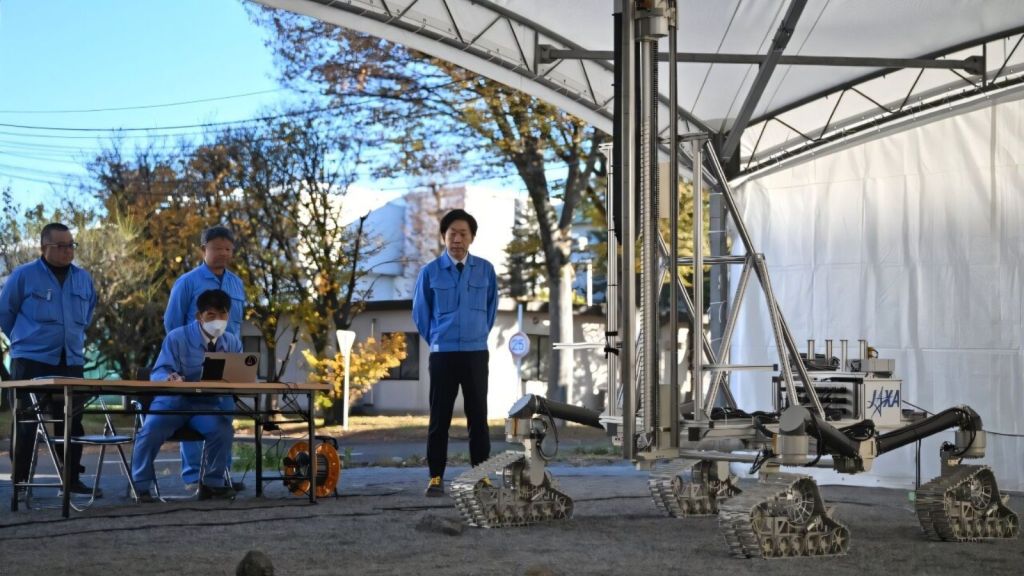
Reference image of the Chandrayaan-5/LUPEX rover prototype. Japan’s JAXA is developing the rover to explore lunar polar water and other volatiles, working with an ISRO-built lander in the joint India–Japan mission.
Image: Indian Express
Why in news
JAXA unveiled the rover prototype at the Chofu Aerospace Centre in Japan on November 25, demonstrating its movement over simulated uneven lunar terrain. The unveiling is a development milestone, not the mission’s launch or a demonstration of operations on the Moon.
2028
Scheduled launch year
Around 350 kg
Reported rover mass
Up to 1.5 metres
Planned sampling depth
7
Scientific instruments on rover
11
Mission-wide payloads
3.5 months
Nominal surface mission duration
Background
The Chandrayaan programme has progressively developed India’s capabilities in lunar remote sensing, landing and surface exploration. Chandrayaan-1 contributed to evidence of water-related molecules on the Moon; Chandrayaan-3 demonstrated soft landing and rover operations. Lunar polar exploration addresses a different question: where water and other volatiles occur locally, in what form and under what physical conditions. Because the Moon’s rotational axis is only slightly tilted relative to its orbital plane, some polar depressions receive no direct sunlight and can act as cold traps. These environments are scientifically valuable but operationally difficult.
What has been unveiled and how the mission is organised
Chandrayaan-5, also called Lunar Polar Exploration or LUPEX, is designated the fifth mission in the Chandrayaan series. It received Union government financial sanction on March 10, 2025, and is scheduled to launch in 2028 aboard Japan’s H3-24L launch vehicle from the Tanegashima Space Centre.
ISRO is developing the lunar lander and contributing scientific instruments, while JAXA is developing the rover. The demonstrated prototype uses belt-like crawler tracks rather than conventional wheels; the Indian Express describes it as a four-legged crawler and reports that the flight model is undergoing advanced testing.
- The rover is reported to weigh around 350 kg, while the mission’s launch mass is roughly 6.5 tonnes.
- The reported seven rover instruments and eleven mission-wide payloads refer to different scopes and should not be treated as interchangeable totals.
- The nominal surface mission is three and a half months, with a possible extension up to one year.
Infographic
Polar target
Investigate volatiles near a south-polar permanently shadowed region.
Complementary roles
ISRO lander; JAXA rover and Japanese launch vehicle.
Two-tier exploration
Survey promising sites, then sample regolith up to 1.5 metres deep.
Global instruments
NASA neutron sensing and ESA exosphere measurements complement other payloads.
Future relevance
Inform lunar science and resource assessment without assuming extractability.
AI-assisted infographic by Pragnya IAS Academy, based on the cited sources.
Scientific objectives: move from detection to local characterisation
LUPEX will investigate volatile materials, including water, in the vicinity of a permanently shadowed region at the lunar south pole. Its objectives include examining the presence and distribution of water and water ice on the surface and below ground, measuring surface temperatures and studying geological clues.
Exploration will proceed through coarse observations to survey terrain and identify promising drilling locations, followed by fine observations involving extraction and analysis of regolith samples from depths of up to 1.5 metres. The rover’s route will be jointly planned for scientific operations, measurements and battery recharging.
NASA’s neutron-sensing contribution will help investigate subsurface hydrogen associated with potential water-bearing material. ESA’s Exploration Mass Spectrometer for LUPEX, or EMS-L, will investigate the Moon’s extremely thin exosphere. Hydrogen detection alone does not establish the quantity of usable water ice; complementary measurements and local sample analysis are important.
- The scientific priority is to characterise water locally, rather than merely repeat the general finding that water-related material exists on the Moon.
- Subsurface sampling can reveal material whose properties differ from the exposed surface.
- Measurements of the exosphere can complement surface investigations of volatile behaviour.
Why lunar water matters
Scientifically, polar volatiles can help reconstruct the delivery, migration and preservation of water on the Moon. Potential sources include impact-delivered material and processes involving the solar wind; interpreting local measurements requires distinguishing among these processes.
For future exploration, accessible water could potentially support life-support systems and, after processing and electrolysis, provide oxygen and hydrogen. However, detecting water is not equivalent to establishing an economically or technically usable resource. Concentration, depth, physical form, terrain, energy availability and extraction requirements all matter.
- Water abundance and distribution can inform the selection of future exploration sites.
- Local resource use could reduce some supplies transported from Earth, subject to technical feasibility.
- LUPEX is an exploration and characterisation mission, not an operational lunar mining project.
India–Japan cooperation and the operational challenge
LUPEX combines India’s lander-development role with Japan’s rover and launch responsibilities. ESA and NASA contributions broaden the scientific collaboration without changing the mission’s core India–Japan partnership.
The partnership extends beyond hardware: jointly planned rover routes must reconcile scientific priorities, terrain safety and energy needs. Interface compatibility, integrated testing and shared interpretation of observations will therefore be as important as individual subsystem performance.
The polar environment creates a central trade-off: cold, shadowed locations are attractive for volatile preservation, but limited sunlight complicates power generation and thermal management. A successful mission must connect scientifically valuable sites with feasible mobility, communication and recharge arrangements.
- India gains opportunities to deepen landing, payload and mission-integration capabilities.
- Joint implementation can distribute responsibilities while creating dependence on coordinated readiness.
- The mission can inform longer-term lunar exploration, but does not itself guarantee a crewed landing or usable water reserves.
| Partner | Contribution |
|---|---|
| ISRO | Lunar lander and some scientific instruments; joint planning of surface operations. |
| JAXA | Rover development and Japanese H3 launch capability; joint planning of surface operations. |
| NASA | Neutron-sensing instrumentation to investigate subsurface hydrogen and potential water-bearing material. |
| ESA | EMS-L mass spectrometer to investigate the lunar exosphere. |
- 1. Land near the targeted lunar south-polar exploration area.
- 2. Follow a jointly planned route balancing science, mobility and battery recharging.
- 3. Conduct coarse observations to survey terrain and identify promising drilling locations.
- 4. Extract regolith samples from depths of up to 1.5 metres for fine observations.
- 5. Analyse samples and combine findings with other instrument measurements.
- 6. Characterise local volatiles and assess implications for lunar science and future exploration.
2008
Chandrayaan-1 launched, beginning India’s Chandrayaan lunar exploration programme.
2019
Chandrayaan-2 launched, advancing orbiter-based lunar exploration.
2023
Chandrayaan-3 demonstrated lunar soft landing and rover-based in-situ exploration.
March 10, 2025
Chandrayaan-5/LUPEX received Union government financial sanction.
November 25, 2026
JAXA unveiled and demonstrated the LUPEX rover prototype in Japan.
2028, scheduled
LUPEX is scheduled to launch aboard Japan’s H3 launch vehicle.
2040, stated goal
India’s longer-term lunar ambitions include sending the first Indian to the Moon; this is distinct from LUPEX’s mission objectives.
Significance, challenges & way forward
Significance
- Direct surface and subsurface investigations can strengthen the interpretation of remotely detected water-related signatures.
- Polar volatile studies can improve understanding of the Moon’s environmental history and water cycle.
- Resource-characterisation data can support more informed planning of future robotic and human exploration.
- India–Japan collaboration expands opportunities for complementary engineering capabilities and joint scientific research.
- International instruments allow different measurement techniques to address related questions about lunar volatiles.
Challenges
- Limited sunlight and extreme cold near shadowed terrain complicate power supply and thermal control.
- Uneven terrain and loose regolith create risks for rover mobility, drilling and reliable sample acquisition.
- Hydrogen-related signals require careful interpretation before conclusions about water ice abundance can be drawn.
- Lander, rover, launch vehicle and payload interfaces require coordinated testing across participating agencies.
- A positive water detection would not by itself establish practical extractability or resource economics.
- The scheduled launch and possible mission extension remain plans rather than completed outcomes.
Way forward
- Prioritise end-to-end testing of lander–rover interfaces, mobility, drilling and thermal performance under representative conditions.
- Select exploration routes that balance scientific potential with terrain safety, communication and recharge requirements.
- Combine neutron, sample, temperature and exosphere measurements to reduce uncertainty in volatile interpretation.
- Agree on interoperable data standards, calibration procedures and clear arrangements for joint scientific access.
- Use resource findings to guide subsequent demonstrations rather than treating early detections as proof of extractable reserves.
- Report prototype milestones, flight readiness and mission outcomes separately to maintain scientific clarity.
Key terms
- LUPEX
- Lunar Polar Exploration, the joint India–Japan mission designated Chandrayaan-5.
- Permanently shadowed region
- A location, generally within polar terrain, that receives no direct sunlight because of local topography and the Moon’s illumination geometry.
- Cold trap
- An environment sufficiently cold to retain certain volatile substances over long periods.
- Volatiles
- Substances, including water, that can enter the gaseous state relatively readily under suitable temperature and pressure conditions.
- Regolith
- The loose layer of dust, rock fragments and other unconsolidated material covering solid planetary surfaces.
- Exosphere
- An extremely tenuous gaseous environment in which collisions between particles are rare.
- Neutron spectrometer
- An instrument that measures neutron signatures, which can help infer hydrogen-bearing material beneath a planetary surface.
- In-situ resource utilisation
- The use of locally available extraterrestrial materials to support exploration instead of transporting all supplies from Earth.
Link with static syllabus
Prelims practice MCQs
Q1. With reference to Chandrayaan-5/LUPEX, consider the following statements: 1. ISRO is developing the lunar lander. 2. JAXA is developing the rover. 3. The mission is scheduled to launch aboard an Indian launch vehicle. Which of the statements given above are correct?
Q2. Which of the following best explains the scientific importance of permanently shadowed regions on the Moon?
Q3. Consider the following pairs concerning LUPEX: 1. NASA’s neutron-sensing instrument — Investigation of subsurface hydrogen 2. ESA’s EMS-L — Investigation of the lunar exosphere 3. Fine observations — Extraction and analysis of regolith samples How many of the above pairs are correctly matched?
Q4. With reference to lunar water exploration, consider the following statements: 1. Detecting hydrogen alone establishes the existence of economically extractable water ice. 2. The depth, concentration and physical form of water influence its potential usability. 3. Subsurface sampling can complement remote sensing observations. Which of the statements given above are correct?
Mains practice questions
GS 3 · 15 marks · 250 words
Explain the scientific and strategic significance of Chandrayaan-5/LUPEX. How can India–Japan cooperation address the challenges of lunar polar exploration?
Frequently asked questions
Are Chandrayaan-5 and LUPEX the same mission?
Yes. LUPEX stands for Lunar Polar Exploration and is designated Chandrayaan-5 in India’s lunar mission series.
What will LUPEX add to existing knowledge of lunar water?
It will investigate the local presence and distribution of surface and subsurface water near a lunar south-polar permanently shadowed region. Planned sampling will help characterise conditions that remote detection alone cannot fully establish.
How do Chandrayaan-4 and Chandrayaan-5 differ?
Chandrayaan-4 is planned as India’s first lunar sample-return mission. Chandrayaan-5/LUPEX focuses on polar volatile exploration and in-situ analysis; extracting samples for local analysis is not the same as returning them to Earth.
Does unveiling the prototype mean LUPEX is ready to launch?
No. The unveiling demonstrates development progress, while flight qualification, integration and mission readiness remain distinct requirements; launch is scheduled for 2028.
Sources
- The Hindu: Prototype of Chandrayaan-5/LUPEX rover unveiled
- Indian Express: Japan space agency unveils Chandrayaan-5 rover prototype ahead of 2028 lunar mission
Analysis prepared by the Pragnya IAS Academy current-affairs desk with AI assistance from the cited reports. Verify figures with the original sources.
Turn current affairs into marks
Join Pragnya IAS Academy's mentorship for daily answer-writing evaluation on stories like this — classroom programmes from a trusted name in IAS coaching in Hyderabad.