
Women’s Open Prison Colonies: Prison Reform, Family Life and Children’s Rights
Revise the static topic: UPSC Social Justice notes
In short: Maharashtra is planning its first open prison colony exclusively for women, with possible sites identified in Nashik and Chhatrapati Sambhajinagar following Supreme Court directions on open correctional facilities. The proposal could enable eligible prisoners to live with children and families, work in the community and prepare for release, but requires safeguards for children, fair selection and meaningful rehabilitation.
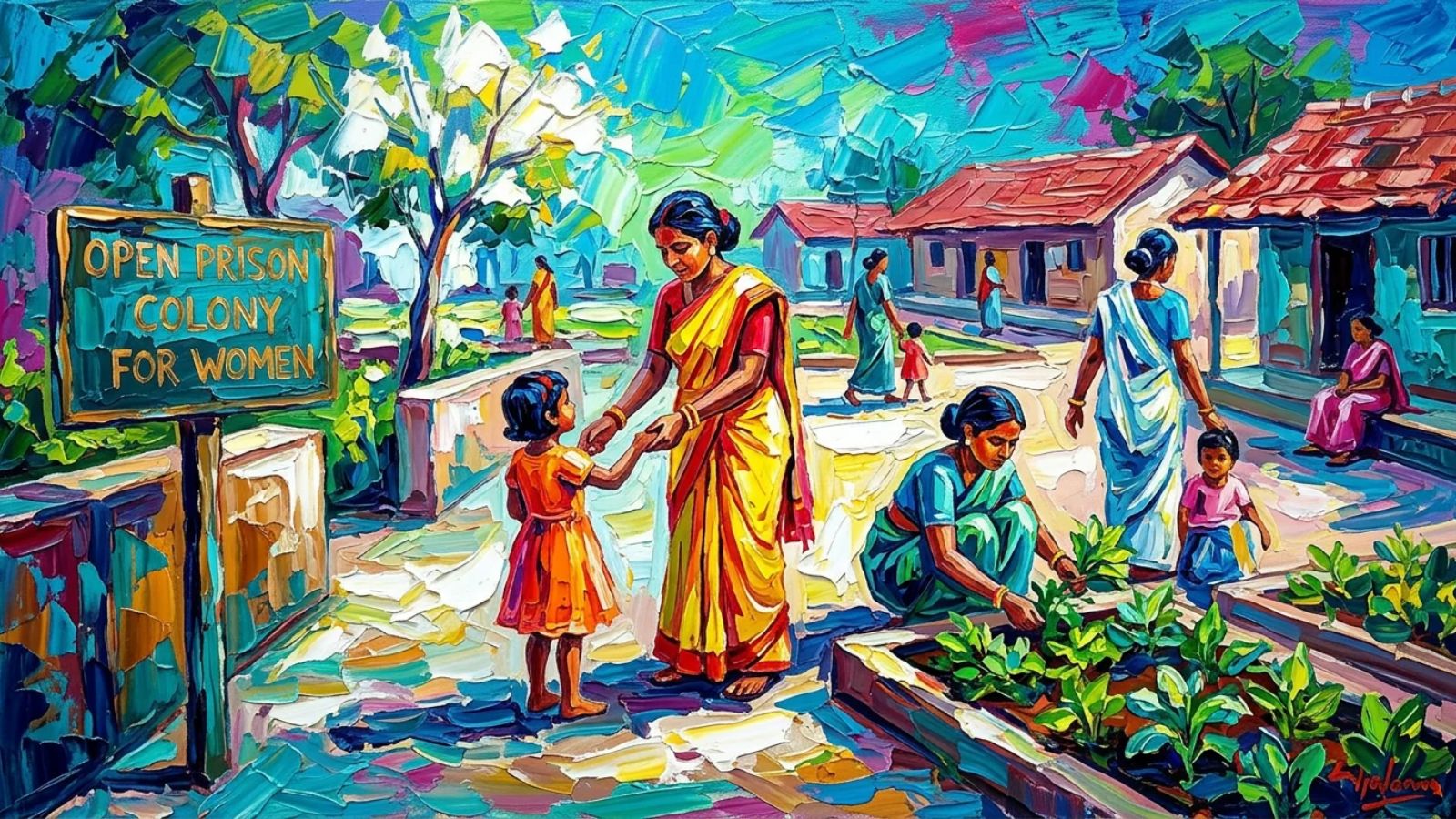
Photo from the source report: Women’s Open Prison Colonies: Prison Reform, Family Life and Children’s Rights
Image: Indian Express
Why in news
A committee constituted following a Supreme Court order has identified possible locations for women’s open prison colonies in Maharashtra. The Court directed states to establish new open and semi-open correctional facilities, fill vacancies in existing facilities and oversee their functioning, including transfers of eligible prisoners.
103
Open prisons in India, 2024
19
Open prisons in Maharashtra, 2024
2
Maharashtra open facilities for women
57.8%
National open-prison occupancy, 2024
Background
Open prisons are correctional institutions that give eligible prisoners greater liberty and opportunities for work while retaining legal custody. They reflect the reformative approach to punishment, which emphasises rehabilitation and social reintegration rather than confinement alone. Prisons fall under Entry 4 of the State List in the Seventh Schedule, making state governments central to implementation. Incarceration does not extinguish all fundamental rights: Article 21 continues to protect life and dignity, subject to lawful restrictions inherent in custody.
What Maharashtra is proposing
The proposed colony would allow eligible women prisoners to live with their children and families, take up employment and gradually prepare for life outside prison. Nashik and Chhatrapati Sambhajinagar are possible locations; the report does not establish that either facility has begun operating.
The committee is headed by Bombay High Court judge Justice Bharati Dangre. Its work includes identifying eligible prisoners and employment opportunities. Maharashtra already has open correctional facilities for women at Yerwada and Akola; the proposed initiative is distinct because it envisages an exclusively women-focused, family-residential colony.
- Existing eligibility considerations include time already served, conduct and the circumstances of the offence.
- The proposal could allow children presently in care institutions to live with their mothers and attend nearby schools, subject to appropriate assessment and arrangements.
- The Supreme Court’s direction concerns expansion and effective use of open correctional facilities; it does not automatically transfer every prisoner to such institutions.
Infographic
Fair access
Transparent eligibility, reasoned decisions and review.
Women’s dignity
Safety, counselling and support beyond family dependence.
Child-centred care
Individual assessment, schooling, healthcare and freedom from stigma.
Decent livelihoods
Community work with fair remuneration and safeguards.
Reintegration
Housing and social support that continue after release.
AI-assisted infographic by Pragnya IAS Academy, based on the cited sources.
From less restrictive custody to community living
The Model Prisons and Correctional Services Act, 2023 describes an open correctional institution as a place of confinement that gives eligible prisoners greater liberty outside a regular prison to facilitate rehabilitation after release. It is a model legislative framework, not an automatically operative replacement for prison laws across all states.
Maharashtra’s existing open facilities generally operate within regular prison premises, using separate accommodation for selected prisoners. Inmates may work on prison farms or nearby and return at night. A family-residential colony would extend this approach by integrating housing, family relationships and community employment.
The committee is considering the Sanganer model in Rajasthan, established in 1963, where prisoners can live with families, work in the surrounding community and participate in Bandi panchayats. Maharashtra’s Atpadi open colony in Sangli also permits family residence and farm work. These are reference models, not proof that identical arrangements will work everywhere.
- Open custody remains a form of confinement; it is not acquittal, remission or unconditional release.
- The reported national occupancy of open prisons indicates spare capacity, but does not by itself establish why facilities are underused.
- Family-residential arrangements must be supported by livelihoods and services rather than treated merely as a change of accommodation.
Women’s rights and children’s best interests
Officials cited in the report identify family abandonment and weak support networks as important difficulties for incarcerated women, particularly where offences arise from domestic disputes. A gender-responsive correctional system must therefore prepare women for independent living, not assume that a marital household will receive them after release.
For children, the central principle is that they are not serving a sentence. Living with a mother may preserve emotional bonds and continuity of care, but relocation should depend on the child’s best interests, safety, schooling and existing care relationships. Family reunification is an option to assess, not an automatic outcome.
Article 14 supports non-arbitrary treatment, Article 15(3) permits special provisions for women and children, and Article 21 protects dignity. Article 39(f), a Directive Principle, calls for children’s development in conditions of freedom and dignity and protection against exploitation and abandonment. The Convention on the Rights of the Child provides an additional framework for best-interests assessment.
- Women without supportive relatives should not be disadvantaged merely because they cannot form a conventional family household.
- Children need access to ordinary schools, healthcare, recreation and protection from stigma.
- A child’s views should be considered in a manner appropriate to age and maturity.
Implementation: eligibility, location and accountability
The experience of Atpadi highlights a practical constraint: families from distant regions may be unwilling to relocate. Location therefore determines access to relatives, jobs and schools, not merely the availability of government land.
Selection must balance individual suitability and public safety through transparent criteria and recorded reasons. Implementation should also address women’s safety, fair employment, grievance redressal and continuity of support after release. The success of a colony should be judged by reintegration and well-being, not occupancy alone.
- Publish eligibility criteria and establish a review mechanism for rejected applications.
- Assess local employment, transport, schools and healthcare before finalising a site.
- Provide independent complaints channels and safeguards against workplace exploitation.
- Monitor children’s educational continuity and women’s access to stable livelihoods without compromising privacy.
| Dimension | Conventional prison | Existing Maharashtra open facilities | Proposed women’s colony |
|---|---|---|---|
| Custodial setting | Predominantly enclosed confinement | Generally separate spaces within regular prison premises | Envisaged as a family-residential correctional setting |
| Work | Movement and work remain closely controlled | Work on prison farms or in nearby areas | Community employment opportunities to be identified |
| Family life | Routine family co-residence is restricted | Family-colony living is not the general arrangement | Eligible women could live with children and families |
| Core reform concern | Dignity and conditions of confinement | Fair selection and effective use of capacity | Child welfare, livelihoods, safety and reintegration |
| Legal position | Custody under applicable law | Custody continues with greater liberty | Custody would continue despite community living |
- 1. Assess eligibility through transparent criteria and individual suitability.
- 2. Consult the woman and assess children’s best interests and family willingness.
- 3. Confirm housing, schooling, healthcare, employment and safety arrangements.
- 4. Transfer under prescribed custodial conditions with proportionate supervision.
- 5. Review welfare, grievances and progress towards independent living.
- 6. Link release with housing, livelihoods and continuing social support.
1963
Sanganer open prison in Rajasthan was established; it provides a reference model for family residence and community employment.
2023
The Model Prisons and Correctional Services Act articulated a rehabilitation-oriented definition of open correctional institutions.
2024
Prison Statistics of India recorded open-prison capacity and occupancy figures cited in the report.
February, as reported
The Supreme Court directed states to establish new open and semi-open facilities, fill existing vacancies and oversee transfers and functioning.
June, following the order
A committee headed by Justice Bharati Dangre was constituted.
Current reported stage
Possible sites in Nashik and Chhatrapati Sambhajinagar have been identified, with prisoner selection and employment planning under consideration.
Significance, challenges & way forward
Significance
- The proposal advances reformative justice by connecting custody with preparation for life after release.
- A women-focused colony can address gender-specific disadvantages that conventional correctional arrangements may overlook.
- Where appropriate, mother-child co-residence can reduce separation while preserving access to community services.
- Greater use of suitable open facilities can contribute to easing pressure on conventional prisons.
- Community work and family relationships can provide practical foundations for social reintegration.
Challenges
- Distant locations may discourage family relocation and disrupt children’s schooling or existing support networks.
- Family abandonment can leave women without the relatives or resources needed to benefit from a family-residential model.
- Opaque eligibility decisions may exclude suitable prisoners or produce inconsistent access.
- Employment opportunities may be insecure or exploitative unless accompanied by labour safeguards.
- Children may face stigma or restrictions if residential design reproduces the environment of a conventional prison.
- Replicating another state’s model without adapting to local conditions may produce low uptake.
Way forward
- Select sites through an integrated assessment of jobs, transport, schools, healthcare and proximity to prisoners’ support networks.
- Make admission criteria transparent and provide reasoned decisions with periodic review.
- Offer viable accommodation and support to eligible women who lack family backing.
- Use individual child-welfare assessments rather than presume that either separation or co-residence is always preferable.
- Ensure safe workplaces, fair remuneration, legal aid, counselling and accessible grievance redressal.
- Evaluate rehabilitation, child well-being and post-release continuity alongside occupancy and compliance.
Key terms
- Open correctional institution
- A custodial institution that gives eligible prisoners greater liberty under prescribed conditions to facilitate rehabilitation.
- Family-residential open colony
- An open custodial arrangement in which eligible prisoners may live with family members and undertake permitted work.
- Reformative justice
- An approach to punishment that prioritises rehabilitation and reintegration while maintaining lawful accountability.
- Best interests of the child
- A child-rights principle requiring decisions affecting children to give primary consideration to their welfare and development.
- Bandi panchayat
- A prisoner self-governance arrangement reported in the Sanganer open-prison model.
- Model legislation
- A legislative template for adoption or adaptation by competent legislatures, rather than a law automatically applicable everywhere.
Link with static syllabus
Prelims practice MCQs
Q1. With reference to open correctional institutions, consider the following statements: 1. Transfer to an open institution ends the prisoner’s legal custody. 2. Such institutions may permit eligible prisoners to work with relatively little supervision. 3. The model legislative framework links greater liberty with rehabilitation after release. Which of the statements given above are correct?
Q2. Consider the following constitutional pairs: 1. Article 15(3): Special provisions for women and children 2. Article 39(f): Children’s development in conditions of freedom and dignity 3. State List, Entry 4: Prisons and related institutions How many of the pairs given above are correctly matched?
Q3. Which one of the following correctly describes the legal significance of the Model Prisons and Correctional Services Act, 2023?
Q4. Consider the following pairs relating to open correctional models: 1. Sanganer — Rajasthan 2. Atpadi — Maharashtra 3. Proposed sites at Nashik and Chhatrapati Sambhajinagar — Gujarat Which of the pairs given above are correctly matched?
Mains practice questions
GS 2 · 15 marks · 250 words
Open prison colonies for women can make correctional justice more humane, but family co-residence alone cannot ensure rehabilitation. Examine with reference to women’s rights and children’s best interests.
Frequently asked questions
Has Maharashtra opened the proposed women’s prison colony?
The supplied report describes a planning-stage proposal, with possible sites identified in Nashik and Chhatrapati Sambhajinagar. It does not confirm that a colony has become operational.
How is the proposal different from Maharashtra’s existing women’s open facilities?
Maharashtra already has women’s open facilities at Yerwada and Akola. The proposed colony would specifically enable eligible women to live with children and families while undertaking permitted employment.
Does an open prison mean that the prisoner has been released?
No. Legal custody continues, but eligible prisoners receive greater liberty under prescribed conditions to support rehabilitation.
Should every child of an incarcerated woman live in the colony?
No automatic rule is appropriate. Each arrangement should be assessed against the child’s best interests, including safety, schooling, relationships and views appropriate to age and maturity.
Sources
- Indian Express: Why a Supreme Court order may let Maharashtra's women prisoners live with their children in a colony
Analysis prepared by the Pragnya IAS Academy current-affairs desk with AI assistance from the cited reports. Verify figures with the original sources.
Turn current affairs into marks
Join Pragnya IAS Academy's mentorship for daily answer-writing evaluation on stories like this — classroom programmes from a trusted name in IAS coaching in Hyderabad.