
COP31: The 1.5°C Overshoot, Climate Finance and Equity Challenge
Revise the static topic: UPSC Environment notes
In short: At COP31 in Antalya, countries are debating how to retain the Paris Agreement’s 1.5°C ambition as crossing the threshold becomes imminent, while vulnerable countries face slow and inadequate climate-finance delivery. Overshoot would intensify adaptation needs and potentially irreversible losses, making rapid emissions cuts, accessible finance and equitable burden-sharing inseparable priorities.
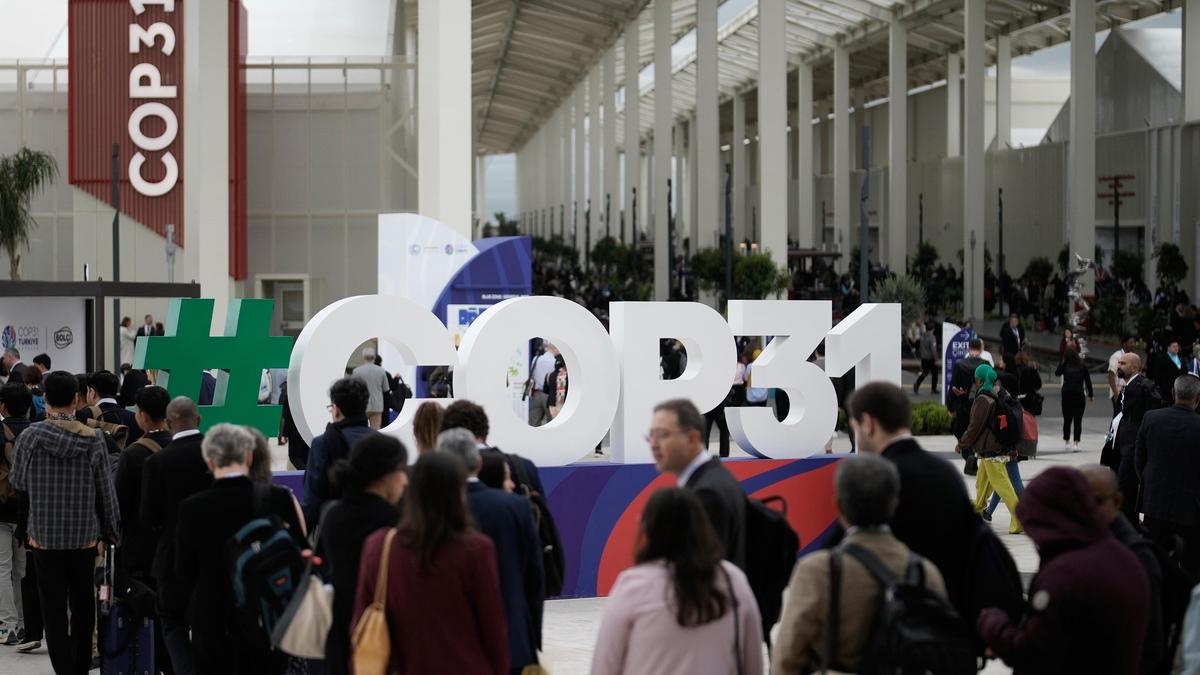
Photo from the source report: COP31: The 1.5°C Overshoot, Climate Finance and Equity Challenge
Image: The Hindu
Why in news
The supplied reports describe ongoing COP31 negotiations following a UN warning that crossing 1.5°C is imminent and unavoidable. They also highlight a projected financing shortfall against the wider annual climate-finance goal for 2035; no final COP31 settlement is reported.
About 1.4°C
Reported warming above pre-industrial levels
1.5°C
Paris Agreement's more ambitious temperature limit
$300 billion annually
Agreed climate-finance target by 2035
$1.3 trillion annually
Wider all-source financing goal by 2035
$137 billion
Finance mobilised in 2024, per cited Brazilian analysis
$840 billion
Projected shortfall against wider 2035 goal
Background
The Paris Agreement operates under the United Nations Framework Convention on Climate Change. It seeks to hold warming well below 2°C above pre-industrial levels while pursuing efforts to limit it to 1.5°C. Countries communicate nationally determined contributions, supported by transparency and periodic collective assessment. Its implementation reflects equity and common but differentiated responsibilities and respective capabilities, in the light of different national circumstances. Developed countries are required to provide financial resources to assist developing countries with mitigation and adaptation; private investment complements rather than replaces this public responsibility.
What COP31 is debating: retain ambition, confront overshoot
According to the supplied reporting, some countries want the final COP31 outcome to reaffirm 1.5°C as the appropriate goal and support a return to that level as soon as possible after an exceedance. Small island states regard the threshold as central to food security, livelihoods and sovereignty, rather than merely a diplomatic benchmark.
The reports also describe concerns among some developing countries that stronger temperature language could create additional mitigation pressure without matching financial support. Claims that particular negotiating blocs favour weakening the target are attributed to observers of closed-door talks; they should not be treated as an adopted position of every member, including India.
The central policy choice is not between acknowledging overshoot and retaining ambition. A credible outcome can recognise the danger while committing countries to minimise the magnitude and duration of overshoot.
- Turkiye is hosting COP31, while Australia is leading the negotiations, according to the reports.
- Negotiating proposals remain distinct from a final agreed COP31 decision.
- Implementation of existing commitments is receiving greater emphasis than a new headline finance target.
Infographic
Retain ambition
Preserve the Paris goals and minimise overshoot magnitude and duration.
Cut emissions
Prioritise rapid reductions over speculative future removals.
Fund resilience
Deliver accessible grants and concessional adaptation support.
Share burdens fairly
Align responsibility, capability, vulnerability and development needs.
Verify delivery
Track disbursement, finance quality and resilience outcomes.
AI-assisted infographic by Pragnya IAS Academy, based on the cited sources.
Overshoot does not cancel the Paris Agreement
Temperature overshoot means exceeding a specified warming level before potentially returning below it. The Paris temperature goal concerns long-term warming: an isolated annual or seasonal exceedance should not automatically be equated with a sustained breach of that goal.
Exceeding 1.5°C would not terminate the Paris Agreement or remove countries' mitigation, reporting and support obligations. Nor is the agreement's well-below-2°C objective a licence to abandon efforts towards 1.5°C. Every increment of additional warming matters for climate risk.
Returning temperatures towards 1.5°C would require rapid emissions reductions alongside carbon dioxide removal. However, the source stresses that large-scale deployment over decades is highly ambitious and uncertain. A later temperature decline would not necessarily reverse ecosystem destruction, accumulated losses or all physical consequences of warming.
- Overshoot magnitude and duration both matter for exposure to climate hazards.
- Carbon removal must supplement deep emissions cuts rather than justify delayed mitigation.
- The 1.5°C threshold is not a boundary below which climate damage is absent.
Finance shortfalls make adaptation the immediate test
The reports distinguish an agreed annual climate-finance target of $300 billion by 2035 from a wider goal of $1.3 trillion annually from public and private sources combined. These figures are not adaptation-only allocations, and the wider goal should not be described as a commitment to provide that entire amount as developed-country public grants.
A Brazilian analysis cited in the reporting estimates that current trends would leave an $840 billion shortfall against the wider goal. It also reports $137 billion mobilised in 2024, alongside weaker direct aid and future commitments to multilateral funds. These figures indicate delivery pressures but do not establish a separate quantified adaptation-finance gap.
Overshoot strengthens the case for immediate investment in heat preparedness, water security, coastal protection, resilient agriculture and early warning. Yet many adaptation measures provide public benefits without dependable commercial returns, making grants and highly concessional public finance especially important.
- Loan-heavy support can increase debt pressures in countries repeatedly financing disaster recovery.
- Complex application and appraisal processes can prevent available funds from reaching administratively constrained states.
- Finance quality must be assessed through accessibility, concessionality, predictability and actual disbursement, not headline totals alone.
Equity: responsibility, capability and development space
Climate equity requires attention to historical emissions, present capabilities and unequal vulnerability. Small island states face severe risks despite limited responsibility for accumulated warming, while developing economies must expand essential services and employment alongside decarbonisation.
This creates a dual obligation: developed countries should lead in emissions reductions and support, while all countries strengthen action according to national circumstances. Differentiation is not an exemption from climate action, but neither can a shared temperature goal justify shifting disproportionate adjustment costs onto poorer societies.
For India, a defensible negotiating approach is to combine support for ambitious collective action with demands for predictable finance, affordable technology and protection of development priorities. This is an analytical recommendation, not a claim that the sources establish an official Indian COP31 position.
- Adaptation reduces prospective harm, whereas loss and damage concerns adverse impacts not avoided through mitigation and adaptation.
- An equitable transition should protect vulnerable households and workers while avoiding prolonged dependence on high-emission infrastructure.
- The survival concerns of island states and the development concerns of larger developing economies require a common implementation framework.
From pledges to delivery: public finance and institutional reform
The source links weak financing momentum to geopolitical conflict, domestic cost-of-living pressures and competing security expenditure. It also reports a shift by Britain from some grants to loans, illustrating why unchanged headline commitments can conceal deterioration in the terms of support.
Multilateral development banks can use shareholder-backed financing capacity and risk-sharing to expand investment. However, private capital will not automatically reach the most vulnerable communities or non-commercial adaptation projects. Public finance must address these gaps rather than focus only on commercially attractive mitigation.
A group of multilateral funds has indicated that it will rely more on shared assessments in co-financed operations. Such procedural coordination, coupled with national project preparation and clearer links between climate plans and budgets, could reduce delays without abandoning safeguards.
- Use risk-sharing instruments where they address identifiable investment barriers.
- Simplify overlapping assessments while maintaining environmental, social and fiduciary safeguards.
- Assess delivery through resilience outcomes and equitable access, alongside money mobilised.
| Response | Purpose | Key limitation or equity concern |
|---|---|---|
| Mitigation | Reduce greenhouse gas emissions and limit further warming. | Delayed reductions increase dependence on uncertain future removals. |
| Adaptation | Reduce vulnerability through preparedness and resilient systems. | Public-benefit projects often require grant or concessional support. |
| Loss and damage response | Address adverse impacts not avoided through mitigation and adaptation. | Some cultural, ecological and territorial losses cannot be fully restored. |
| Carbon dioxide removal | Remove atmospheric carbon dioxide and support potential temperature decline. | Scale, durability, land demands and technological feasibility remain constraints. |
- 1. Insufficient emissions reductions increase the risk of temperature overshoot.
- 2. Greater warming intensifies hazards and adaptation requirements.
- 3. Delayed or loan-heavy finance constrains preventive investment.
- 4. Repeated disasters divert public budgets towards recovery.
- 5. Reduced fiscal capacity weakens resilience and can delay climate action.
2024
Countries agreed on a $300 billion annual climate-finance target by 2035 and a wider $1.3 trillion annual financing goal, according to the supplied report.
September 2026
The UN warned that crossing 1.5°C was imminent and unavoidable; UNEP published a study examining overshoot and possible return pathways.
November 2026
COP31 negotiations in Antalya debated retaining the 1.5°C goal and accelerating climate-finance implementation.
Significance, challenges & way forward
Significance
- Retaining the 1.5°C ambition provides direction for emissions cuts even when overshoot becomes likely.
- The debate connects mitigation ambition with the credibility of financial and technological support.
- Adaptation finance becomes a development and security priority as climate impacts intensify.
- The terms and accessibility of finance can determine whether support builds resilience or adds to fiscal stress.
- For India, the negotiations connect global climate governance with energy access, resilient development and distributive justice.
Challenges
- Returning temperatures below an exceeded threshold depends on uncertain removal capacity and sustained emissions reductions.
- Some losses may be irreversible even if global temperatures subsequently decline.
- Geopolitical tensions and domestic budget pressures weaken the predictability of developed-country support.
- High capital costs and weak revenue prospects discourage private investment in vulnerable regions and adaptation projects.
- Overlapping fund procedures strain the administrative capacity of small and vulnerable states.
- Disagreement over differentiated responsibilities can weaken cooperation if ambition and support are negotiated separately.
Way forward
- Reaffirm the Paris temperature goals while explicitly seeking to minimise overshoot magnitude and duration.
- Prioritise rapid emissions cuts and require credible safeguards against excessive reliance on future carbon removal.
- Translate finance pledges into transparent delivery plans distinguishing grants, loans, public funding and mobilised private investment.
- Provide predictable grant-based and highly concessional support for vulnerable countries' adaptation needs.
- Simplify fund access through coordinated assessments, stronger national institutions and project-preparation support.
- Use multilateral development banks and risk-sharing selectively to mobilise additional investment without creating unsustainable debt.
- Align India's climate plans, public budgets and resilience investments while seeking fair access to finance and technology.
Key terms
- Temperature overshoot
- Exceeding a specified global warming level before potentially returning below it.
- Nationally determined contribution
- A country's nationally determined climate-action commitment communicated under the Paris Agreement.
- Common but differentiated responsibilities and respective capabilities
- The principle that countries share climate responsibilities but differ in their contributions to the problem and capacities to respond.
- Adaptation finance
- Funding that supports adjustment to actual or expected climate impacts and reduces vulnerability.
- Loss and damage
- Adverse climate impacts not avoided through mitigation and adaptation, including economic and non-economic losses.
- Carbon dioxide removal
- Human activities that remove carbon dioxide from the atmosphere and durably store it in natural or engineered reservoirs.
- Concessional finance
- Finance offered on more favourable terms than market finance.
- Fiscal space
- A government's capacity to undertake spending without jeopardising fiscal sustainability.
Link with static syllabus
Prelims practice MCQs
Q1. With reference to the Paris Agreement, consider the following statements: 1. It seeks to hold warming well below 2°C while pursuing efforts to limit it to 1.5°C. 2. Exceeding 1.5°C automatically terminates countries' obligations under the agreement. 3. Implementation reflects equity and differentiated responsibilities in the light of national circumstances. Which of the statements given above are correct?
Q2. With reference to temperature overshoot, consider the following statements: 1. An isolated annual temperature exceedance necessarily establishes a sustained breach of a long-term warming threshold. 2. A subsequent decline in global temperature need not reverse all damage incurred during overshoot. 3. Carbon dioxide removal can be treated as a guaranteed substitute for rapid emissions reductions. Which of the statements given above is/are correct?
Q3. Consider the following pairs: 1. Early-warning systems: Adaptation 2. Direct air capture with durable storage: Carbon dioxide removal 3. Replacing fossil-fuel electricity with renewable electricity: Mitigation Which of the pairs given above are correctly matched?
Q4. Regarding the climate-finance goals described in the supplied COP31 reports, consider the following statements: 1. The wider $1.3 trillion annual goal by 2035 includes public and private sources. 2. The $300 billion annual target by 2035 is exclusively an adaptation-finance allocation. 3. Grant and loan composition matters when assessing the burden on recipient countries. Which of the statements given above are correct?
Mains practice questions
GS 3 · 15 marks · 250 words
An imminent overshoot of 1.5°C strengthens, rather than weakens, the case for climate ambition and equity. Discuss with reference to Paris Agreement commitments and adaptation finance.
Frequently asked questions
Does crossing 1.5°C mean the Paris Agreement has ended?
No. Exceeding the threshold does not terminate the agreement; it strengthens the need to limit further warming and implement mitigation, adaptation and support commitments.
Can global temperatures return below 1.5°C after overshoot?
Potentially, through deep emissions reductions and sustained carbon removal, but the feasibility and scale are uncertain. A later temperature decline would not necessarily undo all damage.
Why are grants particularly important for adaptation?
Many adaptation investments deliver essential public benefits without reliable commercial revenues. Grants can support such projects without adding repayment burdens to already vulnerable countries.
Has COP31 adopted a final decision on overshoot and finance?
The supplied reports describe ongoing negotiations and proposals, not a final COP31 settlement. Observer accounts of negotiating positions should not be confused with formally adopted commitments.
Sources
- The Hindu: Nations grapple with loss of 1.5°C target at UN climate summit
- The Hindu: Urgent climate finance pleas at COP31 face a non-urgent response
Analysis prepared by the Pragnya IAS Academy current-affairs desk with AI assistance from the cited reports. Verify figures with the original sources.
Turn current affairs into marks
Join Pragnya IAS Academy's mentorship for daily answer-writing evaluation on stories like this — classroom programmes from a trusted name in IAS coaching in Hyderabad.