
Delhi-NCR Air Pollution: Airshed Governance and Enforcement Accountability
Revise the static topic: UPSC Environment notes
In short: The Centre has directed Delhi and neighbouring NCR States to strengthen coordinated pollution enforcement through designated senior officers, field inspections, real-time monitoring and weekly reporting to the Commission for Air Quality Management. The directions highlight the need to manage pollution across administrative boundaries while making agencies accountable for implementation rather than merely preparing action plans.
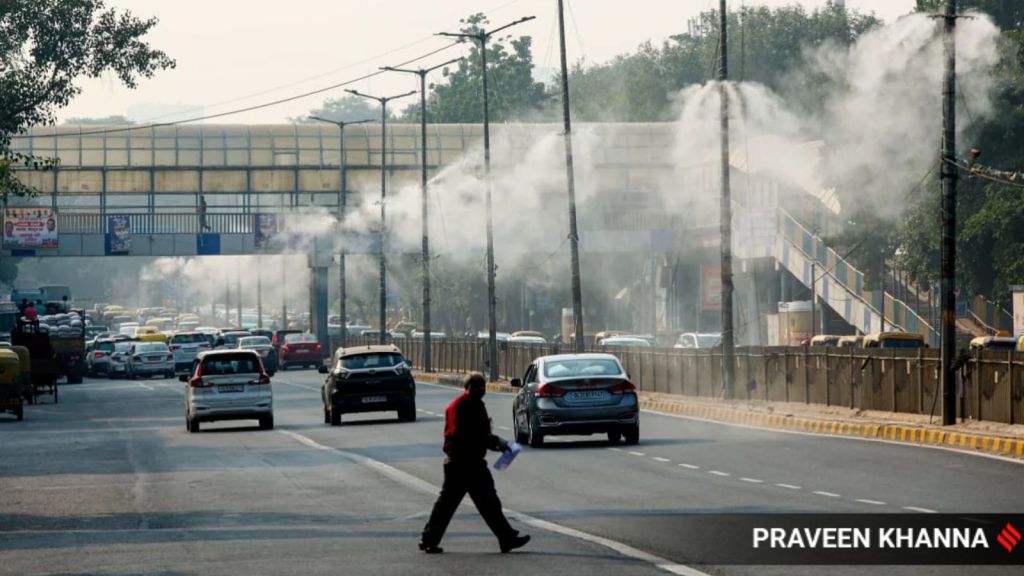
Reference view of water sprinklers at ITO in New Delhi used for pollution control, illustrating a field-level measure whose implementation must be verified. Photo: Praveen Khanna/The Indian Express.
Image: Indian Express
Why in news
At a review meeting on November 14, 2026, Union Environment Minister Bhupender Yadav directed time-bound action on industrial emissions, polluting vehicles, road dust, construction waste and traffic congestion across Delhi-NCR. The review covered measures undertaken by Delhi, Haryana, Uttar Pradesh and Rajasthan.
191
Non-conforming industries ordered to be sealed
3,221 km
Roads redeveloped
5,480 km
Road redevelopment target
233
Identified NCR congestion points
154
Delhi border entry points targeted for free-flow systems
Over 3,000
Active construction and demolition sites requiring inspection
Background
An airshed is a geographical area within which emissions and meteorological conditions interact to influence air quality. Its functional boundaries need not coincide with municipal or State borders. In India, the Air (Prevention and Control of Pollution) Act, 1981 provides a foundational pollution-control framework, while the Commission for Air Quality Management in National Capital Region and Adjoining Areas Act, 2021 establishes a dedicated regional mechanism. The Central Pollution Control Board, State Pollution Control Boards, Delhi Pollution Control Committee and sectoral agencies have distinct implementation responsibilities. Effective regional air-quality management therefore requires both coordinated policy and reliable local execution.
What the Centre has directed
States were asked to nominate secretary-level officials for seven cities in Haryana, four in Uttar Pradesh and four in Rajasthan. These officials are to conduct field visits and report weekly to CAQM; the Commission was also requested to issue notices to non-performing officers.
The CPCB was directed to immediately seal the identified non-conforming industries that had neither installed air pollution control devices nor placed orders despite repeated directions. These are reported directions for action, not confirmation that sealing has been completed.
The review also sought strict implementation of GRAP and adoption of Delhi’s hotspot-focused winter approach across NCR States, alongside stronger monitoring of vehicles, roads, construction sites and waste handling.
- Fuel stations are to have Automatic Number-plate Recognition cameras linked with VAHAN and Pollution Under Control Certificate databases.
- The reported direction envisages CAQM initiating criminal prosecution against delinquent Transport Department officials after November 30 for failure to implement the camera requirement.
- Road-owning agencies must prioritise pothole repairs, damaged footpaths, central verges and end-to-end paving under the CAQM framework.
- The Municipal Corporation of Delhi was asked to complete multi-lane free-flow systems at the identified Delhi border entry points by December 31.
- Integrated Command and Control Centres are to support real-time monitoring and digital tracking of waste from collection to processing.
Infographic
Airshed science
Map connected sources beyond administrative borders.
Shared coordination
Align CAQM, States and local implementing agencies.
Named ownership
Assign officers, deadlines and weekly reporting.
Verified enforcement
Combine digital alerts with inspections and lawful action.
Lasting outcomes
Pair winter responses with year-round emission reduction.
AI-assisted infographic by Pragnya IAS Academy, based on the cited sources.
Why airshed-based management is essential
Pollutants move with winds, while atmospheric conditions influence their dispersion and accumulation. Some pollutants are emitted directly; others form through atmospheric reactions involving precursor gases. Consequently, a city’s air quality reflects both local emissions and contributions from outside its jurisdiction.
Airshed management addresses this mismatch between ecological processes and administrative boundaries. It requires shared emissions information, compatible monitoring, coordinated sectoral measures and synchronised implementation across connected jurisdictions.
The NCR framework enables regional coordination, but an administrative region should not automatically be equated with the complete scientific airshed. Policy must account for relevant adjoining sources while retaining hotspot-level action within cities.
- Independent city plans may underperform when neighbouring jurisdictions do not implement comparable controls.
- Regional planning should integrate industrial emissions, transport, road dust, construction, waste burning and agricultural residue management.
- Hotspot action and airshed management are complementary: one tackles concentrated local exposure, while the other addresses wider pollution transport.
- Winter emergency measures should supplement, not replace, sustained reductions in emissions throughout the year.
Accountability must connect monitoring with verified action
The emphasis on named senior officers seeks to address fragmented responsibility across transport departments, municipalities, road agencies and pollution-control bodies. Weekly reporting can create an escalation channel, but it becomes meaningful only when reports identify violations, responsible agencies, corrective deadlines and verified closure.
The Gurugram case illustrates the shift towards individual accountability. According to the source, CAQM inspections identified failures in road sweeping and dust mitigation; an executive engineer was subsequently suspended, and steps towards prosecution were sought. Suspension, initiation of prosecution and a judicial finding of guilt remain legally distinct.
Sensors, cameras, satellite inputs and AI-based surveys can improve detection, but they should complement physical inspection. A digital alert or a database match should trigger verification rather than be treated as conclusive proof of every alleged violation.
- Measure compliance through verified pollution-control outcomes, not merely meetings, notices or inspection counts.
- Assign responsibility according to each officer’s legal mandate and operational control.
- Use interoperable databases, reliable records and auditable enforcement trails.
- Provide adequate staff, equipment and technical support so accountability does not become punishment for institutional incapacity.
Legal and federal dimensions
The Supreme Court’s interpretation of Article 21 encompasses environmental quality necessary for a dignified life. Article 48A directs the State to protect and improve the environment, while Article 51A(g) establishes a corresponding fundamental duty of citizens. These provisions support environmental governance but do not substitute for statutory authority when imposing penalties.
The CAQM Act provides a regional statutory mechanism for coordination and directions concerning air quality in NCR and adjoining areas. Nevertheless, implementation depends substantially on State and local institutions. The appropriate model is coordinated regional oversight with clearly assigned decentralised execution.
Directions concerning sealing or prosecution must be implemented under applicable law, with jurisdiction, evidence and procedural safeguards respected. The November review represents an enforcement push within existing arrangements; the supplied reports do not announce a new national airshed law.
- Cooperative federalism is necessary because the benefits of emission reduction extend beyond the jurisdiction bearing the implementation cost.
- Common regional objectives should be translated into agency-specific responsibilities and locally appropriate measures.
- GRAP provides graded emergency responses; it is not a substitute for permanent industrial, transport and urban-management reforms.
- Procedural fairness strengthens the legitimacy and durability of environmental enforcement.
| Tool | Primary function | Implementation safeguard |
|---|---|---|
| Airshed-based management | Coordinates emission reduction across interconnected jurisdictions | Use scientific evidence rather than administrative borders alone |
| GRAP | Provides graded measures against deteriorating air quality | Combine emergency restrictions with year-round structural action |
| ICCC-based monitoring | Integrates operational information for detection and follow-up | Verify alerts through reliable data and field inspections |
| ANPR linked with VAHAN and PUCC | Supports identification and enforcement concerning vehicles | Ensure accurate records, lawful action and correction of mismatches |
| Designated secretary-level officers | Creates senior ownership of implementation and weekly reporting | Link responsibility to mandate, resources and verified corrective action |
- 1. Map regional sources and local hotspots using shared scientific evidence.
- 2. Assign each intervention to a responsible agency and designated officer.
- 3. Combine ICCC alerts, database checks and physical inspections to identify violations.
- 4. Undertake corrective or enforcement action under applicable legal procedures.
- 5. Verify closure, report progress to CAQM and escalate unresolved failures.
- 6. Assess emission and exposure outcomes and revise the regional strategy.
October 30, 2026
CPCB issued an order directing the relevant State pollution-control bodies and Delhi Pollution Control Committee to act against industrial units that had neither installed APCDs nor placed orders.
November 3–4, 2026
Following a CAQM hearing and direction to file a complaint, the Gurugram municipal executive engineer concerned was suspended for implementation lapses.
November 12, 2026
The Gurugram Municipal Commissioner sought examination of applicable statutory provisions and appropriate prosecution proceedings after necessary approvals.
November 14, 2026
The Union Environment Minister reviewed Delhi-NCR pollution measures and directed coordinated, time-bound enforcement.
After November 30, 2026
The reported direction envisages prosecution against delinquent Transport Department officials for failure to implement the fuel-station ANPR requirement; this is a prospective enforcement step.
December 31, 2026
Deadline specified for completing multi-lane free-flow systems at the identified Delhi border entry points.
Significance, challenges & way forward
Significance
- Regional coordination aligns pollution governance more closely with the movement of pollutants across State boundaries.
- Named officers and weekly reporting can reduce the diffusion of responsibility among multiple implementing agencies.
- Industrial, transport, dust and waste interventions address several emission sources rather than relying on a single-source explanation.
- Integrated monitoring can shorten the interval between identifying a violation and initiating corrective action.
- Sustained improvements in air quality support public health, especially for people with high exposure or greater physiological vulnerability.
Challenges
- Fragmented mandates can allow agencies to shift responsibility for roads, waste, vehicles and industrial compliance.
- Uneven municipal staffing, technical capacity and financing may impede implementation despite senior-level directions.
- Database errors, sensor limitations and incomplete monitoring can produce missed violations or mistaken enforcement.
- Short-term air-quality changes are influenced by weather, making them an imperfect standalone measure of administrative performance.
- Emergency restrictions impose livelihood and compliance costs, requiring predictable rules and support for cleaner alternatives.
- An excessively punitive approach may encourage defensive reporting unless accountability is evidence-based and proportionate.
Way forward
- Develop a shared regional emissions inventory and periodically update source-apportionment evidence to prioritise interventions.
- Translate regional objectives into agency-specific action plans with named officers, realistic deadlines and adequate resources.
- Publish verified compliance information, including unresolved violations and corrective action, rather than only activity counts.
- Maintain year-round controls on industrial emissions, road dust, construction waste and open burning alongside winter GRAP measures.
- Audit monitoring systems and vehicle databases, and provide mechanisms to correct erroneous records before adverse action.
- Use lawful, proportionate enforcement alongside technical assistance and cleaner alternatives for regulated actors.
- Evaluate progress through both verified emission reductions and air-quality trends interpreted in their meteorological context.
Key terms
- Airshed
- A geographical area within which emissions and atmospheric processes interact to influence air quality.
- CAQM
- The statutory Commission for Air Quality Management in National Capital Region and Adjoining Areas.
- GRAP
- The Graded Response Action Plan, which provides progressively stronger measures in response to deteriorating air quality.
- ICCC
- An Integrated Command and Control Centre that brings operational information together to support monitoring and coordinated response.
- ANPR
- Automatic Number-plate Recognition, a camera-based technology that identifies vehicle registration numbers.
- PUCC
- A Pollution Under Control Certificate documenting compliance with prescribed vehicular emission testing requirements.
- APCD
- An Air Pollution Control Device used to reduce pollutant emissions from a source.
- Source apportionment
- Scientific estimation of the contributions of different sources to measured air pollution.
Link with static syllabus
Prelims practice MCQs
Q1. With reference to airshed-based pollution management, consider the following statements: 1. An airshed must coincide with the boundary of a State. 2. Pollution transported from outside a city can influence its air quality. 3. Hotspot-level interventions can complement regional pollution management. Which of the statements given above are correct?
Q2. Consider the following pairs: 1. ANPR: Identification of vehicle registration numbers 2. APCD: Reduction of emissions from a pollution source 3. ICCC: Integration of operational information for monitoring and response Which of the pairs given above are correctly matched?
Q3. With reference to the constitutional basis of environmental protection in India, consider the following statements: 1. Article 48A is a Directive Principle of State Policy. 2. Article 51A(g) concerns a fundamental duty relating to the natural environment. 3. An executive review meeting can, by itself, create a new criminal offence for environmental non-compliance. Which of the statements given above are correct?
Q4. Which of the following best describes the relationship between GRAP and long-term air-quality management?
Mains practice questions
GS 3 · 15 marks · 250 words
Air pollution is an airshed-level problem, but enforcement remains fragmented across administrative jurisdictions. Examine how inter-state coordination and field-level accountability can bridge this governance gap, with reference to Delhi-NCR.
Frequently asked questions
What is airshed-based pollution management?
It manages air pollution across an interconnected geographical region shaped by emissions and atmospheric processes, rather than within administrative boundaries alone. It combines shared evidence, coordinated interventions and local enforcement.
Were the identified industrial units already sealed?
The supplied reports state that CPCB was directed to immediately seal the identified non-conforming units. They do not establish that sealing had been completed.
Does installing ANPR cameras directly measure vehicle emissions?
No. ANPR identifies registration numbers; links with VAHAN and PUCC records can support compliance checks, but the camera itself does not measure exhaust emissions.
Why is GRAP alone insufficient?
GRAP provides graded responses to deteriorating air quality but does not by itself eliminate persistent emission sources. Sustained improvement requires year-round industrial, transport, dust and waste-management reforms.
Sources
- The Hindu: Air pollution does not recognise State boundaries, coordinated action required: Union Minister
- Indian Express: Centre asks states to fix officers to track pollution curbs, seals 191 units
Analysis prepared by the Pragnya IAS Academy current-affairs desk with AI assistance from the cited reports. Verify figures with the original sources.
Turn current affairs into marks
Join Pragnya IAS Academy's mentorship for daily answer-writing evaluation on stories like this — classroom programmes from a trusted name in IAS coaching in Hyderabad.