
Starship’s Orbital Return and Tower Catch: Reusability, Launch Costs and India
Revise the static topic: UPSC Science & Technology notes
In short: The Hindu reports that SpaceX’s Starship upper-stage spacecraft returned from orbit and was caught by mechanical arms at Starbase, Texas, on November 14, 2026. The achievement advances upper-stage recovery technology, but does not yet establish routine, fully reusable operations: the Super Heavy booster was not recovered on this flight, and rapid refurbishment and repeated reflight remain to be demonstrated.
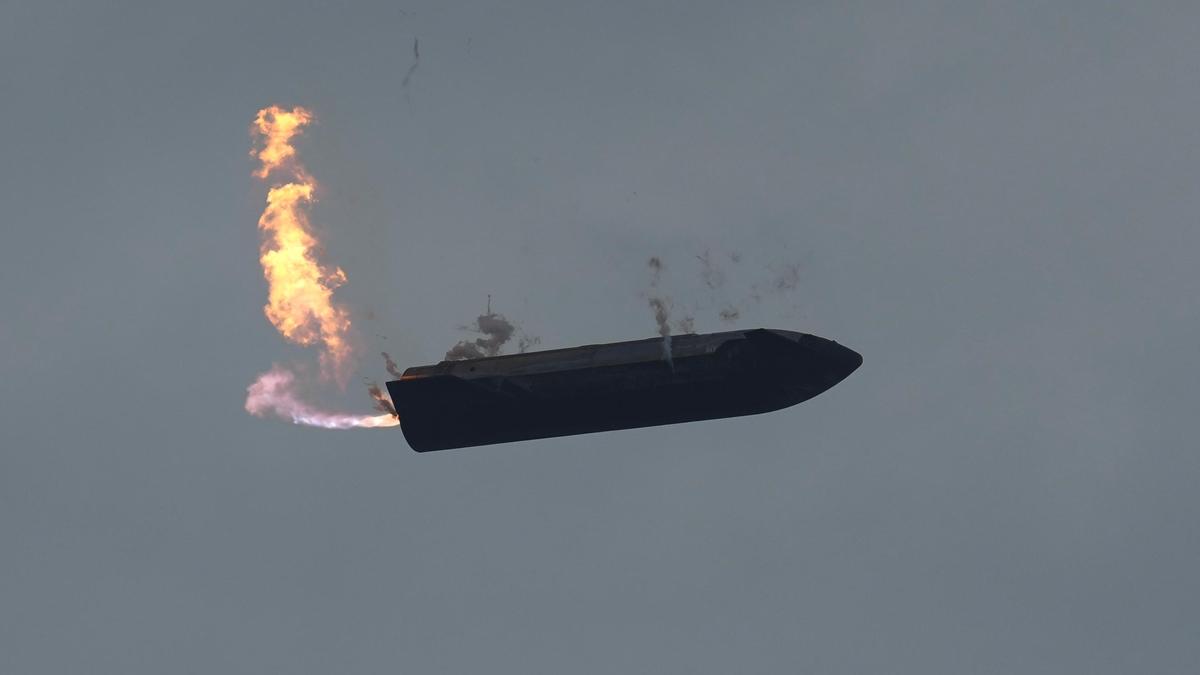
Starship’s reported upper-stage catch at Starbase, Texas, marks progress in recovery technology, but routine refurbishment and repeated reflight remain unproven.
Image: The Hindu
Why in news
Starship’s reported first spaceship tower catch followed an orbital mission that deployed Starlink satellites. It brings renewed attention to whether reusable launch systems can lower the cost of space access and reshape commercial competition, including for India.
15th
Starship test flight
14
Earth orbits completed
26
Starlink satellites deployed
22 hours
Reported mission duration
3
Previous booster tower catches
Background
An expendable launch vehicle discards its stages after use, whereas a reusable system is designed to recover and fly some or all major flight hardware again. Starship is a two-stage architecture comprising the Super Heavy booster and the Starship upper-stage spacecraft. Partial reusability is already established through systems such as SpaceX’s Falcon rockets; historically, the Space Shuttle also reused its orbiter and solid rocket boosters, while its external tank was expendable. The present milestone therefore concerns the reported first tower catch of an orbital-return spacecraft, not the invention of spacecraft reuse.
What the mission demonstrated—and what it did not
According to the supplied reports, Starship launched from Starbase on November 13, 2026, deployed operational Starlink satellites, completed its orbital mission and returned the following day. After atmospheric re-entry, an engine-controlled descent positioned the spacecraft between the launch tower’s mechanical ‘chopstick arms’.
The upper-stage recovery must be distinguished from recovery of the entire launch system. Super Heavy’s planned catch was aborted. The reports differ on its terminal outcome: the launch report describes an explosion above the Gulf of Mexico, while the subsequent report refers to a splashdown. Neither reports successful booster recovery.
A successful catch demonstrates recovery capability. It does not, by itself, demonstrate that the recovered vehicle can be inspected, refurbished and relaunched quickly, safely and economically.
- The achievement is an upper-stage tower-catch milestone, not a completed demonstration of routine full-system reuse.
- Repeated successful flights are necessary before the architecture can be treated as operationally reliable.
- Projected launch frequencies are company ambitions rather than demonstrated operating performance.
Infographic
Reported milestone
Starship upper stage returned from orbit and was caught at Starbase.
Technical foundation
Thermal protection, autonomous guidance and controlled descent.
Evidence still needed
Repeated recovery, successful reflight and reliable booster operations.
Economic test
Low refurbishment burden, sufficient demand and competitive mission costs.
India’s response
Build reusable capabilities and a competitive, safety-conscious space ecosystem.
AI-assisted infographic by Pragnya IAS Academy, based on the cited sources.
How orbital-return recovery works
Reaching orbit requires substantial horizontal velocity. A returning spacecraft must shed this energy while maintaining structural integrity and control. Atmospheric deceleration produces severe heating, making thermal protection a central requirement for upper-stage reuse.
Recovery combines guidance, navigation and control with aerodynamic manoeuvring and powered descent. The vehicle must reach a tightly defined position and velocity near the tower so that the arms can support it safely. Returning boosters generally face lower re-entry energy than spacecraft returning from orbit.
Tower capture can shift some landing-support functions from the vehicle to ground infrastructure and potentially simplify handling after recovery. However, it also concentrates risk around expensive launch facilities and demands precise vehicle–tower coordination.
- Thermal protection must withstand re-entry and remain maintainable across repeated flights.
- Engines and flight-control systems must operate reliably during critical descent manoeuvres.
- Abort routes and exclusion zones are essential if safe tower capture becomes impossible.
- Ground facilities are part of the reusable system, not merely passive launch infrastructure.
Launch economics: recovery is necessary, but insufficient
Reusability can spread hardware manufacturing costs across multiple missions rather than charging an entire vehicle to each launch. The economic advantage depends on the number of successful reuses, inspection and refurbishment requirements, recovery expenses, reliability and launch frequency.
Reusable hardware also carries trade-offs. Propellant reserved for return, thermal protection and recovery-related equipment can reduce payload capability relative to an otherwise comparable expendable configuration. Savings must therefore be assessed against delivered payload and mission requirements, not recovery success alone.
Lower launch costs could widen access for research missions, universities, satellite operators and commercial services. However, launch cost is only one component of a space mission: satellite manufacture, insurance, ground systems, spectrum access and operations remain important. The sources do not establish a verified launch-cost reduction from this flight.
- High utilisation can spread fixed infrastructure and operating costs across more missions.
- Lengthy refurbishment can weaken the economic advantage of recovered hardware.
- Large launch capacity needs sufficient demand; underutilisation can undermine expected savings.
- Lower provider costs need not translate fully into lower customer prices where competition is limited.
India’s commercial opportunity and strategic response
India’s response should combine technology development with a competitive space ecosystem. ISRO’s reusable launch vehicle experiments provide experience in autonomous landing and winged recovery, but these should not be equated with demonstrated routine orbital-stage reuse. Different recovery architectures can serve different mission needs.
Institutional roles matter: ISRO provides research and technology capability; IN-SPACe promotes, authorises and supervises non-governmental space activities; and NewSpace India Limited commercialises space capabilities and services. Predictable authorisation, access to testing infrastructure and commercially viable demand can help firms turn engineering demonstrations into services.
India need not replicate a foreign heavy-lift architecture to compete. Potential strengths include responsive launch services, mission integration, propulsion and avionics supply chains, satellite manufacturing, Earth-observation applications and other downstream services. Strategic autonomy also requires retaining dependable domestic access to space.
- Support reusable technologies through staged demonstrations and measurable reliability targets.
- Evaluate Indian missions by cost, schedule, orbit requirements and customer needs rather than headline payload scale alone.
- Use public procurement transparently to create demand without protecting inefficient business models indefinitely.
- Integrate launch expansion with debris mitigation, environmental assessment and range safety.
| Dimension | Expendable system | Partially reusable system | Fully reusable architecture |
|---|---|---|---|
| Hardware treatment | Major flight stages are discarded. | Selected stages or components are recovered for reuse. | All major flight stages are designed for recovery and reuse. |
| Economic logic | Hardware production costs recur with each mission. | Reuse can reduce recurring costs for recovered elements. | Repeated reuse could spread most flight-hardware costs across missions. |
| Key constraint | Recurring manufacturing requirements. | Refurbishment plus continued replacement of expendable elements. | Reliable recovery, short turnaround and sustainable utilisation. |
| Relevant example | Conventional expendable launch configuration. | Falcon rockets; the historical Space Shuttle system. | Starship’s intended architecture, not yet established as routine by this flight. |
- 1. Launch and stage separation place the upper-stage spacecraft on its orbital mission.
- 2. The spacecraft deploys its payload and prepares its return trajectory.
- 3. Controlled atmospheric re-entry dissipates energy while thermal protection protects the vehicle.
- 4. Guidance and engine-controlled descent align the spacecraft with the tower.
- 5. Mechanical arms capture and support the returning spacecraft.
- 6. Inspection, necessary refurbishment and successful reflight establish whether recovery becomes practical reuse.
2021
NASA selected Starship for a lunar-lander role under Artemis, according to the supplied report.
2023
The Starship test-flight series described in the reports began.
March 2025
The launch report identifies this as the most recent successful Super Heavy tower catch before the reported mission.
September 2026
The preceding reported flight reached orbit with satellites, but ended with the upper stage splashing down and subsequently burning.
November 13, 2026
The reported test flight launched from Starbase; Super Heavy’s planned tower recovery was aborted.
November 14, 2026
Starship reportedly completed its orbital mission and was caught by the launch tower’s arms.
Significance, challenges & way forward
Significance
- Recovering an orbital upper stage addresses a demanding part of the full-reusability challenge because of re-entry heating and high return energy.
- Economically successful reuse could reduce barriers to scientific missions and commercial satellite deployment.
- Reliable high-frequency launch services could support larger space infrastructure, although demand and project viability remain uncertain.
- Reusable launch competition creates incentives for India to improve technology, authorisation processes, infrastructure and customer service.
- The milestone is relevant to Starship’s lunar ambitions, but does not replace the need for orbital propellant-transfer demonstrations.
Challenges
- A single successful catch cannot establish vehicle lifespan, acceptable failure risk or predictable turnaround time.
- The unsuccessful booster recovery shows that upper-stage progress does not eliminate system-wide reliability challenges.
- Thermal-protection inspection, engine servicing and structural assessment may remain expensive or time-consuming.
- A failed catch could damage launch infrastructure and interrupt subsequent missions.
- Orbital propellant transfer remains a major unresolved requirement for the lunar and Mars missions described in the sources.
- Higher launch activity would intensify the need to manage debris, collision risk, local environmental impacts and public safety.
Way forward
- Judge reusable launch systems through repeated recovery and reflight, maintenance requirements and delivered-payload economics rather than isolated demonstrations.
- Publish credible operational evidence before treating projected launch frequency or affordability as established outcomes.
- For India, prioritise reusable propulsion, thermal protection, autonomous guidance and testing infrastructure through milestone-based support.
- Strengthen coordination among ISRO, IN-SPACe, NSIL and private firms while maintaining clear institutional responsibilities.
- Develop demand across launch services, satellites and downstream applications so that launch capacity is supported by viable customers.
- Embed environmental safeguards, debris mitigation and independent safety scrutiny in the expansion of launch operations.
Key terms
- Reusable launch vehicle
- A launch vehicle designed to recover and fly again some or all of its major flight hardware.
- Super Heavy
- The booster stage of SpaceX’s Starship launch system.
- Upper stage
- The stage that operates after lower-stage separation to help place a payload or spacecraft on its required trajectory.
- Thermal protection system
- Materials and structures that protect a spacecraft from intense heating, particularly during atmospheric re-entry.
- Tower catch
- Recovery in which ground-mounted mechanical arms capture and support a returning vehicle.
- Turnaround time
- The interval required to prepare recovered hardware for another flight.
- Launch cadence
- The frequency at which launches are conducted.
- Orbital propellant transfer
- Movement of propellant between spacecraft in orbit to support subsequent manoeuvres or missions.
Link with static syllabus
Prelims practice MCQs
Q1. With reference to reusable launch systems, consider the following statements: A. Recovery of a spacecraft necessarily demonstrates its readiness for immediate reflight. B. Thermal protection is important for spacecraft returning from orbit. C. Recovery-related hardware and reserved propellant can affect payload capability. Which of the statements given above are correct?
Q2. Which of the following best describes the technological significance of the Starship event reported in the supplied sources?
Q3. Consider the following institution–function pairs: A. IN-SPACe — Promotion, authorisation and supervision of non-governmental space activities in India B. NSIL — Commercialisation of Indian space capabilities and services C. ISRO — Research and development of space technologies Which of the pairs given above are correctly matched?
Q4. Consider the following statements regarding the economics of reusable launch vehicles: A. Launch frequency affects how fixed infrastructure costs are spread across missions. B. Reusability eliminates satellite manufacturing and ground-segment costs. C. Extensive refurbishment can reduce the economic benefits of hardware recovery. Which of the statements given above are correct?
Mains practice questions
GS 3 · 15 marks · 250 words
Reusable launch systems can transform access to space, but recovery alone does not establish commercial viability. Discuss in the context of Starship’s reported orbital return and assess the implications for India’s commercial space ambitions.
Frequently asked questions
Did this mission establish a fully reusable Starship system?
No. It demonstrated the reported upper-stage tower catch, but the booster was not recovered and the flight did not establish repeated, rapid reuse of the complete system.
Why is catching an orbital spacecraft harder than recovering a booster?
An orbital spacecraft returns with substantially greater energy and faces severe atmospheric heating. It must then achieve precise guidance and controlled descent for capture.
Will this achievement immediately make launches cheaper?
Not necessarily. Savings depend on successful reflight, limited refurbishment, reliability and sufficient launch demand; the sources provide no verified cost reduction from this mission.
What should India prioritise in response?
India should develop reusable technologies alongside reliable launch services, predictable authorisation and access to testing infrastructure. Commercial opportunities also extend to components, satellites and downstream applications.
Sources
- The Hindu: SpaceX pulls off first-ever spaceship ‘catch’
- The Hindu: SpaceX launches 15th Starship flight with hopes of achieving first round trip
Analysis prepared by the Pragnya IAS Academy current-affairs desk with AI assistance from the cited reports. Verify figures with the original sources.
Turn current affairs into marks
Join Pragnya IAS Academy's mentorship for daily answer-writing evaluation on stories like this — classroom programmes from a trusted name in IAS coaching in Hyderabad.