
COP31 in Antalya: Climate Finance, Clean Energy and India’s Equity Priorities
Revise the static topic: UPSC Environment notes
In short: COP31 opened in Antalya, Türkiye, on November 9, 2026, with an emphasis on implementing existing climate commitments rather than negotiating a new landmark treaty. Its central test is whether countries can translate finance promises, adaptation goals and energy-transition pledges into measurable outcomes while respecting equity and developing countries’ needs.
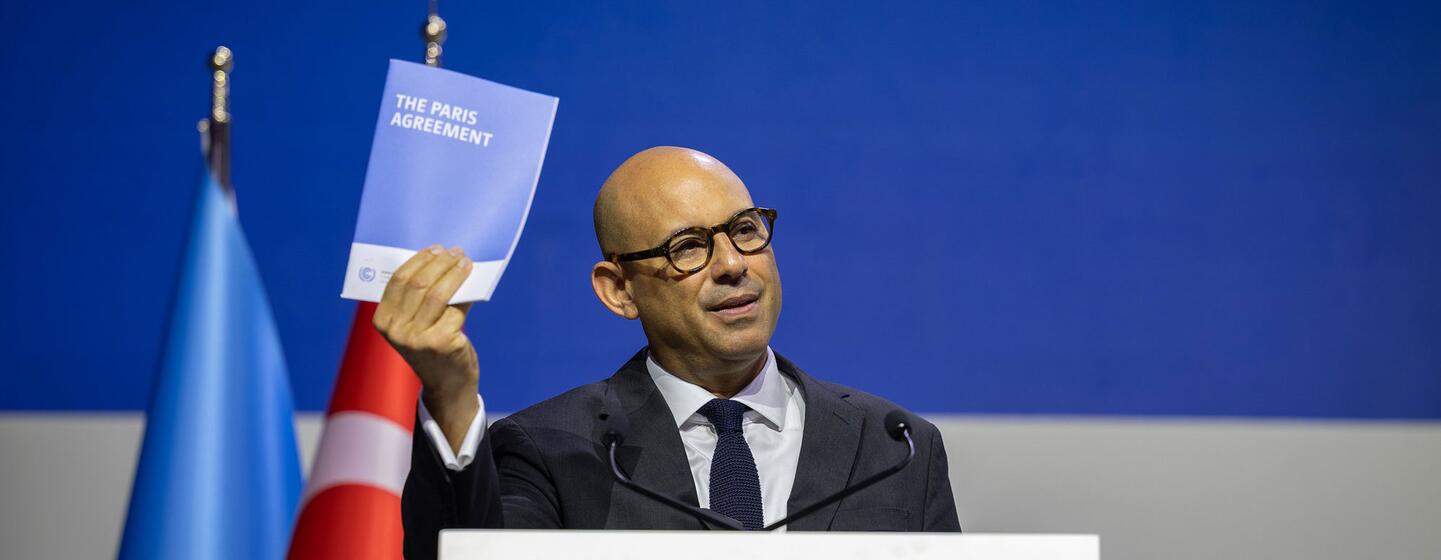
Reference image: UN climate chief Simon Stiell holds up the Paris Agreement at a podium, illustrating COP31’s focus on implementing existing climate commitments.
Image: UN News
Why in news
Türkiye is hosting and formally presiding over COP31, while Australia leads the negotiations under an unusual division of responsibilities. As of November 10, the discussions concern proposed measures and inherited commitments, not a final COP31 agreement.
$300 billion a year
COP29 finance goal for 2035
$1.3 trillion a year
Broader finance roadmap ambition for 2035
At least tripled by 2035
Inherited adaptation finance commitment
35% by 2035
Proposed global electrification target
47% below 2005 levels
India’s reported 2035 GDP emissions-intensity target
60% by 2035
India’s reported non-fossil installed power capacity target
Background
The United Nations Framework Convention on Climate Change provides the overarching framework for international climate cooperation. Its Conference of the Parties meets to advance implementation, alongside separate governing-body meetings for the Kyoto Protocol and Paris Agreement. The Paris Agreement combines nationally determined contributions with transparency, periodic assessment and progressively stronger action, seeking to hold warming well below 2°C while pursuing efforts to limit it to 1.5°C. Equity and common but differentiated responsibilities and respective capabilities recognise that countries differ in historical responsibility and capacity to act. Climate cooperation therefore covers mitigation and adaptation as well as finance, technology transfer and capacity-building.
An implementation COP: What is actually on the table?
COP31 inherits unresolved questions about delivering finance, operationalising adaptation indicators and implementing the transition away from fossil fuels. Türkiye controls hosting arrangements and the voluntary Action Agenda, while Australia leads formal negotiations and text preparation. This arrangement requires coordination so that political announcements and negotiated decisions reinforce rather than contradict each other.
The source reports describe COP30 as having advanced finance roadmaps, adaptation indicators and implementation initiatives, but without explicitly mentioning fossil fuels in its final deal. COP31 must therefore address the gap between broad political commitments and nationally implementable measures.
- An opening statement or proposed pledge is not an adopted COP decision.
- The voluntary Action Agenda must be distinguished from formal negotiations and existing treaty obligations.
- Success should be assessed through finance delivered, implementation capacity and outcomes, not merely the number of announcements.
Infographic
Finance
Move from pledges to accessible, verifiable disbursements.
Adaptation
Fund resilience and measure reduced vulnerability.
Clean energy
Pair electrification with cleaner supply and reliable grids.
Equity
Respect differentiated responsibilities and development needs.
Accountability
Track both national action and international support.
AI-assisted infographic by Pragnya IAS Academy, based on the cited sources.
Climate finance: Scale matters, but so do obligation and access
The inherited architecture includes the $300 billion-a-year goal agreed at COP29 and the broader Baku-to-Belém Roadmap ambition of at least $1.3 trillion annually by 2035 from public and private sources. These are related but distinct: a mobilisation ambition is not evidence that money has been disbursed, nor is every financial flow equivalent to public support.
Developing countries, including India, have sought discussion of Article 9.1 of the Paris Agreement, which requires developed-country Parties to provide financial resources to assist developing-country Parties with mitigation and adaptation. The reported US withdrawal from the Paris Agreement intensifies concerns over burden-sharing and the reliability of support.
Finance quality is as important as its headline volume. Loan-heavy support can worsen debt pressures, while complex application procedures can exclude local institutions and small farmers. Adaptation investments with limited commercial returns particularly require predictable public and concessional support.
- Separate pledges, approvals and actual disbursements in finance reporting.
- Clarify the contribution of grants, concessional loans and private investment rather than treating them as interchangeable.
- Simplify access while retaining fiduciary safeguards and community participation.
- Assess whether finance is new and additional rather than relabelled existing assistance.
Adaptation: From global indicators to local protection
According to the supplied Indian Express report, COP30 called for adaptation finance to be at least tripled by 2035 without establishing a clear baseline. COP31 must help make this commitment operational: tripling cannot be verified without an agreed starting point, accounting rules and delivery milestones.
The Global Goal on Adaptation concerns stronger adaptive capacity, greater resilience and reduced vulnerability. The reported Belém indicators offer a basis for assessing progress, but metrics should capture locally relevant outcomes rather than reward countries merely for preparing plans.
UN News highlights the practical links between climate services, health and agriculture. Heat forecasts can inform hospital preparedness and worker protection; seasonal information can help farmers manage crop risks. These examples show why adaptation finance must reach public services and communities, not remain concentrated in international intermediaries.
- Track reduced exposure and vulnerability alongside expenditure and infrastructure created.
- Support countries’ statistical and administrative capacity so reporting does not become an unfunded burden.
- Keep adaptation distinct from loss and damage, which addresses harms not avoided through mitigation or adaptation.
- Recognise that adaptation cannot substitute for emissions reductions because warming increases risks and adaptation limits.
Clean electrification and a just energy transition
Türkiye’s proposed Action Agenda seeks to raise electricity’s share of global energy use to 35% by 2035. The supplied reports use different descriptions and estimates for the current baseline, so that baseline should not be treated as settled. The proposal remains a voluntary initiative, not an adopted COP31 obligation.
Electrification is not automatically decarbonisation. Its climate benefits depend on the electricity mix, energy efficiency, grid readiness and the fuels displaced. The EU’s call for clean electrification therefore raises a substantive question: whether rising electricity use will be accompanied by lower-emission generation.
For India, higher fossil-fuel prices strengthen the long-term case for clean energy but also intensify immediate affordability and supply-security pressures. A just transition must address workers, communities and regions dependent on fossil-fuel activities, rather than treating the transition solely as a technological substitution.
- Pair electrification with cleaner generation, transmission, storage and demand management.
- Distinguish installed power capacity from actual electricity generation and total final energy consumption.
- Provide skills, social protection and economic diversification for affected workers and communities.
- Translate the COP28 transition-away commitment into nationally appropriate pathways with credible support.
India’s negotiating priorities: Equity with credible implementation
The supplied Indian Express report states that India submitted its third NDC in April 2026 for the 2031–2035 period. It reports targets of reducing GDP emissions intensity by 47% from the 2005 level, achieving a 60% non-fossil share of installed power capacity, and creating an additional forest-and-tree carbon sink of 3.5–4.0 billion tonnes of CO₂ equivalent. It also states that further ambition is linked to new and additional finance and technology support.
India’s reported co-chairing of mitigation consultations with Germany gives it a role in reconciling stronger global action with differentiated national circumstances. Its negotiating case should connect historical responsibility and development needs with practical requirements such as affordable capital, technology access, adaptation support and reliable electricity.
Equity does not eliminate implementation accountability. A credible position combines demands for developed-country support with transparent domestic progress, better climate data and institutionally coordinated delivery. Accountability should examine both developing countries’ actions and developed countries’ provision of the means of implementation.
- Defend CBDR-RC without presenting it as an exemption from climate action.
- Seek balanced attention to mitigation, adaptation and means of implementation.
- Resist treating an emissions-intensity target as an absolute emissions-reduction commitment.
- Align national plans with state-level implementation, local adaptation and a just transition.
| Issue | Reported status | Implementation test |
|---|---|---|
| Climate finance | COP29 goal and broader Baku-to-Belém finance roadmap are inherited commitments and ambitions. | Track sources, financial terms, additionality and actual disbursement. |
| Adaptation finance | COP30 called for at least tripling finance by 2035. | Agree on a baseline, milestones and accessible funding channels. |
| Electrification | Türkiye proposes a voluntary 35% share by 2035. | Clarify the denominator and link electrification to cleaner supply. |
| Fossil-fuel transition | COP28 commitment remains relevant; COP30 omitted explicit fossil-fuel language. | Develop supported, nationally appropriate implementation pathways. |
| India’s NDC | The supplied report describes updated intensity, capacity and carbon-sink targets. | Measure each target correctly and identify finance and technology requirements. |
- 1. Define the commitment, legal status, baseline and responsible institutions.
- 2. Identify finance, technology and capacity-building requirements.
- 3. Translate the commitment into national, sectoral and locally appropriate plans.
- 4. Disburse support and implement projects with community participation.
- 5. Measure outcomes and report both action and support transparently.
- 6. Review gaps and strengthen implementation and subsequent commitments.
1992
The UNFCCC established the overarching framework for international climate cooperation.
2015
The Paris Agreement established a framework centred on national climate contributions and collective temperature goals.
2023
COP28 in Dubai called for transitioning away from fossil fuels in energy systems.
COP29, Baku
Countries agreed on a climate finance goal of $300 billion annually by 2035.
COP30, Belém
The reported package advanced adaptation indicators, finance ambitions and implementation initiatives, while omitting explicit fossil-fuel language.
April 2026
According to the supplied Indian Express report, India approved and submitted its third NDC.
November 9, 2026
COP31 opened in Antalya, with Türkiye as host and formal president and Australia leading negotiations.
November 11–20, 2026
A World Leaders’ Summit is scheduled for November 11–12, with COP31 scheduled to conclude on November 20.
Significance, challenges & way forward
Significance
- An implementation focus can connect international negotiations with tangible improvements in energy access, resilience and public health.
- Predictable climate finance can enable developing countries to raise ambition without sacrificing essential development expenditure.
- Clean electrification can reduce exposure to fossil-fuel price volatility when supported by reliable grids and affordable technologies.
- India’s mitigation consultations offer an opportunity to combine development equity with constructive climate leadership.
- Transparent tracking of both action and support can strengthen trust in the multilateral climate regime.
Challenges
- Geopolitical conflict and energy-price pressures can weaken cooperation and encourage short-term fossil-fuel dependence.
- Unclear baselines and accounting methods can make large finance promises difficult to verify.
- Complex funding procedures can exclude small farmers, local governments and vulnerable communities.
- Consensus-based negotiations can dilute outcomes when national interests diverge sharply.
- The division between Türkiye’s presidency and Australia’s negotiating leadership requires close coordination.
- Electrification without cleaner generation and grid investment may deliver limited emissions benefits.
Way forward
- Develop finance delivery schedules that identify contributors, instruments, recipients and disbursement milestones.
- Prioritise grants and concessional support for vulnerable communities and adaptation activities with limited commercial returns.
- Operationalise adaptation indicators through locally relevant outcomes and adequately funded reporting systems.
- Link electrification initiatives to cleaner supply, efficiency, storage, grid reliability and affordability.
- Embed worker protection, retraining and regional economic diversification in transition plans.
- For India, combine a firm equity-based negotiating position with transparent NDC implementation and stronger Centre–state coordination.
- Assess COP31 outcomes against both emissions and resilience results and the delivery of promised international support.
Key terms
- CBDR-RC
- Common but differentiated responsibilities and respective capabilities recognises shared climate responsibilities alongside differences in responsibility and capacity.
- Nationally determined contribution
- A country’s climate contribution under the Paris Agreement, communicated periodically and expected to progress over time.
- Article 9.1
- The Paris Agreement provision requiring developed-country Parties to provide financial resources to assist developing-country Parties with mitigation and adaptation.
- Global Goal on Adaptation
- The Paris Agreement’s collective goal of enhancing adaptive capacity, strengthening resilience and reducing vulnerability to climate change.
- Emissions intensity of GDP
- Greenhouse gas emissions per unit of economic output; lower intensity does not necessarily mean lower absolute emissions.
- Clean electrification
- Replacing direct fuel use with electricity while reducing the emissions associated with supplying that electricity.
- Just transition
- A transition towards a sustainable economy that addresses impacts on workers, communities and vulnerable groups.
- Means of implementation
- Finance, technology development and transfer, and capacity-building needed to put climate commitments into practice.
Link with static syllabus
Prelims practice MCQs
Q1. With reference to the Paris Agreement, consider the following statements: 1. Article 9.1 requires developed-country Parties to provide financial resources to assist developing-country Parties with mitigation and adaptation. 2. The Agreement requires every Party to adopt an identical absolute emissions-reduction target. 3. Nationally determined contributions are communicated every five years. Which of the statements given above are correct?
Q2. Consider the following statements about energy and emissions indicators: 1. A reduction in emissions intensity of GDP necessarily implies a reduction in absolute emissions. 2. The non-fossil share of installed electricity capacity is identical to its share in actual electricity generation. 3. Electrification’s emissions benefits depend partly on the electricity supply mix. Which of the statements given above is/are correct?
Q3. Which of the following are primarily climate adaptation measures? 1. Using heat forecasts to prepare hospitals for higher patient demand. 2. Introducing drought-resistant crops in drought-prone areas. 3. Replacing fossil-based electricity generation with low-emission generation solely to reduce greenhouse gas emissions. Select the correct answer using the options below.
Q4. With reference to COP31 as described in the supplied reports, consider the following pairs: 1. Türkiye — Host and formal COP president. 2. Australia — Leadership of formal negotiations. 3. India and Germany — Co-chairing mitigation consultations. Which of the pairs given above are correctly matched?
Mains practice questions
GS 3 · 15 marks · 250 words
An implementation-oriented climate regime must hold countries accountable for both climate action and the means of implementation. Discuss in the context of COP31 and India’s negotiating priorities.
Frequently asked questions
Why is COP31 called an implementation COP?
Its stated emphasis is on delivering existing climate commitments through finance, practical action and measurable progress rather than negotiating a new landmark treaty. The label expresses an ambition, not proof of successful delivery.
What is India’s central negotiating concern?
India seeks stronger climate action consistent with CBDR-RC, development needs and energy security, supported by developed-country finance and technology. It also seeks balanced attention to mitigation, adaptation and implementation support.
Does the proposed electrification target guarantee lower emissions?
No. Its emissions benefits depend on the electricity supply mix, efficiency and the fuels displaced, alongside grid and storage readiness.
Has COP31 already adopted the measures discussed here?
No final COP31 agreement is reported in the supplied opening coverage. Existing treaty duties, inherited COP commitments and new voluntary proposals must be distinguished.
Sources
- The Hindu: COP31 opens as climate and geopolitical pressures mount
- Indian Express: Expert Explains | COP31: What’s at stake at UN climate summit in Antalya
- UN News: COP31 opens in Antalya: Can climate promises finally deliver results?
Analysis prepared by the Pragnya IAS Academy current-affairs desk with AI assistance from the cited reports. Verify figures with the original sources.
Turn current affairs into marks
Join Pragnya IAS Academy's mentorship for daily answer-writing evaluation on stories like this — classroom programmes from a trusted name in IAS coaching in Hyderabad.