
Draft BS-VII Norms: Real-World Emissions Testing and Brake-Tyre Pollution Controls
Revise the static topic: UPSC Environment notes
In short: India’s draft Bharat Stage VII vehicle emission standards propose stronger real-world emissions testing, brake and tyre pollution controls, and battery-performance requirements, with a phased rollout beginning with passenger cars in April 2029. For passenger cars, the principal tailpipe limits remain unchanged; the proposed shift is towards broader pollution coverage and sustained compliance beyond laboratory testing.
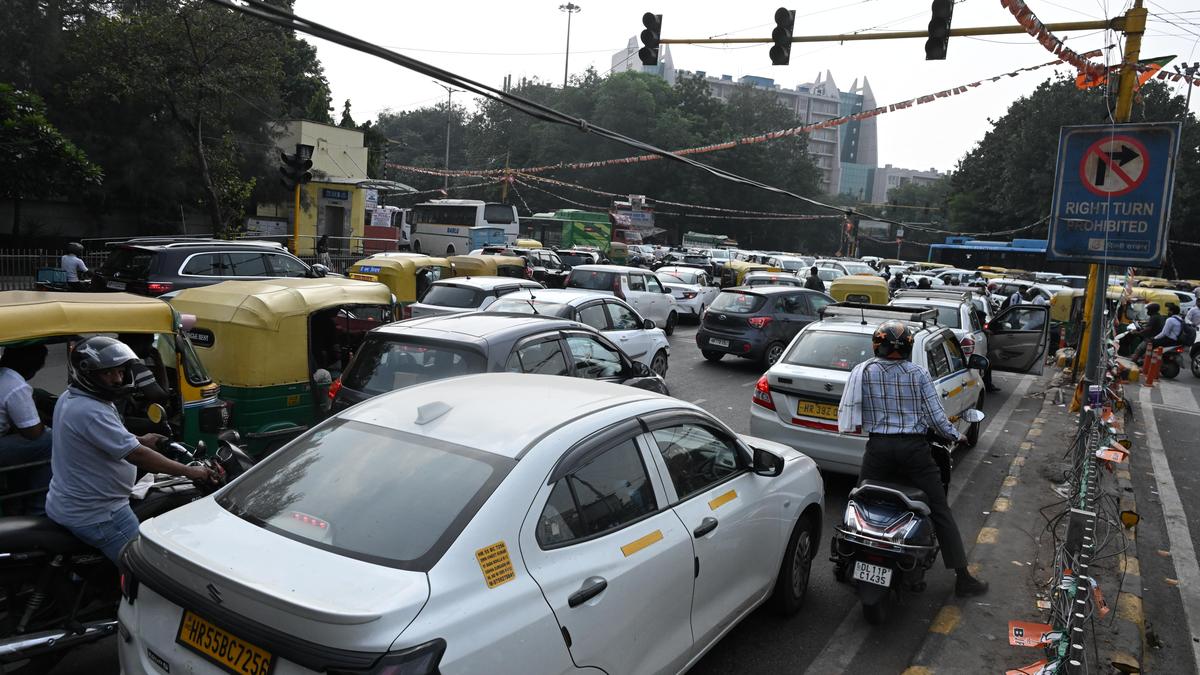
India’s draft BS-VII standards propose broader pollution controls, including real-world emissions testing and brake and tyre pollution requirements, while keeping principal passenger-car tailpipe limits unchanged.
Image: The Hindu
Why in news
The Ministry of Road Transport and Highways published draft BS-VII notifications in October 2026, inviting public comments for 30 days from their public availability. These are proposals and may change before finalisation.
1 April 2029
Proposed passenger-car rollout
10 nanometres
Proposed particle-number threshold
3 mg/km
Proposed common car brake-particle limit from April 2035
April 2030
Proposed car on-road type-approval testing
30 days
Public consultation window
875,000 km or 15 years
Longest proposed heavy-vehicle durability period
Background
Bharat Stage standards regulate emissions from motor vehicles within India’s vehicle-regulation framework under the Motor Vehicles Act and the Central Motor Vehicles Rules. India adopted BS-VI nationwide in April 2020; the BS-VI regime tightened pollutant limits and introduced real-driving emissions tests for applicable vehicles. Tailpipe pollution arises from combustion and exhaust processes, whereas non-exhaust pollution includes particles generated by brake wear, tyre wear and road-dust resuspension. Battery-electric vehicles have no tailpipe emissions during operation, but they are not free from non-exhaust pollution.
What the draft changes: Broader regulation, not merely tighter exhaust limits
The proposed BS-VII framework covers exhaust emissions, smaller particles, real-world performance, non-exhaust pollution and battery performance. Its implementation is staggered by vehicle category and by individual requirement, so the initial rollout date does not activate every provision simultaneously.
For passenger cars, the principal limits for carbon monoxide, nitrogen oxides and exhaust particulate matter are retained. The particle-number measurement threshold would fall from 23 nanometres to 10 nanometres, bringing smaller particles within the measurement regime.
- Passenger cars would enter the proposed regime from 1 April 2029, followed by light commercial vehicles in April 2030 and buses and heavy trucks in April 2031.
- Petrol-car limits would be 1,000 mg/km for carbon monoxide and 60 mg/km for nitrogen oxides.
- Diesel-car limits would be 500 mg/km for carbon monoxide and 80 mg/km for nitrogen oxides.
- The proposed exhaust particulate-matter limit would be 4.5 mg/km for both petrol and diesel cars.
- The draft specifies performance requirements rather than prescribing a particular engine design.
Infographic
Real-world testing
Strengthen on-road verification alongside laboratory assessment.
Smaller particles
Extend particle-number measurement down to 10 nanometres.
Brake and tyre wear
Address non-exhaust pollution across powertrains.
Sustained performance
Monitor emissions controls and verify durability over time.
Battery performance
Introduce performance-retention benchmarks for EVs and plug-in hybrids.
Credible implementation
Match phased standards with testing capacity and effective enforcement.
AI-assisted infographic by Pragnya IAS Academy, based on the cited sources.
Real-world testing and monitoring: Closing the compliance gap
The draft proposes on-road testing with portable equipment as part of passenger-car type approval from April 2030. This should be understood as strengthening the existing real-driving emissions framework, not introducing on-road emissions testing in India for the first time.
Laboratory testing provides controlled, repeatable measurements, but actual emissions can vary with traffic, driving patterns, load and environmental conditions. Combining laboratory tests, on-road measurement and monitoring over time can make certification more representative of vehicle use.
For cars, an on-board monitoring system would detect specified emissions exceedances, including levels at least 2.5 times the relevant limit. Monitoring data would have to be accessible through the diagnostic port for vehicles manufactured from 1 April 2032; the draft also phases in monitoring of emissions and fuel or electric-energy consumption.
- Certification should establish initial compliance, while monitoring and durability checks should help verify continued performance.
- Monitoring data can support enforcement only when diagnostic access, verification protocols and corrective-action procedures are effective.
Brake and tyre pollution: Why electrification alone is insufficient
Brakes release particles as friction surfaces wear, while tyres shed material through contact with the road. These sources remain relevant even when tailpipe emissions are eliminated, making non-exhaust controls important for both conventional and electric vehicles.
For passenger cars, the draft proposes brake-particle limits of 3 mg/km for pure electric cars and 7 mg/km for other specified vehicle types from April 2031. A common limit of 3 mg/km across powertrains is proposed from April 2035.
Passenger-car tyre-abrasion requirements are proposed from April 2031, but their numerical limits would be notified separately. Electric vehicles and plug-in hybrids would also face battery-performance benchmarks; these address performance retention over time and should not be confused with particulate-emission limits.
- Regenerative braking can reduce reliance on friction brakes, but it does not eliminate tyre wear.
- Regulating wear particles complements electrification rather than replacing its benefits.
- Particle-number measurement, particulate mass and tyre abrasion are distinct regulatory parameters.
Category-specific obligations and the regulatory framework
Light commercial vehicles would face weight-dependent requirements from April 2030. Their brake-particle requirements would begin in April 2032, with a common limit across powertrains proposed from 2035; numerical brake limits would be notified separately.
Buses and heavy trucks are covered by a separate draft. Their exhaust limits are expressed relative to engine energy output rather than distance travelled, reflecting their different duty cycles. The draft covers nitrogen oxides and particles as well as ammonia, methane and nitrous oxide, with the longest proposed durability period extending to 875,000 km or 15 years.
The legal context includes the Motor Vehicles Act and the Central Motor Vehicles Rules. Articles 48A and 51A(g) provide broader constitutional environmental context, but the specific compliance duties must come from the applicable vehicle rules. Publication of a draft does not make its proposed limits final or immediately enforceable.
- Heavy-vehicle exhaust limits, on-road testing and on-board monitoring are proposed from April 2031.
- Additional heavy-vehicle monitoring and brake-particle requirements are proposed from April 2033.
- Heavy-vehicle tyre-abrasion requirements are proposed from April 2035; numerical brake, tyre-wear and battery-performance limits would be notified separately.
Implementation economics: Standards must be matched by enforcement capacity
Manufacturers may need additional testing, sensors, calibration, exhaust-treatment improvements or software changes, depending on existing vehicle technology. Brake and tyre compliance and battery-performance verification could add further development costs; however, a uniform cost increase across models cannot be inferred from the supplied material.
The public-health value of stronger standards depends on credible measurement and sustained compliance. Portable testing equipment, calibrated instruments, trained personnel and reliable data systems are therefore as important as the notification itself.
Phasing provides preparation time, but unresolved numerical limits can delay product planning and testing investment. The central policy task is to combine predictable requirements with technically robust enforcement, without treating certification alone as proof of lifetime compliance.
- Cost impacts may differ across vehicle categories, technologies and manufacturers.
- New-vehicle standards should be complemented by maintenance and in-use compliance measures for the existing fleet.
- Independent verification and transparent testing procedures can strengthen confidence in manufacturer-reported compliance.
| Parameter | Proposed provision | Exam-relevant distinction |
|---|---|---|
| Principal tailpipe limits | CO, NOx and exhaust PM limits retained | BS-VII is not simply a uniform tightening of all exhaust limits |
| Particle-number measurement | Threshold reduced from 23 nm to 10 nm | Smaller particles enter measurement; this is not a mass limit |
| On-road type-approval testing | Portable-equipment testing from April 2030 | Builds on real-driving emissions testing under BS-VI |
| Brake particles | From April 2031: 3 mg/km for pure electric cars and 7 mg/km for other specified types; common 3 mg/km from April 2035 | Non-exhaust pollution affects multiple powertrains |
| Tyre abrasion | Requirements from April 2031; numerical limits to be notified separately | A proposed commencement date is not a complete numerical standard |
| On-board monitoring data | Diagnostic-port access for vehicles manufactured from 1 April 2032 | Monitoring complements initial certification |
- 1. Set category-specific pollutant limits, testing conditions and durability requirements.
- 2. Verify vehicle performance through prescribed laboratory and on-road tests.
- 3. Measure brake particles, tyre abrasion and battery performance under applicable requirements.
- 4. Monitor emissions-control performance during vehicle operation.
- 5. Use verified compliance evidence to identify failures and support corrective action.
April 2020
India adopted BS-VI vehicle emission standards nationwide.
October 2026
Draft BS-VII notifications published for public consultation.
April 2029
Proposed BS-VII rollout begins with passenger cars.
April 2030
Proposed light commercial vehicle rollout and passenger-car on-road type-approval testing.
April 2031
Proposed heavy-vehicle rollout and commencement of passenger-car brake-particle and tyre-abrasion requirements.
April 2032
Proposed diagnostic-port availability of car monitoring data for vehicles manufactured from this date, alongside light commercial vehicle brake-particle requirements.
April 2033
Proposed additional heavy-vehicle monitoring and brake-particle requirements.
April 2035
Proposed common passenger-car brake-particle limit across powertrains and heavy-vehicle tyre-abrasion requirements.
Significance, challenges & way forward
Significance
- Real-world testing can make certification more representative of emissions during actual vehicle use.
- Measuring smaller particles broadens the coverage of particulate-emission regulation.
- Brake and tyre requirements address pollution that persists even with fleet electrification.
- Monitoring and durability provisions strengthen the focus on sustained emissions-control performance.
- Performance-based rules preserve manufacturers’ flexibility to choose suitable compliance technologies.
Challenges
- Additional testing and technology requirements may raise development and compliance costs unevenly across vehicle segments.
- Unnotified numerical limits create uncertainty for component design, validation and investment.
- On-road results require carefully defined testing conditions to ensure comparability without ignoring real-world variability.
- Enforcement agencies and testing institutions need equipment, trained personnel and credible verification systems.
- Diagnostic data will have limited regulatory value without reliable access, interpretation and follow-up.
- Standards for newly manufactured vehicles alone cannot address pollution from the entire existing fleet.
Way forward
- Finalise pending numerical limits and test protocols sufficiently ahead of their implementation dates.
- Expand accredited testing capacity, instrument calibration and technical training alongside the rollout.
- Define representative on-road testing conditions and safeguards against selective testing.
- Establish clear responsibilities for monitoring-data access, verification and corrective action.
- Assess category-wise compliance costs while retaining environmental objectives and technology-neutral standards.
- Combine new-vehicle norms with effective in-use inspection, maintenance, public transport and road-dust management.
Key terms
- Bharat Stage standards
- India’s regulatory standards governing pollutant emissions from motor vehicles.
- Real-driving emissions
- Emissions assessed during on-road vehicle operation under prescribed conditions.
- Portable emissions measurement system
- Equipment carried on a vehicle to measure emissions during road testing.
- Type approval
- Certification that a vehicle type meets applicable regulatory requirements.
- Non-exhaust emissions
- Pollution from sources other than the tailpipe, including brake wear, tyre wear and resuspended road dust.
- Particle-number threshold
- The particle-size threshold defining which particles are included in a prescribed counting measurement.
- On-board monitoring
- Vehicle-integrated monitoring designed to identify specified emissions exceedances during operation.
- Emissions durability
- The requirement for emissions-control performance to remain compliant over a prescribed distance or period.
Link with static syllabus
Prelims practice MCQs
Q1. With reference to the draft BS-VII standards for passenger cars, consider the following statements: 1. The principal tailpipe limits for carbon monoxide, nitrogen oxides and exhaust particulate matter are retained. 2. The particle-number measurement threshold is proposed to increase from 10 nanometres to 23 nanometres. 3. Numerical tyre-abrasion limits are to be notified separately. Which of the statements given above are correct?
Q2. Consider the following statements about vehicle-emission testing in India: 1. The BS-VI regime introduced real-driving emissions tests for applicable vehicles. 2. Draft BS-VII proposes portable-equipment on-road testing as part of passenger-car type approval from April 2030. 3. On-board monitoring makes laboratory testing unnecessary. Which of the statements given above are correct?
Q3. With reference to non-exhaust vehicular pollution, consider the following statements: 1. Battery-electric vehicles can generate tyre-wear particles. 2. Regenerative braking can reduce reliance on friction brakes. 3. The draft proposes a common passenger-car brake-particle limit across powertrains from April 2035. Which of the statements given above are correct?
Q4. How does the draft BS-VII framework express exhaust-emission limits for buses and heavy trucks, in contrast to passenger-car limits?
Mains practice questions
GS 3 · 15 marks · 250 words
India’s proposed BS-VII standards represent a shift from tailpipe certification towards broader, sustained vehicle-emission compliance. Examine their environmental significance and implementation challenges.
Frequently asked questions
Have BS-VII standards become final and enforceable?
No. The supplied material describes draft notifications published in October 2026 for public consultation, with proposed implementation beginning in April 2029 for passenger cars.
Does BS-VII reduce every passenger-car exhaust limit?
No. The draft retains the principal CO, NOx and exhaust PM limits for passenger cars while expanding smaller-particle measurement, real-world testing, monitoring and non-exhaust controls.
Why are electric vehicles included in the proposed requirements?
Electric vehicles still generate brake and tyre wear despite having no operational tailpipe emissions. The draft also proposes battery-performance benchmarks for electric vehicles and plug-in hybrids.
Will every BS-VII requirement begin in April 2029?
No. The rollout is phased by vehicle category and individual requirement, with passenger-car on-road type-approval testing, brake controls and monitoring-data access proposed for later dates.
Sources
Analysis prepared by the Pragnya IAS Academy current-affairs desk with AI assistance from the cited reports. Verify figures with the original sources.
Turn current affairs into marks
Join Pragnya IAS Academy's mentorship for daily answer-writing evaluation on stories like this — classroom programmes from a trusted name in IAS coaching in Hyderabad.