
Electoral-Roll Deletions: Appeals, Fresh Enrolment and Safeguards Against Exclusion
Revise the static topic: UPSC Polity notes · UPSC Governance notes
In short: Reports from Karnataka and Chennai highlight concerns that electoral-roll deletions during Special Intensive Revision have left eligible voters struggling to secure inclusion. Karnataka appellants allege that officials are redirecting them towards Form 6 applications instead of resolving deletion appeals, raising questions about due process and whether corrective action will become effective before elections.
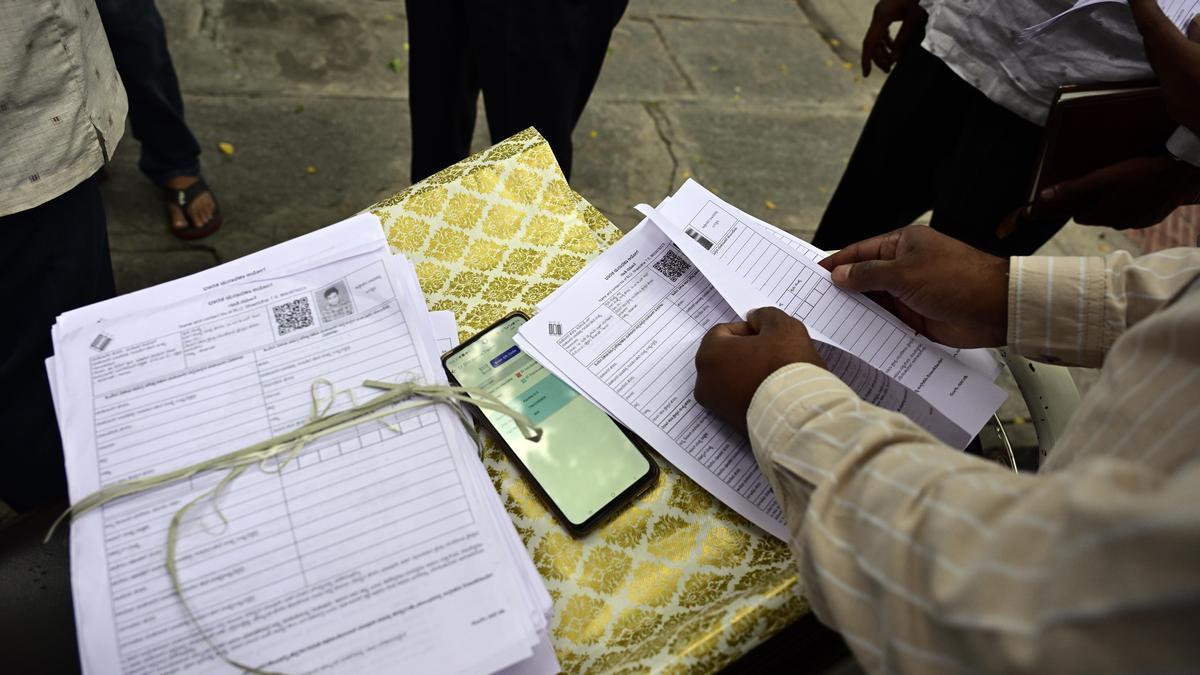
Photo from the source report: Electoral-Roll Deletions: Appeals, Fresh Enrolment and Safeguards Against Exclusion
Image: The Hindu
Why in news
The Hindu reports that more than 350 deletion appeals have been filed across Karnataka, while most electors removed as permanently shifted in Chennai have not applied for inclusion. The approaching Greater Bengaluru Authority elections make the distinction between successful registration and inclusion in the operative election roll particularly important.
More than 350
Deletion appeals filed across Karnataka
12.22 lakh
Chennai electors removed as permanently shifted
83,972
Post-SIR inclusions reported in Chennai
49%
Estimated Chennai residents in rental accommodation
Background
Electoral rolls identify persons entitled to vote in a constituency. The Representation of the People Act, 1950 and the Registration of Electors Rules, 1960 govern their preparation, revision, correction and inclusion procedures. Eligibility rests on citizenship, the prescribed voting age, ordinary residence and absence of statutory disqualification, not ownership of a house. Article 324 places the preparation of electoral rolls for parliamentary and State legislature elections under the Election Commission of India’s superintendence, direction and control. Articles 325 and 326 establish the constitutional framework of a general electoral roll and adult suffrage. Revision must therefore reconcile the removal of ineligible entries with protection against wrongful exclusion.
What the reports establish—and what they do not
In Karnataka, several voters say their names were deleted from final SIR rolls despite their participation in hearings and submission of documents. Some Bengaluru appellants allege that officials asked them to withdraw appeals and submit Form 6; others say officials submitted such applications on their behalf. These are reported allegations requiring verification, not adjudicated findings of misconduct.
The Chennai report identifies a broader inclusion problem involving residents classified as permanently shifted. It records 83,972 post-SIR inclusions, but does not establish that every inclusion represents restoration of someone from the deleted group. The figure should not be treated as a verified restoration rate.
The cases suggest two distinct risks: erroneous deletion despite compliance, and failure to secure registration at a new address after genuine residential movement. Each requires an appropriate remedy rather than a uniform administrative response.
- Reported discrepancies include cross-State family mapping, transliteration differences and an age-gap flag involving twins.
- Different outcomes within a family warrant scrutiny, although each person’s electoral eligibility must be assessed individually.
- Chennai officials have promised renewed verification, registration camps and intensified outreach.
Infographic
Verify
Establish deletion grounds through evidence, not anomaly flags alone.
Hear
Give the legally required opportunity to respond and assess documents.
Review
Decide appeals without forcing substitution by fresh applications.
Assist
Provide appropriate registration support to tenants and mobile residents.
Implement
Translate valid decisions into timely inclusion in the applicable roll.
AI-assisted infographic by Pragnya IAS Academy, based on the cited sources.
Appeal and fresh enrolment serve different purposes
An appeal challenges an adverse electoral-registration decision and seeks review of its correctness. Form 6 is an application for inclusion; its acceptance does not, by itself, establish that the earlier deletion was justified or unlawful. A new application should not become an administrative substitute for deciding a pending appeal.
For the Karnataka SIR described in the report, the Deputy Commissioner or District Election Officer is the first appellate authority, followed by the Chief Electoral Officer. The CEO’s office states that appeals received so far are pending or have been disposed of at the first stage.
Form 6 may provide a route to inclusion, but officials must explain the applicable procedure and ensure that declarations accurately reflect the applicant’s circumstances. Where an enrolled elector shifts residence, Form 8 provides the prescribed route for shifting an existing registration; officials should distinguish such cases from those involving deletion.
- A voluntary inclusion application does not answer whether the original deletion followed due process.
- Officials should not condition assistance on withdrawal of an appeal.
- The practical remedy must address inclusion in the roll actually used for the relevant election.
Legal safeguards governing deletion
Section 22 of the Representation of the People Act, 1950 governs correction and deletion of entries after appropriate verification. For deletion on grounds such as cessation of ordinary residence or lack of entitlement, the affected person must receive a reasonable opportunity of being heard. Section 23 concerns inclusion, while Section 24 provides an appellate framework for specified electoral-registration orders.
A hearing is meaningful only if the person knows the alleged defect, can submit relevant evidence and receives a decision that addresses that evidence. An unexplained anomaly flag or an unresolved spelling difference should trigger verification rather than operate as conclusive proof of ineligibility.
Ordinary residence is a factual connection with a constituency, not a property-ownership test. Temporary absence does not by itself terminate ordinary residence. Genuine relocation may require updating registration, but tenants and mobile workers must not be treated as presumptively ineligible.
- Article 14 supports non-arbitrary administration and consistent treatment of comparable cases.
- Article 325 prohibits exclusion from electoral rolls on grounds only of religion, race, caste or sex.
- Article 326 provides the constitutional basis of adult suffrage; the exercise of voting rights is regulated by election law.
Why timing and institutional jurisdiction matter
The Karnataka report states that the Greater Bengaluru Authority elections are to use the SIR final rolls and be conducted by December. Consequently, an applicant’s eventual inclusion in a supplementary list may not secure participation in those elections if that list is not part of the operative roll.
An Elector’s Photo Identity Card is not a substitute for an entry in the applicable electoral roll. Receiving an EPIC or an assurance of future inclusion therefore does not resolve the immediate problem.
The Election Commission of India administers parliamentary and State legislature electoral rolls, while Article 243ZA places municipal electoral-roll preparation and elections under the State Election Commission’s superintendence, direction and control. Where State law uses Assembly rolls for municipal elections, correction and adoption must be coordinated within the applicable legal framework.
- Continuous updation is not an assurance that every inclusion will take effect for an imminent election.
- For parliamentary and Assembly rolls, statutory restrictions apply during the election period.
- Authorities should publish which roll and legally valid supplements will govern the local election.
Urban mobility exposes an inclusion deficit
Chennai’s experience shows why formal availability of online applications and camps may be insufficient. Frequent residential movement, uncertainty about procedures and the time cost of visiting offices can leave otherwise eligible residents outside the rolls.
Roll accuracy has two dimensions: excluding ineligible entries and retaining or registering eligible electors. A revision process judged mainly by deletions risks overlooking the administrative burden placed on citizens and the democratic cost of unresolved errors.
- Absence during a field visit should prompt further verification rather than automatically establish permanent relocation.
- Outreach should distinguish wrongful deletion, genuine shifting and first-time enrolment.
- Political-party Booth Level Agents can support awareness, but statutory decisions remain the responsibility of election authorities.
| Route | Purpose | Critical distinction |
|---|---|---|
| Appeal against deletion | Review an adverse registration decision | Examines the correctness of deletion; requires a reasoned decision |
| Form 6 | Apply for inclusion in the electoral roll | Does not by itself adjudicate the earlier deletion or guarantee inclusion for an imminent poll |
| Form 8 | Seek shifting of residence or correction of an existing entry, among other prescribed services | Appropriate procedure depends on whether an existing registration remains on the roll |
| Verification of the operative roll | Confirm whether the elector can vote in the relevant election | An EPIC or application acknowledgement alone is insufficient |
- 1. Communicate the specific proposed deletion ground and undertake appropriate verification.
- 2. Provide the legally required opportunity to respond and assess the evidence submitted.
- 3. Issue and communicate a reasoned decision with information on the available remedy.
- 4. Decide an appeal independently without compelling substitution by a fresh application.
- 5. Give effect to the decision through the legally applicable roll-updating process.
- 6. Confirm whether the elector appears in the operative roll for the relevant election.
After publication of Karnataka’s final SIR rolls
Affected electors challenged deletions; more than 350 appeals were reported across the State.
2026 Assembly election in Tamil Nadu
Some Chennai residents who had shifted residence reported being unable to vote after deletion during SIR.
November 12, 2026
Chennai’s draft electoral roll for Special Summary Revision was published.
November 22, 2026
Chennai District Election Office conducted inclusion camps; the report described limited participation.
November 29, 2026
Further special camps in Chennai are scheduled, according to the district administration.
By December 2026
The Karnataka report states that Greater Bengaluru Authority elections are to be conducted using the SIR final rolls.
Significance, challenges & way forward
Significance
- Accurate and inclusive rolls translate constitutional adult suffrage into effective electoral participation.
- Reasoned deletion and appellate decisions strengthen public confidence in electoral administration.
- Distinguishing appeals from inclusion applications preserves accountability for potentially erroneous decisions.
- Address-sensitive registration assistance protects tenants and mobile workers from avoidable exclusion.
- Coordination between parliamentary or Assembly roll administration and municipal election authorities can prevent remedies from becoming ineffective through delay.
Challenges
- Documentary inconsistencies and family-mapping flags may be mistaken for substantive ineligibility.
- Repeated office visits impose time and income costs on residents seeking correction.
- An appeal may lose practical value if decided after the operative roll for an election is settled.
- Fresh inclusion can resolve registration prospectively while leaving the legality of an earlier deletion unanswered.
- Aggregate inclusion figures do not reveal how many deleted eligible electors have actually regained registration.
- Publicity alone may not reach residents who are unaware that their names have been removed.
Way forward
- Audit disputed deletions, particularly cases involving submitted documents, unresolved hearings and contradictory outcomes.
- Provide trackable appeal acknowledgements, accessible case status and reasoned decisions with election-sensitive prioritisation.
- Prohibit coercive withdrawal of appeals and ensure that any separately filed application is informed and accurately completed.
- Deploy targeted assistance in rental neighbourhoods and other high-mobility areas, alongside online facilities.
- Publish anonymised data distinguishing deletion grounds, appeals, appellate outcomes, fresh inclusions and restorations.
- Clarify the operative municipal roll and applicable supplements through coordination with the State Election Commission.
- Train field staff to assess ordinary residence and documentary variation through evidence rather than rigid assumptions.
Key terms
- Special Intensive Revision
- An intensive electoral-roll revision exercise involving verification of existing entries and eligible electors.
- Ordinary residence
- The residence-based connection relevant to registration in a constituency, assessed under election law rather than property ownership.
- Electoral Registration Officer
- The statutory officer responsible for preparing and revising the electoral roll of a constituency.
- Continuous updation
- The process of updating electoral rolls between revisions, subject to applicable legal restrictions.
- EPIC
- The Elector’s Photo Identity Card, which does not independently establish that its holder is on the operative electoral roll.
- Operative electoral roll
- The legally applicable roll, including valid supplements where relevant, used to determine voter eligibility for a particular election.
- Natural justice
- Procedural fairness, including an appropriate opportunity to respond before an adverse decision.
Link with static syllabus
Prelims practice MCQs
Q1. With reference to electoral registration, consider the following statements: 1. Possession of an EPIC is sufficient to vote even if the holder’s name is absent from the applicable electoral roll. 2. Ownership of a dwelling is necessary to establish eligibility for electoral registration. 3. Ordinary residence is relevant to registration in a constituency. Which of the statements given above is/are correct?
Q2. Consider the following pairs: 1. Article 324: Superintendence, direction and control of parliamentary and State legislature elections 2. Article 325: Prohibition of electoral-roll exclusion on grounds only of religion, race, caste or sex 3. Article 243ZA: Municipal elections Which of the pairs given above are correctly matched?
Q3. With reference to electoral-roll remedies, consider the following statements: 1. An appeal against deletion and an application for inclusion serve distinct purposes. 2. Filing Form 6 automatically establishes that an earlier deletion was unlawful. 3. Form 8 provides a route for shifting the residence of an already enrolled elector. Which of the statements given above are correct?
Q4. Which one of the following best describes the subject of the Representation of the People Act, 1950?
Mains practice questions
GS 2 · 15 marks · 250 words
Electoral-roll accuracy requires both removal of ineligible entries and protection against wrongful exclusion. Discuss the safeguards governing deletion and explain why fresh enrolment cannot substitute for an effective appellate remedy.
Frequently asked questions
Can a person vote merely because they possess an EPIC?
No. The person’s name must appear in the electoral roll applicable to that election; an EPIC alone does not confer eligibility to vote.
Why are voters objecting to Form 6 instead of an appeal?
They seek review of allegedly wrongful deletions, not merely prospective inclusion. A fresh application does not decide whether the deletion was correct and may not become effective for an imminent election.
Does living in rented accommodation affect electoral eligibility?
Renting does not disqualify a person. Registration depends on ordinary residence and other statutory eligibility conditions, not ownership of the dwelling.
Who is responsible when Assembly rolls are used for municipal elections?
Assembly-roll administration falls within the ECI framework, while municipal electoral-roll preparation and elections fall under the State Election Commission. Their responsibilities must be coordinated according to applicable State law.
Sources
- The Hindu: SIR: Voters in Karnataka challenge deletions, say officials asking them to withdraw appeals, file Form 6
- The Hindu: Most of the 12.22 lakh electors removed during SIR yet to apply for inclusion in the rolls
Analysis prepared by the Pragnya IAS Academy current-affairs desk with AI assistance from the cited reports. Verify figures with the original sources.
Turn current affairs into marks
Join Pragnya IAS Academy's mentorship for daily answer-writing evaluation on stories like this — classroom programmes from a trusted name in IAS coaching in Hyderabad.