
Gaganyaan Separation Tests: Validating Safety Before the G1 Uncrewed Mission
Revise the static topic: UPSC Science & Technology notes
In short: ISRO has completed Crew Module–Service Module separation tests ahead of Gaganyaan’s first uncrewed mission, G1. The tests validated the separation system’s design adequacy and demonstrated the shock-survivability of critical Crew Module subsystems, strengthening confidence in a crucial operation before atmospheric re-entry.
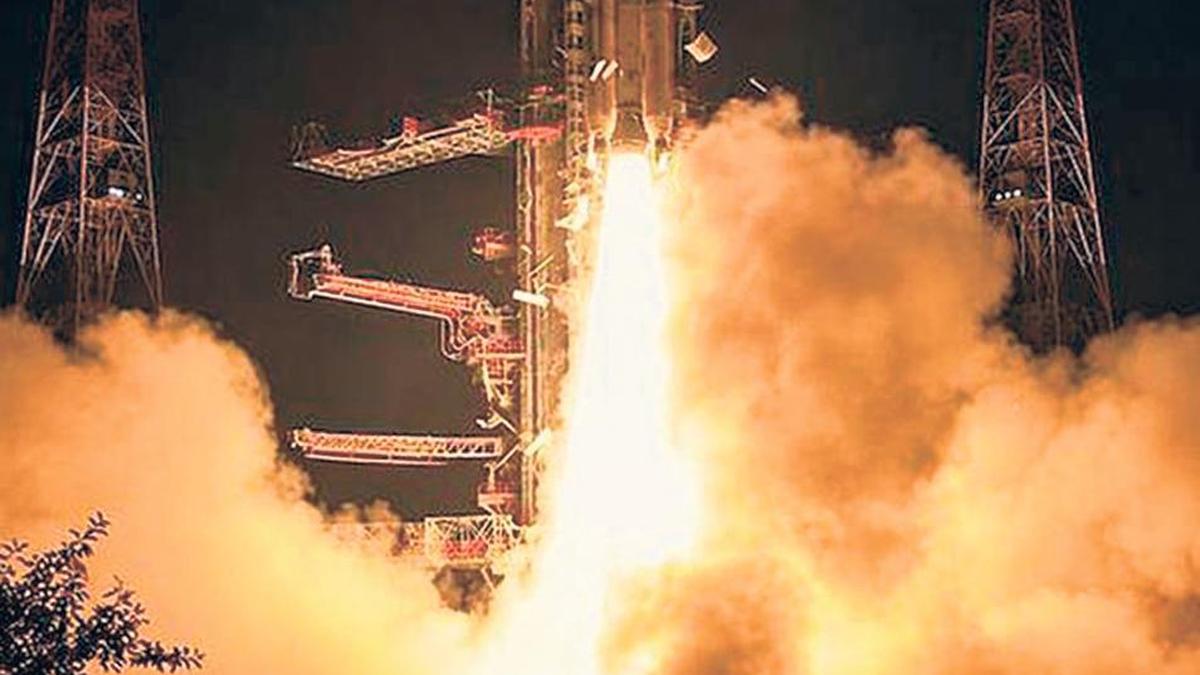
Photo from the source report: Gaganyaan Separation Tests: Validating Safety Before the G1 Uncrewed Mission
Image: The Hindu
Why in news
ISRO conducted a series of instrumented separation tests at the Vikram Sarabhai Space Centre, Thiruvananthapuram, ahead of the upcoming G1 mission. The reported milestone concerns readiness for an uncrewed flight, not final certification for carrying astronauts.
3 members
Envisaged crew
400 km
Envisaged orbital altitude
3 days
Envisaged crewed mission duration
Background
Gaganyaan is India’s programme to demonstrate indigenous human-spaceflight capability, including safe return to Earth. Its envisaged crewed mission involves carrying three members to an orbit of 400 km for three days, followed by landing in Indian sea waters. These parameters describe the programme’s crewed objective, not an astronaut complement for G1. Human spaceflight requires validation of the complete mission chain, from launch and orbital operations to re-entry, landing and recovery. Human-rating therefore goes beyond launch capability to include reliability, fault management and crew protection.
What ISRO tested and established
Gaganyaan’s Orbital Module comprises the Crew Module and Service Module, joined through a separation system. Electrical and fluid servicing between them is provided through umbilical connections. The modules are integrated before launch and operate together until completion of the on-orbit phase.
At the Vikram Sarabhai Space Centre, ISRO created an extensively instrumented setup simulating the overall module assembly. The tests reproduced separation events, including severing several umbilical connections, to assess the adequacy of the separation design.
According to ISRO, the tests also demonstrated robustness and shock-survivability of critical Crew Module subsystems. This supports confidence in the implemented separation system for G1; it does not establish that every aspect of the spacecraft has been fully qualified.
- Subsystems assessed included avionics and inertial navigation systems.
- The assessment covered the thermal protection system in the aft and conical heat shields and the deployable umbilical shield.
- It also included pyrotechnic devices associated with the crew module uprighting system and the thermal and humidity control system.
Infographic
Separation reliability
Validate release sequencing and umbilical disconnection.
Subsystem survivability
Check that critical equipment withstands separation shocks.
Uncrewed validation
Assess integrated performance in actual flight conditions.
Safety assurance
Resolve anomalies and verify readiness through cumulative evidence.
Technological self-reliance
Deepen domestic design, testing and industrial quality capabilities.
AI-assisted infographic by Pragnya IAS Academy, based on the cited sources.
Why separation before re-entry is safety-critical
Before atmospheric re-entry begins, the Crew Module must separate from the Service Module. Separation requires several precisely sequenced events involving pyrotechnic devices and jettisoning systems, rather than a single mechanical release.
The engineering challenge is to achieve complete disengagement while ensuring that separation-induced shocks do not disable systems needed subsequently. Incomplete release, residual connections or damage to critical equipment could jeopardise the intended return sequence.
This illustrates the importance of interface reliability: individual subsystems may function correctly, yet the mission can remain vulnerable where structures, electrical links, fluid connections and commands interact.
- Sequence integrity matters because release and disconnection events must occur in the intended order.
- Shock-survivability matters because sensitive equipment must remain functional after the separation event.
- Instrumented testing provides evidence of system behaviour rather than relying on design calculations alone.
Ground tests and uncrewed flights provide complementary evidence
Ground tests allow engineers to isolate mechanisms, measure loads and responses, and investigate anomalies without exposing astronauts to risk. The reported separation tests are an example of targeted validation of a critical mission event.
Uncrewed flights provide an opportunity to assess integrated performance in actual flight conditions. They help examine interactions among systems across mission phases that cannot all be reproduced together in a ground facility.
Neither a successful component test nor an uncrewed flight eliminates all risk. Readiness for crewed flight must rest on cumulative evidence, anomaly resolution and verification of safety-critical functions. The source reports successful separation testing; it does not report completion of G1.
- Ground validation establishes confidence in specific mechanisms and interfaces.
- Flight validation examines integrated behaviour under real mission conditions.
- Any anomaly should feed back into design correction, verification and, where required, repeat testing.
Implications for self-reliance and India’s space ecosystem
Technological self-reliance in human spaceflight means more than assembling a launch vehicle or spacecraft. It includes the ability to design safety-critical systems, manufacture them consistently, test their interfaces and independently interpret performance data.
Programmes such as Gaganyaan can strengthen capabilities in precision manufacturing, sensors, avionics, materials, environmental control and test instrumentation. Their wider industrial value depends on translating mission requirements into repeatable processes, qualified suppliers and a strong quality culture.
The reported milestone demonstrates progress in indigenous validation capability. It should not be interpreted as proof that every component is indigenous or that complete technological autonomy has already been achieved.
- Testing infrastructure is a strategic capability because it enables domestic verification of complex systems.
- Industry participation should prioritise traceability, qualification and configuration control, not merely component supply.
- Academic and industrial collaboration can support materials research, modelling and reliability engineering.
| Validation layer | Principal contribution | Important limitation |
|---|---|---|
| CM–SM separation ground tests | Assess separation design adequacy and shock-survivability under simulated test conditions | Do not validate the entire mission or complete human-rating |
| Uncrewed mission | Provides flight evidence on integrated spacecraft performance without astronauts aboard | Cannot establish zero risk or replace all crew-specific assessments |
| Human-rating assessment | Brings together evidence on reliability, crew protection and fault management | Requires cumulative verification rather than reliance on one successful milestone |
- 1. Crew Module and Service Module are integrated before launch, with electrical and fluid umbilical connections.
- 2. The modules operate as a combined Orbital Module through the on-orbit phase.
- 3. Before re-entry, precisely sequenced separation events activate pyrotechnic devices and jettisoning systems.
- 4. Umbilical connections are severed and the Crew Module separates from the Service Module.
- 5. The Crew Module proceeds towards atmospheric re-entry and subsequent return to Earth.
Significance, challenges & way forward
Significance
- The tests strengthen confidence in a critical transition between orbital operations and atmospheric re-entry.
- Demonstrated shock-survivability helps establish that essential Crew Module equipment can withstand the separation event.
- Uncrewed missions allow integrated flight validation without exposing astronauts to developmental flight risks.
- Domestic design and testing capabilities strengthen technological self-reliance beyond hardware assembly.
- Human-spaceflight requirements can encourage higher standards of manufacturing, documentation and quality assurance across the space ecosystem.
Challenges
- Multiple release and disconnection events must occur reliably in a tightly coordinated sequence.
- Ground facilities cannot reproduce every interaction and environmental condition of an actual mission.
- Surviving separation shocks does not by itself prove performance under re-entry heating or other distinct mission stresses.
- Supplier-level variations and uncontrolled design changes can undermine otherwise sound system designs.
- Schedule pressure must not weaken anomaly investigation, verification or safety review.
Way forward
- Use G1 flight data to evaluate integrated performance and resolve anomalies before advancing towards crewed operations.
- Maintain rigorous subsystem qualification alongside integrated testing, with repeat verification after safety-relevant design changes.
- Strengthen independent technical review, configuration control and traceable acceptance criteria for mission-critical hardware.
- Expand industry and academic participation through clear qualification standards and appropriate access to testing infrastructure.
- Communicate milestones precisely, distinguishing a successful mechanism test from uncrewed-flight success and crewed-flight readiness.
Key terms
- Orbital Module
- The combined Crew Module and Service Module that function together during Gaganyaan’s on-orbit phase.
- Crew Module
- The spacecraft module intended to accommodate the crew and return them safely to Earth.
- Service Module
- The module that supports the Crew Module during the mission and separates from it before re-entry.
- Umbilical connections
- Connections that provide electrical and fluid servicing between the Crew Module and Service Module.
- Pyrotechnic devices
- Devices using controlled energetic reactions to perform functions such as release or separation.
- Shock-survivability
- The ability of equipment to withstand sudden mechanical loads without unacceptable damage or loss of function.
- Human-rating
- The process of establishing that a space system meets requirements for safely carrying humans, including reliability and crew protection.
- Inertial navigation system
- A system that uses inertial sensors to estimate motion, orientation and position without depending on continuous external references.
Link with static syllabus
Prelims practice MCQs
Q1. With reference to Gaganyaan’s Orbital Module, consider the following statements: 1. It comprises the Crew Module and Service Module. 2. Electrical and fluid servicing between the modules is ensured through umbilical connections. 3. The Service Module remains attached to the Crew Module throughout atmospheric re-entry. Which of the statements given above are correct?
Q2. The reported Gaganyaan Crew Module–Service Module separation tests were conducted at which of the following centres?
Q3. Consider the following statements about testing for human spaceflight: 1. Ground tests can assess the shock-survivability of spacecraft subsystems. 2. A successful separation test alone establishes complete readiness for carrying astronauts. 3. Uncrewed missions can provide evidence on integrated system performance in actual flight conditions. Which of the statements given above are correct?
Q4. With reference to the envisaged crewed Gaganyaan mission described in the source, consider the following pairs: 1. Crew size — Three members 2. Orbital altitude — 400 km 3. Mission duration — Three days How many of the above pairs are correctly matched?
Mains practice questions
GS 3 · 15 marks · 250 words
Human-spaceflight capability depends as much on a culture of testing as on launch technology. Discuss with reference to Gaganyaan, highlighting the implications for technological self-reliance and India’s space ecosystem.
Frequently asked questions
What did ISRO’s latest Gaganyaan test validate?
It validated the design adequacy of the Crew Module–Service Module separation system and demonstrated shock-survivability of critical Crew Module subsystems. The tests simulated separation events, including severing umbilical connections.
Why must the Crew Module separate before re-entry?
The modules operate together during the on-orbit phase, but the Crew Module is the returning element. Separation places it in the intended configuration for atmospheric re-entry.
Does this milestone mean Gaganyaan is ready to carry astronauts?
No. It strengthens confidence in a specific system ahead of G1; readiness for carrying astronauts requires broader validation and assessment.
Why are uncrewed missions important?
They allow integrated spacecraft performance to be examined in actual flight conditions without astronauts aboard. Their findings help identify and resolve problems before crewed operations.
Sources
Analysis prepared by the Pragnya IAS Academy current-affairs desk with AI assistance from the cited reports. Verify figures with the original sources.
Turn current affairs into marks
Join Pragnya IAS Academy's mentorship for daily answer-writing evaluation on stories like this — classroom programmes from a trusted name in IAS coaching in Hyderabad.