
India–Nepal Summit: Energy, Connectivity and the Test of Neighbourhood First
Revise the static topic: UPSC International Relations notes
In short: Nepal Prime Minister Balendra Shah arrived in New Delhi on November 22, 2026, ahead of scheduled talks with Prime Minister Narendra Modi on energy, connectivity and development cooperation. The agenda offers an opportunity to strengthen India’s Neighbourhood First policy through mutually beneficial infrastructure and electricity trade, while addressing concerns over trust and sovereign equality. The supplied reports describe anticipated outcomes, not confirmed summit decisions.
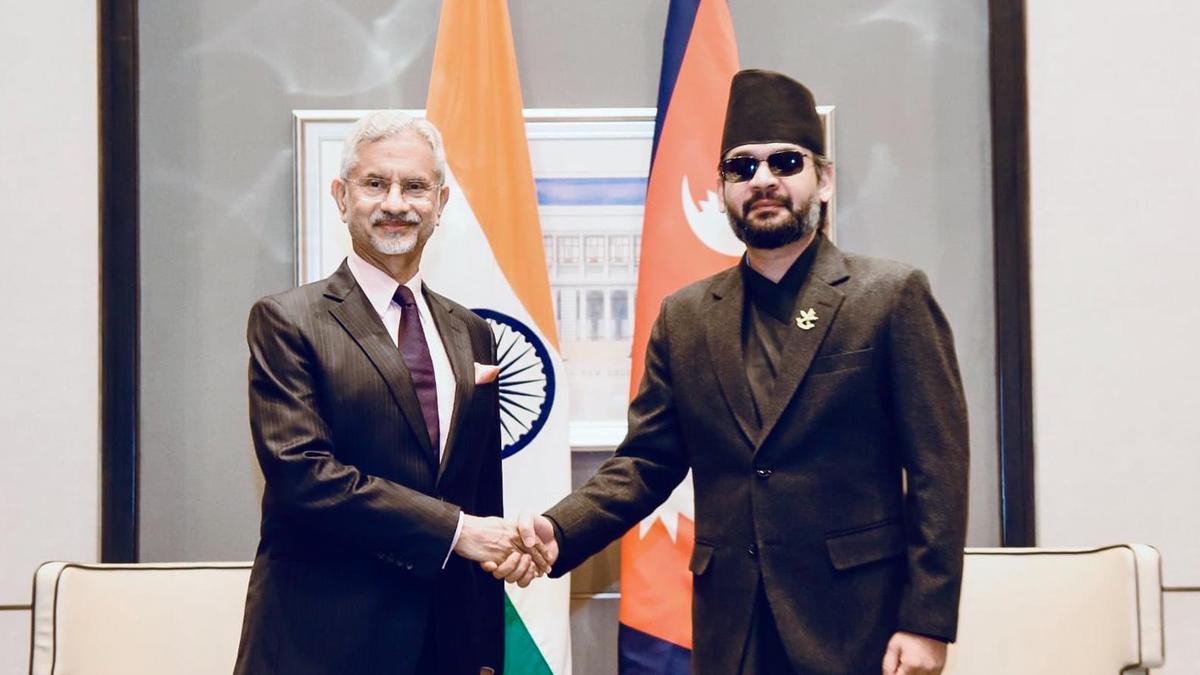
Nepal Prime Minister Balendra Shah arrives in New Delhi ahead of scheduled talks on energy, connectivity and development cooperation; summit outcomes remain unconfirmed.
Image: The Hindu
Why in news
The leaders were scheduled to hold their first in-person meeting on November 23, 2026, during Shah’s first official bilateral foreign visit since taking office. Expected discussions include long-term electricity trade, railway links, post-flood reconstruction assistance and an economic vision document.
Up to 10,000 MW
Envisaged imports from Nepal under long-term power trade agreement
10 years
Period envisaged for scaling up power imports
US$ 1–2 billion
Reported reconstruction assistance sought by Nepal
Background
India and Nepal share an open border, extensive cultural and family ties, and interconnected Himalayan river systems. Landlocked Nepal relies on transit connectivity through India for access to maritime trade, while cross-border infrastructure supports commerce and mobility in adjoining Indian states. The Treaty of Peace and Friendship forms part of the bilateral institutional framework. Nepal’s hydropower resources and India’s large electricity market create opportunities for mutually beneficial exchange. However, territorial disagreements, unequal economic capabilities and concerns about sovereignty make consultation and predictable implementation essential to India’s Neighbourhood First policy.
What is on the agenda—and what remains unconfirmed
The reports anticipate cooperation across energy, hydropower, railways, development partnership, climate resilience, infrastructure and technology. An economic vision document could bring energy, financial payment linkages and assistance into a broader partnership framework.
Nepal reportedly seeks reconstruction assistance following the August 2026 flash floods. The amount and the mix of grants, loans and lines of credit remain subjects for discussion; the reported request must not be treated as an Indian commitment.
Rail-service descriptions differ across the reports: The Hindu mentions an expected Janakpur–Gorakhpur connection, while The Indian Express describes an Ayodhya–Janakpur Dham passenger service. Neither account establishes a confirmed outcome in the supplied material.
- The Dharchula Bridge and Banbasa land port were reported as expected inaugurations, not verified completed summit outcomes.
- The Raxaul–Kathmandu railway remains under discussion; the reports do not establish a construction commitment.
- New air routes, start-up support, a possible offshore IIT campus and cricket cooperation are additional agenda items.
Infographic
Energy
Link hydropower markets with transmission and dependable trade rules.
Connectivity
Combine rail, land ports and bridges with efficient border services.
Resilience
Make reconstruction and infrastructure climate- and disaster-sensitive.
People
Expand tourism, skills, start-up mentoring and educational links.
Trust
Respect sovereign equality through consultation and transparent delivery.
AI-assisted infographic by Pragnya IAS Academy, based on the cited sources.
Electricity trade: from resource potential to dependable interdependence
The existing long-term power trade agreement envisages Indian imports of up to 10,000 MW from Nepal over ten years. This provides a framework for expanding trade, rather than proof that the envisaged scale has already been achieved. The reports also indicate efforts to augment cross-border transmission capacity.
For Nepal, predictable market access can improve the commercial viability of hydropower projects and create export opportunities. For India, access to hydropower can diversify electricity supply and support renewable-energy integration, depending on plant characteristics and water availability.
Hydropower output depends on river flows, and run-of-river projects have limited ability to shift generation across seasons. Cooperation should therefore combine generation investment with transmission, seasonal scheduling, dependable payments and environmental safeguards.
- Transmission availability is as important as generation capacity: electricity cannot be traded reliably without adequate evacuation infrastructure.
- MW measures power capacity or transfer capability; it does not measure annual electricity traded, which requires an energy unit such as MWh.
- Commercial predictability and transparent market-access rules can reduce the perception of one-sided dependence.
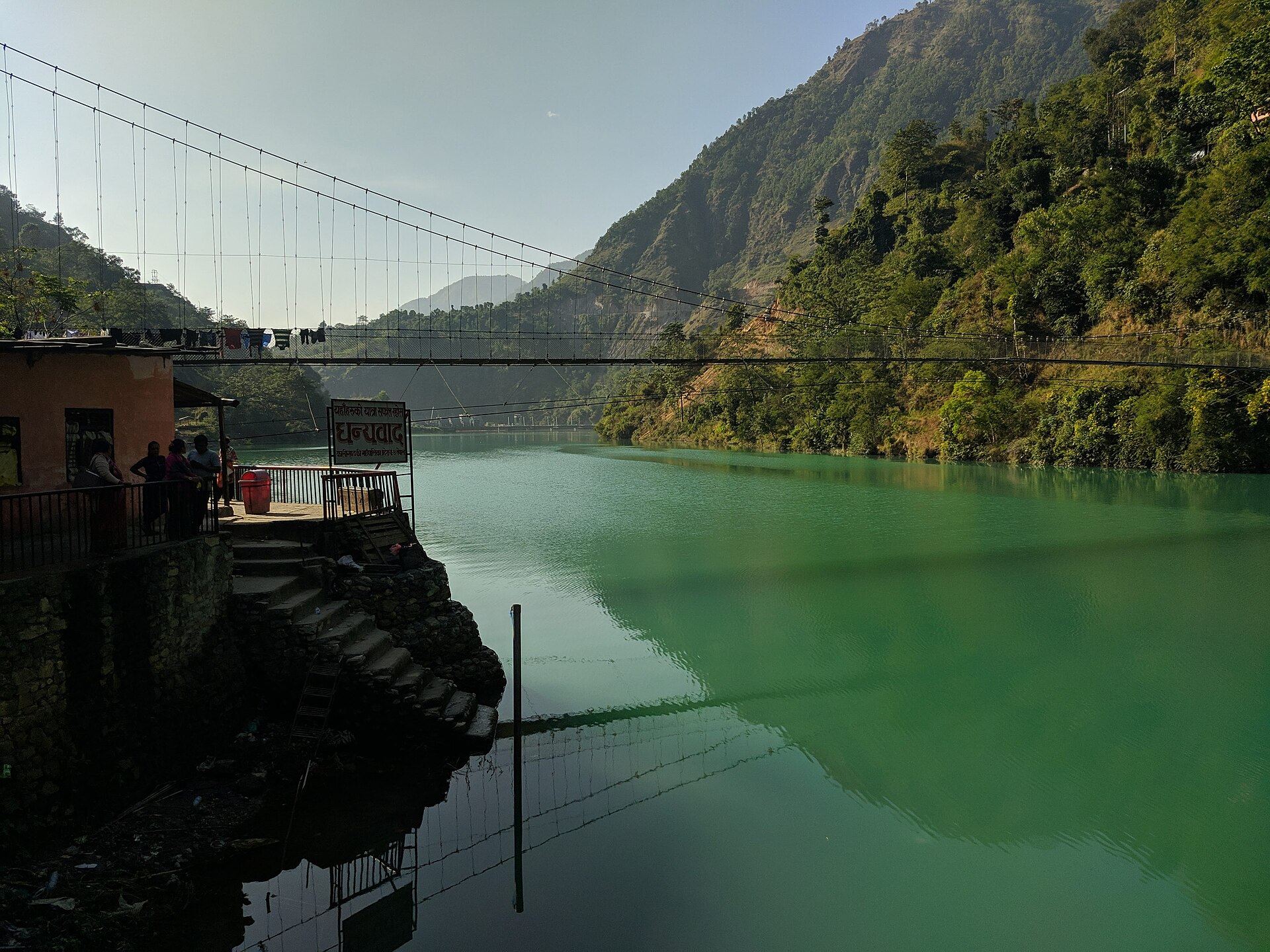
Reference view of the Kali Gandaki A hydropower dam in Nepal’s Syangja district, illustrating the generation infrastructure underpinning Nepal’s electricity-trade potential—not a summit announcement or newly agreed project.
Image: Bhumbdr · CC BY-SA 4.0
Connectivity: linking infrastructure to actual economic use
India-supported railway links connect Jaynagar with Kurtha and Bijalpura, and Jogbani with Nepal Customs Yard in Biratnagar. Proposed extensions and the Raxaul–Kathmandu link could widen passenger and freight connectivity, while pilgrimage-oriented services could strengthen tourism and people-to-people exchanges.
Infrastructure produces lasting benefits only when accompanied by efficient customs, reliable services, last-mile links and maintenance. A bridge, land port or railway should therefore be assessed by its contribution to usable connectivity rather than its inauguration alone.
The Indian Express reports Nepal’s request for additional air routes serving Pokhara and Bhairahawa through Indian airspace, alongside Indian access considerations involving Nepalese airspace near the Siliguri corridor. These discussions require technical coordination on safety, air traffic management and security.
- Rail and border facilities can lower logistical friction and improve market access for firms on both sides.
- Pilgrimage connectivity should be supported by local transport, visitor facilities and environmental management.
- Railway proposals in Himalayan terrain require rigorous geological, financial and ecological appraisal.
Bilateral sensitivities: sovereign equality must shape delivery
The supplied reports record concerns from Nepalese opposition figures about trust, consultation and national interest. These are attributed political assessments, not independently established findings about the entire bilateral relationship. They nevertheless show that the domestic legitimacy of agreements matters alongside their economic rationale.
India’s larger economy and Nepal’s transit dependence create an asymmetrical relationship. Neighbourhood First will be more credible if cooperation is visibly demand-driven, respects Nepal’s policy autonomy and distributes benefits transparently.
Development cooperation cannot substitute for diplomatic engagement on territorial and other outstanding issues. Dedicated dialogue should address disagreements while protecting routine trade, mobility and project implementation from avoidable disruption.
- Consultation should include affected communities and relevant subnational authorities, alongside national governments.
- Public disclosure of financing terms can help distinguish grants, concessional loans and other credit arrangements.
- India should frame partnership around Nepal’s development priorities rather than solely through competition with external powers.
Disaster resilience and human capital: broadening the partnership
Reconstruction support offers an opportunity to connect immediate recovery with safer long-term infrastructure. Himalayan transport and hydropower assets face floods, landslides and seismic risks; rebuilding without risk-sensitive planning could recreate vulnerability.
Start-up mentoring through the India–Nepal Start-up Partnership Network, educational cooperation and sports exchanges can broaden the partnership beyond large infrastructure. These initiatives can make cooperation more visible to young people and smaller enterprises, provided access is transparent and outcomes are evaluated.
- Reconstruction finance should prioritise resilient design, local requirements and sustainable maintenance.
- Shared river systems create a practical case for stronger hydrological information exchange and early-warning coordination.
- Any offshore IIT proposal should be assessed for academic quality, affordability, regulatory feasibility and local demand before commitment.
| Area | Status in supplied reports | Potential gain | Key safeguard |
|---|---|---|---|
| Long-term electricity trade | Existing agreement envisages imports of up to 10,000 MW over ten years | Hydropower market access and diversified electricity supply | Transmission readiness, reliable settlement and ecological safeguards |
| Cross-border rail | Existing India-supported links; additional services anticipated | Passenger mobility, freight access and pilgrimage tourism | Confirm service details and ensure last-mile integration |
| Raxaul–Kathmandu railway | Under discussion | Direct passenger and freight connectivity with Kathmandu | Geological appraisal, financial viability and local consultation |
| Post-flood reconstruction | Nepal reportedly seeks US$ 1–2 billion; terms under discussion | Recovery and resilient infrastructure | Transparent financing and debt sustainability |
| Additional air routes | Requests and technical discussions reported | Potentially shorter routes and lower operating costs | Aviation safety, security and reciprocal coordination |
| Offshore IIT campus | Exploratory proposal | Higher education and skills development | Academic standards, affordability and regulatory clarity |
- 1. Agree on predictable market access and commercially viable power arrangements.
- 2. Develop generation with environmental assessment and community consultation.
- 3. Build cross-border transmission and strengthen domestic evacuation networks.
- 4. Coordinate grid operations, seasonal scheduling and payment settlement.
- 5. Deliver supply benefits and revenues while sharing local development gains.
- 6. Use transparent review and dispute resolution to sustain public trust.
2025
According to The Indian Express, Nepalese start-ups began receiving training through the India–Nepal Start-up Partnership Network.
September 2025
The Hindu reports a Gen Z uprising followed by an interim government in Nepal.
March 2026
Balendra Shah took office as Nepal’s Prime Minister following his party’s election victory.
August 2026
Flash floods in Nepal generated reconstruction needs cited in the reported assistance discussions.
November 22, 2026
Shah arrived in New Delhi and met External Affairs Minister S. Jaishankar.
November 23, 2026
Talks with Prime Minister Narendra Modi, project-related ceremonies and a meeting with President Droupadi Murmu were scheduled.
Significance, challenges & way forward
Significance
- Energy and connectivity cooperation can give Neighbourhood First a tangible development focus rather than leaving it primarily at the level of diplomatic signalling.
- Reliable electricity trade can align Nepal’s hydropower opportunities with India’s demand while supporting investment confidence.
- Railways, bridges and land ports can improve access to markets, services and pilgrimage destinations on both sides.
- Climate-resilient reconstruction can integrate disaster preparedness into the development partnership.
- Education, entrepreneurship and sports cooperation can build constituencies for stable relations beyond governments.
Challenges
- Unresolved bilateral sensitivities can weaken public support even for economically beneficial projects.
- Seasonal river flows, climate hazards and inadequate transmission can constrain dependable electricity trade.
- Land acquisition, difficult terrain, ecological impacts and weak last-mile links can delay or dilute infrastructure benefits.
- The financing mix for reconstruction must balance urgent recovery needs with Nepal’s repayment capacity.
- Announcing proposals before settling feasibility and implementation arrangements can create an expectations–delivery gap.
- Different reported rail-service descriptions underline the need for official confirmation before treating anticipated outcomes as settled facts.
Way forward
- Publish an outcome-based implementation framework distinguishing completed projects, signed commitments, feasibility studies and exploratory proposals.
- Coordinate generation, transmission and power-market arrangements so that electricity-trade ambitions are supported by operational capacity.
- Adopt joint monitoring with clear responsibilities, transparent procurement and accessible grievance mechanisms.
- Design reconstruction assistance around Nepal’s priorities, debt sustainability and resilient public infrastructure.
- Pair physical connectivity with customs facilitation, service reliability, maintenance and local economic linkages.
- Maintain dedicated diplomatic channels for outstanding issues while respecting sovereign equality and avoiding coercive linkage with routine cooperation.
- Institutionalise consultation and transparent benefit-sharing to sustain support across political transitions.
Key terms
- Neighbourhood First
- India’s policy approach prioritising relations, development cooperation and connectivity with neighbouring countries.
- Cross-border electricity trade
- The purchase and sale of electricity across national boundaries through interconnected grids and agreed commercial rules.
- Run-of-river hydropower
- Hydroelectric generation relying mainly on river flows, with limited storage for shifting output across seasons.
- Evacuation infrastructure
- Transmission facilities that carry electricity from generating stations to the grid and consumers.
- Line of credit
- A financing arrangement allowing borrowing up to an agreed limit under specified conditions; it is not a grant.
- Sovereign equality
- The principle that states possess equal sovereign status irrespective of differences in size or economic power.
- Land port
- A border facility providing infrastructure for cross-border movement of goods and passengers, including customs and related services.
Link with static syllabus
Prelims practice MCQs
Q1. With reference to India–Nepal electricity cooperation described in the supplied reports, consider the following statements: 1. The long-term power trade agreement envisages Indian imports of up to 10,000 MW from Nepal over ten years. 2. MW is a unit of annual electrical energy traded. 3. Expansion of cross-border transmission capacity is part of the reported cooperation. Which of the statements given above are correct?
Q2. Consider the following pairs of railway locations and Indian states: 1. Raxaul — Bihar 2. Jaynagar — Bihar 3. Jogbani — Uttarakhand How many of the pairs given above are correctly matched?
Q3. With reference to hydropower and cross-border electricity trade, consider the following statements: 1. Run-of-river projects may experience seasonal variations in electricity generation. 2. Additional generation capacity alone guarantees an equivalent increase in cross-border electricity trade. Which of the statements given above is/are correct?
Q4. Regarding development finance, consider the following statements: 1. A line of credit is necessarily a non-repayable grant. 2. The grant–loan composition of an assistance package affects its implications for debt sustainability. 3. A request for assistance does not by itself establish a commitment by the prospective financing country. Which of the statements given above are correct?
Mains practice questions
GS 2 · 15 marks · 250 words
Cross-border electricity trade and connectivity can strengthen India’s Neighbourhood First policy only when accompanied by trust and sovereign equality. Discuss with reference to India–Nepal relations.
Frequently asked questions
What was the principal focus of the India–Nepal summit agenda?
The reported agenda centred on energy, rail and other connectivity, development cooperation and disaster resilience. An economic vision document and additional education, technology and sports initiatives were also under consideration.
Did the summit approve US$ 1–2 billion in assistance to Nepal?
The supplied reports do not establish such approval. They describe Nepal’s reported request and anticipated discussions on grants, loans and lines of credit.
Why is electricity trade strategically important?
It can provide Nepal with a market for hydropower and India with an additional electricity source. Its reliability depends on transmission, seasonal availability, commercial rules and environmental safeguards.
Which new passenger train service was confirmed?
No final confirmation appears in the supplied material. The Hindu mentions an expected Janakpur–Gorakhpur connection, while The Indian Express describes an anticipated Ayodhya–Janakpur Dham service.
Sources
- The Hindu: Nepal PM Balendra Shah arrives in Delhi for first official visit to India
- The Hindu: Nepal PM India visit LIVE: Balen Shah begins bilateral visit; energy, connectivity on agenda
- Indian Express: PM Modi, Balendra Shah meet today: Focus on economic and energy ties
- Indian Express: Strained ties, visits and a meet in August: How Nepal came around, planned Balen Shah visit
Analysis prepared by the Pragnya IAS Academy current-affairs desk with AI assistance from the cited reports. Verify figures with the original sources.
Turn current affairs into marks
Join Pragnya IAS Academy's mentorship for daily answer-writing evaluation on stories like this — classroom programmes from a trusted name in IAS coaching in Hyderabad.