
India’s Ageing Population: Building a Skilled, Gender-Sensitive Care Economy
Revise the static topic: UPSC Social Justice notes
In short: The supplied report highlights the Budget 2026–27 announcement to train 1.5 lakh caregivers aligned with the National Skills Qualifications Framework, against a projected elderly population of 347 million by 2050. India needs to combine professional training with recognition of unpaid family caregivers, gender-sensitive social protection and affordable community-based services rather than treat elderly care as a private household responsibility.
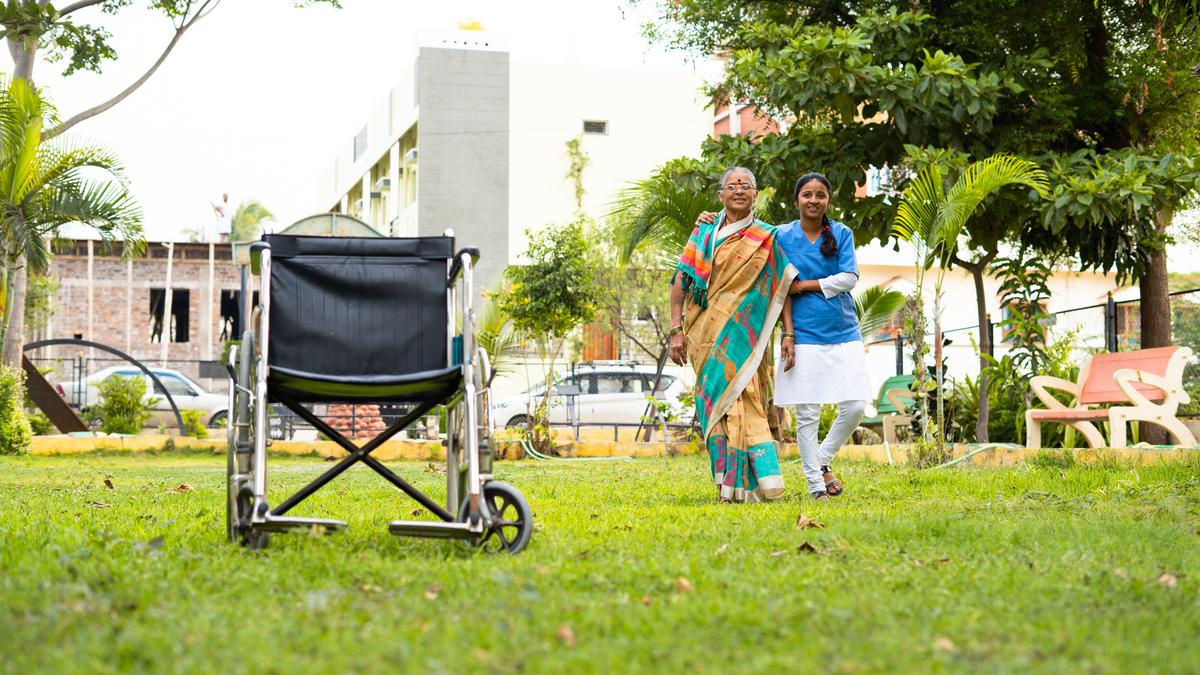
Reference image on elderly care in India. A skilled, gender-sensitive care economy requires professional training, recognition of unpaid caregivers and affordable community-based services.
Image: The Hindu
Why in news
The Hindu examines the caregiver-training announcement alongside NITI Aayog’s August 2026 report, “Reimagining Care: Strategies for Empowering Caregivers in Viksit Bharat@2047”. The discussion places workforce development and recognition of unpaid care at the centre of India’s response to demographic ageing.
149 million
Estimated population aged 60-plus in 2022
347 million
Projected population aged 60-plus by 2050
20.8%
Projected elderly share of population by 2050
1.5 lakh
Caregiver-training target announced in Budget 2026–27
838
K4 Care course completions reported by the source
Background
Population ageing results from changes in fertility, mortality and longevity that increase the relative importance of older age groups. Elderly care extends beyond medical treatment to assistance with daily living, rehabilitation, emotional support and protection from neglect. Families remain important providers, but household fragmentation and migration can weaken the availability of continuous support. Article 41 directs the State, within its economic capacity and development, to make effective provision for public assistance in old age, while Article 47 places improvement of public health among its primary duties. The Maintenance and Welfare of Parents and Senior Citizens Act, 2007 provides a statutory framework for maintenance and welfare, but family obligations cannot substitute for an accessible care-service system.
Policy shift: From household obligation to an economic activity
According to the supplied report, Budget 2026–27 announced training for 1.5 lakh caregivers aligned with the National Skills Qualifications Framework. The source also describes NITI Aayog’s August 2026 report as framing caregiving as an economic activity rather than merely welfare work.
This approach recognises that care requires skills, time and institutional support. However, an announced training target is not evidence of completed training, employment or service availability. Similarly, the National Caregiver Council discussed in the report is envisaged, not established on the evidence supplied.
- Workforce policy must connect training with certification, decent employment and affordable services.
- Unpaid family caregivers need recognition and support alongside the expansion of paid care.
- Care demand must be assessed through functional needs, not age alone; older persons are not a uniformly dependent group.
Infographic
Skilled care
Practical training, certification and clinical referral boundaries
Recognised unpaid care
Prior-learning assessment, counselling and respite
Gender equality
Shared responsibilities and men’s participation
Accessible services
Affordable home and community support with offline access
Decent work
Fair remuneration, safety and social protection
Accountable delivery
Quality monitoring, privacy and grievance redress
AI-assisted infographic by Pragnya IAS Academy, based on the cited sources.
Training priorities: Safe care, mental health and clinical boundaries
Informal caregivers often learn through crises rather than structured instruction. A national curriculum should cover assistance with daily living, safe mobility, observation of warning signs, medication-support routines, emergency response and referral. Training must clarify that caregivers assist with prescribed care and do not independently diagnose illness or alter treatment.
The source stresses the emotional and behavioural dimensions of conditions such as Alzheimer’s disease and Parkinson’s disease. Communication, dementia-sensitive care, psychological support and caregiver wellbeing should therefore accompany physical-care protocols.
- Use supervised practical assessment rather than attendance-based certification alone.
- Include consent, privacy, dignity and recognition of elder abuse in training.
- Provide local-language modules and refresher training for both professional and family caregivers.
- Offer recognition of prior learning while assessing actual competence and addressing skill gaps.
Gender justice: Recognise, reduce and redistribute unpaid care
The source describes a disproportionate care burden on women within smaller households. When care remains invisible, its costs are absorbed through lost earnings, reduced rest and constrained participation in education or employment. Training women alone, without changing responsibility-sharing, could professionalise the task while preserving its unequal distribution.
A gender-sensitive approach should recognise unpaid work, reduce avoidable drudgery through accessible services and redistribute responsibilities among men, women, communities, employers and the State. The source’s suggestion of training more than one family member offers a practical route towards shared responsibility.
- Encourage men’s participation in both family caregiving and professional care occupations.
- Provide respite services so that family caregivers can rest, work or attend to their own health.
- Explore caregiver-sensitive social protection without treating continued unpaid care as women’s default duty.
- Ensure that care-sector employment offers fair remuneration, safe conditions and grievance redress.
Delivery architecture: Build on local institutions without overburdening them
The source identifies Kerala’s Kudumbashree K4 Care programme and elderly-care training for ASHA workers as existing entry points. K4 Care was launched in February 2024; the source reports 838 course completions. It also notes that the National Health Systems Resource Centre has prepared an elderly-care training manual for ASHAs, but publicly available granular information on training completion is lacking.
These initiatives offer potential platforms for expansion, not proof of a nationally validated model. Appropriately trained personnel could support a trainer network, provided additional responsibilities are accompanied by supervision, remuneration and workload safeguards. ASHAs should not be treated as substitutes for a dedicated long-term care workforce.
An envisaged National Caregiver Council could help standardise curricula, certification and a caregiver registry. Such an arrangement would still require clear legal authority, coordination with States and local institutions, data-protection safeguards and effective complaint mechanisms.
- Integrate home-based support with primary healthcare, rehabilitation and hospital referral.
- Provide assisted offline access alongside any digital caregiver portal.
- Assess affordability and rural access before treating workforce expansion as service expansion.
- Measure care quality, retention and user experience, not certification totals alone.
| Care provider | Core contribution | Required support and safeguards |
|---|---|---|
| Unpaid family caregiver | Daily assistance, companionship and continuity of care | Basic training, respite, referral support and recognition of acquired skills |
| Trained paid caregiver | Competency-based personal care and observation within a defined role | Fair pay, certification, supervision and worker protection |
| Community health worker | Community outreach, health-system linkage and appropriate referral | Role clarity, additional training and protection against workload expansion without support |
| Clinical professional | Diagnosis, treatment and clinical management | Clear referral pathways and coordination with caregivers |
| Public institutions and local bodies | Access planning, financing, oversight and grievance redress | Adequate resources, accountability and participation of older persons |
- 1. Assess the older person’s functional needs and the household’s care burden.
- 2. Identify existing caregiver skills and training gaps.
- 3. Deliver accessible training with supervised practical assessment.
- 4. Certify competencies and connect caregivers with suitable work or family-support services.
- 5. Link care delivery to clinical referral, respite and social protection.
- 6. Review safety, affordability, worker conditions and the older person’s experience.
2007
The Maintenance and Welfare of Parents and Senior Citizens Act established a statutory framework for maintenance and welfare.
2022
India’s population aged 60-plus was estimated at approximately 149 million, according to the source.
February 2024
Kudumbashree launched the K4 Care training programme in Kerala.
Budget 2026–27
Training of 1.5 lakh caregivers aligned with the National Skills Qualifications Framework was announced, as reported in the source.
August 2026
The cited NITI Aayog report framed caregiving as an economic activity and envisaged a National Caregiver Council.
2050
India’s population aged 60-plus is projected to reach 347 million, or roughly 20.8% of the population; this is a projection, not an observed outcome.
Significance, challenges & way forward
Significance
- A trained workforce can improve the safety and continuity of assistance while enabling earlier recognition of warning signs.
- Recognising unpaid care makes household contributions visible and strengthens the case for caregiver support.
- Shared care responsibilities can expand women’s choices regarding employment, education and rest.
- Community-based services can support older persons who prefer to remain in familiar surroundings.
- Formal care-sector development can create skilled employment while strengthening social infrastructure.
Challenges
- The reported training target is limited relative to the scale of ageing and informal caregiving, although age alone cannot determine staffing requirements.
- Certification without practical assessment and supervision may fail to improve care quality.
- Low-income households may remain excluded if services depend predominantly on out-of-pocket payment.
- Expanding care work through women’s groups without fair remuneration may reproduce gender inequality.
- Additional duties for ASHAs could weaken existing services unless staffing, remuneration and workload are addressed.
- Fragmented information on training completion, care needs and service outcomes constrains planning.
- Home-based care requires safeguards against neglect, abuse and violations of privacy.
Way forward
- Develop a needs-based care strategy that distinguishes population ageing from functional dependency and maps local service gaps.
- Adopt competency-based curricula covering physical assistance, mental health, safeguarding and referral boundaries.
- Recognise prior learning among family caregivers through accessible assessment and bridge training.
- Combine workforce expansion with affordable home-care, day-care and respite options, prioritising underserved households.
- Promote shared household responsibilities and men’s participation instead of equating caregiving with women’s work.
- Link professionalisation to fair remuneration, safe workplaces, social protection and credible grievance redress.
- Evaluate existing initiatives before scaling them and publish training, placement, retention and quality outcomes.
- If a national coordinating body is established, define its mandate clearly and preserve State-level flexibility and accessible offline services.
Key terms
- Demographic ageing
- An increase in the share of older persons in a population.
- Care economy
- Paid and unpaid activities that support people’s daily needs, wellbeing and capabilities.
- Long-term care
- Sustained assistance for people with continuing limitations in everyday functioning.
- Activities of daily living
- Basic self-care tasks such as bathing, dressing, eating and using the toilet.
- Respite care
- Temporary substitute care that gives the usual caregiver a break.
- Recognition of prior learning
- Assessment and recognition of skills acquired through experience or informal learning.
- National Skills Qualifications Framework
- A competency-based framework that organises qualifications according to learning outcomes.
- Ageing in place
- Remaining in one’s home or community as one grows older, with appropriate support.
Link with static syllabus
Prelims practice MCQs
Q1. With reference to constitutional provisions relevant to elderly welfare, consider the following statements: 1. Article 41 refers to public assistance in old age within the limits of the State’s economic capacity and development. 2. Article 47 places improvement of public health among the primary duties of the State. 3. Directive Principles of State Policy are directly enforceable by courts. Which of the statements given above are correct?
Q2. Consider the following pairs: 1. Kudumbashree — Kerala-based mission associated with self-help groups 2. National Health Systems Resource Centre — Elderly-care training manual for ASHA workers 3. Recognition of prior learning — Recognition restricted to formal classroom education How many of the above pairs are correctly matched?
Q3. Which of the following best describes respite care?
Q4. With reference to planning an elderly-care workforce, consider the following statements: 1. Functional dependency is relevant to estimating care requirements. 2. A caregiver-training target, by itself, establishes that affordable services are available to all households. 3. Training family members of different genders can support redistribution of unpaid care. Which of the statements given above are correct?
Mains practice questions
GS 2 · 15 marks · 250 words
India’s demographic ageing requires more than an expansion of caregiver training. Examine the role of unpaid-care recognition, gender-sensitive social protection and accessible services in building an elderly-care ecosystem.
Frequently asked questions
Why does India need formally trained elderly caregivers?
Population ageing increases the importance of reliable support for daily living, cognitive difficulties and continuing care needs. Formal training can improve safety and referral while reducing dependence on trial-and-error learning.
Does recognising unpaid caregivers mean paying every family member a salary?
No. Recognition can include assessment of existing skills, training, counselling, respite services and appropriate social-protection support; payment arrangements are a separate policy choice.
Has the National Caregiver Council already been established?
The supplied source describes it as envisaged in the cited NITI Aayog report. It does not establish that the Council has been constituted or is operational.
How is elderly-care policy connected to gender equality?
Unequal unpaid-care responsibilities can restrict women’s employment, education and rest. Shared responsibilities, accessible services and decent paid-care jobs can reduce this disadvantage.
Sources
Analysis prepared by the Pragnya IAS Academy current-affairs desk with AI assistance from the cited reports. Verify figures with the original sources.
Turn current affairs into marks
Join Pragnya IAS Academy's mentorship for daily answer-writing evaluation on stories like this — classroom programmes from a trusted name in IAS coaching in Hyderabad.