
India’s Indigenous H5N1 Poultry Vaccine: Evidence, Biosecurity and One Health
Revise the static topic: UPSC Social Justice notes · UPSC Science & Technology notes
In short: Scientists at ICAR-NIHSAD, Bhopal, have developed India’s first indigenous H5N1 vaccine for chickens, targeting clade 2.3.2.1a, which has caused a majority of Indian chicken outbreaks since 2011. Researchers reported complete protection against the targeted clade during experimental observation after booster vaccination, but commercial availability awaits technology transfer and manufacturing arrangements. Its importance lies in protecting poultry livelihoods and potentially reducing zoonotic exposure, not in directly immunising humans.
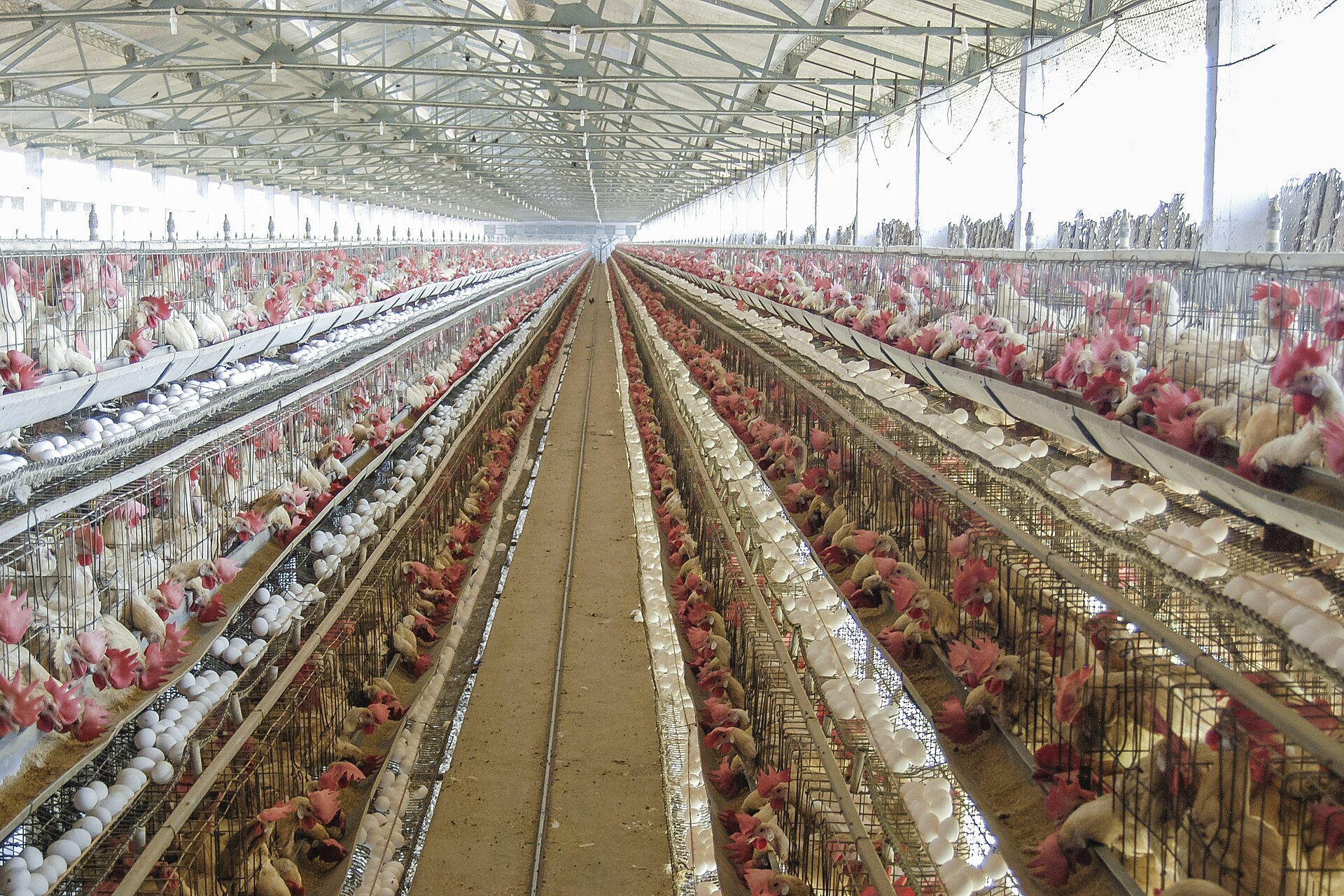
Reference view of a poultry farm in Namakkal, Tamil Nadu. India’s indigenous H5N1 vaccine is intended to protect chickens, while surveillance and farm biosecurity remain essential.
Image: Matthew T Rader · CC BY-SA 4.0
Why in news
Union Agriculture Minister Shivraj Singh Chouhan announced the vaccine in Bhopal on November 20. The development brings attention to strain-matched animal vaccination, the limits of experimental evidence and the need to integrate vaccination with surveillance and poultry biosecurity.
Rs 1–2
Reported vaccine price per dose
More than 500
Indian outbreaks reported since 2006
100%
Reported experimental protection against target clade
24 weeks
Observation period after booster vaccination
2006
India’s first reported bird-flu outbreak
Background
Avian influenza is an infection caused by influenza A viruses that primarily affects birds, although some strains can infect mammals, including humans. H5N1 denotes a viral subtype based on its haemagglutinin and neuraminidase surface proteins; a clade identifies a genetic lineage within that subtype. India’s first reported bird-flu outbreak occurred in Navapur, Maharashtra, in 2006. Poultry outbreaks threaten farm incomes, production and occupational health, making their control relevant to both animal husbandry and public health. ICAR-NIHSAD in Bhopal specialises in the diagnosis, surveillance and research of high-risk animal diseases.
What has been developed and whom it protects
The indigenous vaccine targets H5N1 clade 2.3.2.1a, responsible for a majority of bird-flu outbreaks in Indian chickens since 2011. Its intended beneficiaries are chickens, particularly layers raised for egg production and growers being raised towards maturity.
The achievement is primarily one of matching a vaccine to a viral lineage circulating in India. The source does not frame it as ending dependence on imported animal vaccines, nor does it establish protection against every H5N1 lineage.
The reported price is Rs 1–2 per dose. However, the vaccine is not yet commercially available to farmers: technology transfer to manufacturers and arrangements involving the Department of Animal Husbandry and Dairying remain necessary.
- This is a poultry vaccine, not a vaccine intended for human administration.
- Protection against clinical disease and deaths could reduce losses and production disruptions.
- Affordability at the dose level does not by itself establish the total cost of delivering a vaccination programme.
Infographic
Targeted protection
Chicken vaccine against H5N1 clade 2.3.2.1a.
Evidence limits
Post-booster experimental results require field validation.
Surveillance
Track circulating viruses, vaccine match and breakthrough infection.
Biosecurity
Prevent pathogen entry and spread within poultry systems.
One Health
Connect animal, human and wildlife risk monitoring.
Responsible rollout
Secure technology transfer, quality and equitable access.
AI-assisted infographic by Pragnya IAS Academy, based on the cited sources.
Development and trial evidence: promising but bounded
NIHSAD’s work on circulating strains, viral evolution and cross-species infection provided the research setting for vaccine development. Scientists worked under strict biosafety protocols intended to prevent laboratory-associated exposure and escape of infection.
According to the researchers, the vaccine passed safety, efficacy and potency tests under prescribed World Organisation for Animal Health guidelines. Experimental trials reportedly showed 100% protection against the targeted clade throughout the 24-week observation period following booster vaccination.
Vaccinated chickens reportedly did not transmit the virus to unvaccinated contact birds in the trials. These findings are important, but the source does not provide the number of birds, detailed trial design or commercial-farm performance. Compliance with testing guidelines should not be confused with a claim of WOAH marketing approval.
- The 24-week result describes the observed post-booster period, not proven lifelong protection.
- Experimental protection cannot automatically be equated with identical effectiveness across farms.
- The reported contact-trial result does not establish universal elimination of transmission under all field conditions.
Why surveillance and biosecurity remain indispensable
Influenza viruses evolve, making continued genetic and antigenic surveillance necessary to assess whether circulating viruses remain well matched to the vaccine. Surveillance must also detect outbreaks in vaccinated as well as unvaccinated populations rather than treating vaccination status as proof of freedom from infection.
Farm-level protection requires barriers against introduction and spread of infection: controlled entry, cleaning and disinfection, separation from wild birds, safe carcass disposal and prompt investigation of unusual mortality. Vaccination should complement these measures and outbreak-response protocols, not replace them.
- Publish detailed trial evidence and assess performance under commercial and backyard production conditions.
- Monitor disease, viral circulation and transmission after deployment, not merely the number of doses administered.
- Link laboratory findings to decisions on vaccine matching and outbreak response.
One Health: animal vaccination as upstream risk reduction
The source reports infections involving the same clade in several mammalian species in 2025. It also attributes reports of three human deaths involving this clade in Haryana, Andhra Pradesh and Karnataka to the lead scientist. These observations underline the importance of monitoring the animal–human interface; they do not by themselves establish sustained human-to-human transmission.
The vaccine’s potential public-health benefit is indirect: reducing viral circulation in poultry could reduce exposure among people handling infected birds and limit environmental contamination. This is risk reduction, not a guarantee that a human pandemic will be prevented.
A One Health response connects veterinary services, public-health authorities, wildlife agencies and environmental surveillance. Shared alerts and coordinated investigations are especially important where poultry outbreaks coincide with mammalian illness or human exposure.
- Protect poultry workers through safe handling practices, appropriate protective equipment and timely evaluation after exposure.
- Investigate unusual wildlife and mammalian mortality alongside poultry outbreaks.
- Communicate clearly that animal vaccination does not confer immunity on people.
| Aspect | Reported finding | Interpretation limit |
|---|---|---|
| Intended use | Protection of chickens, particularly layers and growers | Not a human vaccine |
| Viral target | H5N1 clade 2.3.2.1a | Protection against all H5N1 clades is not established |
| Experimental protection | 100% protection during 24 weeks after booster vaccination | Not proof of lifelong protection or identical field effectiveness |
| Transmission | No transmission from vaccinated to unvaccinated contact chickens in trials | Not proof that transmission will cease under every farm condition |
| Testing | Safety, efficacy and potency tests under prescribed WOAH guidelines | Not a reported WOAH marketing approval |
| Availability | Technology transfer is the next step | Announcement does not mean commercial access has begun |
- 1. Surveillance identifies circulating poultry viruses and assesses vaccine match.
- 2. Quality-assured vaccination is administered alongside farm biosecurity.
- 3. Protection against the targeted virus reduces poultry disease and may limit transmission.
- 4. Lower viral circulation can reduce contamination and human exposure.
- 5. Joint animal–human surveillance detects breakthrough infections and emerging risks.
2006
India’s first reported bird-flu outbreak occurred in Navapur, Maharashtra.
Since 2011
H5N1 clade 2.3.2.1a has been responsible for a majority of outbreaks in Indian chickens.
2025
According to the lead scientist, outbreaks involving the same clade were reported in several mammalian species.
November 20, 2026
The indigenous H5N1 chicken vaccine developed at ICAR-NIHSAD was announced in Bhopal.
Significance, challenges & way forward
Significance
- A vaccine matched to a major Indian poultry lineage offers a targeted tool against recurring outbreaks.
- Protection of layers and growers could safeguard farm incomes and continuity of poultry production.
- The reported low per-dose price creates scope for affordable access, subject to manufacturing and delivery arrangements.
- Indigenous development strengthens the connection between domestic surveillance, laboratory research and animal-health interventions.
- Reducing infection at the animal source could lower opportunities for zoonotic spillover.
Challenges
- The source provides limited trial-design details, constraining independent assessment of the reported protection.
- Commercial-farm effectiveness and performance across diverse production settings remain to be established.
- Viral evolution may alter vaccine matching and requires sustained surveillance.
- Technology transfer, manufacturing quality and distribution must be secured before farmers can benefit.
- A low dose price may coexist with additional administration, booster and monitoring costs.
- False reassurance after vaccination could weaken reporting, biosecurity and vigilance for infection.
Way forward
- Publish detailed safety, efficacy and transmission-study data, including trial design and duration of follow-up.
- Facilitate technology transfer with clear quality-control requirements and transparent information on availability.
- Undertake monitored field evaluation before assuming laboratory results will be reproduced across poultry systems.
- Maintain genetic and antigenic surveillance to detect changes in circulating viruses and guide vaccine updates.
- Integrate vaccination with farm biosecurity, prompt reporting, diagnostic testing and prescribed outbreak-control measures.
- Create operational links among animal husbandry, public health and wildlife authorities for shared alerts and joint investigations.
- Ensure small and backyard poultry keepers can access reliable information, veterinary support and affordable delivery.
Key terms
- H5N1
- An influenza A virus subtype identified by haemagglutinin type 5 and neuraminidase type 1 surface proteins.
- Clade
- A genetic group sharing common ancestry; here, 2.3.2.1a identifies a lineage within H5N1.
- Highly pathogenic avian influenza
- A classification based on specified pathogenicity criteria in poultry, not a direct measure of severity in humans.
- Booster vaccination
- A subsequent vaccine dose intended to reinforce the immune response generated by earlier vaccination.
- Biosecurity
- Measures designed to prevent the introduction and spread of infectious agents.
- Zoonotic spillover
- Transmission of a pathogen from an animal source to humans.
- One Health
- An integrated approach recognising the interdependence of human, animal and ecosystem health.
- Efficacy and effectiveness
- Efficacy concerns performance under controlled study conditions, while effectiveness concerns performance in real-world use.
Link with static syllabus
Prelims practice MCQs
Q1. With reference to India’s indigenous H5N1 vaccine developed at ICAR-NIHSAD, consider the following statements: 1. It is intended for administration to humans exposed to infected poultry. 2. It targets H5N1 clade 2.3.2.1a. 3. It was commercially available to farmers at the time described in the source. Which of the statements given above is/are correct?
Q2. Consider the following statements about the reported experimental findings for the indigenous H5N1 poultry vaccine: 1. The 24-week observation period followed booster vaccination. 2. The findings establish lifelong protection against all H5N1 clades. 3. Vaccinated chickens reportedly did not transmit the virus to unvaccinated contact birds in the trials. Which of the statements given above are correct?
Q3. With reference to influenza terminology, consider the following pairs: 1. H5N1: An influenza A subtype identified by surface proteins 2. Clade: A genetic grouping sharing common ancestry 3. Layers: Chickens raised primarily for egg production How many of the pairs given above are correctly matched?
Q4. Which of the following best illustrates a One Health approach to avian influenza?
Mains practice questions
GS 3 · 15 marks · 250 words
India’s indigenous H5N1 poultry vaccine is an important disease-control tool, but not a stand-alone solution. Discuss with reference to surveillance, biosecurity and One Health.
Frequently asked questions
Is India’s indigenous bird-flu vaccine meant for humans?
No. It is intended for chickens, particularly layers and growers; any human-health benefit would be indirect, through reduced viral circulation and exposure.
Does the reported 100% protection mean bird flu can now be eliminated?
No. The figure relates to experimental protection against the targeted clade during a 24-week observation period after booster vaccination, not proof of universal field protection or elimination.
Can poultry farmers purchase the vaccine immediately?
The source states that it is not yet commercially available. Technology transfer and manufacturing arrangements must precede farmer access, and no definite availability date is provided.
Why is surveillance necessary after vaccination?
Surveillance is needed to detect infection, monitor viral evolution and assess whether circulating strains remain matched to the vaccine. Vaccination does not remove the need for biosecurity or outbreak reporting.
Sources
Analysis prepared by the Pragnya IAS Academy current-affairs desk with AI assistance from the cited reports. Verify figures with the original sources.
Turn current affairs into marks
Join Pragnya IAS Academy's mentorship for daily answer-writing evaluation on stories like this — classroom programmes from a trusted name in IAS coaching in Hyderabad.