
India’s Satellite Supply Chain: Import Dependence and the Next Phase of Space Reforms
Revise the static topic: UPSC Science & Technology notes
In short: An IN-SPACe report finds that India’s satellite manufacturing supply chain remains highly dependent on imported critical components, with limited testing infrastructure and long procurement delays. Strengthening component manufacturing, qualification capabilities and predictable demand is essential to convert India’s space-sector opening into technological autonomy and export competitiveness.
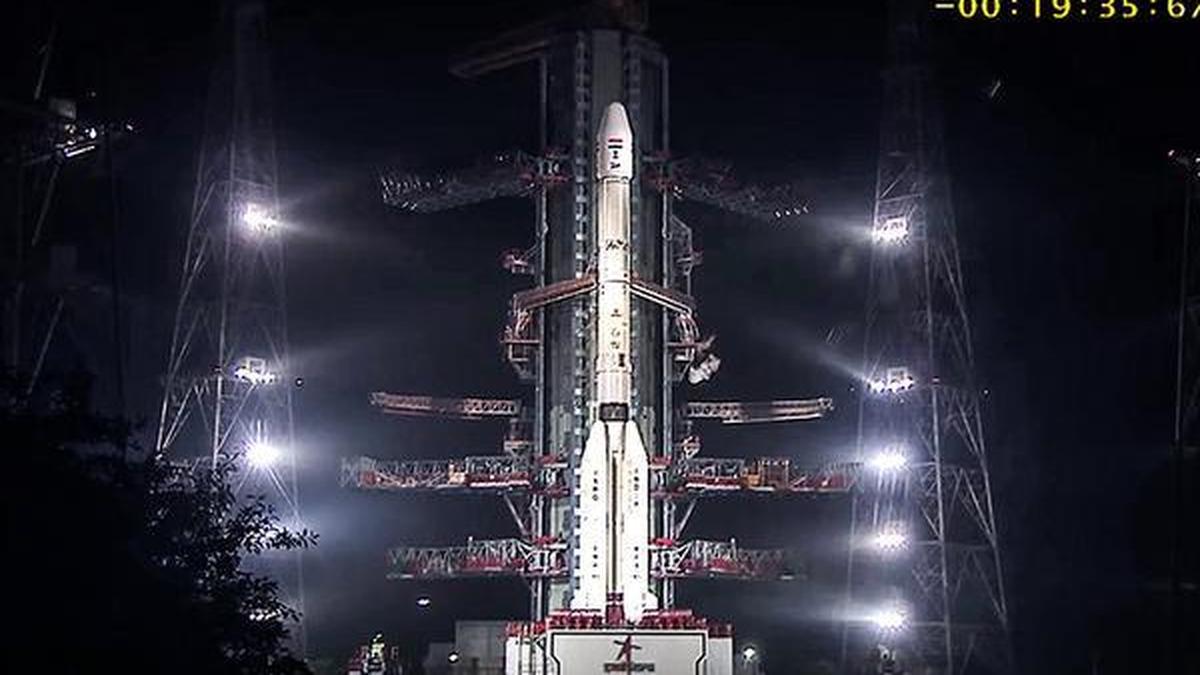
India’s satellite supply chain remains highly dependent on imported critical components, according to an IN-SPACe report.
Image: The Hindu
Why in news
IN-SPACe’s report, The Supply Chain Landscape of Satellite Manufacturing in India, highlights gaps in domestic satellite manufacturing. Its findings sharpen the debate on reforms needed to support the government’s projected expansion of India’s space economy.
Nearly $9 billion
Current space economy, as stated by the Minister
$40–45 billion
Projected space economy in less than a decade
Nearly 60%
Satellite costs attributed to EEE components and specialised materials
12–16 months
Frequent procurement lead time for critical components
53
Indian suppliers listed in the report
162
Foreign suppliers listed in the report
Background
A satellite combines a mission-specific payload with a platform providing functions such as power, propulsion, communication, thermal control and attitude control. Building a complete satellite therefore requires more than final assembly: it depends on reliable components, specialised materials, systems engineering and qualification facilities. India’s space-sector framework combines ISRO’s research and mission capabilities, IN-SPACe’s role in promoting and authorising non-governmental space activities, and NewSpace India Limited’s commercial role. The central industrial challenge is to deepen domestic capability across this value chain rather than equate satellite assembly with technological self-reliance.
What the report establishes—and what it does not
The report describes India’s satellite supply chain as highly dependent on imports for critical components. It identifies structural assemblies and propulsion components as areas of existing supply capability, while noting that established public-sector and long-standing private firms dominate much of the supplier base.
Electronic, electrical and electromechanical components, together with specialised materials, account for nearly 60% of satellite costs; many of these inputs are imported. This is a cost-composition figure, not a finding that imports constitute 60% of every Indian satellite.
The document is a descriptive supply-chain map, not a statistical survey. Its listing of 53 Indian and 162 foreign suppliers helps identify available capabilities, but cannot establish market shares, procurement volumes or an exact import-dependence ratio.
- The foreign suppliers listed include companies from the United States, Germany, Japan, France and the Netherlands.
- The report identifies opportunities in low-cost small satellites, advanced communication payloads and high-resolution imaging systems.
- The projected expansion of the space economy is an opportunity, not evidence that domestic component capabilities have already reached the required scale.
Infographic
Critical components
Prioritise mission-critical inputs with limited substitutes.
Assured quality
Expand testing, qualification and process traceability.
Predictable demand
Create credible orders that justify production investment.
Finance and skills
Support development cycles and specialised technical talent.
Global integration
Combine technology partnerships, diversified sourcing and exports.
AI-assisted infographic by Pragnya IAS Academy, based on the cited sources.
Why critical components are the strategic bottleneck
Space hardware must operate reliably under demanding conditions, including launch vibration, vacuum, temperature variation and radiation. A component’s suitability therefore depends not merely on its design or manufacture, but also on materials, process consistency, traceability and qualification.
Import dependence becomes strategically significant when a difficult-to-substitute component can hold up an entire satellite. The report records procurement periods frequently extending to 12–16 months, delaying projects and reducing responsiveness to market opportunities.
The policy objective should be selective technological autonomy, not indiscriminate import substitution. Components should be prioritised according to mission criticality, availability of alternatives, procurement delays and the feasibility of competitive domestic production.
- Domestic satellite integration does not automatically imply domestic control over the underlying component supply chain.
- Strategic resilience requires qualified alternative suppliers, not merely a larger number of unverified vendors.
- International collaboration and diversified sourcing can complement domestic manufacturing rather than contradict it.
Manufacturing, testing and skills gaps reinforce each other
The report finds that many firms operate through project-based manufacturing. Uncertain follow-on orders weaken incentives to invest in automation, dedicated production capacity and long-term supplier development.
Limited testing and certification facilities constrain the demonstration of reliability and weaken prospects for acceptance in global markets. Domestic production alone is therefore insufficient: buyers must also be able to verify that products meet demanding technical requirements.
Shortages in satellite systems engineering, quality assurance, testing and qualification are compounded by limited private-sector research and development and technology transfer. These constraints require an ecosystem response rather than support for individual satellite assemblers alone.
- Shared testing facilities can reduce duplicated investment and improve access for smaller firms.
- Industry-linked training should cover manufacturing quality and qualification, alongside satellite design.
- Technology transfer must be accompanied by process know-how, supplier readiness and the ability to reproduce quality consistently.
The next phase of reforms: demand, finance and predictable procedures
At the India International Space Conclave, IN-SPACe Chairman Pawan Goenka emphasised demand creation, finance and procedures as priorities after the initial opening of the sector. The analytical implication is clear: permission to participate does not, by itself, create a commercially viable manufacturing ecosystem.
Predictable procurement and service-purchase opportunities can help firms justify investment in qualified production lines. Finance should address the long development and validation cycles of space hardware, while procedural clarity should reduce uncertainty without diluting safety or reliability requirements.
The report envisages a transition from satellite assembly towards exports of systems, subsystems, space-grade components and turnkey solutions. Achieving this requires coordinated policy interventions, strategic investment and international collaboration; it is not an automatic outcome of market growth.
- Aggregate public demand where technically feasible and use transparent, competitive procurement.
- Support component development through milestones linked to testing, qualification and customer adoption.
- Facilitate access to suitable public infrastructure and clarify procedures for private firms.
- Assess progress through qualified domestic products and sustained orders, not company counts alone.
| Institution | Core role | Relevance to the supply chain |
|---|---|---|
| IN-SPACe | Autonomous body under the Department of Space promoting and authorising non-governmental space activities | Facilitates private participation and identifies ecosystem gaps. |
| ISRO | National space agency undertaking space research, technology development and missions | Provides technical expertise and opportunities for technology transfer and access to infrastructure. |
| NewSpace India Limited | Public-sector enterprise under the Department of Space with a commercial mandate | Supports commercialisation of space products and services. |
- 1. Map mission-critical imports and identify components with limited alternative suppliers.
- 2. Select localisation priorities using strategic importance, demand and manufacturing feasibility.
- 3. Support joint development, technology transfer and patient investment.
- 4. Provide accessible testing, qualification and manufacturing-quality support.
- 5. Create predictable procurement opportunities and establish product reliability.
- 6. Scale competitive suppliers for domestic missions and export markets.
Significance, challenges & way forward
Significance
- Reliable domestic access to critical components can improve mission scheduling and reduce vulnerability to external supply disruptions.
- Greater domestic value addition can help India capture more of the economic benefits of expanding satellite demand.
- Qualified component and subsystem suppliers can open export opportunities beyond complete satellites and launch services.
- Stronger satellite capabilities support applications such as communications, navigation, disaster management and Earth observation.
- A deeper supplier ecosystem can create opportunities in specialised manufacturing, testing, systems engineering and research.
Challenges
- Demand uncertainty makes capital-intensive production and automation difficult to justify.
- Long procurement lead times can delay complete missions even where domestic assembly capability exists.
- Limited testing and certification access can impede qualification and acceptance by international buyers.
- Skill shortages and limited private research and development constrain movement into higher-value activities.
- Localisation without attention to reliability, cost and scale risks producing protected but uncompetitive suppliers.
- The report’s descriptive evidence must be supplemented before setting precise localisation targets or allocating support.
Way forward
- Build a regularly updated component-level capability map covering supplier readiness, import exposure, lead times and qualification status.
- Prioritise difficult-to-substitute, mission-critical inputs rather than require blanket localisation.
- Publish credible procurement pipelines and use competitive contracts that reward reliability, delivery and domestic capability development.
- Expand shared testing and qualification infrastructure with transparent access conditions for private firms.
- Link financial support to technical milestones and verified customer demand while accommodating long development cycles.
- Strengthen industry–academia–ISRO collaboration in systems engineering, quality assurance and manufacturing processes.
- Combine domestic capability-building with diversified international sourcing and partnerships that enable meaningful technology absorption.
Key terms
- EEE components
- Electronic, electrical and electromechanical components used to perform or support satellite functions.
- Satellite platform
- The supporting system that provides essential services such as power, control and thermal management to the payload.
- Payload
- The instruments or equipment that perform a satellite’s principal mission.
- Space-grade component
- A component designed and qualified against the environmental and reliability requirements of its intended space application.
- Qualification
- The process of demonstrating through testing and analysis that a design or product meets specified requirements.
- Procurement lead time
- The period between placing an order and receiving the required product.
- Technological autonomy
- The ability to sustain critical technological functions without excessive dependence on external suppliers.
Link with static syllabus
Prelims practice MCQs
Q1. With reference to the IN-SPACe report on satellite manufacturing, consider the following statements: 1. EEE components and specialised materials account for nearly 60% of satellite costs. 2. The report establishes that imports account for exactly 60% of the cost of every Indian satellite. 3. The report is a descriptive supply-chain map rather than a statistical survey. Which of the statements given above are correct?
Q2. Consider the following institution–role pairs: 1. IN-SPACe — Promotion and authorisation of non-governmental space activities 2. ISRO — Space research, technology development and missions 3. NewSpace India Limited — Commercialisation of space products and services Which of the pairs given above are correctly matched?
Q3. In satellite manufacturing, qualification primarily refers to:
Q4. With reference to satellite supply-chain resilience, consider the following statements: 1. Project-based manufacturing with uncertain repeat orders can discourage investment in automation. 2. Domestic final assembly necessarily eliminates dependence on imported critical components. 3. Shared testing facilities can support smaller firms in demonstrating product reliability. Which of the statements given above are correct?
Mains practice questions
GS 3 · 15 marks · 250 words
India’s space-sector reforms must move beyond enabling private participation to building a resilient satellite manufacturing ecosystem. Discuss in the context of critical import dependence.
Frequently asked questions
Does the report say that 60% of every Indian satellite is imported?
No. It says nearly 60% of satellite costs are attributable to EEE components and specialised materials, many of which are imported; it does not establish an exact import share.
Why can India build satellites and still depend heavily on imports?
Systems integration and final assembly are different from manufacturing every critical input. A domestically built satellite can still rely on imported components and specialised materials.
Why is demand creation central to the next phase of space reforms?
Predictable orders help firms justify long-term investment in production capacity, automation and qualification. Opening the sector to participation does not by itself guarantee commercially viable demand.
Does technological autonomy require eliminating all space-sector imports?
No. A resilient approach combines domestic capability in critical areas with qualified alternative suppliers, diversified imports and international collaboration.
Sources
Analysis prepared by the Pragnya IAS Academy current-affairs desk with AI assistance from the cited reports. Verify figures with the original sources.
Turn current affairs into marks
Join Pragnya IAS Academy's mentorship for daily answer-writing evaluation on stories like this — classroom programmes from a trusted name in IAS coaching in Hyderabad.