
RBI Report on Panchayat Finances: Revenue Autonomy and Rural Capacity Gaps
Revise the static topic: UPSC Economy notes · UPSC International Relations notes
In short: The RBI’s second biennial report on Panchayati Raj finances finds that intergovernmental transfers account for about 90 per cent of Gram Panchayat receipts, while own-source revenues contribute about 10 per cent. It highlights the need to strengthen local revenue mobilisation and administrative capacity so that fiscal decentralisation translates into effective rural service delivery.
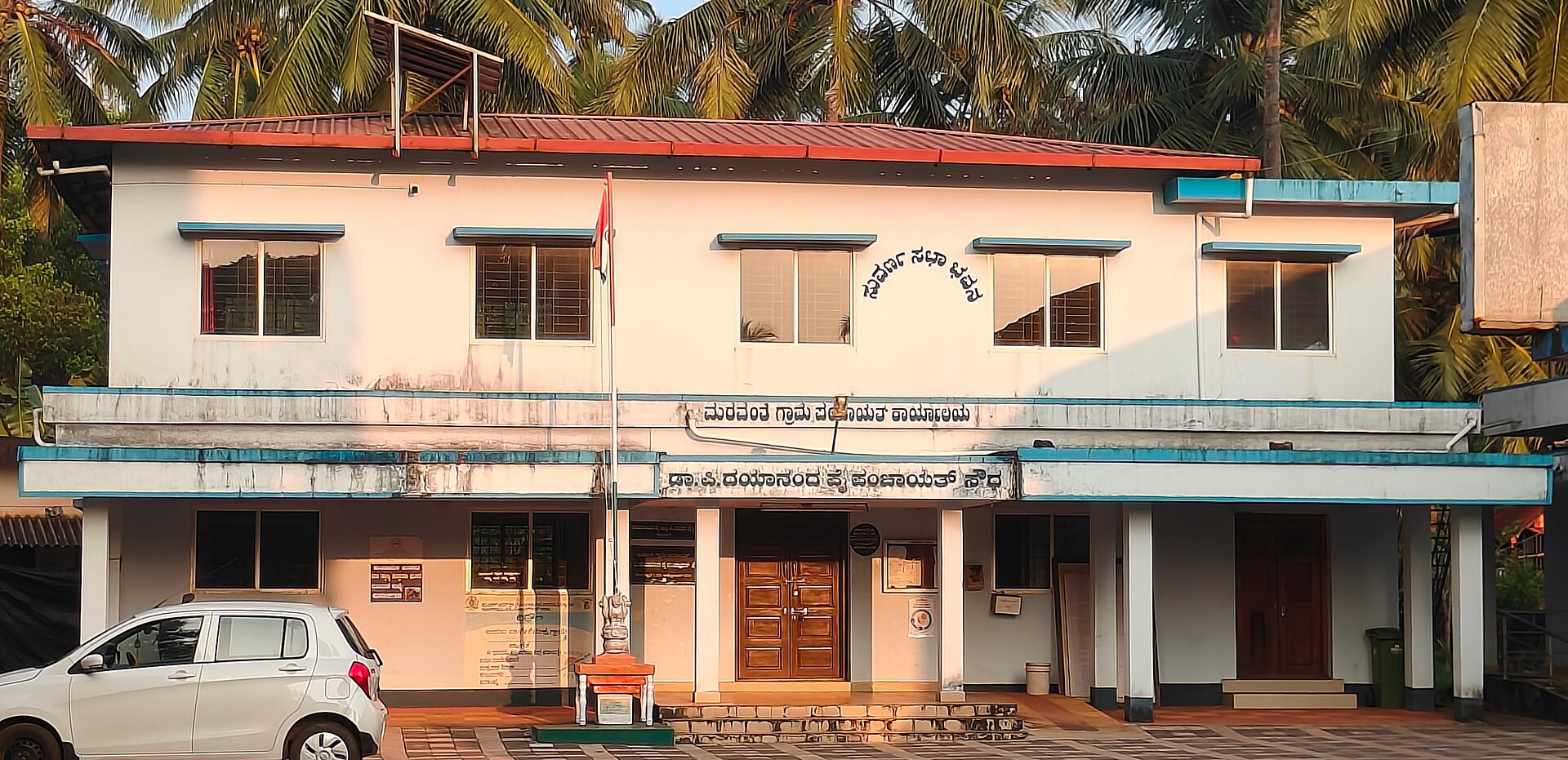
Reference view of the Maravanthe Gram Panchayat office in Udupi district, Karnataka. The RBI report finds that intergovernmental transfers account for about 90 per cent of Gram Panchayat receipts, highlighting the challenge of strengthening local revenue autonomy.
Image: Rohan Pinto · CC BY-SA 4.0
Why in news
The RBI has released its report, Finances of Panchayati Raj Institutions, themed ‘Local Finances and Capacity Building in Rural India’. It assesses a balanced panel of 2.25 lakh Gram Panchayats over 2022-23 to 2024-25.
2.25 lakh
Gram Panchayats in the balanced panel
2022-23 to 2024-25
Assessment period
About 90%
Transfers in total receipts
About 10%
Own-source revenues in total receipts
About 40%
Water supply and sanitation in total expenditure
Background
The 73rd Constitutional Amendment gave constitutional status to Panchayati Raj institutions through Part IX of the Constitution. Article 243G enables state legislatures to endow panchayats with powers for self-government, including planning and implementation concerning matters in the Eleventh Schedule. Article 243H provides for state legislation authorising local taxation, assignment of revenues, grants-in-aid and panchayat funds. Article 243I requires periodic State Finance Commissions to review panchayat finances. This framework makes state-level decisions central to translating constitutional recognition into effective devolution of functions, funds and functionaries.
What the RBI report establishes
The report records that Gram Panchayat finances strengthened during 2022-23 and 2023-24, but receipts remained heavily dependent on intergovernmental transfers. Its balanced-panel approach examines the same set of Gram Panchayats over the assessment period; the findings should not be treated as a census of every rural local body.
Own-source revenues account for a modest share and are predominantly driven by non-tax receipts. The release lists interest receipts, Panchayati Raj programme funds and user charges in this context. This reported classification should not be equated automatically with independent local taxing capacity.
- The report’s assessment period extends to 2024-25, but the release specifically identifies financial strengthening during 2022-23 and 2023-24.
- The supplied release does not provide state-wise fiscal rankings or detailed tax-wise revenue shares.
- The RBI report is an analytical assessment, not a decision conferring new taxation powers on panchayats.
Infographic
Revenue autonomy
Improve lawful local collections and rationalise taxes and fees.
Reliable transfers
Support equalisation, predictability and local spending priorities.
Administrative capacity
Strengthen staffing, accounts, procurement and maintenance.
Service outcomes
Track access, quality and functionality, not spending alone.
Accountability
Combine public disclosure, audits and Gram Sabha scrutiny.
AI-assisted infographic by Pragnya IAS Academy, based on the cited sources.
Transfer dependence versus genuine fiscal autonomy
Intergovernmental transfers are essential because local expenditure responsibilities and revenue capacity rarely match. They can also help equalise service provision across richer and poorer jurisdictions. Therefore, a high transfer share is not, by itself, proof of failed decentralisation.
The more relevant questions concern the predictability of transfers, discretion over their use and alignment with devolved responsibilities. A narrow own-revenue base can restrict locally chosen spending, while highly prescriptive funding can make panchayats implementers of higher-level priorities rather than institutions of self-government.
- Evaluate fiscal autonomy through both spending discretion and revenue authority, not receipt growth alone.
- Strengthen local collections without treating own-source revenues as a substitute for equalising transfers.
- Assess revenue effort against the size and characteristics of each panchayat’s taxable base.
Constitutional design and service-delivery priorities
The constitutional framework enables decentralisation but does not automatically transfer every Eleventh Schedule subject or create uniform local tax powers. State laws, activity mapping, staffing arrangements and fiscal decisions determine the effective scope of panchayat authority.
The report finds that expenditure reflects Fifteenth Finance Commission mandates and convergence with national schemes and missions. Water supply and sanitation account for the largest expenditure share, at about 40 per cent. While rural infrastructure has improved, inter-state disparities remain in access, quality and functionality.
- Article 243I provides for State Finance Commissions to review panchayat finances and recommend fiscal arrangements.
- Article 280 provides for Union Finance Commission recommendations on augmenting state consolidated funds to supplement panchayat resources.
- Article 243J enables state legislation on the maintenance and audit of panchayat accounts.
- High expenditure on a sector does not, by itself, establish service quality or asset functionality.
Capacity building and the rural–urban transition
Revenue authority is useful only when accompanied by the ability to identify taxable properties, maintain records, assess liabilities and collect dues fairly. Budgeting, procurement, engineering, accounting and asset maintenance are equally necessary to convert funds into reliable services.
The report warns that some large Gram Panchayats transitioning to small urban local bodies or Town Panchayats may acquire responsibilities faster than their fiscal and administrative preparedness. It calls for transitional fiscal support, capacity building and calibrated strengthening of own-source revenues through better collection efficiency and rationalised property taxes and licence fees.
- Prepare transition plans covering service obligations, staffing, revenues and existing assets.
- Differentiate legally permissible revenue measures from measures that require changes in state law.
- Link revenue reforms to transparent assessments, grievance redressal and demonstrable service improvements.
| Provision | Core role |
|---|---|
| Article 243G | Enables state legislatures to devolve powers for self-government, planning and implementation. |
| Article 243H | Provides for state laws on panchayat taxation, assigned revenues, grants-in-aid and funds. |
| Article 243I | Requires State Finance Commissions to review panchayat finances and recommend fiscal arrangements. |
| Article 243J | Provides for state legislation on panchayat accounts and their audit. |
| Article 280 | Includes Union Finance Commission recommendations for augmenting state funds to supplement panchayat resources. |
| Eleventh Schedule | Lists subjects relevant to panchayat planning and implementation; listing does not itself ensure operational devolution. |
- 1. States clearly assign functions and revenue powers under enabling laws.
- 2. Predictable transfers and realistic own-revenue plans fund assigned responsibilities.
- 3. Trained personnel prepare budgets, maintain accounts and manage procurement.
- 4. Panchayats create and maintain assets according to local needs.
- 5. Gram Sabha scrutiny, audits and service monitoring identify gaps.
- 6. Corrective action improves spending priorities, collection practices and service reliability.
73rd Constitutional Amendment
Part IX established the constitutional framework for Panchayati Raj, including provisions concerning local finances and State Finance Commissions.
2022-23 and 2023-24
The RBI report records strengthening of Gram Panchayat finances during these financial years.
2022-23 to 2024-25
The report assesses a balanced panel of 2.25 lakh Gram Panchayats.
Second biennial report
The RBI focuses on local finances and capacity building in rural India.
Significance, challenges & way forward
Significance
- The report shifts attention from the volume of local funds to the relationship between financial resources and institutional capacity.
- Its findings help assess whether panchayats function as self-governing institutions or primarily as scheme-implementation agencies.
- The concentration of spending on water and sanitation connects local finance directly with essential services and public health.
- Its focus on rural–urban transitions highlights the need to align changing responsibilities with revenue powers and staffing.
Challenges
- A narrow own-revenue base can limit discretionary expenditure and responsiveness to locally identified needs.
- Different economic bases create unequal revenue potential, making uniform collection targets inappropriate.
- Functional devolution without corresponding funds and personnel can leave local responsibilities inadequately supported.
- Persistent inter-state differences in access, quality and functionality show that spending alone cannot establish service outcomes.
- Urban transition can expand service obligations before revenue systems and administrative capacity are ready.
Way forward
- States should align activity mapping, budget allocations and staffing with the responsibilities assigned to each panchayat tier.
- Constitute State Finance Commissions on time, publish their recommendations and explain action taken through the constitutionally prescribed process.
- Improve property records, assessment procedures and collection efficiency within the authority conferred by state law.
- Rationalise licence fees and user charges with transparent rules, affordability safeguards and grievance redressal.
- Retain predictable, equalising transfers while providing scope for locally determined priorities.
- Build professional support for accounting, engineering, procurement and asset maintenance, including shared services where appropriate.
- Provide transition-specific fiscal and administrative support before rural bodies assume expanded urban responsibilities.
- Track asset functionality and service reliability alongside expenditure, and strengthen public disclosure and Gram Sabha scrutiny.
Key terms
- Own-source revenue
- Revenue attributed to a local body’s own tax and non-tax sources, whose composition must be checked against the reporting framework.
- Intergovernmental transfers
- Funds transferred between levels of government to support expenditure responsibilities and address fiscal imbalances.
- Fiscal decentralisation
- The assignment of expenditure responsibilities, revenue powers and financial resources to subnational governments.
- Balanced panel
- A dataset following the same set of entities across all periods covered by the analysis.
- State Finance Commission
- A constitutional body that periodically reviews local finances and recommends fiscal arrangements within a state.
- Activity mapping
- The clear allocation of specific tasks and responsibilities among different levels of government.
- Tied grant
- A grant whose use is restricted to specified purposes or conditions.
Link with static syllabus
Prelims practice MCQs
Q1. With reference to the RBI report on Finances of Panchayati Raj Institutions, consider the following statements: 1. Its assessment draws upon a balanced panel of Gram Panchayats for 2022-23 to 2024-25. 2. Own-source revenues account for about 90 per cent of total receipts. 3. Water supply and sanitation account for about 40 per cent of total expenditure. Which of the statements given above are correct?
Q2. Consider the following pairs: 1. Article 243G: Powers, authority and responsibilities of panchayats 2. Article 243H: Powers concerning panchayat taxation and funds 3. Article 243J: Constitution of State Finance Commissions Which of the pairs given above are correctly matched?
Q3. With reference to fiscal decentralisation in India, consider the following statements: 1. Inclusion of a subject in the Eleventh Schedule automatically transfers its administration to panchayats. 2. State legislation can authorise panchayats to levy and collect specified taxes. 3. The Union Finance Commission can recommend measures to augment state consolidated funds to supplement panchayat resources. Which of the statements given above are correct?
Q4. In the context of the RBI’s assessment of Gram Panchayat finances, what does a balanced panel mean?
Mains practice questions
GS 2 · 15 marks · 250 words
Transfer dependence does not necessarily imply failed decentralisation, but weak revenue autonomy and administrative capacity can undermine local self-government. Examine in light of the RBI report on Panchayati Raj finances.
Frequently asked questions
What is the main finding of the RBI report on panchayat finances?
Gram Panchayat finances strengthened during 2022-23 and 2023-24, but intergovernmental transfers still account for about 90 per cent of receipts. The report emphasises stronger own-source revenues and administrative capacity.
Does the 73rd Amendment automatically give panchayats independent taxation powers?
No. Article 243H provides for state legislatures to authorise panchayat taxation and related fiscal arrangements; actual powers depend on state law.
Why are transfers necessary even when own-source revenues improve?
Local revenue potential differs across jurisdictions and may not match assigned responsibilities. Transfers remain necessary to support essential services and reduce fiscal disparities.
Why does the report highlight rural–urban transition?
Some large Gram Panchayats may acquire expanded responsibilities when transitioning to urban local bodies or Town Panchayats. Fiscal support and administrative preparation are needed to prevent responsibilities from outpacing capacity.
Sources
Analysis prepared by the Pragnya IAS Academy current-affairs desk with AI assistance from the cited reports. Verify figures with the original sources.
Turn current affairs into marks
Join Pragnya IAS Academy's mentorship for daily answer-writing evaluation on stories like this — classroom programmes from a trusted name in IAS coaching in Hyderabad.