
SIR Voter Deletions: Electoral Inclusion, Due Process and Citizenship Claims
Revise the static topic: UPSC Polity notes · UPSC Governance notes
In short: Union Home Minister Amit Shah defended the Special Intensive Revision of electoral rolls in Hyderabad, claiming that deletions included alleged Bangladeshi infiltrators, while Opposition parties protested against the exercise. The supplied reports do not independently establish these claims and give differing category-wise figures. The central issue is how to remove ineligible entries without excluding eligible citizens, while keeping electoral eligibility decisions distinct from citizenship and deportation proceedings.
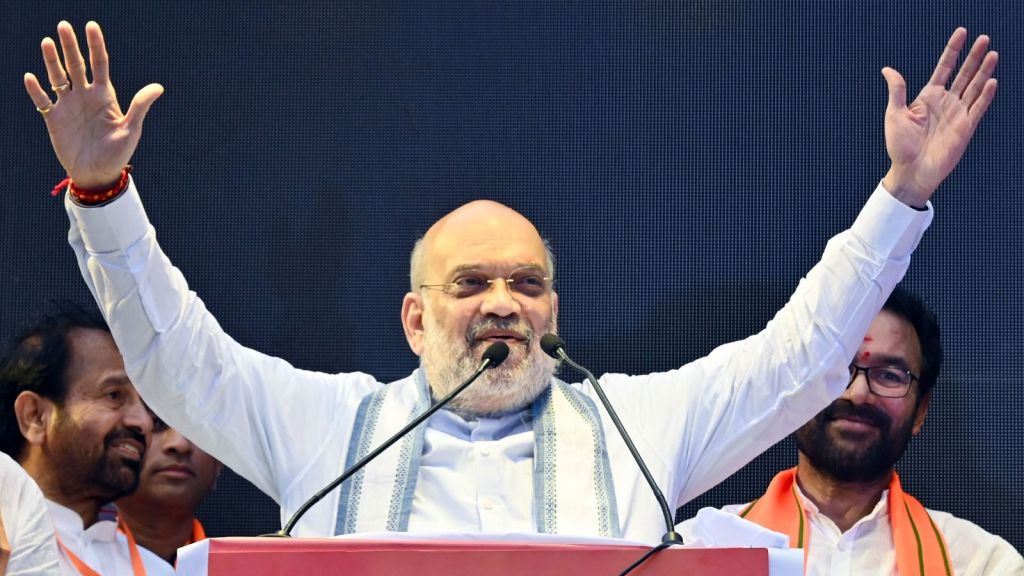
Reference image: Union Home Minister Amit Shah addressing a gathering in Hyderabad. His defence of the Special Intensive Revision frames the debate over electoral inclusion and due process; the supplied reports do not independently establish his claims about alleged Bangladeshi infiltrators.
Image: Indian Express
Why in news
On November 2, 2026, Amit Shah defended SIR at a Hyderabad public meeting following an Opposition mobilisation in Delhi. His claims about deleted entries have brought electoral-roll accuracy, procedural safeguards and the evidentiary basis of allegations of infiltration into focus.
13 crore
Deleted entries cited by Shah; not independently verified
3 crore
Alleged infiltrators in Shah's claim; not established
Background
Electoral rolls identify persons entitled to participate in elections in a constituency. Article 324 places their preparation under the superintendence, direction and control of the Election Commission of India. Article 325 provides for a general electoral roll for each territorial constituency and prohibits exclusion solely on grounds of religion, race, caste or sex. Article 326 anchors elections to the Lok Sabha and State Legislative Assemblies in adult suffrage, subject to constitutionally permitted disqualifications. The Representation of the People Act, 1950, and the Registration of Electors Rules, 1960, govern electoral registration, revision, correction, deletion and related remedies.
What the reports establish—and what they do not
The reports establish that Shah defended SIR, attributed deletions to several categories and described a substantial group as Bangladeshi infiltrators. They do not supply an ECI dataset, individual orders or citizenship findings that independently establish his numerical and nationality claims.
The category-wise accounts differ. The Hindu reports his claim of 4.25 crore voters registered at two locations, whereas The Indian Express reports 6.15 crore people who had shifted. The reported deceased-voter figures also differ in precision. These categories and figures should not be combined into a reconciled statistical account.
The Hindu editorial argues that SIR could undermine electoral inclusion and calls for institutional accountability. It also cautions Rahul Gandhi against questioning the legitimacy of an earlier election without substantive evidence. Editorial assessments and political allegations must be distinguished from verified administrative findings.
- A deleted entry is not necessarily a unique person deprived of voting eligibility; a duplicate entry may be removed while a valid registration remains.
- An untraceable person, a duplicate entry and a non-citizen represent different factual and legal categories.
- The supplied material does not establish a nationwide count of eligible citizens wrongly excluded or of non-citizens conclusively identified.
Infographic
Legal authority
Apply constitutional and statutory requirements.
Verified evidence
Distinguish death, duplication, relocation and ineligibility.
Fair procedure
Provide required notice, hearing and reasoned decisions.
Effective remedies
Make correction and appeals accessible.
Transparent data
Separate political claims from established findings.
Citizenship boundary
Do not equate deletion with foreign nationality or deportation.
AI-assisted infographic by Pragnya IAS Academy, based on the cited sources.
Legal framework: accurate rolls and inclusive suffrage
The Representation of the People Act, 1950, makes citizenship, qualifying age and ordinary residence central to registration. Non-citizens are disqualified from registration. The Act also prohibits registration in more than one constituency and multiple registration within the same constituency.
Section 21 governs preparation and revision of electoral rolls and empowers the ECI to direct a special revision for reasons to be recorded. Section 22 addresses correction, transposition and deletion of entries, while Section 23 governs inclusion. The Electoral Registration Officer is the statutory authority responsible for registration decisions.
Ordinary residence is not identical to property ownership or permanent domicile. Temporary absence does not, by itself, end ordinary residence. Consequently, failure to find someone during a field visit cannot automatically establish that the person has permanently shifted or is ineligible.
- Article 324 powers operate within the Constitution and the statutory framework; they do not displace legislative safeguards.
- Roll accuracy requires both removing ineligible entries and retaining or enrolling eligible citizens.
- The applicable revision instructions must be examined before asserting that a particular document or procedure is mandatory.
Notice, hearing and appeals: the safeguards that matter
Section 22 requires proper verification before specified changes or deletions. Its hearing safeguard applies to correction or transposition and to proposed deletion on grounds of ceasing to be ordinarily resident or otherwise not being entitled to registration. Death-based deletion is treated differently under the provision, although proper verification remains essential.
The Registration of Electors Rules provide procedures for draft publication, claims, objections and their consideration. A meaningful opportunity to respond requires communication of the proposed adverse action and its basis, rather than a generic announcement that revision is under way.
Section 24 provides statutory appeals against specified orders under Sections 22 and 23, with a further appeal to the Chief Electoral Officer. The Rules also provide an appeal mechanism for specified decisions during revision. The correct route, authority and deadline depend on the provision and stage involved; these should be communicated with the decision.
- A field-level verification report should inform, not replace, the statutory officer's decision.
- Speaking orders should identify the evidence, applicable ground and reasons for rejecting the elector's explanation.
- Accessible hearings and assistance are especially important for migrant workers, elderly persons and people with disabilities.
- Judicial review remains subject to constitutional principles and election-related limits; statutory remedies should be clearly explained.
Electoral eligibility is not a general citizenship determination
Citizenship is a legal condition for electoral registration, so an Electoral Registration Officer may examine citizenship-related eligibility for that purpose. However, electoral-roll revision is not a substitute for proceedings under citizenship and immigration law.
A deletion for duplication, death, relocation or another registration-related reason does not establish foreign nationality. Nor does deletion itself authorise deportation. Any action concerning foreigner status or removal from India must rest on the applicable legal framework and competent authorities.
The description of absent or unaccounted persons as infiltrators therefore requires evidence beyond their absence from a roll or failure to be located. Equally, claims that the entire revision is fraudulent require substantiation rather than inference from political disagreement.
- Eligibility scrutiny must be individualised and based on legally relevant evidence.
- Language, religion or community identity cannot substitute for proof of nationality.
- An electoral-roll entry is not conclusive proof of citizenship, just as deletion is not conclusive proof of foreign nationality.
Institutional accountability: reconcile integrity with inclusion
Removing dead, duplicate and otherwise ineligible entries serves electoral integrity. Wrongful deletion can be equally damaging because an eligible citizen's ability to vote depends on enrolment. Administrative performance should therefore be assessed through accuracy and correction outcomes, not deletion totals alone.
The supplied reports contain political claims and editorial criticism, but no comprehensive ECI response or audited category-wise dataset. The appropriate response is transparent verification: consistent categories, clear methodology, reasons for adverse decisions and accessible correction mechanisms.
Public disclosure should permit scrutiny without exposing sensitive personal documents. Political parties can assist citizens and flag errors, but the ECI and registration authorities must retain independent, evidence-based control over decisions.
- Publish disaggregated deletion grounds and distinguish proposed deletions from final decisions.
- Disclose the results of claims, objections, appeals and restoration requests.
- Independently examine samples of both deleted and retained entries to detect errors in either direction.
- Communicate verified findings promptly without adopting partisan descriptions.
| Category or issue | Relevant electoral inquiry | What cannot be inferred automatically |
|---|---|---|
| Reported death | Verify death and ensure that the correct entry is identified. | A matching name alone does not establish that the registered elector has died. |
| Duplicate registration | Establish that multiple entries concern the same person and preserve the lawful registration. | Duplicate entries do not establish foreign nationality. |
| Shifted or absent elector | Examine ordinary residence and distinguish relocation from temporary absence. | Absence during a visit does not itself justify deletion. |
| Citizenship-related ineligibility | Examine registration eligibility through the applicable legal procedure. | Roll deletion does not itself constitute a general citizenship ruling or deportation order. |
| Claim of mass disenfranchisement | Verify how many eligible people lost valid registration and whether errors were corrected. | The total number of deleted entries is not automatically the number of unique eligible voters excluded. |
- 1. Identify a specific discrepancy and the legally relevant ground for scrutiny.
- 2. Verify the entry and supporting evidence without presuming ineligibility.
- 3. Give the affected elector the required notice and opportunity to respond.
- 4. Have the competent registration authority consider the evidence and issue a reasoned decision.
- 5. Communicate the outcome and the applicable appeal procedure.
- 6. Implement any correction or restoration ordered and preserve an audit trail.
Sunday preceding the Hyderabad meeting
Congress-led INDIA bloc parties held a protest at Delhi's Ramlila Maidan against SIR and raised concerns about electoral integrity.
November 2, 2026
Amit Shah defended SIR in Hyderabad, made claims about the categories of deleted entries and expressed readiness for a parliamentary discussion.
Significance, challenges & way forward
Significance
- Accurate electoral rolls protect equal political participation by preventing both multiple registration and wrongful exclusion.
- Meaningful notice and remedies make adult suffrage effective rather than merely formal.
- Separating electoral decisions from citizenship and deportation claims prevents administrative findings from being overstated.
- Transparent explanations strengthen public confidence in the ECI's independence and impartiality.
Challenges
- Migrant workers and temporarily absent residents may be incorrectly classified as having permanently shifted.
- Document gaps and difficulties receiving notices can make procedural compliance unequal across social groups.
- Inconsistent category definitions can conceal overlap and make aggregate deletion claims misleading.
- Large administrative workloads can weaken verification and reduce opportunities for individual hearings.
- Partisan narratives may convert registration errors into unsupported allegations about nationality or election legitimacy.
- A remedy that is inaccessible or delayed may fail to protect effective participation in the relevant election.
Way forward
- Publish the applicable revision order, legal basis, eligibility criteria, document requirements and remedy procedures in accessible languages.
- Ensure that deletion proposals identify a specific statutory ground supported by verified evidence.
- Provide effective notice and hearings wherever required, with assistance for vulnerable electors.
- Publish consistent, privacy-conscious statistics on additions, deletions, grounds, appeals and restorations.
- Audit erroneous deletions as well as wrongful inclusions, rather than treating a high deletion count as proof of success.
- Keep electoral registration findings distinct from proceedings concerning citizenship, foreigner status or deportation.
- Promote parliamentary scrutiny and party consultation without allowing political actors to determine individual registration outcomes.
Key terms
- Special Intensive Revision
- A detailed electoral-roll revision exercise whose operative procedures must be assessed against the relevant ECI directions and electoral law.
- Electoral Registration Officer
- The statutory officer responsible for electoral-roll preparation and registration decisions for the relevant constituency.
- Ordinary residence
- The statutory residence connection relevant to enrolment, which is not lost merely through temporary absence.
- Natural justice
- Principles of fair decision-making, including an opportunity to answer an adverse case and an impartial determination.
- Speaking order
- A decision that explains the material considered, legal grounds and reasons for its conclusion.
- Disenfranchisement
- Deprivation of voting entitlement or effective access to voting, including through wrongful exclusion from electoral rolls.
- Adult suffrage
- The constitutional basis of electoral participation by adult citizens, subject to legally permitted qualifications and disqualifications.
Link with static syllabus
Prelims practice MCQs
Q1. With reference to electoral registration in India, consider the following statements: 1. Ownership of a dwelling house is by itself sufficient to establish ordinary residence. 2. Temporary absence does not by itself cause a person to cease to be ordinarily resident. 3. Registration in more than one constituency is prohibited. Which of the statements given above are correct?
Q2. Consider the following pairs: 1. Article 324: Superintendence, direction and control of electoral-roll preparation by the ECI 2. Article 325: General electoral roll and prohibition of exclusion solely on specified identity grounds 3. Article 326: Elections to the Lok Sabha and State Legislative Assemblies based on adult suffrage Which of the pairs given above are correctly matched?
Q3. Which of the following best describes the relationship between electoral-roll deletion and citizenship?
Q4. With reference to the Representation of the People Act, 1950, consider the following statements: 1. Section 21 deals with preparation and revision of electoral rolls. 2. Section 22 requires proper verification before specified corrections or deletions. 3. Section 24 excludes appeals against all orders under Sections 22 and 23. Which of the statements given above are correct?
Mains practice questions
GS 2 · 15 marks · 250 words
Electoral-roll integrity requires the prevention of both wrongful inclusion and wrongful exclusion. Discuss with reference to safeguards governing revision and the distinction between electoral eligibility and citizenship determinations.
Frequently asked questions
Do the supplied reports establish that SIR identified three crore illegal infiltrators?
No. They report Amit Shah's allegation but do not provide an independently verified ECI dataset or individual legal findings establishing that claim.
Can a person be deleted from the roll merely because they are away for work?
Temporary absence does not by itself terminate ordinary residence. The registration authority must examine the facts and follow the applicable verification and procedural safeguards.
Does every proposed deletion require the same hearing procedure?
No. Section 22 distinguishes death-based deletion from specified grounds requiring a reasonable opportunity of being heard; proper verification remains necessary, and the applicable revision procedure must also be considered.
What should an elector do after an adverse registration decision?
Obtain the decision and its reasons, identify the applicable correction or appeal route, and act within the prescribed deadline. The appropriate remedy depends on the provision and stage of the revision.
Sources
- The Hindu: Amit Shah backs SIR, alleges 3 crore ‘illegal infiltrators’ identified in 13 crore deleted voters
- The Hindu (Editorial): United stand: On protests against SIR
- Indian Express: Amit Shah calls 3 crore votes dropped in SIR ‘infiltrators': ‘They never existed’
Analysis prepared by the Pragnya IAS Academy current-affairs desk with AI assistance from the cited reports. Verify figures with the original sources.
Turn current affairs into marks
Join Pragnya IAS Academy's mentorship for daily answer-writing evaluation on stories like this — classroom programmes from a trusted name in IAS coaching in Hyderabad.