
Supreme Court on Sales Tax Surcharge: State Taxing Powers and Fiscal Federalism
Revise the static topic: UPSC Polity notes · UPSC Governance notes
In short: A seven-judge Constitution Bench of the Supreme Court has reiterated that States could levy a surcharge calculated on sales tax payable under the pre-GST framework because it remained an additional sales tax. The majority declared the reference infructuous, holding that the issue was already settled; the ruling clarifies that a tax’s method of calculation does not by itself determine its constitutional character.
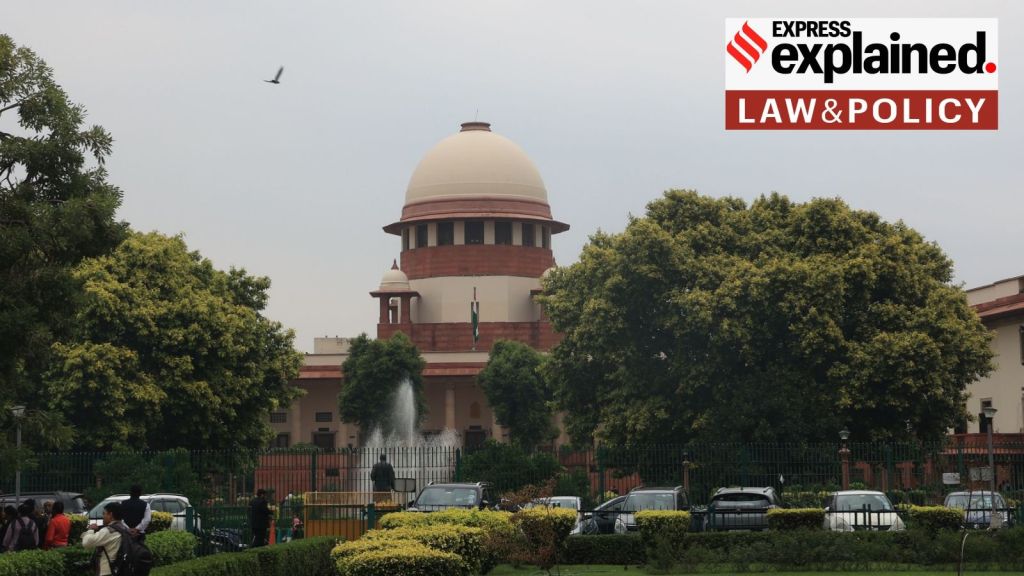
Reference view of the Supreme Court of India. A seven-judge Constitution Bench held that the pre-GST sales tax surcharge issue was already settled and declared the reference infructuous.
Image: Indian Express
Why in news
The Supreme Court has closed a reference pending for nearly three decades concerning States’ competence to impose a surcharge on sales tax. It reaffirmed the distinction between what is taxed and how the tax liability is calculated.
Seven judges
Bench hearing the reference
1990
Odisha sales tax amendment
Above Rs 10 lakh
Odisha gross turnover threshold
10%
Surcharge on sales tax payable
1974
S. Kodar precedent
Background
India’s Constitution distributes legislative powers through Article 246 and the Seventh Schedule, while Article 265 requires authority of law for every tax levy and collection. Before the GST restructuring, Entry 54 of the State List empowered States to tax the sale or purchase of goods, subject to Entry 92A of the Union List concerning inter-State transactions. The Constitution (One Hundred and First Amendment) Act, 2016 introduced the GST framework and Article 246A, while narrowing Entry 54 to specified goods. A State tax must therefore be traced to an applicable constitutional power; merely describing a levy as a surcharge does not establish its validity.
The dispute and what the Supreme Court settled
Odisha’s 1990 amendment required dealers with gross turnover exceeding Rs 10 lakh to pay an additional amount equal to 10% of their sales tax liability. Dealers argued that this was a tax on an existing tax, rather than a tax on the sale or purchase of goods authorised by Entry 54.
The State maintained that the surcharge merely increased the sales tax burden for a specified class of dealers. The Supreme Court reaffirmed that this question had already been settled in S. Kodar and that there was no reason to revisit that ruling.
The majority declared the reference infructuous because the legal doubt underlying it no longer survived. This was a reaffirmation of settled doctrine, not the creation of an unrestricted State power to impose taxes on taxes.
- The constitutional issue was legislative competence, not merely the terminology used for the levy.
- The reference concerned old sales tax laws under the pre-GST framework.
- Closing the reference should not be read as a determination of every issue in every underlying individual dispute.
Infographic
Taxable subject
The sale or purchase of goods remained the subject.
Calculation measure
Sales tax payable supplied the arithmetic base.
State competence
The former Entry 54 supported the additional sales tax.
Settled precedent
S. Kodar governed; the majority closed the reference.
GST boundary
No automatic authority for a surcharge on GST.
AI-assisted infographic by Pragnya IAS Academy, based on the cited sources.
Subject versus measure: the decisive constitutional distinction
The subject of a tax identifies what is being taxed; the measure identifies how the amount payable is calculated. Here, the subject remained the sale or purchase of goods even though the surcharge was measured as a percentage of sales tax payable.
The Court illustrated that a 10% surcharge on sales tax charged at 10% of turnover is equivalent to an additional levy of 1% of turnover. A different arithmetical route did not create a different taxable subject.
The Court also rejected the argument that the surcharge was a tax on a dealer’s income. Liability depended on turnover and sales tax payable, not profitability; a loss-making dealer could still be liable after crossing the prescribed turnover threshold.
- The calculation base does not, by itself, determine the constitutional character of a tax.
- A turnover threshold can identify liable dealers without converting the levy into an income tax.
- The distinction does not validate every surcharge: each levy must remain within legislative competence and satisfy constitutional requirements.
Why the mineral royalty cases did not invalidate the surcharge
In S. Kodar, a Constitution Bench upheld an additional sales tax measured with reference to sales tax payable. Hoechst Pharmaceuticals subsequently reiterated that such a surcharge was a higher rate of tax for raising general revenue.
Dealers relied on India Cement, which had invalidated a cess on mineral royalty and described royalty as a tax. The present Bench explained that India Cement concerned a different constitutional field, including the limits of State power where central legislation operated; it did not establish that every levy calculated on another levy was unconstitutional.
Kesoram Industries had questioned the description of royalty as a tax. The nine-judge ruling in Mineral Area Development Authority subsequently held that royalty is contractual consideration for mineral rights, not a tax. This removed the basis of the apparent conflict with S. Kodar.
- A precedent must be applied in light of the constitutional field and legal issue it actually decides.
- The royalty ruling helped remove the apparent conflict; it was not an independent source of sales tax power.
- A larger-Bench reference need not continue once the doubt requiring it has been authoritatively resolved.
Fiscal federalism and the limits imposed by the GST transition
The ruling protects State fiscal autonomy within an assigned taxation field: a valid additional sales tax does not become unconstitutional simply because it is computed on the underlying tax liability. It also provides doctrinal clarity for disputes arising under legacy sales tax laws.
Its prospective reach is limited. The constitutional amendment introducing GST narrowed Entry 54 to specified petroleum products and alcoholic liquor for human consumption, while Article 246A established a distinct framework for GST legislation.
The judgment therefore cannot be treated as blanket permission for States to impose a surcharge on GST. Any contemporary levy requires an independent examination of the applicable constitutional power, statutory authority and restrictions.
- Fiscal autonomy operates within the constitutional distribution of taxing powers.
- Legacy sales tax competence and present GST competence must be analysed separately.
- Legal validity and economic desirability remain distinct questions: an authorised surcharge can still raise concerns about tax burden and compliance.
| Concept | Meaning and application |
|---|---|
| Subject of taxation | What is taxed: the sale or purchase of goods in this dispute. |
| Measure of taxation | How liability is quantified: a percentage of sales tax payable. |
| Liability threshold | Which dealers are covered: those whose gross turnover exceeds the prescribed limit. |
| Income tax | A levy on income; the surcharge was not linked to the existence or quantum of profit. |
| Royalty | Contractual consideration for mineral rights, not a tax, as clarified in Mineral Area Development Authority. |
| Post-GST competence | Requires examination of Article 246A, the narrowed Entry 54 and the applicable legislation. |
- 1. Identify the levy’s true subject and taxable event.
- 2. Locate the applicable constitutional source of legislative competence.
- 3. Separate the calculation method from the subject being taxed.
- 4. Check the charging law, liability threshold and other constitutional restrictions.
- 5. Apply relevant precedents within the correct constitutional and temporal framework.
1974
S. Kodar upheld additional sales tax calculated with reference to sales tax payable.
1983
Hoechst Pharmaceuticals upheld a sales tax surcharge as a higher rate of tax.
1990
Odisha amended its sales tax law to impose the disputed surcharge; India Cement separately invalidated a cess on mineral royalty.
1999
A five-judge Supreme Court Bench in Arjun Floor Mills referred the matters to a seven-judge Bench.
2004
Kesoram Industries suggested that India Cement’s description of royalty as a tax was an inadvertent error.
2016
The constitutional amendment establishing the GST framework narrowed Entry 54 of the State List.
2024
Mineral Area Development Authority held that royalty is not a tax but contractual consideration for mineral rights.
Present ruling
The seven-judge Bench reaffirmed the settled sales tax surcharge principle; the majority declared the reference infructuous.
Significance, challenges & way forward
Significance
- The ruling preserves State flexibility to structure additional taxation within a constitutionally assigned field.
- It reinforces the distinction between a tax’s subject and its measure, a foundational principle of legislative competence.
- It removes doctrinal uncertainty affecting legacy sales tax surcharge disputes.
- It strengthens judicial discipline by declining to reopen a question already settled by binding precedent.
Challenges
- The phrase tax on tax can obscure the legal distinction between a taxable subject and a calculation mechanism.
- Applying a pre-GST ruling mechanically to GST-era taxation could misstate the scope of State powers.
- The closure of a constitutional reference does not necessarily resolve every separate issue in underlying proceedings.
- Constitutional validity alone does not establish that an additional levy is economically efficient or administratively simple.
Way forward
- State tax legislation should clearly identify the taxable event, rate, calculation base and dealers liable to pay.
- Legacy cases should apply the settled subject–measure distinction while examining any unresolved statutory or factual issues.
- Proposed GST-era surcharges should undergo a separate competence analysis rather than rely solely on pre-GST precedents.
- Revenue measures should balance fiscal needs with predictable tax burdens and manageable compliance requirements.
- Courts should periodically review long-pending references to determine whether later judgments or constitutional changes have removed the underlying doubt.
Key terms
- Surcharge
- An additional levy over an existing tax; in this dispute, it retained the character of sales tax.
- Legislative competence
- The constitutional authority of a legislature to enact a law on a particular subject.
- Subject of taxation
- The transaction, activity, property or other matter on which a tax is imposed.
- Measure of taxation
- The basis or formula used to calculate the amount of tax payable.
- Gross turnover
- The aggregate sales or business receipts computed under the applicable statute, distinct from profit.
- Infructuous reference
- A judicial reference that no longer requires an answer because its underlying issue or doubt has ceased to survive.
- Fiscal federalism
- The allocation and interaction of revenue powers, expenditure responsibilities and transfers across levels of government.
Link with static syllabus
Prelims practice MCQs
Q1. With reference to the Supreme Court’s reasoning on sales tax surcharge, consider the following statements: 1. Computing a surcharge as a percentage of sales tax necessarily creates a separate taxable subject. 2. The subject of a levy and the measure used to calculate it are distinct concepts. 3. Liability linked to turnover rather than profit necessarily makes a surcharge an income tax. Which of the statements given above is/are correct?
Q2. Consider the following pairs: 1. Article 265 — No tax shall be levied or collected except by authority of law 2. Article 246A — Special provisions concerning GST legislation 3. Article 279A — GST Council Which of the pairs given above are correctly matched?
Q3. Which of the following best describes the relationship between the royalty cases and the sales tax surcharge reference?
Q4. With reference to State taxation after the constitutional amendment establishing GST, consider the following statements: 1. Entry 54 of the State List continues to provide the same broad sales tax power that it provided before GST. 2. Article 246A provides a distinct constitutional basis for GST legislation. 3. A ruling upholding a pre-GST sales tax surcharge automatically validates a similar surcharge on GST. Which of the statements given above is/are correct?
Mains practice questions
GS 2 · 15 marks · 250 words
Distinguish between the subject and measure of a tax. In light of the Supreme Court’s sales tax surcharge ruling, examine the implications of this distinction for State fiscal autonomy in the GST era.
Frequently asked questions
Can States levy a tax on sales tax?
The Court reaffirmed that a surcharge calculated on sales tax payable could be a valid additional sales tax under the pre-GST framework. Its calculation on an existing tax did not, by itself, make it unconstitutional.
Does the judgment allow States to impose a surcharge on GST?
Not automatically. The reference concerned pre-GST sales tax powers; a GST-era levy must independently satisfy the applicable constitutional and statutory requirements.
Why was the surcharge not treated as income tax?
Liability depended on turnover and sales tax payable rather than profit. A dealer making losses could still be liable after crossing the prescribed turnover threshold.
Why did the majority declare the reference infructuous?
The issue had already been settled in S. Kodar, and the later clarification on royalty removed the basis of the apparent conflict. The majority therefore found no surviving doubt requiring the reference to be answered afresh.
Sources
- Indian Express: Can states levy a tax on sales tax? The 30-year-old legal question SC has now settled, explained
Analysis prepared by the Pragnya IAS Academy current-affairs desk with AI assistance from the cited reports. Verify figures with the original sources.
Turn current affairs into marks
Join Pragnya IAS Academy's mentorship for daily answer-writing evaluation on stories like this — classroom programmes from a trusted name in IAS coaching in Hyderabad.