
Yamuna Pollution: Supreme Court Pushes Municipal Accountability Beyond Cleanup Spending
Revise the static topic: UPSC Environment notes
In short: The Supreme Court has directed the Central Pollution Control Board to monitor the Yamuna and its major drains at administrative entry and exit points, linking deterioration in water quality to territorial accountability. Observing that pollution has increased despite substantial cleanup expenditure, it emphasised pollution control at source, functional sewage networks and coordinated civic administration rather than sewage treatment plant construction alone.
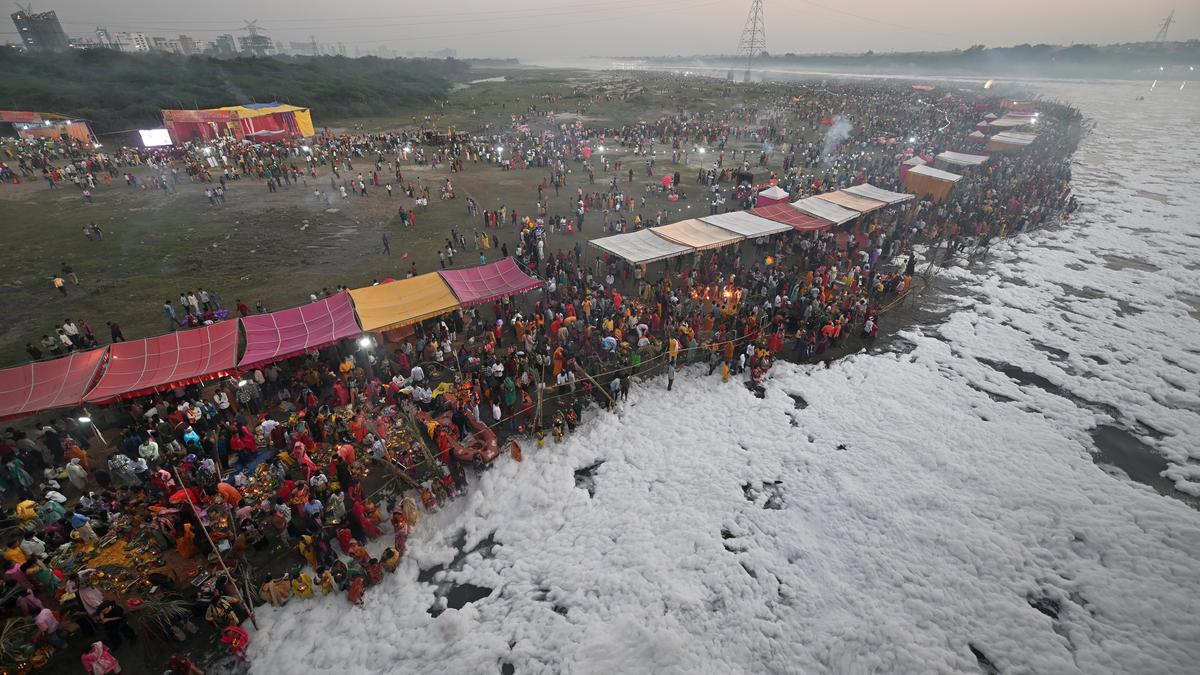
Photo from the source report: Yamuna Pollution: Supreme Court Pushes Municipal Accountability Beyond Cleanup Spending
Image: The Hindu
Why in news
In an order dated November 4, 2026, the Supreme Court directed enhanced monitoring, inspections and pollution-incident investigations, and asked CPCB to suggest a formula for compensation payable by jurisdictions where water quality deteriorates.
520
Drains discharging wastewater into the Yamuna, cited by the Court
Background
The Yamuna is a major tributary of the Ganga, originating in the Himalayan region near Yamunotri and joining the Ganga at Prayagraj. River pollution crosses administrative boundaries, whereas sanitation, sewerage, industrial regulation and water management are divided among local bodies, state agencies and central institutions. CPCB is a statutory body constituted under the Water (Prevention and Control of Pollution) Act, 1974. Municipal sanitation functions, pollution-control regulation and basin-level coordination must therefore work together for sustained restoration.
What the Supreme Court has directed
The Court linked the Yamuna’s poor health to failures of civic administration along its banks. Its directions seek to make pollution traceable across administrative boundaries and expose weaknesses in wastewater infrastructure through inspections and access to operational records.
CPCB must monitor water quality where the river and its major drains enter and exit states, Union territories and districts. The Court directed that jurisdictions where quality deteriorates on any parameter be held accountable and penalised, with compensation or fines deposited with its registry. CPCB has been asked to suggest the calculation formula; the supplied report does not provide a final formula or penalty amount.
- CPCB must investigate incidents such as fish deaths, foam, eutrophication, algal blooms and increases in BOD, COD or TSS, identifying causes and remedies.
- Public and private infrastructure operators must allow immediate, unhindered access for surprise inspections, sampling, volumetric audits and sensor verification.
- Central and state bodies must provide administrative, logistical, technical, operational and infrastructural assistance.
- Operators and authorities must provide unrestricted data access and integrate with CPCB’s centralised monitoring architecture.
Infographic
Prevent
Control industrial pollution and untreated sewage at source.
Collect and treat
Connect sewerage networks to reliably operated treatment systems.
Measure
Monitor boundaries and investigate pollution incidents.
Assign responsibility
Link verified deterioration to jurisdictions and corrective duties.
Coordinate fairly
Combine intergovernmental action, due process and rehabilitation.
Institutionalise
Convert judicial directions into routine regulatory and civic performance.
AI-assisted infographic by Pragnya IAS Academy, based on the cited sources.
Why treatment plants alone cannot restore the river
A sewage treatment plant is only one link in the sanitation chain. Wastewater must first be collected, conveyed and delivered to a functioning facility, then treated to applicable standards. Installed capacity cannot establish successful treatment if sewage bypasses the network, pumping fails or plant operation is inadequate.
The Court identified weak sewerage systems and the mixing of stormwater and sewage drains as obstacles to interception. It also observed that dense, unplanned settlements may lack the space and layout required for conventional sewer networks. These observations make service delivery and urban planning central to river restoration.
Industrial pollutants require prevention and treatment at source. Municipal sewage treatment cannot be treated as a universal substitute for appropriate industrial effluent control.
- Performance should be assessed through wastewater actually collected and adequately treated, not merely infrastructure sanctioned or built.
- Maintenance, electricity, trained operators and reliable conveyance systems are essential complements to capital expenditure.
- Where conventional sewerage is impracticable, locally suitable sanitation options should be evaluated without relaxing discharge standards.
Municipal accountability needs cooperative federalism
Boundary monitoring can reveal where pollution worsens and reduce the ability of authorities to shift responsibility upstream or downstream. However, attribution requires more than comparing isolated concentration readings: river flow, incoming drains, abstraction, rainfall and sampling conditions influence observed water quality.
Responsibility is also fragmented within a jurisdiction. Municipal bodies, sewerage utilities, industrial regulators and other agencies may control different parts of the pollution pathway. A credible accountability system must connect each observed failure to the agency with the legal mandate, operational control and resources to correct it.
The policy challenge is to combine territorial accountability with basin-wide cooperation. Downstream water quality is a shared outcome, but corrective tasks must have clearly identified owners.
- Use consistent sampling protocols and flow measurements to support defensible pollution attribution.
- Map each drain to its catchment, pollution sources, treatment assets and responsible agencies.
- Create joint action arrangements for cross-boundary drains and upstream-downstream pollution events.
- Strengthen municipal staffing and recurrent financing alongside enforceable service obligations.
Constitutional basis, rehabilitation and limits of judicial oversight
Article 21 has been judicially interpreted to include protection of a healthy environment. Article 48A directs the State to protect and improve the environment, while Article 51A(g) places an environmental duty on citizens. Article 243W, read with the Twelfth Schedule, provides the constitutional framework for state legislatures to endow municipalities with functions including public health, sanitation and solid waste management; actual powers depend on state law.
The Court stated that settlements on drains and the river bed would continue contributing sewage unless removed with rehabilitation of occupants. Rehabilitation is therefore an express component of the reported observation, not an optional addition. Implementation must observe applicable law and due process, while sanitation provision should not be postponed pending settlement disputes.
Judicial oversight can compel disclosure, inspections and inter-agency cooperation when executive action is inadequate. It cannot itself operate sewer networks, sustain municipal finances or replace technical regulators. Durable restoration requires judicially enforced accountability to translate into functioning executive institutions rather than permanent dependence on court supervision.
- Environmental enforcement should address industrial, municipal and other pollution sources rather than disproportionately targeting vulnerable residents.
- Penalties require transparent attribution, a reasoned methodology and procedural fairness.
- Ecological restoration and secure, serviced rehabilitation should be planned together.
| Governance dimension | Inadequate approach | Outcome-oriented approach |
|---|---|---|
| Sewage treatment | Treat plant construction as proof of cleanup | Verify collection, conveyance, actual treatment and compliant discharge |
| Pollution monitoring | Rely on disconnected readings | Use comparable river and drain data with flow and source information |
| Administrative responsibility | Treat the river as another jurisdiction’s problem | Identify territorial deterioration and agency-specific corrective duties |
| Financial accountability | Report spending without environmental results | Link expenditure review to treatment reliability and pollution reduction |
| Settlement management | Separate removal from service delivery and rehabilitation | Combine lawful planning, sanitation access and rehabilitation |
| Judicial intervention | Depend indefinitely on case-by-case directions | Build routine regulatory enforcement and capable local institutions |
- 1. Monitor the Yamuna and major drains at administrative entry and exit points.
- 2. Identify deterioration and investigate pollution incidents.
- 3. Verify causes using inspections, sampling, operational records and flow information.
- 4. Determine jurisdictional responsibility and agency-specific corrective tasks.
- 5. Apply accountability measures under the Court’s directions, with the compensation formula to be developed.
- 6. Implement remedies and verify subsequent water-quality improvement.
November 4, 2026
The Supreme Court issued directions on boundary-point monitoring, accountability for deteriorating water quality, pollution-incident reporting and access to infrastructure and operational data.
Significance, challenges & way forward
Significance
- The directions shift attention from cleanup expenditure to measurable environmental outcomes.
- Boundary monitoring can make upstream-downstream responsibilities more visible and support intergovernmental accountability.
- Unannounced inspections and access to records can expose gaps between reported treatment performance and actual operations.
- Source-control emphasis connects river restoration with everyday municipal service delivery and industrial compliance.
- Incident-specific investigation can distinguish visible symptoms from their underlying pollution causes.
Challenges
- Fragmented mandates can allow municipalities, utilities and regulators to transfer responsibility without correcting failures.
- Missing sewer connections, inadequate conveyance and mixed drains can prevent sewage from reaching treatment facilities.
- Inconsistent sampling and unreliable flow data can undermine fair attribution of water-quality deterioration.
- Financial penalties alone may not improve services where local bodies lack staff, revenue or operational capacity.
- Settlement interventions can create serious livelihood and housing risks unless rehabilitation and due process are secured.
- Sustained court supervision cannot substitute for routine maintenance, technical regulation and accountable municipal management.
Way forward
- Prepare a drain-wise inventory linking pollution sources, catchments, treatment facilities and responsible agencies.
- Publish quality-assured monitoring data with sampling methods, flow information and explanations of uncertainty.
- Audit the entire sanitation chain, including connections, pumping, plant operation, sludge handling and final discharge.
- Provide predictable operation and maintenance funding, trained staff and enforceable performance obligations.
- Develop a transparent compensation methodology that addresses attribution, severity and procedural fairness.
- Coordinate across jurisdictions through common monitoring protocols and time-bound corrective action plans.
- Integrate lawful floodplain protection with rehabilitation and sanitation access for affected communities.
- Use judicial review to enforce milestones while building durable executive and regulatory capacity.
Key terms
- Biochemical Oxygen Demand
- The oxygen microorganisms require to break down biodegradable organic matter under specified test conditions.
- Chemical Oxygen Demand
- The oxygen equivalent required to chemically oxidise susceptible substances in a water sample.
- Total Suspended Solids
- The concentration of suspended particulate matter retained by a specified filtration method.
- Eutrophication
- Nutrient enrichment of a water body that can promote excessive algal growth and oxygen depletion.
- Sewage interception
- Capturing sewage before it enters a river or other receiving water and diverting it for treatment.
- Pollutant load
- The mass of a pollutant transported over time, assessed using its concentration and water flow.
- Polluter pays principle
- The principle that those responsible for pollution should bear the costs of prevention and environmental remediation.
- Environmental flow
- The flow regime needed to sustain river ecosystems and associated ecological functions.
Link with static syllabus
Prelims practice MCQs
Q1. With reference to the Supreme Court’s reported directions on Yamuna pollution, consider the following statements: 1. CPCB must monitor water quality where the river and its major drains enter and exit administrative jurisdictions. 2. The Court has prescribed a final numerical formula for compensation. 3. Infrastructure operators must allow access for unannounced inspections and sampling. Which of the statements given above are correct?
Q2. Consider the following pairs: 1. Article 48A: Directive to the State to protect and improve the environment 2. Article 51A(g): Fundamental duty concerning protection of the natural environment 3. Twelfth Schedule: Municipal functions including public health and sanitation Which of the pairs given above are correctly matched?
Q3. With reference to water-quality indicators, consider the following statements: 1. BOD is associated with microbial breakdown of biodegradable organic matter. 2. COD measures only the oxygen consumed by living microorganisms. 3. TSS is an indicator of suspended particulate matter. Which of the statements given above are correct?
Q4. Why is river-flow information important when assessing pollution accountability across administrative boundaries?
Mains practice questions
GS 2 · 15 marks · 250 words
River restoration is as much a municipal governance challenge as an environmental engineering task. Discuss with reference to the Supreme Court’s directions on Yamuna pollution, examining the role and limits of judicial oversight.
Frequently asked questions
Why can Yamuna pollution worsen despite cleanup expenditure?
Spending on treatment plants cannot ensure restoration if sewage is not collected and conveyed, plants are poorly operated or industrial discharges remain uncontrolled. The Court emphasised source control and stronger civic administration.
What new accountability approach has the Supreme Court directed?
CPCB must monitor water quality at administrative entry and exit points, and jurisdictions where quality deteriorates are to be held accountable and penalised. CPCB has been asked to suggest the compensation formula.
Does the reported order treat settlement removal as sufficient to clean the Yamuna?
No. The Court linked removal of specified settlements to rehabilitation and also stressed source control, sewage systems, industrial pollution prevention and monitoring.
Can judicial oversight alone restore the river?
Judicial oversight can compel compliance and coordination, but sustained restoration depends on capable local bodies, functioning utilities, effective regulators and reliable maintenance funding.
Sources
Analysis prepared by the Pragnya IAS Academy current-affairs desk with AI assistance from the cited reports. Verify figures with the original sources.
Turn current affairs into marks
Join Pragnya IAS Academy's mentorship for daily answer-writing evaluation on stories like this — classroom programmes from a trusted name in IAS coaching in Hyderabad.