
Eight Next-Generation Corvettes: Naval Modernisation and Indigenous Shipbuilding
Revise the static topic: UPSC Internal Security notes
In short: The Cabinet Committee on Security has reportedly approved an over-₹40,000-crore project for eight next-generation corvettes for the Indian Navy, with deliveries expected to begin by 2030. Based on an indigenous naval design, these multirole stealth warships are intended to strengthen maritime surveillance and combat capabilities while reducing the operational burden on larger frontline ships.
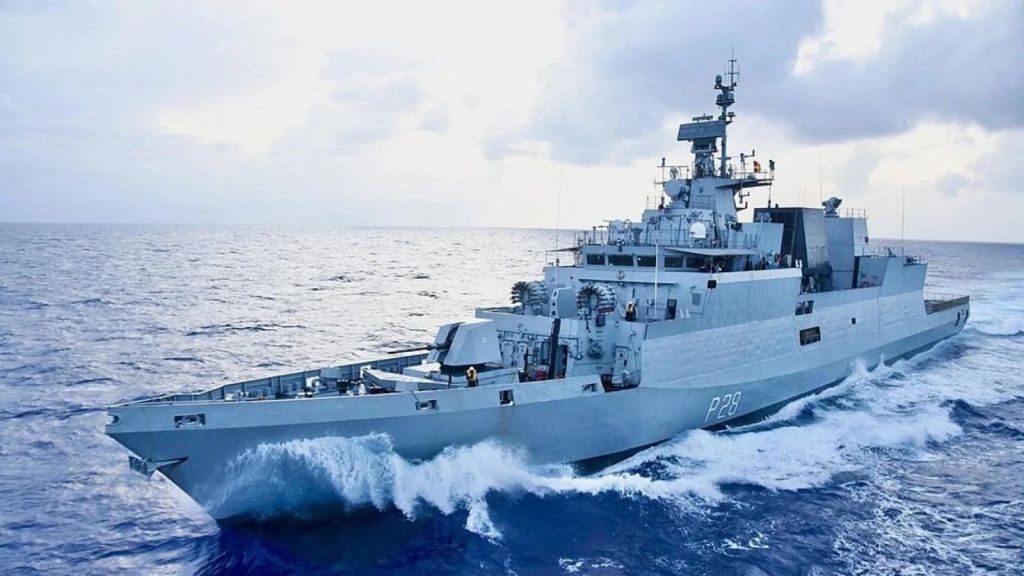
Reference image of an Indian Navy Kamorta-class stealth corvette, illustrating an existing corvette platform. It is not one of the eight proposed next-generation ships, which are intended to expand the Navy’s multirole capabilities.
Image: Indian Express
Why in news
The Indian Express reports that the Cabinet Committee on Security has cleared the project. Contracts with Garden Reach Shipbuilders & Engineers and Goa Shipyard Limited are expected to be signed; approval should not be confused with contract conclusion or operational induction.
Over ₹40,000 crore
Reported project value
8
Next-generation corvettes
2030
Deliveries expected to begin by
Around 30 knots
Planned speed
Approximately ₹36,000 cr
Cost at initial approval stage
4
Existing Kamorta-class corvettes
Background
India's peninsular geography, island territories and dependence on maritime connectivity make naval preparedness a core national-security requirement. A corvette is a relatively small surface combatant, generally smaller than a frigate or destroyer, but its precise capabilities depend on its design and equipment. Modern corvettes can undertake surveillance, anti-surface warfare, anti-submarine warfare and other maritime-security tasks. A balanced fleet combines such vessels with larger combatants, submarines, aircraft and supporting assets rather than treating any single platform category as sufficient.
What has been cleared
According to the report, the Cabinet Committee on Security, headed by the Prime Minister, has approved the construction of eight next-generation corvettes. The government expects to conclude contracts with Kolkata-based Garden Reach Shipbuilders & Engineers and Goa Shipyard Limited.
The ships will use an indigenous design developed in-house by the Navy and are planned as compact, fast, agile and multirole stealth platforms. Their reported speed is around 30 knots, and deliveries are expected to begin by 2030.
The Defence Acquisition Council granted Acceptance of Necessity in June 2022 at an approximate cost of ₹36,000 crore. The report does not explain the difference between that estimate and the subsequently reported project value; attributing it to inflation, expanded scope or cost escalation would therefore be speculative.
- CCS approval is an acquisition milestone, not evidence that the ships have been contracted, delivered or commissioned.
- The source does not specify the distribution of vessels between the two shipyards.
- Specific weapons, sensors, displacement and indigenous-content percentages are not established by the source.
Infographic
Fleet modernisation
Eight proposed multirole stealth corvettes.
Maritime security
Surveillance, ASW, anti-surface warfare and littoral defence.
Indigenous capability
In-house naval design; contracts expected with GRSE and GSL.
Fleet balance
Complement Kamorta-class vessels and ease pressure on larger ships.
Execution
Timely construction, integration, trials and lifecycle readiness.
AI-assisted infographic by Pragnya IAS Academy, based on the cited sources.
Why multirole corvettes matter for fleet modernisation
The programme is intended to support anti-submarine warfare, maritime surveillance and reconnaissance, search-and-attack missions, coastal and littoral defence, deterrence and other maritime-security operations. It will complement the existing four Kamorta-class corvettes, which are primarily oriented towards anti-submarine warfare.
Its operational value lies in matching platforms to missions. Deploying capable smaller combatants for suitable surveillance, littoral and escort tasks can help preserve larger frontline ships for missions requiring their greater capacity. However, smaller vessels cannot automatically substitute for the endurance, payload and command facilities available on larger combatants.
- Multirole capability can give naval planners greater flexibility in assigning ships to changing missions.
- Additional hulls can support more persistent presence, subject to maintenance cycles, crew availability and logistics.
- Stealth reduces detectability; it does not make a warship invisible or invulnerable.
Indigenous shipbuilding: from design ownership to capability
An in-house naval design and planned construction at Indian shipyards provide an opportunity to deepen domestic design, production and systems-integration capabilities. Sustained naval orders can also support specialised suppliers, skilled workers and maintenance capacity.
The strategic benefit is greater control over platform adaptation, upgrades and lifecycle support. Nevertheless, indigenous platform design is not proof that every propulsion component, weapon or sensor is domestically sourced. The actual depth of self-reliance will depend on subsystem sourcing, technology access and the ability to maintain and upgrade equipment.
- Common technical standards will be important for consistency across ships built at different yards.
- Supplier development should prioritise critical components and dependable lifecycle support.
- Domestic value addition should be assessed through capability creation, not merely final assembly.
Indian Ocean security: platforms must operate as a network
India's maritime-security responsibilities span coastal waters, island approaches and wider Indian Ocean sea lanes. The proposed corvettes can add capacity for surveillance and response, but ship numbers alone do not establish maritime domain awareness.
Effective operations require coordination with maritime patrol aircraft, helicopters, unmanned systems, coastal surveillance networks and other naval assets. Anti-submarine warfare particularly depends on detection, classification, tracking and coordinated engagement rather than on the combat ship alone.
- The Navy and Coast Guard require coordinated information-sharing while retaining their distinct responsibilities.
- Forward logistics and maintenance support will influence how persistently vessels can remain deployed.
- Fleet expansion should complement, rather than displace, investment in aviation, submarines and support infrastructure.
Implementation and accountability
The central challenge is converting approval into timely, operationally credible capability. Design maturity, equipment availability, shipyard scheduling, integration and trials will determine whether the reported delivery expectation is achieved.
Programme oversight should distinguish construction progress from combat readiness. A delivered hull becomes an effective operational asset only when its systems, trained crew, spares and support arrangements are ready.
- Contracts should clearly define milestones, responsibilities and performance requirements.
- Cost scrutiny should compare like-for-like programme scope rather than draw conclusions from headline estimates alone.
- Induction planning should address maintenance, training and operating expenditure alongside acquisition costs.
| Parameter | Next-generation corvettes | Kamorta-class corvettes |
|---|---|---|
| Number | Eight planned under the approved project | Four existing vessels |
| Role orientation | Multirole, including ASW, anti-surface warfare, surveillance and littoral defence | Primarily anti-submarine warfare |
| Programme status | CCS approval reported; contracts expected | Existing component of the Navy's fleet |
| Relationship within the fleet | Intended to complement existing capabilities | To be complemented, not identified for replacement in the report |
- 1. CCS approval provides the reported clearance for the project.
- 2. Contract conclusion establishes binding procurement and construction commitments.
- 3. Construction and systems integration translate the naval design into completed vessels.
- 4. Testing, trials and acceptance assess performance against requirements.
- 5. Induction, crew readiness and lifecycle support convert ships into deployable capability.
June 2022
The Defence Acquisition Council granted Acceptance of Necessity at an approximate cost of ₹36,000 crore.
Reported approval
The CCS cleared an over-₹40,000-crore project for eight next-generation corvettes.
Expected next step
Contracts are expected with Garden Reach Shipbuilders & Engineers and Goa Shipyard Limited.
By 2030
Deliveries are expected to begin; this is not a stated completion date for all eight vessels.
Significance, challenges & way forward
Significance
- The project can strengthen India's surface fleet through additional multirole combatants.
- Corvettes can undertake suitable missions that would otherwise absorb larger frontline ships.
- Domestic design and construction offer an opportunity to deepen naval industrial capabilities.
- Additional surveillance and response capacity can support security across India's maritime approaches and the wider Indian Ocean.
- A sustained shipbuilding programme can support specialised industrial skills and supplier development.
Challenges
- The reported delivery expectation depends on timely contracting, design maturity, equipment supply and shipyard execution.
- Integrating combat systems into a compact platform requires careful management of space, power and performance.
- Indigenous design does not eliminate possible dependence on imported subsystems or proprietary technologies.
- Additional ships create recurring requirements for trained personnel, maintenance, spares and operating funds.
- Smaller combatants face design-dependent endurance and payload constraints, making balanced fleet planning essential.
- The source does not disclose detailed costs or configuration, limiting firm conclusions about affordability and capability.
Way forward
- Conclude contracts with clear milestones, defined accountability and rigorous quality assurance.
- Maintain configuration control and common standards across participating shipyards.
- Map critical subsystem dependencies and develop domestic alternatives where technically and economically feasible.
- Synchronise ship induction with crew training, maintenance infrastructure, spares and operational doctrine.
- Integrate the corvettes into joint surveillance and targeting networks rather than deploy them as isolated assets.
- Evaluate progress through delivery reliability, combat readiness and lifecycle availability, not approvals alone.
Key terms
- Corvette
- A relatively small surface combatant, generally smaller than a frigate or destroyer, whose roles depend on its design and equipment.
- Stealth
- Design and operational measures that reduce detectable signatures without making a platform undetectable.
- Anti-submarine warfare
- Operations to detect, classify, track and, when required, engage hostile submarines.
- Littoral
- The coastal zone and adjoining waters where land and maritime operations interact.
- Acceptance of Necessity
- An acquisition-stage approval recognising the requirement for a proposed defence procurement.
- Maritime domain awareness
- Understanding maritime activities and conditions that may affect security, safety, the economy or the environment.
- Lifecycle support
- Maintenance, repairs, spares, upgrades and other support needed throughout a platform's service life.
Link with static syllabus
Prelims practice MCQs
Q1. With reference to the reported next-generation corvette project, consider the following statements: 1. The project covers eight warships based on an indigenous design developed in-house by the Navy. 2. Contracts with the designated shipyards have already been signed, according to the source. 3. Deliveries are expected to begin by 2030. Which of the statements given above are correct?
Q2. Consider the following statements about modern corvettes: 1. A corvette is generally smaller than a frigate or destroyer. 2. Corvettes are necessarily restricted to coastal patrolling. 3. Stealth characteristics make a warship impossible to detect. Which of the statements given above is/are correct?
Q3. Which institution granted Acceptance of Necessity for the next-generation corvette project in June 2022?
Q4. With reference to the next-generation corvettes and the Kamorta class, consider the following statements: 1. The existing Kamorta-class corvettes are primarily anti-submarine warfare-oriented. 2. The next-generation corvettes are intended to complement the Kamorta-class vessels. 3. An indigenous platform design necessarily establishes that all onboard systems are domestically manufactured. Which of the statements given above are correct?
Mains practice questions
GS 3 · 15 marks · 250 words
Assess the significance of the next-generation corvette project for India's naval modernisation and indigenous shipbuilding. What measures are necessary to translate acquisition approval into maritime-security capability?
Frequently asked questions
What has the government approved?
According to the Indian Express, the CCS has approved an over-₹40,000-crore project for eight next-generation corvettes for the Indian Navy. Contracts with GRSE and GSL are expected.
Will all eight corvettes be delivered by 2030?
The source says deliveries are expected to begin by 2030. It does not provide a completion date for the entire programme.
How will these vessels differ from Kamorta-class corvettes?
The proposed vessels have a broader multirole orientation, while the existing Kamorta class is primarily focused on anti-submarine warfare. The report describes them as complementary capabilities, not a replacement programme.
Does indigenous design mean every component will be Indian?
No. The source establishes an in-house naval design but does not specify the origin of every subsystem or an indigenous-content percentage.
Sources
Analysis prepared by the Pragnya IAS Academy current-affairs desk with AI assistance from the cited reports. Verify figures with the original sources.
Turn current affairs into marks
Join Pragnya IAS Academy's mentorship for daily answer-writing evaluation on stories like this — classroom programmes from a trusted name in IAS coaching in Hyderabad.