
Electoral Roll SIR: Supreme Court Scrutiny, Statutory Powers and Voter Safeguards
Revise the static topic: UPSC Polity notes · UPSC Governance notes
In short: The Supreme Court has sought an Election Commission compliance report on alleged Form 7 misuse in Uttar Pradesh, while appeals against judicially restored voters in West Bengal have raised questions about officials’ authority. These developments highlight the need to reconcile accurate electoral rolls with lawful decision-making, protection against wrongful deletion and effective appellate remedies.
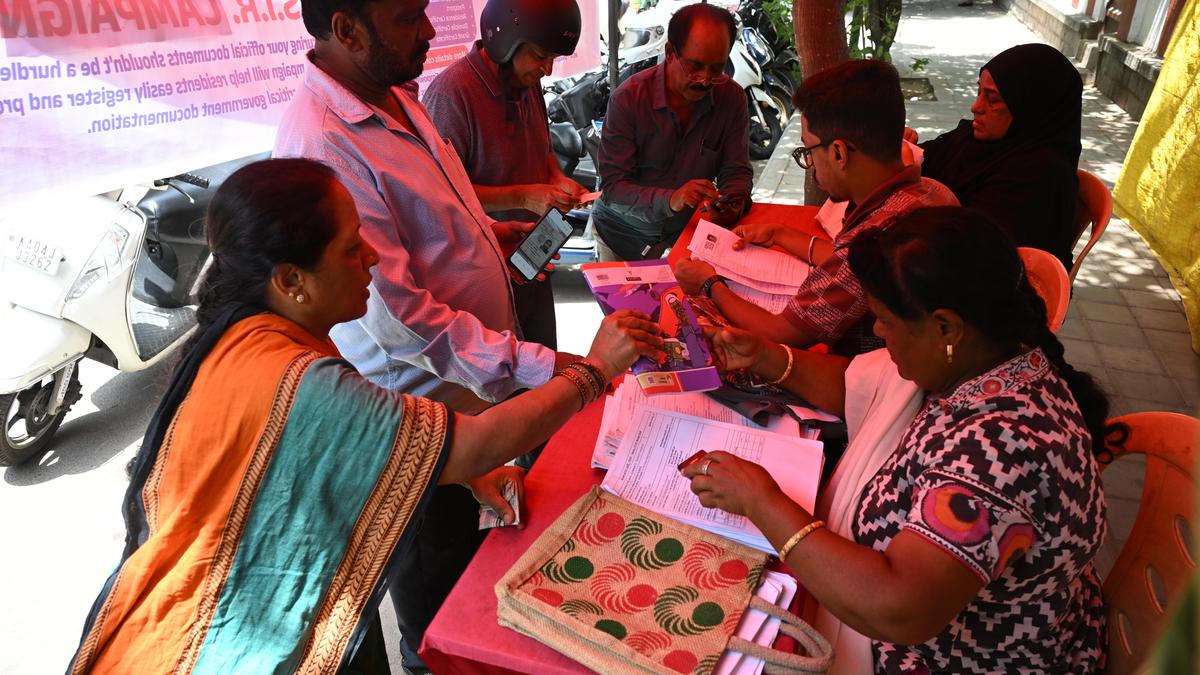
Reference image accompanying coverage of Supreme Court scrutiny of alleged Form 7 misuse in Uttar Pradesh and safeguards against wrongful voter deletion; not a photograph of the court proceedings.
Image: The Hindu
Why in news
On October 30, 2026, the Supreme Court asked the Election Commission of India to examine allegations concerning Form 7 misuse and report compliance; the Commission maintained that false forms had not been accepted. Separately, bulk appeals against voters restored during West Bengal’s Special Intensive Revision have brought the identity and authority of the appellants under scrutiny.
16,10,311
Appeals challenging restored voters in West Bengal
32,77,360
West Bengal voters restored by judicial officers
22 lakh
Appeals against rejection in West Bengal
700
Judicial officers examining West Bengal cases
13.39 crore
Reported final Uttar Pradesh electorate
Over two crore
Voters reportedly removed during Uttar Pradesh revision
Background
Electoral rolls identify persons entitled to vote in a constituency. Article 324 places their preparation under the Election Commission’s superintendence, direction and control; Articles 325 and 326 establish the framework of a general electoral roll, non-discrimination and adult suffrage. The Representation of the People Act, 1950 governs registration, preparation and revision of rolls, while the Registration of Electors Rules, 1960 prescribe procedures. Eligibility ordinarily depends on Indian citizenship, the qualifying age, ordinary residence and absence of statutory disqualification. Special Intensive Revision is a revision exercise within this constitutional and statutory framework, not an exemption from it.
West Bengal: the authority to appeal is the central legal question
During the court-supervised SIR, judicial officers examined cases flagged as doubtful or pending and restored eligible voters. Subsequently, bulk appeals challenged the inclusion of 16,10,311 restored electors. These appeals are distinct from appeals filed by people whose inclusion had been rejected.
In its October 26 affidavit, the ECI stated that the appeals had not earlier been brought to its notice and referred to a communication from the West Bengal CEO’s office. It asserted that the officers had authority under Supreme Court orders, but the report notes that the affidavit described them as officers of the CEO’s office without categorically identifying them as the recognised statutory authorities.
The legal issue is therefore not whether an inclusion decision can ever be challenged. It is whether these particular appellants possessed authority under the applicable law or court orders, followed the prescribed procedure and supplied individual grounds. The supplied material does not establish that the Supreme Court has finally ruled these appeals unlawful.
- Employment in a statutory authority’s office does not, by itself, establish power to exercise every function assigned to that authority.
- The special appellate tribunals’ jurisdiction and access requirements must be examined through the Supreme Court orders establishing the arrangement.
- Filing an appeal is not equivalent to a final finding of ineligibility or an automatic deletion from the roll.
- Demands for cancellation of appeals and an IT audit are political and petitioner demands, not reported final judicial directions.
Infographic
Lawful authority
Identify the competent decision-maker and authorised appellant.
Verified objections
Check authenticity, evidence and legal grounds.
Procedural fairness
Apply inquiry, notice and hearing requirements.
Traceable decisions
Preserve reasoned orders and secure digital records.
Effective remedies
Make appeals accessible and timely.
Accountable oversight
Combine administrative supervision with judicial scrutiny.
AI-assisted infographic by Pragnya IAS Academy, based on the cited sources.
Uttar Pradesh: Form 7 allegations and the Commission’s response
The petition before the Supreme Court alleged forged signatures, false or incomplete objector particulars, impersonation and pre-filled Form 7 applications targeting multiple electors. Counsel also alleged community-specific targeting in Hata. These remain allegations requiring verification, rather than established judicial findings.
The ECI acknowledged discovering false forms but maintained that forms violating norms were not accepted and that corrective action was prompt. Its earlier affidavit described attempted bulk submissions and directions to BLOs not to digitise forms without checking or accept Form 7 applications in bulk.
On October 30, the Court asked the petitioner’s counsel to supply details and directed the ECI to examine the issues, take necessary action and file a compliance report. This is a direction for investigation and accountability, not a judicial endorsement of either side’s complete account.
- Form 7 enables objections to proposed inclusion and requests for deletion; it does not itself authorise deletion.
- An authentic application and a legally sustainable ground for deletion are separate requirements.
- The reported electorate total and deletion count should not be treated as a complete reconciliation of roll changes because the source does not specify every comparison baseline.
Statutory powers: revision, correction, appeal and accountability
Section 21 of the Representation of the People Act, 1950 governs preparation and revision of rolls. Under Section 21(3), the ECI may direct a special revision for reasons recorded. Section 22 concerns correction, transposition and deletion of entries after the prescribed inquiry, while Section 23 concerns inclusion. Section 24 provides the ordinary statutory appellate framework for specified ERO decisions.
The CEO supervises electoral-roll work at the State level; the DEO coordinates and supervises it within the district; and the ERO is the statutory registration decision-maker. AEROs perform assigned functions subject to the ERO’s control. BLOs provide field-level support and verification; their role must not be confused with independent adjudicatory power.
Section 13CC places specified electoral officers and roll-preparation staff on deemed deputation to the ECI during the relevant work, subject to its control, superintendence and discipline. District coordination and supervision are also grounded in Section 13AA. Section 31 addresses knowingly false written statements or declarations connected with electoral rolls; it does not make every clerical error a criminal offence.
- Article 324 supplements the statutory framework; it does not authorise disregard of an express statutory provision.
- The ordinary appeal route and the court-created West Bengal tribunal arrangement should not be treated as interchangeable without examining the relevant orders.
- Penal action for false objections requires evidence satisfying the applicable offence, including its knowledge requirement.
Due process and digital controls must reinforce each other
Roll integrity requires both exclusion of ineligible entries and protection of eligible electors. A database discrepancy is a reason for verification, not conclusive proof of ineligibility. For adverse decisions, statutory inquiry and applicable notice-and-hearing requirements must be observed; cases involving residence or entitlement cannot be resolved merely through an unverified objection.
The Uttar Pradesh CEO’s October 30 directions require daily DEO review through ECI Net, monitoring of applications and pending cases, prompt correction of wrong assignments and prohibition of credential sharing. These measures strengthen administrative responsibility but cannot replace individual verification and lawful orders.
Judicial oversight is most effective when it makes administrative action traceable and remedies usable before electoral deadlines. A legally available appeal can become practically ineffective if prolonged pendency prevents an eligible elector from voting in the relevant election.
- Record the objector’s identity, grounds, supporting material and the officer handling each application.
- Use alerts and data matching to prioritise verification, not to automate adverse eligibility decisions.
- Communicate reasoned decisions and the applicable appeal route to affected electors.
- Preserve digital audit trails while protecting personal information from unnecessary disclosure.
| Authority or mechanism | Core role | Essential safeguard |
|---|---|---|
| Election Commission of India | Superintendence, direction and control of electoral-roll preparation | Exercise constitutional powers consistently with electoral law |
| Chief Electoral Officer | State-level supervision of electoral-roll work | Clarify authorisation and monitor compliance across districts |
| District Election Officer | District coordination and supervision | Review pendency, assignment errors and quality of processing |
| ERO and AERO | Registration decisions and assigned statutory functions | Apply eligibility rules, prescribed inquiry and hearing requirements |
| Booth-level officer | Field verification and registration assistance | Verify applications without assuming independent deletion authority |
| Form 7 | Objection to proposed inclusion or request for deletion | An application must be examined; filing does not establish ineligibility |
| West Bengal appellate tribunals | Hear challenges within the court-supervised arrangement | Follow the Supreme Court orders governing jurisdiction and procedure |
- 1. Receive the application through an authorised channel and record its origin.
- 2. Check the objector’s particulars, authenticity and stated legal ground.
- 3. Assign the matter to the competent registration authority for prescribed verification.
- 4. Provide notice and a reasonable opportunity to respond wherever required by law.
- 5. Issue and communicate an individual, reasoned decision and update the roll lawfully.
- 6. Enable the applicable appeal and preserve records for supervisory or judicial review.
March 10, 2026
The Supreme Court directed establishment of a separate appellate body for challenges to judicial officers’ decisions in the West Bengal SIR.
March 21, 2026
According to the report, the ECI constituted the West Bengal appellate tribunals.
Around April 13, 2026
The West Bengal appellate tribunals began functioning.
April 16, 2026
The Supreme Court directed inclusion through supplementary lists of voters whose appeals succeeded.
October 26, 2026
The ECI filed an affidavit addressing appeals against inclusion of voters restored in West Bengal.
October 29, 2026
The Congress submitted a memorandum seeking cancellation of the inclusion-challenging appeals and an IT audit.
October 30, 2026
The Supreme Court sought ECI action and a compliance report on Uttar Pradesh Form 7 allegations; the Uttar Pradesh CEO separately issued directions on roll supervision and digital access.
Significance, challenges & way forward
Significance
- Accurate electoral rolls protect electoral legitimacy by addressing both wrongful inclusion and wrongful exclusion.
- Verification of appellants’ authority prevents statutory powers from being exercised merely on the basis of office affiliation.
- Supreme Court scrutiny can make voter-protection safeguards enforceable without displacing routine registration administration.
- Secure digital access and audit trails connect each action to an identifiable official, strengthening institutional accountability.
- Timely appeals protect meaningful electoral participation rather than offering relief only after the relevant election.
Challenges
- Large-scale objections and appeals can overwhelm individual adjudication and delay remedies.
- Forged or impersonated applications can exploit a legitimate objection mechanism to seek wrongful deletions.
- Court-created arrangements require clear rules on jurisdiction, authorised appellants and interaction with statutory remedies.
- Unverified discrepancy flags may disadvantage electors facing difficulties in producing or reconciling records.
- Shared credentials, inactive accounts and incorrect application routing can weaken traceability and delay decisions.
- Political allegations and institutional denials must be tested against records without prejudging either fraud or procedural compliance.
Way forward
- Disclose the legal basis, official designation and authorisation relied upon for appeals against restored voters, subject to privacy safeguards.
- Independently verify disputed filings and preserve submission records, timestamps and officer-level action logs.
- Require individual grounds and reasoned decisions rather than treating bulk processing as a substitute for adjudication.
- Enforce applicable notice-and-hearing requirements and provide accessible assistance to affected electors.
- Prioritise registration appeals before electoral deadlines through the competent legal or judicial mechanism.
- Investigate knowingly false declarations under Section 31 and other applicable provisions without criminalising innocent mistakes.
- Implement the Uttar Pradesh directions on daily review, correct routing and non-sharing of credentials, and audit compliance.
- Publish privacy-protecting aggregate information on applications, outcomes, pendency and appeal reversals to enable public scrutiny.
Key terms
- Special Intensive Revision
- An intensive electoral-roll revision exercise conducted under the Commission’s powers within the governing legal framework.
- Ordinary residence
- The statutory connection between an elector and a constituency, assessed under electoral law rather than merely through property ownership.
- Form 7
- The prescribed application for objecting to proposed inclusion or seeking deletion of a name from an electoral roll.
- Electoral Registration Officer
- The statutory officer responsible for electoral-roll preparation and registration decisions for the assigned constituency.
- Locus standi
- The legal standing required to bring a claim or challenge before a competent forum.
- Natural justice
- Procedural fairness, including an appropriate opportunity to be heard and impartial decision-making.
- Supplementary electoral roll
- A supplementary list recording legally authorised changes to the electoral roll.
- Digital audit trail
- A chronological record showing who performed a digital action, when it occurred and what was changed.
Link with static syllabus
Prelims practice MCQs
Q1. With reference to electoral-roll revision, consider the following statements: 1. Article 324 places preparation of electoral rolls under the Election Commission’s superintendence, direction and control. 2. Section 21 of the Representation of the People Act, 1950 provides for revision of electoral rolls. 3. Article 324 permits the Commission to disregard an express statutory provision during a special revision. Which of the statements given above are correct?
Q2. Consider the following statements about Form 7: 1. It can be used to object to a proposed inclusion or seek deletion from an electoral roll. 2. Its submission automatically suspends the affected elector’s registration. 3. Knowingly false written declarations concerning electoral rolls may attract Section 31 of the Representation of the People Act, 1950. Which of the statements given above are correct?
Q3. Which of the following correctly describes Section 13CC of the Representation of the People Act, 1950?
Q4. With reference to constitutional provisions on elections, consider the following pairs: 1. Article 324 — Superintendence, direction and control of electoral-roll preparation and elections 2. Article 325 — General electoral roll and prohibition of exclusion solely on specified grounds 3. Article 326 — Elections to the Lok Sabha and State Legislative Assemblies on the basis of adult suffrage How many of the above pairs are correctly matched?
Mains practice questions
GS 2 · 15 marks · 250 words
Electoral-roll integrity requires protection against both wrongful inclusion and wrongful exclusion. Examine the statutory and procedural safeguards necessary during Special Intensive Revision, with reference to recent Supreme Court interventions.
Frequently asked questions
Has the Supreme Court found that fraudulent Form 7 applications caused wrongful deletions in Uttar Pradesh?
The supplied report does not record such a final finding. The Court sought examination, necessary action and a compliance report, while the ECI maintained that false forms had not been accepted.
Why are the West Bengal appeals legally disputed?
The dispute concerns whether the officials filing appeals against restored voters had the required authority under law or the relevant Supreme Court orders. The supplied material does not establish a final judicial ruling invalidating those appeals.
Can a booth-level officer independently delete a voter’s name?
A BLO’s field-verification role does not confer independent statutory deletion power. Electoral-roll changes must be decided by the competent registration authority through the prescribed procedure.
Does filing Form 7 automatically remove someone from the electoral roll?
No. It initiates an objection or deletion request, which requires examination by the competent authority and compliance with applicable procedural safeguards.
Sources
- The Hindu: Election Commission’s appeals against 16.10 lakh cleared voters raise legal questions
- The Hindu: Supreme Court seeks report from ECI on Form 7 misuse allegations
- The Hindu: U.P. CEO directs officials on accurate, error-free and up-to-date maintaining of electoral rolls
- The Hindu (Editorial): Deemed ineligible: On the Supreme Court and SIR
Analysis prepared by the Pragnya IAS Academy current-affairs desk with AI assistance from the cited reports. Verify figures with the original sources.
Turn current affairs into marks
Join Pragnya IAS Academy's mentorship for daily answer-writing evaluation on stories like this — classroom programmes from a trusted name in IAS coaching in Hyderabad.