
NVS-03 Launch: NavIC Architecture, Indigenous Atomic Clocks and Sovereign Navigation
Revise the static topic: UPSC Science & Technology notes
In short: ISRO’s GSLV-F18 successfully placed NVS-03 into its intended geosynchronous transfer orbit, advancing efforts to restore NavIC’s navigation services after satellite and atomic-clock failures. Carrying an indigenous atomic clock alongside procured clocks, the satellite strengthens India’s pursuit of reliable, sovereign positioning, navigation and timing services, although launch success must be followed by orbital deployment and operational validation.
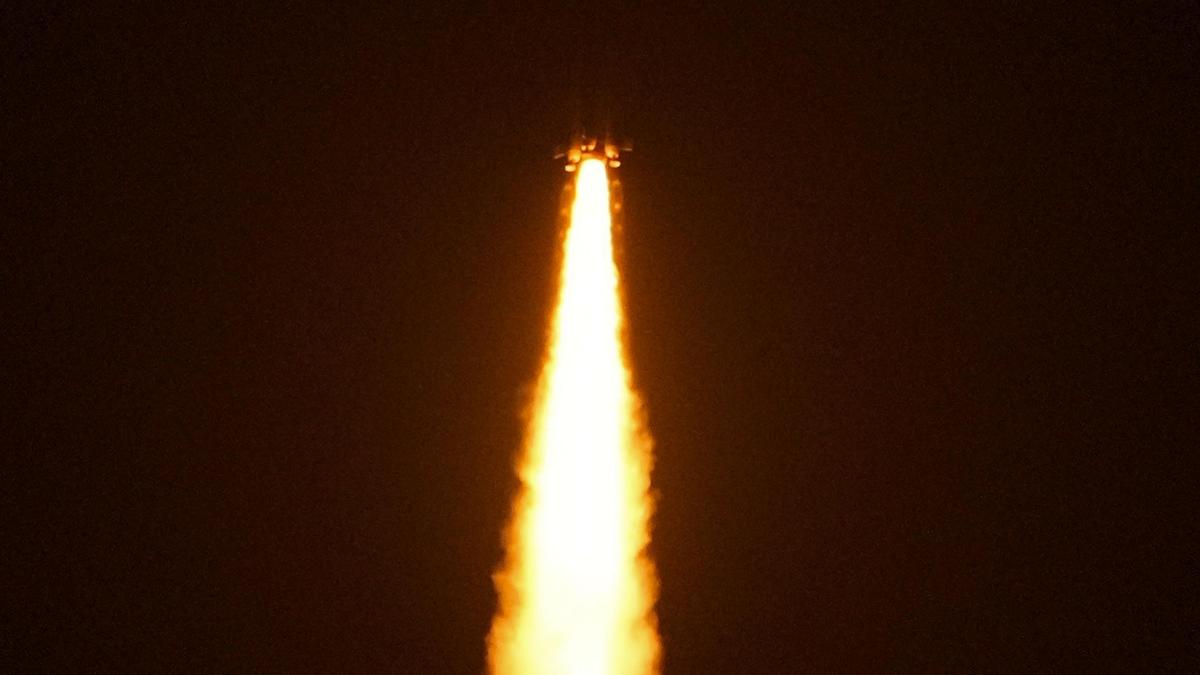
Photo from the source report: NVS-03 Launch: NavIC Architecture, Indigenous Atomic Clocks and Sovereign Navigation
Image: The Hindu
Why in news
Post-launch reports dated October 30, 2026, confirmed NVS-03’s successful injection into its transfer orbit from Sriharikota. ISRO’s Chairman said its addition would bring NavIC back to a minimum operational configuration of four satellites.
2,250 kg
NVS-03 mass
12 years
Planned mission life
1,500 km
Primary coverage beyond India
4 satellites
Stated minimum operational configuration
56 days
Interval between successive GSLV missions
Background
Navigation with Indian Constellation, or NavIC, is India’s independent regional satellite navigation system, also known as the Indian Regional Navigation Satellite System. It provides positioning, navigation and timing services over India and its surrounding region. Unlike global systems such as GPS and BeiDou, NavIC is designed primarily for regional coverage. Its architecture combines geostationary and inclined geosynchronous satellites, ground-based monitoring and control infrastructure, and compatible user receivers. It offers a Standard Positioning Service for civilian users and a Restricted Service for authorised users.
What NVS-03 achieved—and what remains
GSLV-F18 launched NVS-03 from the Satish Dhawan Space Centre, Sriharikota, and injected it into the intended elliptical geosynchronous transfer orbit. NVS-03 is the third satellite in the next-generation navigation satellite series intended to maintain continuity of NavIC services.
Transfer-orbit injection is not equivalent to full operational commissioning. Orbital deployment, payload checks, clock validation and integration with the ground segment remain essential before reliable service delivery can be established. The post-launch statement that NVS-03 would restore the minimum configuration should therefore be understood as the expected operational outcome, not independent proof that all services were already validated.
- The satellite carries an indigenous atomic clock alongside procured atomic clocks.
- Its navigation payload includes L1 signals in addition to existing L5 and S-band signals.
- Its planned mission life is 12 years.
- Earlier live-report projections about additional satellites should be distinguished from the later post-launch statement on minimum operational restoration.
Infographic
Constellation
Regional satellite coverage with timely replenishment and backup capacity.
Precision timing
Indigenous atomic-clock capability backed by qualification and redundancy.
Ground assurance
Orbit estimation, clock monitoring and validated navigation information.
User adoption
L1, L5 and S-band signals require compatible receiver ecosystems.
Service resilience
Sovereign control must be matched by continuity and interference protection.
AI-assisted infographic by Pragnya IAS Academy, based on the cited sources.
NavIC architecture: space, ground and user segments
The space segment broadcasts precisely timed navigation signals and information about satellite positions. A geostationary satellite appears fixed over the equator, while an inclined geosynchronous satellite changes its apparent position in the sky despite remaining synchronised with Earth’s rotation. Together, these orbital arrangements support sustained regional visibility.
The ground segment monitors satellite health, estimates orbits and clock errors, and updates navigation information. User receivers process signals from visible satellites to estimate position and receiver-clock offset. Thus, service quality depends on the entire system—not merely the number of satellites launched.
- Space segment: Satellites provide navigation signals and onboard timing references.
- Ground segment: Monitoring and control infrastructure maintains orbit, timing and navigation-data quality.
- User segment: Compatible receivers convert satellite signals into usable PNT information.
- Services: Civilian Standard Positioning Service and Restricted Service for authorised users serve different access requirements.
Why indigenous atomic clocks are central
Satellite navigation estimates distance from the travel time of radio signals. Atomic clocks use stable atomic transition frequencies as time references, allowing satellites to transmit accurately timed signals. Timing errors translate into ranging errors; therefore, a satellite can remain in orbit yet lose its primary navigation utility if its timing subsystem fails.
An indigenous atomic clock strengthens domestic capability in a critical subsystem and reduces exposure to external procurement constraints. However, indigenous manufacture does not automatically establish reliability. Long-duration performance, space-environment qualification, clock monitoring and effective redundancy remain decisive.
- Repeated atomic-clock failures have weakened NavIC’s functioning.
- NVS-03’s combination of indigenous and procured clocks provides onboard redundancy without implying complete import independence.
- Ground-based estimation and correction of clock errors complement, rather than replace, stable onboard clocks.
- Sovereign timing capability matters for synchronising infrastructure as well as determining location.
L1 signals and the strategic value of sovereign PNT
Adding L1 signals can support broader compatibility with navigation receiver ecosystems and consumer applications. However, compatibility requires suitable receiver hardware, software and signal support; the satellite upgrade alone does not make every existing device NavIC-capable.
Sovereign PNT reduces dependence on navigation infrastructure controlled by foreign governments. It supports strategic autonomy while enabling civilian applications such as train, vehicle and vessel tracking. The supplied report also identifies NavIC as an important component of the One Nation One Time Project.
- Defence: National control over navigation infrastructure reduces exposure to external service restrictions.
- Transport: Reliable positioning supports fleet tracking, maritime navigation and railway applications.
- Timing: Synchronised time supports telecommunications, power systems and financial infrastructure.
- Resilience: NavIC can complement other navigation systems; sovereign capability need not imply technological isolation.
Minimum functionality is not long-term resilience
The reported minimum configuration of four satellites addresses a basic positioning requirement, but reliable service also depends on satellite visibility, geometry, signal quality, clock health and ground-system performance. A constellation operating near its minimum has limited tolerance for further failures.
The sources identify ageing first-generation satellites, repeated clock failures and NVS-02’s inability to reach its intended orbit as major vulnerabilities. NVS-03 is therefore a recovery milestone, while sustained resilience requires timely replenishment, operational backups and verified end-to-end service performance.
- Replacement planning should anticipate satellite ageing rather than respond only after failures.
- Clock redundancy cannot compensate for every orbit-raising, propulsion or launch failure.
- Navigation signals require protection against interference, jamming and spoofing.
- Operational capability should be assessed through validated service performance rather than launch counts alone.
| Element | Function | NVS-03 relevance or limitation |
|---|---|---|
| Satellite constellation | Provides regional navigation signals from geostationary and inclined geosynchronous orbits | Adds replacement capacity; transfer-orbit injection must be followed by operational deployment |
| Atomic clocks | Provide stable timing references for navigation signals | Carries an indigenous clock alongside procured clocks |
| Signal bands | Enable receivers to acquire and process navigation signals | Includes L1 in addition to L5 and S-band signals |
| Ground segment | Monitors health, estimates orbit and clock errors, and updates navigation data | Must validate and integrate the satellite into service |
| User receivers | Calculate position and time from received signals | Need compatible hardware and software to use NavIC signals |
- 1. Onboard atomic clocks provide stable timing references.
- 2. Satellites broadcast time-tagged signals and navigation data.
- 3. Ground infrastructure monitors satellite orbits and clocks and updates navigation information.
- 4. A compatible receiver compares signal transmission and reception times to estimate apparent ranges.
- 5. Measurements from multiple satellites allow the receiver to estimate position and its clock offset.
- 6. Applications use the resulting positioning, navigation and timing information.
May 2023
NVS-01 was launched, beginning deployment of the next-generation navigation satellite series.
January 2025
NVS-02 was launched but subsequently failed to raise its orbit as intended.
March 13, 2026
The last functioning atomic clock aboard IRNSS-1F stopped working, according to the supplied report.
October 30, 2026
Post-launch reports confirmed that GSLV-F18 placed NVS-03 into its intended geosynchronous transfer orbit.
Significance, challenges & way forward
Significance
- NVS-03 advances recovery of a strategic navigation system weakened by clock and satellite-deployment failures.
- Indigenous atomic-clock capability strengthens technological autonomy in a mission-critical subsystem.
- Sovereign PNT infrastructure reduces dependence on externally controlled navigation services.
- L1 capability creates opportunities for wider receiver integration and civilian adoption.
- Reliable timing and positioning can support transport efficiency and critical infrastructure synchronisation.
Challenges
- Transfer-orbit success must translate into successful deployment, commissioning and sustained service delivery.
- A minimum operational constellation offers limited protection against additional satellite or clock failures.
- Ageing satellites and gaps between replenishment missions create continuity risks.
- Indigenous clocks require demonstrated long-duration reliability, not merely successful initial operation.
- Receiver compatibility and commercial adoption can limit the practical benefits of expanded signal capability.
- Sovereign ownership does not by itself eliminate jamming, spoofing or ground-system vulnerabilities.
Way forward
- Complete orbital deployment and publish validated service-readiness information before treating recovery as fully operational.
- Maintain a rolling replenishment programme with backup capacity and realistic allowances for launch or satellite failures.
- Strengthen atomic-clock qualification, failure analysis and redundancy management across satellite generations.
- Assess constellation performance through availability, accuracy, continuity and integrity rather than satellite count alone.
- Encourage compatible chipsets, receivers and public-service applications through standards, testing and industry collaboration.
- Combine sovereign NavIC capability with complementary navigation sources, interference monitoring and terrestrial timing backups.
Key terms
- NavIC
- Navigation with Indian Constellation, India’s independent regional satellite navigation system.
- PNT
- Positioning, navigation and timing services used to determine location, guide movement and synchronise systems.
- Atomic clock
- A precision timekeeping device that uses a stable atomic transition frequency as its reference.
- Geosynchronous transfer orbit
- An elliptical intermediate orbit from which a satellite can manoeuvre towards its intended geosynchronous operational orbit.
- Geostationary orbit
- A circular equatorial geosynchronous orbit in which a satellite appears stationary relative to Earth’s surface.
- Pseudorange
- An apparent satellite-to-receiver distance derived from signal travel time that includes clock offsets and other errors.
- Redundancy
- Additional components or capacity that help maintain a service when individual elements fail.
- Spoofing
- Transmission of deceptive navigation signals intended to mislead a receiver about position or time.
Link with static syllabus
Prelims practice MCQs
Q1. With reference to NVS-03, consider the following statements: 1. It carries an indigenous atomic clock alongside procured atomic clocks. 2. It includes L1 signals in addition to L5 and S-band signals. 3. Its injection into a geosynchronous transfer orbit, by itself, establishes full operational readiness. Which of the statements given above are correct?
Q2. Consider the following pairs: 1. Space segment — Broadcasts navigation signals and timing information 2. Ground segment — Monitors satellite health and estimates orbit and clock errors 3. User segment — Processes satellite signals to estimate position and time Which of the pairs given above are correctly matched?
Q3. Why are atomic clocks critical to a navigation satellite’s primary function?
Q4. With reference to NavIC, consider the following statements: 1. It is designed primarily as a regional navigation system. 2. Every geosynchronous satellite necessarily appears stationary over the equator. 3. Use of multiple navigation constellations can complement sovereign navigation capability. Which of the statements given above are correct?
Mains practice questions
GS 3 · 15 marks · 250 words
The strategic value of a sovereign navigation system depends on service reliability, not merely successful satellite launches. Discuss with reference to NVS-03, indigenous atomic clocks and NavIC.
Frequently asked questions
What does NVS-03 add to NavIC?
NVS-03 adds next-generation navigation capacity, an indigenous atomic clock alongside procured clocks, and L1 signals in addition to L5 and S-band signals. ISRO expects its addition to restore NavIC’s minimum operational configuration after deployment and validation.
Why can atomic-clock failure affect a satellite that is still in orbit?
Navigation depends on precisely timed signals to estimate distance. A satellite may remain physically in orbit but lose its primary navigation utility when its timing capability fails.
Is NavIC a global alternative to GPS?
NavIC is primarily a regional system covering India and approximately 1,500 km beyond it, whereas GPS provides global coverage. NavIC can complement global systems while preserving independent regional capability.
Does the NVS-03 launch prove that NavIC is fully restored?
The launch confirms successful injection into the intended transfer orbit, while ISRO’s statement identifies the expected recovery of minimum operational capacity. Full service readiness requires successful deployment, commissioning and performance validation.
Sources
- The Hindu: GSLV places next-generation navigation satellite NVS-03 into orbit
- The Hindu: Why is ISRO’s NVS-03 satellite launch crucial? | Explained
- The Hindu: NVS-03 launched successfully; satellite placed in intended orbit | LIVE
- The Hindu: Countdown progressing for ISRO’s crucial GSLV-F18 launch carrying navigation satellite NVS-03
Analysis prepared by the Pragnya IAS Academy current-affairs desk with AI assistance from the cited reports. Verify figures with the original sources.
Turn current affairs into marks
Join Pragnya IAS Academy's mentorship for daily answer-writing evaluation on stories like this — classroom programmes from a trusted name in IAS coaching in Hyderabad.